
Descriptive vs Inferential Statistics, With Examples
Descriptive vs inferential statistics on one simulated sample of 150 students: a 0.21-hour sleep gap in the data that a t test could not tell from zero.
Who it is for
Researchers One library, over 10,000 styles and an AI peer review Students Free outlines and in-text citations from real sources
Descriptive vs inferential statistics on one simulated sample of 150 students: a 0.21-hour sleep gap in the data that a t test could not tell from zero.
Internal vs external validity with real data: 96% of samples in top psychology journals came from Western countries. Threats to each, the trade-off, fixes.
Construct validity shown with published numbers: a well-being scale that correlated .77 with WHO-5 and .18 with impression management, HTMT and MTMM explained.
Quasi-experimental design explained through six designs and five real studies, including New Jersey's 1992 minimum wage rise and Italy's 2005 smoking ban.
Parameter vs statistic: a parameter describes a whole population, a statistic one sample. In 10,000 samples of 100, 94.8% of 95% intervals held the true mean.
Random assignment explained with a 10,000-study simulation: with 20 students, chance left a pretest gap above 3 points in 51% of studies; with 400, in 0.2%.
Purposive sampling picks participants for what they can tell you. Nine types with real studies, and why tested interview studies saturated at 9 to 17.
Snowball sampling recruits people through referrals from earlier participants. In our simulation, seeds from one community put a 19% trait at 10.5%.
How to cite a play in MLA 9, APA 7 and Chicago: Hamlet by act, scene and line, a prose play by page and act, dialogue block quotes and live performances.
Response bias is systematic error in survey answers. In one validation study, 30% of voters reported a “no” vote that 65.3% had cast. 7 types and their fixes.
How to cite a PDF in APA 7 and MLA 9: cite what the file is, not the format. 3 real PDFs cited both ways, plus page numbers, no date and lecture slides.
Mediator vs moderator: a mediator explains how X affects Y, a moderator changes when or for whom. One example worked through with numbers, tests and APA lines.
A case-control study starts with people who have an outcome and looks back at exposure. Doll and Hill's 1950 counts give an odds ratio of 14 for male smokers.
Sampling bias is a systematic sample-population gap caused by how the sample is drawn. The 1936 Literary Digest poll missed by 19.6 points on 2.4M ballots.
An operational definition states exactly how a variable is measured. See 9 examples from published measures, such as PHQ-9 ≥ 10, and a fill-in template.
Systematic sampling takes every k-th unit after a random start. In our weekly-cycle simulation, none of the 7 possible samples’ intervals held the true mean.
Inductive vs deductive reasoning in one table, then 2 published studies from one research team showing each approach, plus abductive reasoning explained.
Type 1 and type 2 errors with a worked example: at α = .05 and a medium effect, 20 people per group give power of .34, and 64 per group give power of .80.
A cohort study follows people with and without an exposure to compare who develops an outcome. Worked example: a 7% vs 3% risk gives a relative risk of 2.33.
Cluster sampling picks whole groups, such as schools, at random. With an ICC of 0.05, 600 pupils from 30 schools carry the precision of only 308.
A longitudinal study measures the same people two or more times. Types, four famous studies with real follow-up data, and a worked 4-wave attrition example.
Convenience sampling studies whoever is easiest to reach. In our simulation, a campus sample put voter turnout at 23.5% when the true figure was 48%.
Correlation vs causation: why two variables move together without one causing the other, with a worked r = 0.93 that drops to 0 once age is held constant.
A cross-sectional study measures exposure and outcome at one moment. Worked 2x2 table (prevalence ratio 2.0, odds ratio 2.43) plus a CDC survey of 20,103 teens.
Stratified sampling splits a population into groups and samples each one. Our worked example: Neyman allocation halves a simple random sample's variance.
Claim evidence reasoning (CER) explained with 3 examples: a science CER on CO2 data from 1959 to 2025, an English CER on Poe, and a strong vs weak CER, scored.
A confounding variable is a third factor linked to both cause and effect. 2 real studies where a confounder reversed the result, plus 5 ways to control them.
Et al. means “and others”. When to use et al. in APA, MLA, Chicago and six more styles, tested on 3 real papers, plus its punctuation, italics and commas.
The quote sandwich: introduce a quote, give it with its citation, then explain it. 3 real examples in MLA and APA, starter phrases and what goes wrong.
How to cite a song in MLA 9, APA 7 and Chicago 18: one real recording cited 4 ways, plus timestamps, lyrics with slashes, streaming, covers and features.
How to cite an interview in MLA 9, APA 7 and Chicago 18: published, personal and research interviews, with one real NPR interview cited 3 ways.
How to cite a poem in MLA 9, APA 7 and Chicago 18: one real anthology poem cited 4 ways, plus line numbers, slashes for 1-3 lines, block quotes and web poems.
How to cite the Bible in APA 7, MLA 9 and Chicago 18: one online King James Bible cited 4 ways, plus verse format, version names, Bible Gateway and the Quran.
ACS citation style after the April 2025 update: three in-text options, the 10-author et al. rule, CASSI abbreviations and 9 examples from real sources.
IEEE citation format from IEEE's 2025 Reference Guide: bracketed numbers with no dashed ranges, the six-author et al. rule and 12 verified reference examples.
Vancouver referencing from NLM's Citing Medicine and the ICMJE: numbered citations, the six-author rule and 11 reference examples across eight source types.
Argumentative essay examples in Classical, Rogerian and Toulmin form: 3 full essays citing 14 real sources, with notes on every paragraph and the AP rubric.
How to cite a movie in MLA 9, APA 7 and Chicago 18: one real film cited 4 ways with time stamps for quotes, then streaming, two directors, foreign films and TV.
How to cite a YouTube video in APA 7, MLA 9 and Chicago 18: one real TED talk cited 4 ways with timestamps, plus Shorts, channel names and undated videos.
How to cite an image in APA 7, MLA 9 and Chicago 18: one Met painting cited 4 ways, then figure notes, your own photos, slides and AI-generated images.
Primary vs secondary sources in six disciplines, a sort test of 20 real sources from a 1776 letter to a 2017 preprint, and when to cite the original.

Research proposal example: a complete master's thesis proposal on food insecurity and grades, annotated section by section, citing 8 real studies.
Thesis vs dissertation: the words swap between countries. Rules from 9 universities in the US, UK and Australia on length, defense, examiners and repositories.
Hook examples for essays: 26 openings sorted by hook type and essay type, 7 famous first lines, 6 weak hooks rewritten, and the openings professors dislike.
Reliability vs validity, shown with published numbers: a .82 retest correlation, a .87 alpha, kappa benchmarks, and how to report both in a methods section.
How to choose a research topic in 6 steps, with one topic narrowed from 5,140 papers to 24 in OpenAlex, a feasibility table and what changes for a thesis.
Types of research methodology in one table: 10 designs, the question each answers and what it lets you claim, then how to choose one for a thesis or paper.
How to write a results section of a research paper: what to report and in what order, APA's statistics rules, and 2 published results sections annotated.
How to write the limitations of a study in 5 parts, with example sentences for 7 types, 3 published papers annotated, a template and common mistakes.
How to cite ChatGPT in APA, MLA, Chicago and AMA: one real shared chat cited 4 ways under the 2025-2026 rules, plus when to disclose AI help instead.
The discussion section of a research paper in 8 moves, with 2 published discussions annotated part by part, signal phrases and a length guide.
How to write a methodology section of a research paper: the six parts, the checklist items journals check, and 2 published methods sections, annotated.
How to write a research paper introduction in Swales's 3 moves (CARS), with two published introductions annotated sentence by sentence and the thesis version.
Independent and dependent variables explained with examples from 8 published studies, a one-line test to tell them apart, and which goes on each graph axis.
Qualitative vs quantitative research in one table, then 5 published studies on two shared topics, and how to choose and write up each approach in a thesis.
AMA citation style for the 11th edition: superscript numbers in the text, the 6-author rule, NLM journal abbreviations and 7 verified reference examples.
APA vs MLA for APA 7 and MLA 9: a table of 16 differences in citations, reference lists and page layout, plus one book and one article cited in both styles.

Chicago style bibliography format under CMOS 18: page layout, entries for 5 source types, the six-author rule, and repeated names in place of the 3-em dash.
How to cite a book in APA 7, MLA 9 and Chicago 18: the basic entry and in-text citation side by side, then six variations, from co-authors to group authors.
APA format example: a 5-page APA 7 student sample paper, from title page to references, with each element annotated with the APA rule behind it.
Lab report example: a complete biology report on temperature and catalase, annotated section by section, with the tense and length of all 7 sections.
MLA format example: a 4-page sample paper in MLA 9 with the heading, page header, in-text citations, a block quote and Works Cited, each part annotated.
Paraphrasing examples from 8 real sources, Darwin to a 2013 climate study: the original, a patchwritten fail and a good version, plus APA 7 and MLA 9 citations.
APA title page format, 7th edition: 6 centered lines for a student paper, a bold title 3 to 4 lines down, page number 1 at the top right, and no running head.
A compare and contrast essay example on two Shakespeare sonnets in 5 paragraphs, with a note on each, block and point-by-point outlines and a thesis bank.
How to write a conclusion in 4 parts: restate the thesis in light of the evidence, show how the points fit, say why it matters, end forward. 5 examples.
Literature review outline templates for thematic, chronological, methodological and theoretical reviews, plus 2 filled-in examples built from real studies.
A synthesis essay example on phones in school with 4 real sources, with notes on every paragraph, thesis and intro examples and the AP Lang 6-point rubric.
A persuasive essay example in six paragraphs on later school start times, with the appeal each paragraph uses, an outline and two alternative introductions.
Research question examples quoted from 15 published studies: qualitative, quantitative and mixed methods, with weak-to-strong rewrites and the FINER test.
30 thesis statement examples sorted by essay type, each with a note on why it works, plus weak to strong rewrites and a fill-in template for every type.
Topic sentence examples for essays: 31 sentences grouped by paragraph job, four shown inside full body paragraphs, plus weak-to-strong rewrites and transitions.
How to spot hallucinated citations: six signs a reference is fake, a five-step check for any reference list, worked examples and what a checker cannot tell you.
A rhetorical analysis essay example on the Gettysburg Address, with a note on each paragraph, an outline, thesis examples and the AP Lang scoring rubric.
A narrative essay example in six paragraphs with a note on what each one does, plus the parts of a story, an outline template and how to write your own.
APA reference page format in APA 7: the References label, a 0.5-inch hanging indent, the 4 parts of every entry, DOIs, order rules and a 4-source sample list.
APA 7 headings at all 5 levels in one worked example of a short paper, plus how to save each level as a Word or Google Docs style and the mistakes to avoid.
MLA heading format: 4 double-spaced lines at the top left of page 1 (name, instructor, course, date), a centered title, and a surname-and-page header.
Hypothesis examples for science, psychology and research papers: null and alternative pairs, weak-to-strong rewrites, and five hypotheses from real studies.
Research paper outline templates for an IMRaD study and a thesis-driven paper, a filled-in example with real sources, and the three outline formats compared.
MLA in-text citation rules for the 9th edition: author and page with no comma, two or three authors, no author or page, websites and qtd. in, with 14 examples.
MLA works cited page format for the 9th edition: the 9 core elements, entries for journals, books and web pages, DOIs, et al., and a 5-entry sample list.
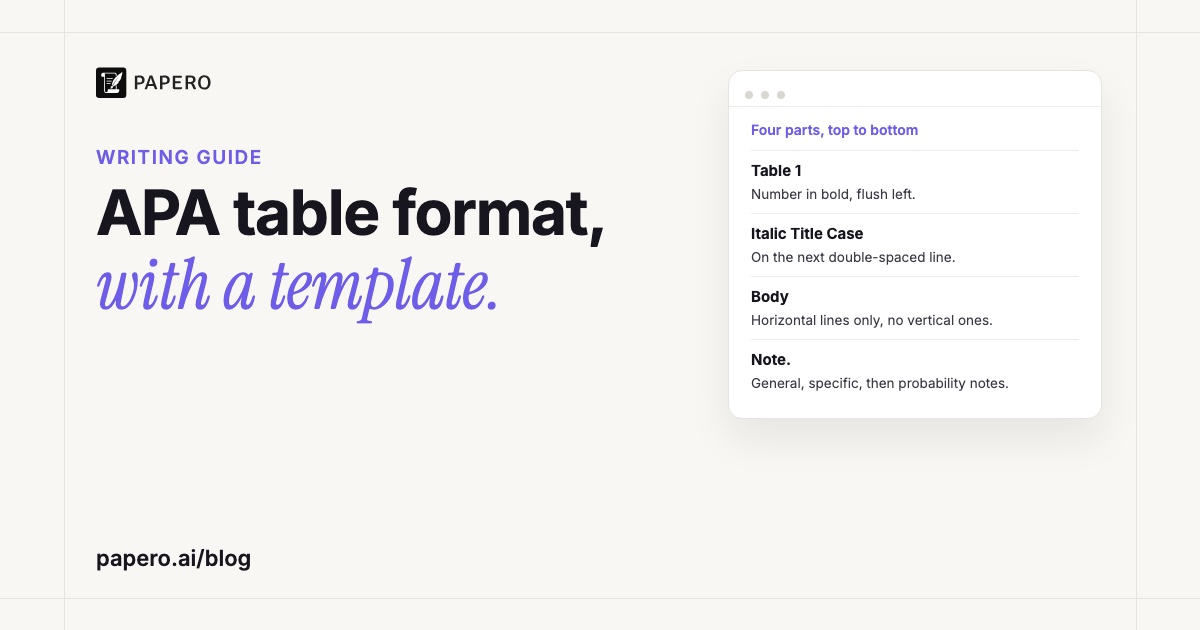
APA table format for the 7th edition: a bold number, an italic title, notes in three types and no vertical lines, with a template and a worked 10-row example.
An expository essay example in 5 paragraphs with APA citations, a note on what each paragraph does, an outline template and how it differs from an argument.
Signal phrases, with examples for quotes and paraphrases: 57 signal verbs grouped by meaning, the tense APA and MLA expect, punctuation and mistakes to avoid.
APA in-text citation rules for the 7th edition: one, two and three or more authors, page numbers, no author or date, secondary sources, with a worked paragraph.
An annotated bibliography example with four real sources in APA 7, one entry in MLA 9, the indent and length rules, and one source annotated three ways.
Chicago style footnotes under CMOS 18: full and shortened notes for books, articles and websites, where the number goes, and why Chicago discourages ibid.
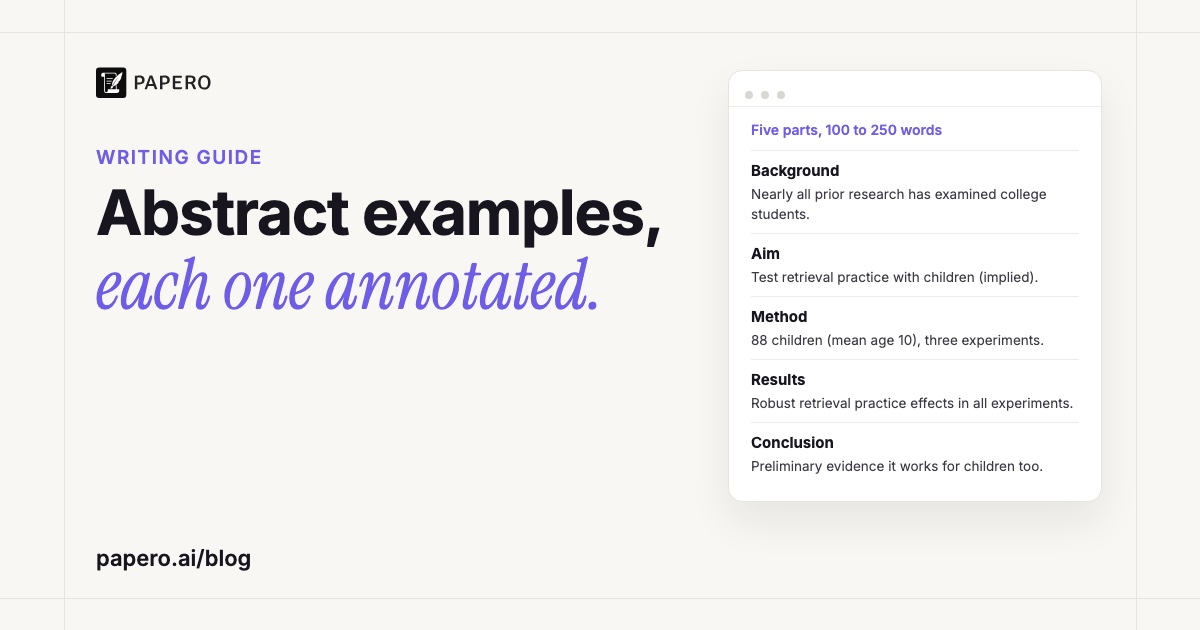
Abstract examples for a research paper: a 164-word empirical abstract, a structured trial abstract and a review abstract, each annotated, plus the APA format.
How to do a hanging indent in Google Docs and Word, the Ctrl+T shortcut, the 0.5-inch depth APA and MLA ask for, the phone apps and five fixes.
Block quote rules for APA (40+ words), MLA (more than four lines) and Chicago (100+ words), with one real passage formatted in all three styles and cited.
A literature review example on retrieval practice, annotated paragraph by paragraph: 10 real sources, a summary vs synthesis rewrite and a matrix to reuse.
Argumentative essay outline in five parts: a template to copy, a full example on laptops in lectures from six real studies, plus Toulmin and Rogerian models.
Example openings for five essay types and three fields, the four parts every essay introduction needs, common mistakes, and eight steps to write your own.
Describe your paper and get an outline in a minute. The Free plan needs no card.