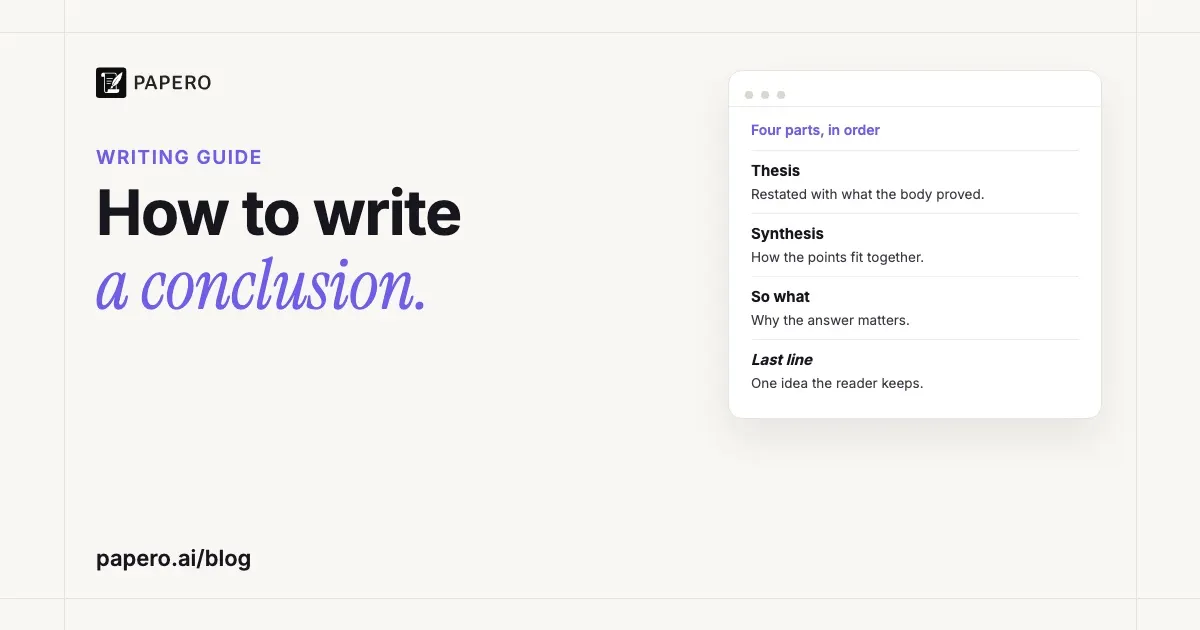
To write a conclusion, restate your thesis in light of what the body proved, show how your main points fit together, say why the answer matters, and end on a sentence that points beyond the essay. Bring in no new argument. Below are four steps, five conclusion paragraph examples, and four weak endings with their fixes.
Key Takeaways
- A conclusion answers the question the introduction raised. It does not list what each paragraph said.
- Restate the thesis in new words and with the confidence the evidence now supports, which Purdue OWL calls readdressing it “in light of the evidence”.
- Ask “so what?” of every sentence, as the UNC Writing Center suggests. A sentence that cannot answer it can usually go.
- New arguments and new evidence belong in the body. A final quotation or an implication is allowed; a new claim that needs proof is not.
- Skip “in conclusion”. The paragraph’s position already tells the reader it is the end.
What goes in a conclusion paragraph?
A conclusion paragraph has four parts, in this order: the thesis restated with what the body established, a synthesis of how the main points connect, the implication or “so what”, and a final sentence. The parts are short. In a five-paragraph essay the whole conclusion is often four to six sentences, about as long as the introduction.
| Part | What it does | Often starts with |
|---|---|---|
| Restated thesis | Gives the answer, now backed by the body | “The evidence points one way:”, “X matters because…” |
| Synthesis | Shows how the points fit together, not one by one | “Together,”, “Taken together,” |
| Implication | Says why the answer matters, or what should follow | “This means”, “For students, this suggests” |
| Final sentence | Closes on one idea the reader keeps | A recommendation, a question for further study, a return to the opening image |
The definition and one more example sit in the glossary entry on the conclusion; this guide is about writing one. The table follows the strategies in the UNC Writing Center’s handout on conclusions and Purdue OWL’s advice to synthesize rather than repeat.
How to write a conclusion in 4 steps
Write the conclusion last, from the finished body, in four steps: reread your thesis and topic sentences, write the answer as one sentence, connect the points, then add the implication and a closing line. Each step works from what you have already proved, which is why a conclusion written before the body usually has to be redone.
- Reread the thesis and every topic sentence. Note what each body paragraph actually established, which may be less, or more qualified, than the thesis promised. The conclusion has to match the body, not the plan.
- Write the answer in one sentence. Restate the thesis in new words, which Purdue OWL calls readdressing it “in light of the evidence”. If the body changed your view slightly, say so: “mostly” or “under these conditions” is more convincing than the original wording repeated.
- Connect the points. Write one or two sentences that show how the reasons work together. UNC’s handout calls this “synthesize, don’t summarize”: show how the points and examples fit, instead of listing them again.
- Play the “so what?” game, then stop. UNC suggests asking “So what?” or “Why should anybody care?” of each statement in your draft conclusion and answering it. A statement with no answer can go. The last answer is often your final sentence: a course of action, a broader implication, or a question for further study.
Our argumentative essay outline shows the same steps at outline stage, where the conclusion is three lines: restated thesis, synthesis, implication.
Conclusion paragraph examples
The five examples below are complete conclusion paragraphs. The first was written for this guide from an outline on this blog; the other four end complete example essays you can read in context. Each one is followed by what it does.
1. Argumentative essay conclusion
This conclusion finishes the argument planned in our argumentative essay outline: universities should make lectures laptop-free by default, with exceptions for students who need a device.
The strongest case against laptops in lectures was never about typing. The replications that weakened the old longhand advantage leave the two findings this essay rests on untouched: off-task screens are linked to lower learning for the students using them and for the students who can see them, and in a randomized trial, allowing computers lowered final exam scores. Together, these findings make a laptop-free default more than a lecturer’s preference, because part of the cost falls on students who did nothing to cause it. A default is not a ban on need, though. Universities that adopt one should make exceptions easy to request and test the policy against their own exam results, so the rule is judged by the same kind of evidence that justified it.
What it does: the first two sentences restate the thesis and fold the counterargument into it, so the answer arrives already tested. “Together” opens the synthesis: the harm to bystanders and the trial result add up to a reason the student’s own choice cannot settle. The last two sentences give the implication as a concrete recommendation. No study appears that the outline did not plan for the body.
2. Expository essay conclusion
From our expository essay example, which explains why spaced study beats cramming:
Spacing beats cramming because the same hours of study last longer when they are divided, a result supported by hundreds of experiments and by classroom research. The gains depend on timing: the further away the test, the longer the best gap between sessions. What keeps students from spacing their study is not a lack of evidence but the fact that cramming feels productive in the moment. Seen this way, the most useful thing to know about spaced study may be that it will feel less effective than it is.
What it does: an expository essay explains rather than argues, so the restated thesis is a finding, not a position. The first three sentences take the body’s three points in order, the first doubling as the restated thesis. The final sentence turns them into one practical idea a reader can use the next time they study.
3. Literature review conclusion
From our literature review example on retrieval practice:
Taken together, the research supports retrieval practice for remembering facts and for applying them to new questions, in laboratories and in classrooms. What remains unclear is how far the benefit extends to highly complex, interconnected material, and the field lacks an agreed, measurable definition of complexity that would let studies on each side be compared. Settling that definition matters most to the students who study such material.
What it does: a review concludes with the state of the evidence and what is still open. The first sentence is the synthesis; the second names the gap, the “questions for further study” ending UNC lists. In a dissertation, that gap becomes the bridge to your research question. Our research question examples show what one looks like in published studies.
4. Narrative essay conclusion
From our narrative essay example about a failed science fair experiment:
I used to think an experiment that did not work was a waste of three weeks. Now I think the waste would have been the bar graph I almost drew that night. A result I did not want was still a result, and it told me something real about the garage that no graph about rainwater could have. Whenever a plan falls apart now, in a lab or anywhere else, I try to ask my dad’s question before I ask how to hide it: why didn’t it grow?
What it does: a narrative essay often holds its point back until the reflection, so here the conclusion states the lesson the story earned. It contrasts the narrator’s view before and after, then widens the lesson beyond the science fair. The last line returns to the dad’s question from the third paragraph, so the essay ends on the question that set up its climax instead of on something new.
5. Rhetorical analysis conclusion
From our rhetorical analysis essay example on the Gettysburg Address:
Lincoln has a few minutes and an occasion built for mourning. He uses the first sentence to remind his audience what the nation was founded on, the repeated “dedicate” to hand his listeners the work the dead had begun, and his own claimed insignificance to make that work feel owed to the soldiers rather than to him. Everett wrote to him the next day that he wished he had come “as near to the central idea of the occasion, in two hours, as you did in two minutes” (“Gettysburg Address”). For Lincoln, that central idea is the living, and what they still owe.
What it does: it restates the three rhetorical choices with what the body showed about each. Then it does something many guides forbid: it adds evidence the essay has not shown before, Edward Everett’s letter. UNC’s handout lists “a provocative insight or quotation from the research or reading you did” as a way to end, and this one works because it confirms the essay’s reading rather than supplying evidence the body needed.
Weak conclusions and how to fix them
Most weak conclusions fall into one of four patterns, which the UNC Writing Center names in its handout: the bare restatement, the thesis held back until the end, the emotional appeal and the grab bag of leftover facts. Each is shown below on the laptop essay, with the fix. The strong version is example 1 above.
| Pattern | Weak version (laptop essay) | Fix |
|---|---|---|
| Bare restatement | “In conclusion, laptops should be banned because they are distracting and lower exam scores.” | Restate what the body showed, including the conceded point, and add the implication |
| Thesis saved for the end | “So, as the evidence shows, lectures should be laptop-free by default.” (the first time the essay says so) | Move the thesis into the introduction; the conclusion then confirms it |
| Emotional appeal | “Every student deserves a classroom free from glowing screens. Let’s give them the gift of focus.” | Replace the appeal with the practical consequence: easy exceptions, checked against exam data |
| Grab bag | “Laptops can also cause eye strain, and phones may be an even bigger problem.” | Cut both: eye strain and phones are new claims the body never supported |
The table makes a point about the grab bag: the fix is to delete, not to rephrase. A new claim in the conclusion needs evidence, and evidence belongs in a body paragraph. If the point matters, give it a paragraph of its own in the body, or leave it out.
How do you start a conclusion paragraph?
Start with the answer, not with a label. A first sentence that restates the thesis in new words signals the ending on its own, so “In conclusion” adds nothing. UNC’s handout describes “in conclusion”, “in summary” and “in closing” as phrases that “can work in speeches” but “come across as wooden and trite in writing”.
Openings that do the same job without the label:
- “Taken together, the evidence shows…”
- “The answer to [the question in your introduction] is…”
- “What these [studies, scenes, choices] have in common is…”
- “[The topic] matters less for X than for Y.”
The examples above follow the same rule. None opens with a label like “In conclusion”; each opens with content.
Where Papero fits
Papero is an AI writing workspace for students and researchers. It turns a description of your paper into a two-level outline in which every section has its own writing prompt, finds real papers to cite as you write, and formats the references in nine citation styles.
A conclusion benefits from that setup because it depends on the sections before it. Give the conclusion heading a prompt that names what the body should have proved, and you can check the draft against it before you write the last paragraph. Papero drafts only from your outline and prompts, so the argument stays yours. Before you submit, Review’s peer-review check gives an AI reviewer’s report with strengths, weaknesses and questions, and its Tone of voice check rewrites sentences in an academic, concise, accessible or persuasive register.
The essay writing page shows how an essay goes from question to finished draft, and you can sign up free. For the other end of the essay, see our guide to essay introduction examples.
Frequently Asked Questions
Can you add new information in a conclusion?
Not new arguments or new evidence that needs discussion; those belong in the body. Purdue OWL says not to introduce new information and to synthesize instead. A final quotation that confirms your reading, an implication, or a question for further study is allowed, and the UNC Writing Center lists all three as ways to end.
Should you start a conclusion with “in conclusion”?
It is better not to. The UNC Writing Center calls “in conclusion”, “in summary” and “in closing” wooden and trite in writing, though acceptable in speeches. Start with the restated thesis instead: a first sentence that gives the answer in new words tells the reader the essay is ending.
How many sentences should a conclusion have?
In a five-paragraph essay, usually four to six: one for the restated thesis, one or two for the synthesis, one or two for the implication, and a final sentence. Longer papers need longer conclusions, and a dissertation’s conclusion is a chapter. A conclusion is often about as long as the introduction.
What is the difference between a summary and a conclusion?
A summary repeats what each paragraph said, in order. A conclusion shows what those points add up to and why the answer matters. The UNC Writing Center puts it as “synthesize, don’t summarize”: a brief reminder of the main points is fine, as long as the paragraph shows how they fit together.
Can a conclusion include a quote?
Yes, if the quotation confirms your argument rather than opening a new one. The UNC Writing Center lists “a provocative insight or quotation from the research or reading you did” as a way to end. Cite it the same way as in the body, and keep the last sentence your own.
Sources
- The Writing Center, University of North Carolina at Chapel Hill, “Conclusions” (writingcenter.unc.edu, accessed October 2026): https://writingcenter.unc.edu/tips-and-tools/conclusions/
- Purdue Online Writing Lab, “Argumentative Essays” (owl.purdue.edu, accessed October 2026): https://owl.purdue.edu/owl/general_writing/academic_writing/essay_writing/argumentative_essays.html