An MLA in-text citation gives the author’s last name and the page number in parentheses, with no comma between them: (Kornell and Bjork 585). If you name the author in your sentence, the parentheses hold only the page: Kornell and Bjork report that participants rated massed study as more effective (585). Whatever comes first in the citation must match the first word of an entry in your works cited list.
Key Takeaways
- MLA uses author-page citations: (Darwin 490). No comma, no “p.” and no year.
- Name the author in your sentence or in the parentheses, never both.
- Two authors: (Kornell and Bjork 585). Three or more: the first author and “et al.” in parentheses.
- No author: use a shortened title. No page or other part numbers: give no number at all.
- The citation goes before the period, after any closing quotation mark.
MLA in-text citation examples
The table covers the cases students meet most, checked against Purdue OWL’s “MLA In-Text Citations: The Basics” and the MLA Style Center in October 2026. Rows marked “pattern” show the shape without a real source; the rest use real sources, listed under Sources at the end.
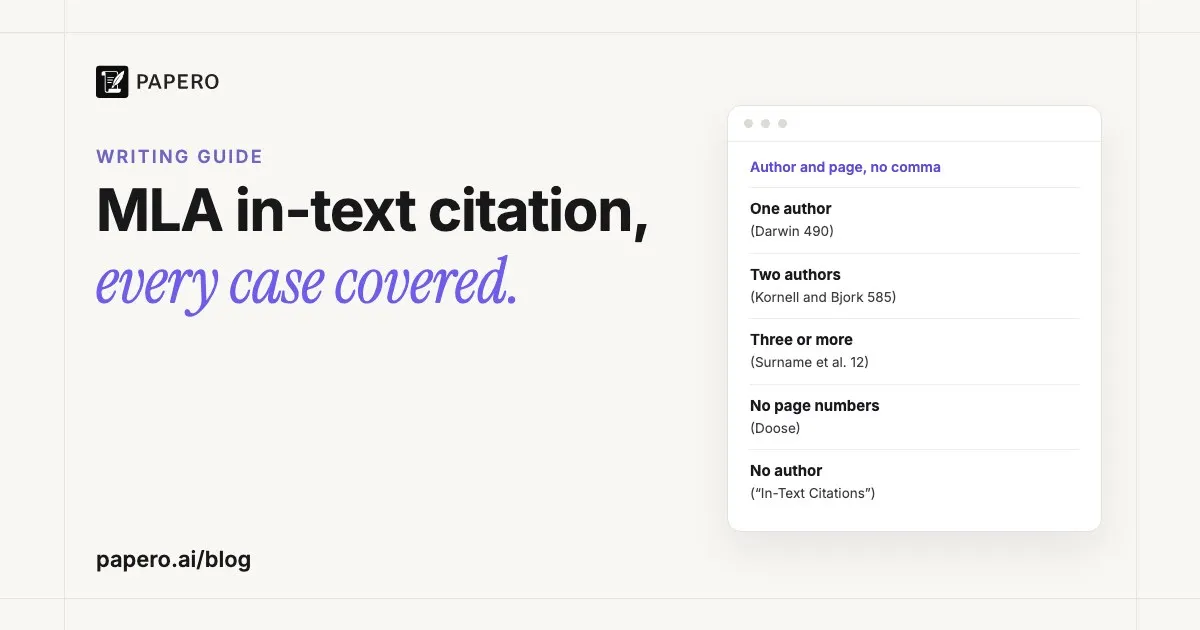
| Case | Parenthetical | In your sentence |
|---|---|---|
| One author | (Darwin 490) | Darwin writes that … (490). |
| Two authors | (Kornell and Bjork 585) | Kornell and Bjork report … (585). |
| Three or more authors (pattern) | (Surname et al. 12) | Surname and others argue … (12). |
| Organization as author, not its own publisher (pattern) | (American Library Association 7) | The American Library Association notes … (7). |
| Organization is author and publisher (title first) | (“In-Text Citations”) | “In-Text Citations: An Overview” explains … |
| No author, book (pattern) | (Shortened Title 15) | Full Title shows … (15). |
| No page numbers | (Doose) | Doose explains … (no parentheses) |
| Two works by one author (pattern) | (Surname, Short Title 22) | Surname argues in Short Title … (22). |
| Two authors with one surname (pattern) | (R. Miller 12; A. Miller 46) | R. Miller claims … (12). |
| Two or more sources (pattern) | (Surname 3; Other 21) | Surname (3) and Other (21) agree … |
| Source quoted in another source (pattern) | (qtd. in Surname 259) | Original Author argues … (qtd. in Surname 259). |
| Poem with line numbers (pattern) | (lines 5–6) | The speaker asks … (lines 5–6). |
| Video or podcast (pattern) | (Surname 00:02:15–00:02:35) | Surname explains … (00:02:15–00:02:35). |
| Classic with many editions (pattern) | (79; ch. 1) | The authors describe … (79; ch. 1). |
Most lost marks come from three habits carried over from APA: a comma between name and page, a “p.” before the page, and a year. MLA uses none of them.
How do you format an MLA in-text citation?
MLA uses the author-page method. Give the author’s last name and the page the material comes from, either both in parentheses at the end of the sentence or the name in your sentence and the page in parentheses. Purdue OWL adds that the page number always goes in the parentheses, never in the sentence itself.
The citation comes after a closing quotation mark and before the sentence’s final period:
- Darwin’s closing sentence describes “endless forms most beautiful and most wonderful” (490).
- The book closes on “endless forms most beautiful and most wonderful” (Darwin 490).
The first word of the citation has to lead the reader to one entry in your works cited list. Purdue OWL puts it plainly: whatever signal word you give, author or title, must be the first thing on the left margin of the matching entry. Our guide to the MLA works cited page shows how those entries are built.
The MLA Style Center marks one habit as incorrect: giving the author both in your sentence and in the parentheses. “According to Darwin, … (Darwin 490)” repeats what the reader already knows; write “According to Darwin, … (490)”. Our guide to paraphrasing a source cites eight reworded passages in MLA and APA, one of them from Darwin.
To cite two or more sources for one point, separate them with semicolons inside one pair of parentheses: (Burke 3; Dewey 21). An MLA Style Center article on finer points of the ninth edition gives the same rule (section 6.30), with commas between two locations in one source: (Samuelson 43, 54; Miller 298).
How do you cite multiple authors in MLA?
For two authors, give both last names joined by “and”: (Kornell and Bjork 585). For three or more, give the first author’s last name and “et al.”: (Surname et al. 12). The same rule applies to the works cited entry, where the first author’s name is reversed and followed by “et al.”
In your own sentences, an MLA Style Center answer prefers words to the abbreviation: spell out the names, or write the first author’s name and “and others”. It was written for the eighth edition, and some guides, Purdue OWL among them, also show “et al.” in a signal phrase, but “and others” remains the usual practice and is what the table above uses. Other styles switch to et al. at other author counts, which our et al. guide lays out side by side.
When two of your sources have authors with the same last name, add first initials so the reader can tell them apart: (R. Miller 12) and (A. Miller 46). When one author wrote two of your sources, add a shortened title after the name: (Surname, Short Title 22).
How do you cite a website in MLA in-text?
Use whatever comes first in the web page’s works cited entry, usually the author’s last name, and give no page number, because web pages have none. Purdue OWL warns against inventing one from your browser’s print preview, and against putting a URL in the citation. If the page has no author, use a shortened version of its title.
Two real pages show both cases. Susan Doose’s MLA Style Center article “A Closer Look at MLA Style” has an author, so it is cited by her name alone, (Doose), or with no parentheses at all when the sentence already names her. The MLA’s own page “In-Text Citations: An Overview” has no personal author, and the MLA is both its author and publisher, so its works cited entry starts with the title. Its in-text citation is a shortened title in quotation marks: (“In-Text Citations”).
That page calls in-text citations “brief, unobtrusive references” that point readers to the list (“In-Text Citations”). Notice the shortened title keeps its quotation marks, because the full title would be in quotation marks too. The title of a whole website or book goes in italics instead.
What if there is no author or no page number?
With no author, use the title, shortened to a noun phrase: Purdue OWL’s example shortens To the Lighthouse to Lighthouse. Put it in quotation marks for a short work, such as an article or web page, and in italics for a long one, such as a book or a whole website. Add the page when you quote or paraphrase a passage of a source with pages.
With no page numbers, give no number. The MLA Style Center quotes the eighth edition of the MLA Handbook: “When a source has no page numbers or any other kind of part number, no number should be given in a parenthetical citation.” If you also named the author in your sentence, the citation is complete without parentheses.
Some sources number something other than pages. Purdue OWL cites a poem by line, starting the parenthetical with the word “line” or “lines”: (lines 5–6). A classic with many editions can take your edition’s page, a semicolon and a chapter or other division: (79; ch. 1). A video or podcast takes a time range: (00:02:15–00:02:35). Our compare and contrast essay example cites two sonnets this way, with a slash marking each line break in a short quotation. The TED talk quoted in our guide on how to cite YouTube videos shortens the end time: (Robinson 00:02:49–58). For poems, our guide on how to cite a poem explains when MLA wants line numbers, page numbers or no number at all. A song is cited by its performer, with a time when you quote it, as our guide on how to cite a song shows: (Collins 00:01:05).
How do you cite a source quoted in another source?
Put “qtd. in” before the source you actually read. Purdue OWL’s example: Ravitch argues that high schools are pressured to act as “social service centers, and they don’t do that well” (qtd. in Weisman 259). Only the source you read, Weisman, goes in your works cited list. Purdue OWL adds that a careful researcher tries to find the original first.
MLA in-text citation example paragraph
Here is a short paragraph with three citations in mixed forms, followed by its works cited list. The sources and quotations are real; the page numbers come from the two articles’ printed pages.
Students often study by rereading the same material in one long session, and the evidence suggests they should not. In experiments on study methods, restudying “increased students’ confidence in their ability to remember the material,” yet students who were tested instead remembered more a week later (Roediger and Karpicke 249). Kornell and Bjork report the same mismatch when people learned to recognize painters’ styles: participants “rated massing as more effective than spacing, even after their own test performance had demonstrated the opposite” (585). Citing such studies is the easy part: MLA asks for “brief, unobtrusive references” in the text (“In-Text Citations”).
Works Cited
“In-Text Citations: An Overview.” MLA Style Center, Modern Language Association of America, 1 Apr. 2021, style.mla.org/in-text-citations-overview/.
Kornell, Nate, and Robert A. Bjork. “Learning Concepts and Categories: Is Spacing the ‘Enemy of Induction’?” Psychological Science, vol. 19, no. 6, 2008, pp. 585–92, https://doi.org/10.1111/j.1467-9280.2008.02127.x.
Roediger, Henry L., III, and Jeffrey D. Karpicke. “Test-Enhanced Learning: Taking Memory Tests Improves Long-Term Retention.” Psychological Science, vol. 17, no. 3, 2006, pp. 249–55, https://doi.org/10.1111/j.1467-9280.2006.01693.x.
Notice the three forms. Roediger and Karpicke are named in the parentheses, with the page. Kornell and Bjork are named in the sentence, so their parentheses hold only the page. The MLA page has no personal author and no pages, so its citation is a shortened title alone. In a paper, the list would start on a new page with a hanging indent, which this page cannot show.
MLA vs APA in-text citation
Both styles name the author in the text and point to a list at the end. The differences are in what goes in the parentheses: MLA gives the page, APA gives the year and adds the page for quotations, with commas between the parts.
| MLA 9 | APA 7 | |
|---|---|---|
| Basic form | (Darwin 490) | (Darwin, 1859, p. 490) |
| Between name and number | No comma | Comma |
| Year | No | Yes (it may be dropped when a narrative citation repeats in one paragraph) |
| Page | When you quote or paraphrase a passage of a source with pages | For quotations; optional for paraphrases |
| Two authors | (Kornell and Bjork 585) | (Kornell & Bjork, 2008, p. 585) |
| Three or more authors | (Surname et al. 12) | (Surname et al., 2020) |
| List at the end | Works Cited | References |
Our guide to APA in-text citation covers the APA side in full. If the author’s name is part of your sentence, the verb you choose matters as well: MLA expects the present tense, “Darwin argues”, as our list of signal phrases explains. The same no-”p.” rule reaches your page header, which reads “Lee 1”, as our guide to the MLA heading and header shows. For the differences beyond the citation itself, from title capitalization to the first page, see our APA vs MLA comparison.
Where Papero fits
Papero is an AI writing workspace for students and researchers. It finds real papers to cite for the sentence you are writing, looks sources up by DOI, PMID, arXiv ID or ISBN, and inserts in-text citations in MLA 9 or eight other styles, including several sources in one citation.
On the free plan, in-text citations work in full and the reference list shows your real entries blurred; Plus makes it readable, copyable and exportable (papero.ai/pricing). Page numbers are still yours to add, since only you know which page you quoted. The find sources page shows the workflow, you can sign up free, and the glossary entries on the in-text citation and parenthetical citation have the short definitions.
Frequently Asked Questions
Is there a comma in an MLA in-text citation?
No. MLA puts the author’s last name and the page number side by side with no comma and no “p.”: (Darwin 490). Commas appear in a few special cases, for example before a shortened title for an author with two works in your list, (Surname, Short Title 22), or between two locations in one source, (Samuelson 43, 54).
How do you cite a website with no page numbers in MLA?
Give the author’s last name alone, (Doose), or nothing in parentheses if your sentence already names the author. If the page has no author, use a shortened title in quotation marks, such as (“In-Text Citations”). Do not count pages from a print preview, and do not put the URL in the citation.
How do you cite three authors in MLA in-text?
Give the first author’s last name followed by “et al.” and the page: (Surname et al. 12). In your own sentence, an MLA Style Center answer written for the eighth edition reserves “et al.” for parentheses and the works cited list, and asks for the first author’s name and “and others”, or all the names.
Does MLA in-text citation include the year?
No. MLA in-text citations give the author and the page, not the year; the date appears only in the works cited entry. If your citations include the year, you are probably following APA, which uses (Author, year, p. page).
Where does the period go in an MLA in-text citation?
After the closing parenthesis: “endless forms most beautiful and most wonderful” (Darwin 490). The quotation mark closes first, then the citation, then the period. Long quotations set off as block quotations are the exception: the period ends the quotation and the citation follows it, with no period after.
Sources
- Purdue OWL, “MLA In-Text Citations: The Basics” (owl.purdue.edu, accessed October 2026): https://owl.purdue.edu/owl/research_and_citation/mla_style/mla_formatting_and_style_guide/mla_in_text_citations_the_basics.html
- Modern Language Association, “In-Text Citations: An Overview” (style.mla.org, accessed October 2026): https://style.mla.org/in-text-citations-overview/
- Susan Doose, “A Closer Look at MLA Style” (ninth-edition rules with MLA Handbook section numbers) (style.mla.org, accessed October 2026): https://style.mla.org/closer-look-at-mla-style/
- MLA Style Center, “What should I include in parentheses if the author’s name is provided in a signal phrase and the source has no page numbers or other kind of part number?” (eighth-edition answer) (style.mla.org, accessed October 2026): https://style.mla.org/citing-unpaginated-works/
- MLA Style Center, “When a work by three or more authors is mentioned in the text of a research paper…should the names of all the authors be included?” (eighth-edition answer) (style.mla.org, accessed October 2026): https://style.mla.org/when-a-work-by-three-or-more-authors-is-mentioned-in-the-text-of-a-research-paper-rather-than-in-a-parenthetical-citation-should-the-names-of-all-the-authors-be-included-or-only-the-first-one-foll/
- Darwin, C. (1859). On the origin of species by means of natural selection, or the preservation of favoured races in the struggle for life. John Murray. First-edition facsimile on Wikisource: https://en.wikisource.org/wiki/On_the_Origin_of_Species_(1859)/Chapter_XIV
- Kornell, N., & Bjork, R. A. (2008). Learning concepts and categories: Is spacing the “enemy of induction”? Psychological Science, 19(6), 585–592. https://doi.org/10.1111/j.1467-9280.2008.02127.x
- Roediger, H. L., III, & Karpicke, J. D. (2006). Test-enhanced learning: Taking memory tests improves long-term retention. Psychological Science, 17(3), 249–255. https://doi.org/10.1111/j.1467-9280.2006.01693.x