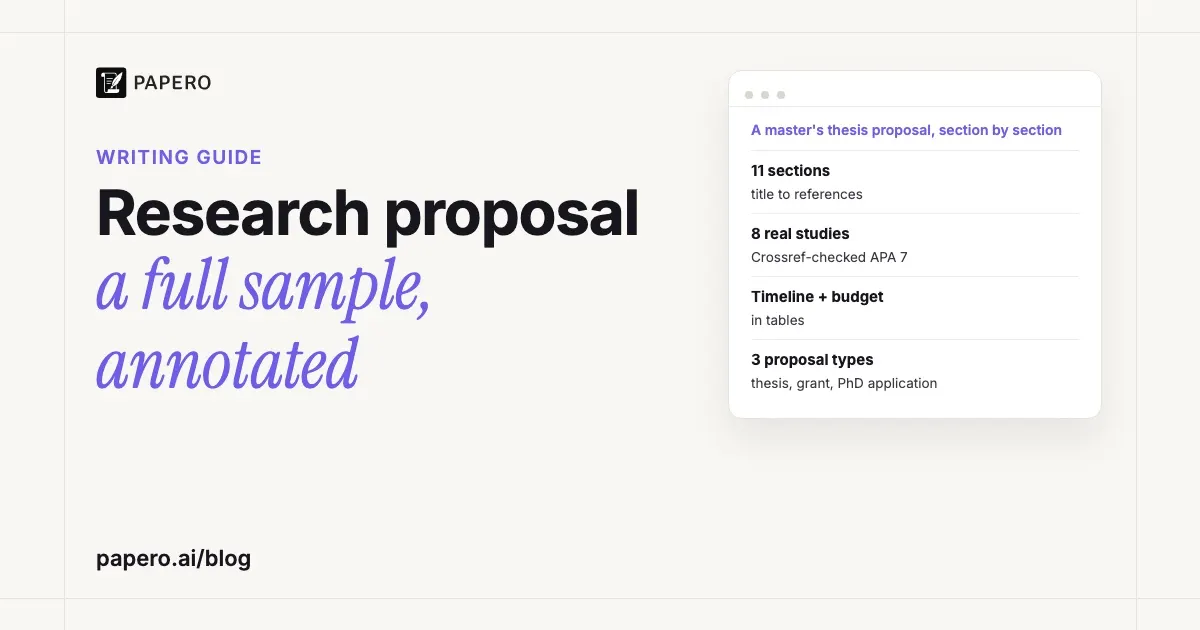
A research proposal sets out what you plan to study, why it matters, and how you will do it. Most include a title, a summary, an introduction, a literature review that ends on a gap, research questions, methods and ethics, a timeline, sometimes a budget, the expected contribution, limitations and references. Below is a full research proposal example for a master’s thesis, annotated section by section.
Key Takeaways
- A proposal holds every element of a finished study except the findings and their analysis, as USC Libraries’ guide puts it.
- The literature review argues for your study. It should end on a specific gap that your questions fill.
- Methods are written in the future tense, tied to each research question, with the sample size worked out.
- Length depends on the reader: some PhD applications ask for 500 to 1,000 words, while an NSF grant allows a 15-page project description.
- Name the risks yourself. Yale College asks for potential pitfalls and alternative strategies; USC asks for limitations.
What are the parts of a research proposal?
A research proposal has up to ten parts: a title, an abstract or summary, an introduction, a literature review, research questions or hypotheses, methods and ethics, a timeline, a budget, the expected contribution and limitations, and references. The abstract and the budget depend on who asked for the proposal.
| Section | Question it answers | What guides say |
|---|---|---|
| Title | What is the study? | York (Language and Communication): no more than 20 words |
| Abstract or summary | What, why and how, in one paragraph? | Yale College: 250 words; USC: most proposals do not include one |
| Introduction | What is the problem, and why care? | USC: two to four paragraphs that answer the “So What?” question |
| Literature review | What is known, and what is missing? | USC: organize by “conceptual categories” (themes) |
| Research questions or hypotheses | What will the study answer? | Yale: the hypothesis is stated in one sentence |
| Methods and ethics | How will you answer each question? | USC: tie the design and methods to the study’s aims |
| Timeline | Can it be done in time? | Reading and Westminster both ask for one |
| Budget | What will it cost? | Grants: required; NSF caps the justification at five pages |
| Contribution and limitations | What will change, and what could go wrong? | USC: implications and limitations; Yale: pitfalls and alternatives |
| References | Whose work does the case rest on? | USC: usually not counted in the page length |
USC’s definition: “The only elements missing from a research proposal are the findings of the study and your analysis of those findings.”
Research proposal example: food insecurity and student grades
The proposal below was written for this guide as a model of a master’s thesis proposal in public health. The university, names and costs are placeholders, and no data have been collected. Every study it cites is real, and its reference list was checked against Crossref.
Title page
Food Insecurity and Academic Performance Among Undergraduates: A Cross-Sectional Survey Linked to Registrar Records
Master of Public Health thesis proposal
[Your name], Department of [Department], [University]
Supervisor: [name]
Submitted [date]
What it does. The title names the two variables, the population and the design in 14 words, and the subtitle flags the main methodological choice: grades from records, not self-report.
Common mistake. A title that names only a topic, such as “Food Insecurity on Campus”. If yours still feels that broad, our guide on how to choose a research topic narrows one by population, place and method.
Summary
Summary
Studies of U.S. college students report food insecurity rates from 10% to 75%, using different instruments, and most of the grade studies reviewed below rely on grades students report themselves. This study will survey a random sample of 4,000 undergraduates at [University] with the 10-item U.S. Adult Food Security Survey Module and, with consent, link answers to the term grade point average (GPA) held by the registrar. It will estimate the prevalence of food insecurity, test whether food-insecure students earn a lower term GPA after adjusting for enrollment, paid work and financial aid, and explore whether depressive symptoms explain part of any difference. The results will give [University]‘s basic-needs office a local estimate and show whether the GPA gap holds when grades come from records.
What it does. It follows the order Yale College’s fellowship guidance sets for an abstract: the problem, why it matters, what will be tested, how, and a closing sentence, in about 125 words against Yale’s 250-word limit.
Common mistake. Promising results (“This study will show that food insecurity lowers grades”).
1. Introduction
1. Introduction
Reports of food insecurity among college students, defined as inadequate access, availability, adequacy and stability of food (Nikolaus et al., 2020), have sparked national calls for policies to alleviate and prevent it. Recent reviews report average prevalence rates of 33% to 51% among students, compared with 9.8% among U.S. adults (Ellison et al., 2021), and food insecurity has been consistently associated with adverse academic outcomes (Bruening et al., 2017).
For a university, the questions are practical: how many of its own students are affected, and do they earn lower grades once paid work and course load are taken into account? This study will answer both at [University] with a standard U.S. Department of Agriculture (USDA) instrument and grades from registrar records, to inform how the basic-needs office sizes its food pantry and emergency aid.
What it does. Two paragraphs answer USC’s four questions: the problem, the topic, the method, and why it matters. Naming a reader who could act on it (the basic-needs office) follows USC’s tip to imagine a real-world audience.
Common mistake. Opening with a history of the whole field. USC warns that the background section, which can be folded into the introduction, “is not an essay going over everything you have learned about the topic.”
2. Literature review
2. Literature Review
How common is it? A systematic review of 17 peer-reviewed studies and 41 gray-literature sources, all cross-sectional, found average rates of 42% and 35% (Bruening et al., 2017). Single campuses vary widely: 15% of 237 undergraduates at a mid-Atlantic public university (Payne-Sturges et al., 2018), but 56% of 301 students at two Maryland community colleges (Maroto et al., 2015).
Why the estimates differ. Nikolaus et al. (2020) reviewed 51 U.S. study samples and found estimates from 10% to 75%; only 4 samples used representative sampling. Prevalence was 50% with the USDA six-item short form and 40% with the 10-item adult module, but 13% with the full household module, and surveys asking about the past 12 months produced lower estimates (31%) than those with reference periods of 9 months or shorter (47%). Ellison et al. (2021) add that no food insecurity measure has been validated for use with college students, so a new estimate is comparable with earlier ones only if it reports its instrument and its reference period.
Food insecurity and grades. At two community colleges, food-insecure students were more likely than food-secure students to report a lower GPA (2.0 to 2.49) rather than a higher one (3.5 to 4.0) (Maroto et al., 2015). Among 2,055 undergraduates at a New Jersey public university, Weaver et al. (2020) combined survey answers with university data and found that food insecurity raised the odds of a GPA in the lowest 10% and lowered the odds of one in the top 10%. Following 2,377 students at seven Georgia colleges and universities, Raskind et al. (2019) found that poorer psychosocial health (depression, anxiety and hope) accounted for 73% of the association between food insecurity and self-reported GPA; once it was taken into account, the direct association was not significant. At a mid-Atlantic public university, Payne-Sturges et al. (2018) found no significant difference in self-reported GPA by food security status.
The gap. Of the four studies above that compared grades, three relied on GPA reported by students (Maroto et al., 2015; Payne-Sturges et al., 2018; Raskind et al., 2019), and the fourth, which took grades from university data, reported its findings only as the odds of falling in the lowest or highest 10% (Weaver et al., 2020). This study will test food insecurity against registrar-recorded GPA across its full range, and whether the psychosocial pathway Raskind et al. describe appears when grades come from records.
What it does. It is organized by theme, as USC recommends, and each paragraph moves toward this study. The last one names the research gap precisely enough that the research questions follow from it.
Common mistake. One study per paragraph, summarized, with no gap at the end. Our literature review outline templates show how to group sources by theme instead.
3. Research questions and hypotheses
3. Research Questions and Hypotheses
RQ1. What proportion of undergraduates at [University] experienced low or very low food security in the past 12 months, as measured by the U.S. Adult Food Security Survey Module?
RQ2. Is food insecurity associated with registrar-recorded term GPA after adjustment for years enrolled, credit load, weekly hours of paid work, Pell Grant receipt, first-generation status, living arrangement and meal plan?
H1. Food-insecure students will have a lower mean term GPA than food-secure students after adjustment for these covariates. H0. Mean term GPA will not differ by food security status after adjustment.
RQ3 (exploratory). Do depressive symptoms account for part of any association between food insecurity and term GPA?
What it does. One descriptive question, one hypothesis with its null, and one question labelled exploratory, so the committee knows it is not a confirmatory test.
Common mistake. Questions the design cannot answer, such as whether food insecurity “causes” lower grades in a one-time survey. Our research question examples match a question’s wording to its design. Why a one-time survey shows associations and not causes is the subject of our guide to cross-sectional studies.
4. Methods
4. Methods
Design. A cross-sectional online survey, linked with each consenting participant’s registrar records.
Participants and sampling. The Office of Institutional Research will draw a simple random sample of 4,000 undergraduates aged 18 or older from the spring enrollment list. Weaver et al. (2020) had a 15% response to a similar invitation; at that rate, about 600 students would respond. Assuming 80% of them consent to the registrar link, about 480 linked records would be available. A power analysis for RQ2 (two-sided α = .05, power = .80, f² = 0.02 for the food security term in a model with eight predictors) requires 395.
Measures. Food security: the 10-item U.S. Adult Food Security Survey Module (Economic Research Service, 2012), with its standard 12-month reference period. All 10 items will go to every respondent, without the module’s screeners. Raw scores of 3 to 10 will be classed as food insecure (low or very low food security) and 0 to 2 as food secure, following the module’s scoring. Depressive symptoms: the eight-item PHQ-8 (Kroenke et al., 2009), as a total score. Academic performance: spring term GPA from the registrar; respondents will also report their fall term GPA, which will be compared with the registrar’s fall figure. Covariates: credit load, years enrolled and Pell Grant receipt from registrar records; paid work, first-generation status, living arrangement and meal plan from the survey.
Procedure. After think-aloud interviews with eight students in January, the survey will be open for three weeks in February, with an invitation and two reminders. Every participant will then see contacts for the food pantry, emergency aid and counseling.
Analysis. RQ1: the proportion food insecure with a 95% confidence interval; respondents will be compared with the sampling frame on sex, class year and Pell receipt, and weighted estimates reported if they differ. RQ2: multiple linear regression of term GPA on food security status and the seven covariates, repeated with the four USDA categories and with self-reported GPA as sensitivity analyses. RQ3: a mediation model with a bootstrapped confidence interval for the indirect effect through PHQ-8 score. Analyses will be run in R.
Ethics. No student will be contacted until the [University] Institutional Review Board (IRB) has approved the study. Consent to the survey and consent to the registrar link will be separate; students who decline the link can still take part. Names and student ID numbers will be kept in a separate file, replaced with study codes after linkage and deleted once analysis ends. No result will be reported for a group of fewer than 10 students. The PHQ-8 was chosen in part because it has no item on self-harm, which an online survey with no clinician on hand could not follow up.
What it does. Every research question has a matching measure and analysis, and the sample size is derived step by step. It is written in the future tense, because nothing has been done yet. The ethics paragraph answers what an IRB asks first: consent, identifiable data and risk. (The PHQ-8 is the PHQ-9 depression scale without item 9, on thoughts of death or self-harm, as Shin et al., 2019, describe.) A proposal that needs separate estimates for a group recorded in the enrollment list, such as Pell Grant recipients, would draw a stratified random sample instead.
Common mistake. A list of tasks with no reasons. USC: “the methodology is not just a list of tasks; it is a deliberate argument as to why techniques for gathering information add up to the best way to investigate the research problem.” Our guide on how to write a methodology section covers the same parts in the past tense.
5. Timeline
5. Timeline
Months Task September to October 2027 Finish the literature review; proposal defense November to December 2027 IRB submission and revisions; data agreement with the registrar January 2028 Think-aloud interviews; final survey February 2028 Survey open for three weeks March to May 2028 Data cleaning; prevalence estimate (RQ1) June 2028 Spring grades posted; registrar linkage; identifiers replaced with study codes June to July 2028 Regression and mediation analyses (RQ2, RQ3) July to August 2028 Identifiers deleted; results and discussion chapters; thesis defense
What it does. It shows the hard constraint: the main analysis waits for spring grades in June. Reading’s guide asks for a rough timeline showing the work can be finished.
Common mistake. Leaving ethics review out of the schedule.
6. Budget
6. Budget
Item Cost (USD) Prize draw: 20 gift cards of $25 500 Think-aloud interviews: 8 participants at $15 120 Survey platform (university license) 0 Total 620
What it does. Each line says what the money buys and how the figure was reached.
Common mistake. A single total with no breakdown. NSF asks for a budget for each year of support and a justification of every line item.
7. Expected contribution
7. Expected Contribution
The study will give [University] its first estimate of student food insecurity with a stated instrument and reference period, comparable with studies that use the same module. It will test whether the GPA gap reported in self-report studies appears in registrar records, and how closely self-reported GPA tracks the recorded figure, which tells future studies how much self-report may distort their results. Its complete item-level food security data will also support the psychometric work with student samples that Ellison et al. (2021) call for.
What it does. It names three outcomes and who uses each. USC calls this section “Preliminary Suppositions and Implications”: how the study will “refine, revise, or extend existing knowledge”.
Common mistake. Predicting the findings. USC says this section “should not delve into idle speculation”.
8. Limitations
8. Limitations
A one-time survey cannot show that food insecurity lowers grades; the direction could also run the other way, if low grades cost students scholarships and aid. A 15% response rate would leave room for nonresponse bias, which the comparison with the sampling frame can detect for registrar variables but not for food insecurity itself. The 12-month reference period covers more than the single term whose GPA is analysed, and the RQ3 mediation model is exploratory, because cross-sectional data cannot establish that depressive symptoms come between food insecurity and grades. Results describe one public university.
What it does. Each limitation says what it does to the conclusions, and the second says what the design does about it, as USC asks: “where and in what form impediments may arise and how you plan to address them.”
Common mistake. Saving limitations for the finished thesis. Our guide to the limitations of a study has example sentences for each common type.
References
References
Bruening, M., Argo, K., Payne-Sturges, D., & Laska, M. N. (2017). The struggle is real: A systematic review of food insecurity on postsecondary education campuses. Journal of the Academy of Nutrition and Dietetics, 117(11), 1767–1791. https://doi.org/10.1016/j.jand.2017.05.022
Economic Research Service. (2012). U.S. adult food security survey module: Three-stage design, with screeners. U.S. Department of Agriculture. https://www.ers.usda.gov/media/6424/us-adult-food-security-survey-module.pdf
Ellison, B., Bruening, M., Hruschka, D. J., Nikolaus, C. J., van Woerden, I., Rabbitt, M. P., & Nickols-Richardson, S. M. (2021). Viewpoint: Food insecurity among college students: A case for consistent and comparable measurement. Food Policy, 101, Article 102031. https://doi.org/10.1016/j.foodpol.2021.102031
Kroenke, K., Strine, T. W., Spitzer, R. L., Williams, J. B. W., Berry, J. T., & Mokdad, A. H. (2009). The PHQ-8 as a measure of current depression in the general population. Journal of Affective Disorders, 114(1–3), 163–173. https://doi.org/10.1016/j.jad.2008.06.026
Maroto, M. E., Snelling, A., & Linck, H. (2015). Food insecurity among community college students: Prevalence and association with grade point average. Community College Journal of Research and Practice, 39(6), 515–526. https://doi.org/10.1080/10668926.2013.850758
Nikolaus, C. J., An, R., Ellison, B., & Nickols-Richardson, S. M. (2020). Food insecurity among college students in the United States: A scoping review. Advances in Nutrition, 11(2), 327–348. https://doi.org/10.1093/advances/nmz111
Payne-Sturges, D. C., Tjaden, A., Caldeira, K. M., Vincent, K. B., & Arria, A. M. (2018). Student hunger on campus: Food insecurity among college students and implications for academic institutions. American Journal of Health Promotion, 32(2), 349–354. https://doi.org/10.1177/0890117117719620
Raskind, I. G., Haardörfer, R., & Berg, C. J. (2019). Food insecurity, psychosocial health and academic performance among college and university students in Georgia, USA. Public Health Nutrition, 22(3), 476–485. https://doi.org/10.1017/S1368980018003439
Weaver, R. R., Vaughn, N. A., Hendricks, S. P., McPherson-Myers, P. E., Jia, Q., Willis, S. L., & Rescigno, K. P. (2020). University student food insecurity and academic performance. Journal of American College Health, 68(7), 727–733. https://doi.org/10.1080/07448481.2019.1600522
What it does. Every source cited in the text is listed, and nothing else, in APA 7.
Common mistake. Citing a review’s summary of a study as if you had read the study itself.
How is a thesis proposal different from a grant or PhD application proposal?
All three describe a study that has not happened yet. A thesis proposal asks a supervisor and committee for approval to start. A grant proposal asks reviewers for money and follows the funder’s rules to the page. A PhD application proposal shows admissions staff that you can frame a project and that the department has someone to supervise it.
| Thesis or dissertation proposal | Grant proposal (NSF, NIH) | PhD application proposal | |
|---|---|---|---|
| Who decides | Supervisor and committee | Expert reviewers and agency staff | Admissions staff and possible supervisors |
| What it wins | Approval to start the study | Funding | A place, and a supervisor in your area |
| Length | USC: 10 to 35 pages in the social sciences | NSF: 15-page project description; NIH R01: 12-page research strategy | Reading: typically 1,000 to 2,000 words; York: from 250 to 350 words (Physics, Engineering and Technology) to about 4,000 (Management), by department |
| Summary | USC: most do not include one; Yale College: 250 words | NSF: one page (overview, intellectual merit, broader impacts); NIH: 30 lines | York’s Language and Communication PhD asks for a 250 to 350 word summary |
| Budget | Only if the program asks | Required; NSF justification up to five pages | Rarely |
| Extra section | Detailed ethics plan | NSF: a separate “Broader Impacts” section; NIH: a one-page Specific Aims | Fit with the department’s research (Westminster, York) |
NIH’s limits apply “unless otherwise specified in the notice of funding opportunity”, and a program solicitation can change NSF’s 15-page limit, so the call you answer always wins.
How long should a research proposal be?
As long as the people asking for it say, and the range is wide. USC’s guide puts most social science proposals at 10 to 35 pages before references. Yale College caps its science fellowship proposals at 8 pages, not counting references. PhD applications usually ask for anything from a few hundred to about 4,000 words, and grant agencies set a page limit for each section.
PhD limits vary even within one university: at York, Computer Science asks for about 500 to 1,000 words and the Management PhD for around 4,000. Westminster asks for 2,000 to 3,500. The sample above runs to about 1,500 words without its references.
How do you write a research proposal, step by step?
Start from the requirements: who will read it, what they decide, and what length and headings they set. Then settle the research question, read until you can name the gap, design methods that answer each question, and write the summary and title last, when you know what the proposal says.
- Read the brief and ask about anything unclear, USC’s first advice.
- Narrow the topic. USC lists failing to “delimit the contextual scope” (time, place, people) as a common mistake.
- Read and group the literature by theme; USC says you have found the main themes once the same conclusions start repeating.
- State the questions or hypotheses, each answerable with data you can get.
- Design the methods question by question, with the ethics plan.
- Plan time and money, putting slow steps such as ethics approval in the timeline.
- Write the summary and title last, and check every citation against the references.
Two more mistakes come up at the design stage. USC names “too much detail on minor issues, but not enough detail on major issues”. Yale names aims that depend on each other, saying they should be “related but NOT interdependent.” In the sample, RQ1 can be answered from the survey alone even if the registrar link falls through.
Where Papero fits
Papero is an AI writing workspace for students and researchers. Its outline builder can start a document from headings it suggests for the paper you describe, each section with its own prompt, so a proposal can begin from the sections above. You can paste a DOI, such as the Bruening et al. review’s, and Papero formats the citation in any of nine styles, including APA 7; on the free plan the reference list is blurred and left out of exports, and Plus makes it exportable.
Papero also keeps a version at most every 10 minutes and lets you name up to 20, such as the draft you sent your supervisor. The thesis writing page shows the steps for longer projects. Papero does not replace your supervisor or your ethics board: the research questions and the case for your study have to be your own, and your program’s rules on AI help apply.
Frequently Asked Questions
What is an example of a research proposal?
One complete example is a master’s thesis proposal asking whether food-insecure undergraduates earn lower grades. It has a title, a short summary, an introduction, a literature review ending on a gap, three research questions with one hypothesis, methods with a sample size calculation, ethics, a timeline, a budget, the expected contribution, limitations and references.
Does a research proposal need an abstract?
It depends on who asked for it. USC Libraries’ guide says most research proposals do not include an abstract before the introduction. Yale College’s science fellowships require an abstract of up to 250 words, NSF requires a one-page project summary, and NIH applications include an abstract of up to 30 lines. Follow the template you were given.
Can a research proposal change after it is approved?
Usually, yes: a proposal is a plan. Westminster’s research degree guide calls the application proposal “just the starting point” and expects the research to change as ideas develop. For a study with human participants, agree any change to the methods with your supervisor and check with your ethics board before you make it.
Sources
- USC Libraries, “Organizing Your Social Sciences Research Assignments: Writing a Research Proposal” (last updated October 13, 2026; accessed November 2026): https://libguides.usc.edu/writingguide/assignments/researchproposal
- Yale College, Science and Quantitative Reasoning Education, “How To Write a Proposal” (accessed November 2026): https://science.yalecollege.yale.edu/stem-fellowships/how-write-proposal
- University of York, “Research proposals” (postgraduate research applications, accessed November 2026): https://www.york.ac.uk/study/postgraduate/apply/supporting-documents/research-proposal-guidance/
- University of Reading, Doctoral and Researcher College, Writing a Research Proposal: A Guide for Prospective PhD or MPhil Students (PDF, September 2025): https://static.reading.ac.uk/content/PDFs/files/Doctoral/pgr-how-to-write-a-research-proposal-August-2025.pdf
- University of Westminster, “How to write your research proposal” (accessed November 2026): https://www.westminster.ac.uk/study/postgraduate/research-degrees/how-to-apply/entry-requirements/how-to-write-your-research-proposal
- National Science Foundation, Proposal and Award Policies and Procedures Guide (NSF 24-1), Chapter II, “Proposal Preparation Instructions” (effective May 20, 2024; accessed November 2026): https://www.nsf.gov/policies/pappg/24-1/ch-2-proposal-preparation
- National Institutes of Health, “Page Limits” (last updated September 30, 2026; read in the Internet Archive capture of October 13, 2026): https://grants.nih.gov/grants-process/write-application/how-to-apply-application-guide/page-limits
- U.S. Department of Agriculture, Economic Research Service, “Survey Tools” (accessed November 2026): https://www.ers.usda.gov/topics/food-nutrition-assistance/food-security-in-the-us/survey-tools
- Shin, C., Lee, S.-H., Han, K.-M., Yoon, H.-K., & Han, C. (2019). Comparison of the usefulness of the PHQ-8 and PHQ-9 for screening for major depressive disorder: Analysis of psychiatric outpatient data. Psychiatry Investigation, 16(4), 300–305. https://doi.org/10.30773/pi.2019.02.01
- The eight studies and the USDA module cited in the sample are listed, with DOIs, in its reference list above.