ACS citation style is the American Chemical Society’s reference format, set out in The ACS Guide to Scholarly Communication. Sources are usually numbered in the order you first cite them, marked in the text with superscript numbers and listed in that order under References. A journal entry gives the authors separated by semicolons, the title, the italic journal, a bold year, an italic volume, the issue and the pages.
Key Takeaways
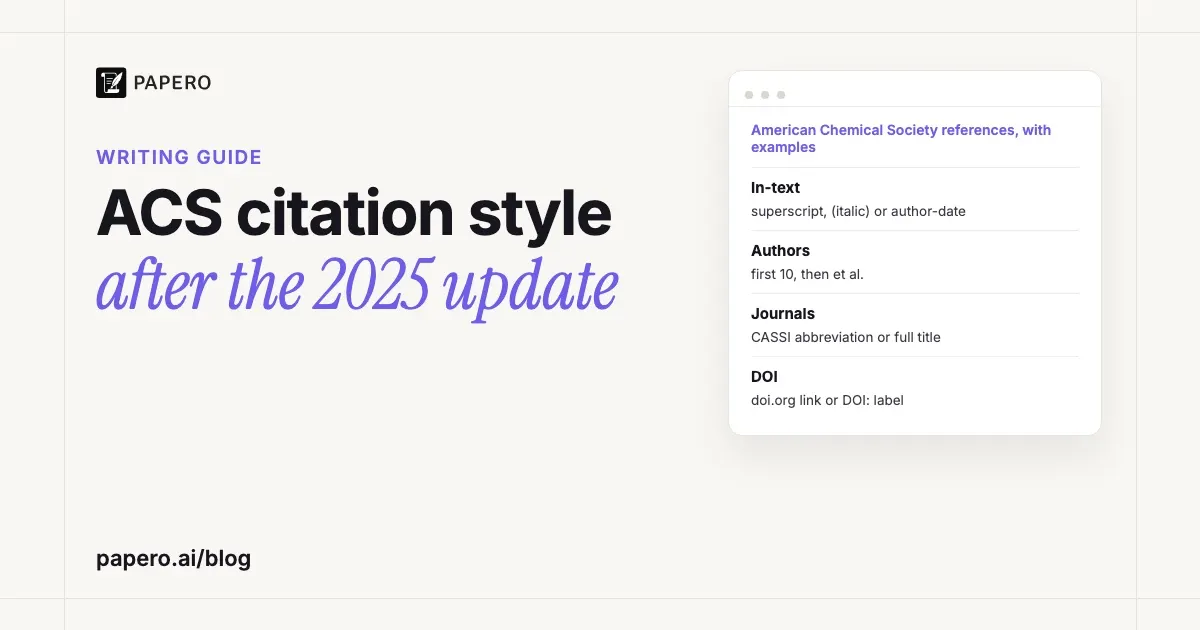
- In the text, the ACS Guide allows three systems: superscript numbers (the usual choice), numbers in parentheses (italic in some guides), or the author and year. Use one system for the whole paper.
- A source keeps its first number every time you cite it again, and the reference list runs in number order, not alphabetically.
- List up to 10 authors, surname first with initials, separated by semicolons. With more than 10, give the first 10, a semicolon and “et al.”
- Journal names follow the CAS Source Index (CASSI), as in J. Am. Chem. Soc.; since the April 2025 revision, full titles are accepted too, as long as every entry uses them.
- The 2025 revision also asks for DOIs as
https://doi.org/links, lets article titles keep their published capitalization and drops the access date by default.
ACS citation format: examples by source type
Every ACS reference starts with the authors, surname first with initials after, joined by semicolons, and then the title. A journal article continues with the journal in italics, the year in bold, the volume in italics, the issue in parentheses and the pages. Books and chapters give the publisher and year, and patents give the patent number. Every example below is a real work, checked against its Crossref, DataCite or registry record in November 2026.
| Source | ACS reference entry |
|---|---|
| Journal article, abbreviated journal name | Agard, N. J.; Prescher, J. A.; Bertozzi, C. R. A Strain-Promoted [3 + 2] Azide−Alkyne Cycloaddition for Covalent Modification of Biomolecules in Living Systems. J. Am. Chem. Soc. 2004, 126 (46), 15046–15047. https://doi.org/10.1021/ja044996f |
| Journal article, full journal name | Danese, M.; Bon, M.; Piccini, G.; Passerone, D. The reaction mechanism of the azide–alkyne Huisgen cycloaddition. Physical Chemistry Chemical Physics 2019, 21 (35), 19281–19287. https://doi.org/10.1039/C9CP02386K |
| Journal article, more than 10 authors | Jumper, J.; Evans, R.; Pritzel, A.; Green, T.; Figurnov, M.; Ronneberger, O.; Tunyasuvunakool, K.; Bates, R.; Žídek, A.; Potapenko, A.; et al. Highly accurate protein structure prediction with AlphaFold. Nature 2021, 596, 583–589. https://doi.org/10.1038/s41586-021-03819-2 |
| Book (ebook with a DOI) | Morgante, P.; Autschbach, J. Molecular Orbitals; American Chemical Society, 2023. https://doi.org/10.1021/acsinfocus.7e7002 |
| Chapter in an edited book in a series | Kaplan, L. J. Chemistry and Crime: Investigating Chemistry from a Forensic Science Perspective. Teaching Chemistry with Forensic Science; Harper-Leatherman, A. S., Huang, L., Eds.; ACS Symposium Series, Vol. 1324; American Chemical Society, 2019, pp 13–34. https://doi.org/10.1021/bk-2019-1324.ch002 |
| Web page | Press release: The Nobel Prize in Chemistry 2022. The Royal Swedish Academy of Sciences, October 5, 2022. https://www.nobelprize.org/prizes/chemistry/2022/press-release/ |
| Patent | Sharpless, K. B.; Fokin, V.; Rostovtsev, V. A.; Green, L.; Himo, F. Copper-catalysed ligation of azides and acetylenes. US7375234B2, 2008. |
| Thesis | Basran, K. Click chemistry in action: expanding the chemical toolbox in biological systems. Ph.D. Thesis. McGill University, 2025. https://doi.org/10.82308/53692 |
| Dataset | Danese, M.; Bon, M.; Piccini, G.; Passerone, D. The reaction mechanism of the azide–alkyne Huisgen cycloaddition (Dataset). Materials Cloud, October 9, 2019. https://doi.org/10.24435/materialscloud:pw-2t (data for Danese et al. https://doi.org/10.1039/C9CP02386K) |
UC San Diego’s ACS guide notes that issue numbers for Nature and Science are often left out because those journals do not restart issue numbering each volume. An article number goes where the pages would, and a print article drops the DOI.
A book title is italic and followed by a semicolon, the publisher and the year; add the city only for a little-known or ambiguous publisher. A chapter keeps its own title in plain type, then gives the italic book title, the editors with “Eds.”, any series and volume, the publisher, the year and “pp” with the page range. Editors are separated by commas, an ACS Publications convention according to UC San Diego’s guide.
How do you write an ACS in-text citation?
The ACS Guide allows three ways to cite in the text: superscript numbers, numbers in parentheses (italic in some guides), and the author’s name with the year. Superscripts are the common choice, and the University of British Columbia’s guide calls them “a preferred method”. Numbers follow the order of first citation and are reused when a source comes back. Whichever system you choose, use it for the whole paper; an author-date paper lists its references alphabetically.
| System | Example | Where it goes |
|---|---|---|
| Superscript number | …was reported independently by two groups in 2002.2,3 | After the punctuation, with no space |
| Italic number in parentheses | …was reported independently by two groups in 2002 (2, 3). | On the line, before the punctuation |
| Author and year | …was reported independently by two groups in 2002 (Rostovtsev et al., 2002; Tornøe et al., 2002). | Before the punctuation; several sources in alphabetical order, separated by semicolons |
The systems and their placement come from Worcester Polytechnic Institute’s ACS page and from UC San Diego’s guide. Separate numbers with commas, with no spaces in a superscript and a space after each comma on the line; three or more consecutive numbers become a range with an en dash, so 4–6,9 cites sources 4, 5, 6 and 9. To point to a source by number, write “ref” or “refs”, as in “see refs 2 and 3”. The superscript belongs in the text only; the reference list is typed at normal size.
Authors can be named in the sentence too. Join two surnames with “and”; for three or more, give the first surname and “et al.”, with no comma before it: “Agard et al.4 showed…”. In the author-date system, only the year then goes in parentheses: “Agard et al. (2004) showed…”.
Your instructor’s choice comes first. According to UC San Diego’s guide, ACS journals print superscripts in their PDFs and numbers in parentheses on their web pages, and do not use author-date. That guide’s parenthetical examples are in roman type, while Worcester Polytechnic’s page asks for italic numbers. The Journal of the American Chemical Society asks for superscripted numerals in order of first citation.
ACS style example: a paragraph and its reference list
Here is a short paragraph on click chemistry, cited with superscript numbers, followed by the reference list it produces. Source 1 keeps its number when the last sentence cites it again, and the list runs in the order of first citation, not by author.
The idea of click chemistry, a small set of fast and reliable reactions for joining molecular building blocks, was set out by Kolb et al. in 2001.1 Its best-known reaction, the copper(I)-catalyzed cycloaddition of azides and alkynes, was reported independently by two groups in 2002.2,3 Because the copper catalyst is toxic to cells, Bertozzi’s group developed a strain-promoted version that needs no catalyst and works on living cells,4 and Bertozzi, Meldal and Sharpless shared the 2022 Nobel Prize in Chemistry.5 The criteria a reaction has to meet to count as click chemistry are the ones the 2001 paper laid down.1
References
- Kolb, H. C.; Finn, M. G.; Sharpless, K. B. Click Chemistry: Diverse Chemical Function from a Few Good Reactions. Angew. Chem., Int. Ed. 2001, 40 (11), 2004–2021.
https://doi.org/10.1002/1521-3773(20010601)40:11<2004::AID-ANIE2004>3.0.CO;2-5- Rostovtsev, V. V.; Green, L. G.; Fokin, V. V.; Sharpless, K. B. A Stepwise Huisgen Cycloaddition Process: Copper(I)-Catalyzed Regioselective “Ligation” of Azides and Terminal Alkynes. Angew. Chem., Int. Ed. 2002, 41 (14), 2596–2599.
https://doi.org/10.1002/1521-3773(20020715)41:14<2596::AID-ANIE2596>3.0.CO;2-4- Tornøe, C. W.; Christensen, C.; Meldal, M. Peptidotriazoles on Solid Phase: [1,2,3]-Triazoles by Regiospecific Copper(I)-Catalyzed 1,3-Dipolar Cycloadditions of Terminal Alkynes to Azides. J. Org. Chem. 2002, 67 (9), 3057–3064.
https://doi.org/10.1021/jo011148j- Agard, N. J.; Prescher, J. A.; Bertozzi, C. R. A Strain-Promoted [3 + 2] Azide−Alkyne Cycloaddition for Covalent Modification of Biomolecules in Living Systems. J. Am. Chem. Soc. 2004, 126 (46), 15046–15047.
https://doi.org/10.1021/ja044996f- Press release: The Nobel Prize in Chemistry 2022. The Royal Swedish Academy of Sciences, October 5, 2022. https://www.nobelprize.org/prizes/chemistry/2022/press-release/
This list writes DOIs as https://doi.org/ links, which ACS’s May 2025 announcement says are now required; UC San Diego’s guide recommends no period after a DOI or URL. Copy the two older Wiley DOIs exactly, angle brackets included. With author-date citations, the same list would drop the numbers and run alphabetically: Agard, Kolb, the press release (under P, for its title), Rostovtsev, then Tornøe. Our lab report example shows where the references sit in a full report.
How many authors do you list in an ACS reference?
List every author when a work has 10 or fewer. With more than 10, list the first 10, then a semicolon and “et al.” Each name is the surname, a comma and the initials, with a period after each initial and a space between initials. Semicolons separate the names, and no “and” comes before the last one.
UC San Diego’s and the University of Auckland’s ACS guides both set that cutoff. The AlphaFold paper in the table has 34 authors on its Crossref record, so its entry stops after Potapenko, the tenth. The University of British Columbia’s guide says to list all authors, so ask which your course expects. Two other numbered styles stop sooner: IEEE citation format lists up to six authors and names only the first, plus et al., from seven on, while NLM’s sample references for Vancouver referencing give the first six and then et al.
Cite names as the publication prints them. A hyphenated given name keeps its hyphen (Lo, Y.-H.), a suffix follows the initials after a comma (Herzik, M. A., Jr.), and a particle stays with the surname as printed (di Scalea, F. L.). An organization as author starts with the highest level: American Chemical Society, Division of Organic Chemistry.
How do you abbreviate journal names in ACS style?
Use the abbreviation listed in the CAS Source Index (CASSI), searchable for free at cassi.cas.org. One-word titles such as Nature, Science and Langmuir are not abbreviated, and a journal missing from CASSI is written out in full. Since the April 2025 revision, full journal titles are acceptable too, provided every journal in your list follows the same choice.
| Full journal title | Abbreviation |
|---|---|
| Journal of the American Chemical Society | J. Am. Chem. Soc. |
| The Journal of Organic Chemistry | J. Org. Chem. |
| Angewandte Chemie International Edition | Angew. Chem., Int. Ed. |
| Physical Chemistry Chemical Physics | Phys. Chem. Chem. Phys. |
| Nature | Nature |
These abbreviations are the short titles the publishers register with Crossref; check any you use in CASSI before you submit. ACS abbreviations keep their periods, unlike the NLM forms in our guide to AMA citation style (N Engl J Med). Keep the name the journal had when the article appeared, and include parts such as the A in Journal of Physical Chemistry A.
For a journal submission, follow the journal. The JACS author guidelines (updated October 5, 2026) accept references in any style at first submission if they are complete and include article titles, yet still ask for CASSI abbreviations, and UC San Diego’s guide adds that ACS editorial staff reformat references before publication.
What changed in ACS style in 2025?
ACS revised the References chapter of its Guide in April 2025 and doubled the number of examples in the open-access ACS Style Quick Guide. Four changes matter for student papers: journal names no longer have to be abbreviated, DOIs are written as links, article titles may keep the capitalization they were published with, and online sources no longer need an access date by default.
| Detail | Older guides | Current guidance (April 2025 revision) |
|---|---|---|
| Journal name | CASSI abbreviation only | Abbreviation or full title, one form for every journal |
| DOI | DOI: 10.1021/ja044996f | https://doi.org/10.1021/ja044996f (ACS’s announcement calls DOI links required; UC San Diego still accepts the label) |
| Article title | Headline-style capitals (Taylor & Francis, 2018) | As published, or one case for every title |
| Access date | (accessed Aug 23, 2007) | Left out by default; when used, year-month-day: (accessed 2025-12-01) |
| Book publisher | McGraw-Hill: Boston, 2003 | Royal Society of Chemistry, 2024 (city only when needed) |
The first four rows are the major changes UC San Diego’s guide lists for 2025. The publisher row is older: the Quick Guide examples Worcester Polytechnic reproduces already omit the city.
Many pages that rank for ACS style still teach the older form. Ohio University’s page cites the printed ACS Style Guide, with a city for every publisher, “[Online]” after journal names and long access dates. The Taylor & Francis PDF of 2018 is that publisher’s house version, with superscript numbers in square brackets and headline-style titles. Use either when a journal or instructor asks for it; neither matches the current Guide.
The full Guide is a subscription product, so the rules here come from the JACS author guidelines and from library guides built on it, chiefly UC San Diego’s, kept by librarian Teri Vogel, first author of the Guide’s References chapter as that guide cites it.
How do you cite a website, patent, thesis or dataset in ACS?
A web page gives its title in italics, the organization, the date if the page shows one, and the URL. A patent gives the inventors, the title, the patent number with its country and kind codes, and the year, with no URL needed. A thesis gives its title in plain type, then the degree, the institution and the year. A dataset adds “(Dataset)” after an italic title and names the repository.
Add an access date only when a page is likely to change and the date would help a reader find the version you saw, for example in the Internet Archive; UC San Diego’s guide notes that it does little for generated content such as AI output. In US7375234B2, US is the country and B2 the kind code for a granted patent whose application was published first. Use the degree as the institution names it: McGill records this work as a doctoral thesis, hence “Ph.D. Thesis”. The dataset row in the examples table follows the Quick Guide’s model as Worcester Polytechnic reproduces it, with “(data for …)” pointing to the article.
Where Papero fits
Papero is an AI writing workspace for students and researchers. It finds real papers to cite for the sentence you are writing, looks sources up by DOI, PMID, arXiv ID or ISBN, and formats the in-text citations and the reference list in ACS or one of eight other styles, including AMA 11 and APA 7.
The formatting is not done by a language model: Papero runs citeproc-js, an open-source citation engine, with the Citation Style Language file titled “ACS Guide 2026 revision”, and in-text citations are superscript numbers. The editor and the free DOI to citation generator use the same engine and style file. A work with more than ten authors lists the first ten and then “; et al.”, and a reference that ends with a DOI link has no period after it. Journal names come out abbreviated when the publisher has registered a short title with Crossref (J. Am. Chem. Soc.) and in full when it has not, so check that one form runs through your whole list, as the 2025 revision requires; article titles come out in title case.
The tool takes up to 10 DOIs at a time and 30 a day without an account. In the app, in-text citations work in full on the free plan while the reference list shows your entries blurred; Plus makes it readable, copyable and exportable (papero.ai/pricing). Whatever produced a reference, confirm the source exists and supports your sentence; our guide to spotting fake AI references shows how. The research paper writing page shows the whole workflow, and you can sign up free.
Frequently Asked Questions
Is ACS citation style numbered or alphabetical?
Usually numbered. Most ACS papers number sources in the order they are first cited, mark them with superscript numbers or numbers in parentheses, and list them in that numerical order under References. The ACS Guide also allows an author-date system, with the author’s name and year in parentheses; a paper that uses it lists its references alphabetically by the first author’s surname.
Does ACS style use superscript numbers or parentheses?
Either, as long as you use one system throughout. The ACS Guide allows superscript numbers, placed after the punctuation, and numbers in parentheses (italic in some guides), placed on the line before the punctuation. Superscripts are the more common choice. ACS journals print superscripts in their PDF articles and numbers in parentheses on their web pages.
How many authors do you list before et al. in ACS style?
Ten. If a work has 10 or fewer authors, list them all, separated by semicolons. If it has more than 10, list the first 10, then a semicolon and “et al.”
Do you have to abbreviate journal names in ACS style?
Not since the April 2025 revision of the ACS Guide. You can use the abbreviations listed in the CAS Source Index (CASSI), such as J. Am. Chem. Soc., or write every journal name in full, but not mix the two in one reference list. One-word titles such as Nature are never abbreviated. A journal’s own submission rules come first.
How do you cite a website in ACS style?
Give the page title in italics, then the organization that publishes it, the date if the page shows one, and the URL with no period after it. Add the date you accessed it, in year-month-day form, only if the page is likely to change. For example: Press release: The Nobel Prize in Chemistry 2022. The Royal Swedish Academy of Sciences, October 5, 2022, followed by the URL.
Is there an ACS style citation generator?
Yes. Reference managers and citation tools that use the Citation Style Language’s ACS file, such as Zotero and Papero’s free DOI to citation tool, build ACS references from a DOI. Check what they produce: author lists may need cutting to 10 plus et al., journal names may come out in full or abbreviated, and the DOI may end with a period you should remove.
Sources
- University of California San Diego Library, “ACS Citation Style Guide” (Teri Vogel; pages on 2025 changes, in-text numbering, names, online resources, journal articles, books, chapters, dissertations, patents and websites; last updated October 26, 2026, accessed November 2026): https://ucsd.libguides.com/acs
- Vogel, T.; Cardinal, S.; Wrublewski, D.; Butkovich, N.; Baysinger, G. “References.” In The ACS Guide to Scholarly Communication, revised April 8, 2025 (subscription; as cited by UC San Diego):
https://doi.org/10.1021/acsguide.40300 - American Chemical Society, “ACS Style Quick Guide,” section 4.3.3 of The ACS Guide to Scholarly Communication (open access; Crossref record checked, page blocked to automated reading): https://doi.org/10.1021/acsguide.40303
- Chi Wang, “The ACS Guide to Scholarly Communication: The Latest Updates for Effective Communication” (ACS Axial, May 9, 2025): https://axial.acs.org/publishing/the-acs-guide-to-scholarly-communication-read-the-latest-updates-for-effective-communication
- ACS Publications, “Journal of the American Chemical Society Author Guidelines” (last updated October 5, 2026, accessed November 2026): https://researcher-resources.acs.org/publish/author_guidelines?coden=jacsat
- Worcester Polytechnic Institute, Gordon Library, “Citing Sources: ACS” (last updated September 29, 2026, accessed November 2026): https://libguides.wpi.edu/citingsources/acs
- University of British Columbia Library, “American Chemical Society (ACS) Citation Style Guide” (last updated August 25, 2026, accessed November 2026): https://guides.library.ubc.ca/acsquickguide
- University of Auckland Libraries, “ACS: Author variations,” QuickCite (last updated October 20, 2026, accessed November 2026): https://auckland.libguides.com/acs/author-variations
- Ohio University Libraries, “ACS,” Citation Styles (last updated October 28, 2025, accessed November 2026): https://libguides.library.ohio.edu/citation/acs
- Taylor & Francis, “American Chemical Society (ACS) style” (PDF, issued 2018, accessed November 2026): https://files.taylorandfrancis.com/tf_usacs.pdf
- CAS, CAS Source Index (CASSI) Search Tool (accessed November 2026): https://cassi.cas.org/
- The Royal Swedish Academy of Sciences, “Press release: The Nobel Prize in Chemistry 2022” (NobelPrize.org, October 5, 2022): https://www.nobelprize.org/prizes/chemistry/2022/press-release/
- Google Patents, US7375234B2, “Copper-catalysed ligation of azides and acetylenes” (published May 20, 2008): https://patents.google.com/patent/US7375234B2/en
- McGill University, eScholarship record for Basran, K., “Click chemistry in action: expanding the chemical toolbox in biological systems” (Doctor of Philosophy, 2025): https://doi.org/10.82308/53692
- Danese, M.; Bon, M.; Piccini, G.; Passerone, D. The reaction mechanism of the azide–alkyne Huisgen cycloaddition (Dataset). Materials Cloud, 2019: https://doi.org/10.24435/materialscloud:pw-2t
- Kolb, H. C.; Finn, M. G.; Sharpless, K. B. Angew. Chem., Int. Ed. 2001, 40 (11), 2004–2021: https://doi.org/10.1002/1521-3773(20010601)40:11<2004::AID-ANIE2004>3.0.CO;2-5
- Rostovtsev, V. V.; Green, L. G.; Fokin, V. V.; Sharpless, K. B. Angew. Chem., Int. Ed. 2002, 41 (14), 2596–2599: https://doi.org/10.1002/1521-3773(20020715)41:14<2596::AID-ANIE2596>3.0.CO;2-4
- Tornøe, C. W.; Christensen, C.; Meldal, M. J. Org. Chem. 2002, 67 (9), 3057–3064: https://doi.org/10.1021/jo011148j
- Agard, N. J.; Prescher, J. A.; Bertozzi, C. R. J. Am. Chem. Soc. 2004, 126 (46), 15046–15047: https://doi.org/10.1021/ja044996f
- Danese, M.; Bon, M.; Piccini, G.; Passerone, D. Phys. Chem. Chem. Phys. 2019, 21 (35), 19281–19287: https://doi.org/10.1039/C9CP02386K
- Jumper, J.; Evans, R.; Pritzel, A.; et al. Nature 2021, 596, 583–589: https://doi.org/10.1038/s41586-021-03819-2
- Morgante, P.; Autschbach, J. Molecular Orbitals; American Chemical Society, 2023: https://doi.org/10.1021/acsinfocus.7e7002
- Kaplan, L. J. Teaching Chemistry with Forensic Science; Harper-Leatherman, A. S., Huang, L., Eds.; ACS Symposium Series, Vol. 1324; American Chemical Society, 2019: https://doi.org/10.1021/bk-2019-1324.ch002