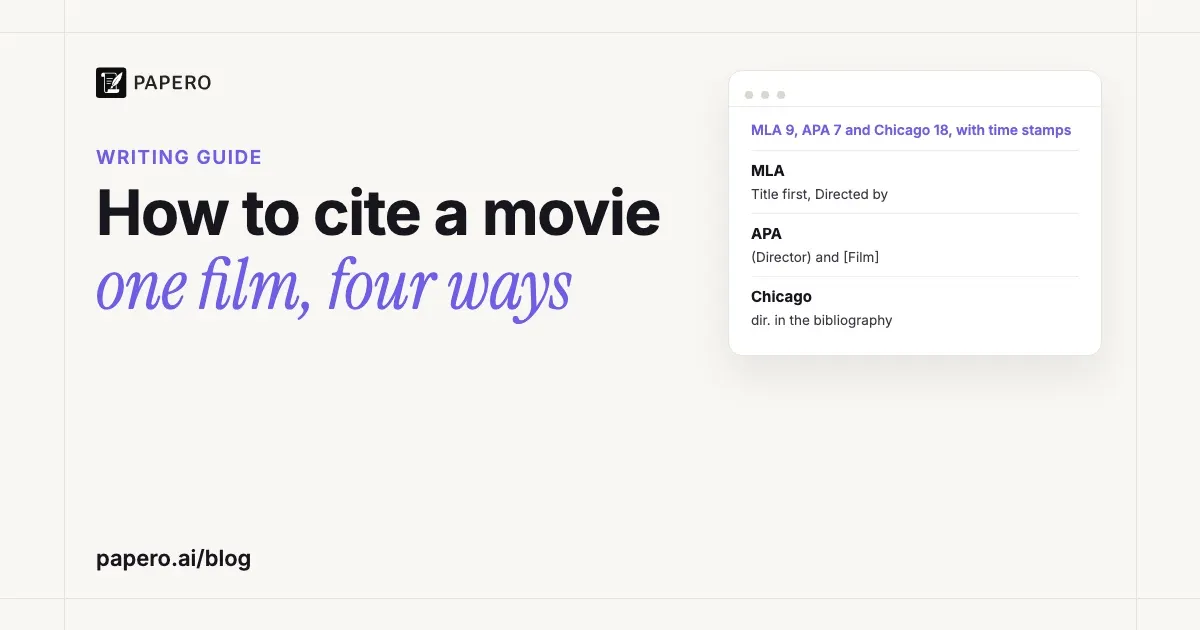
To cite a movie, take the title, director, company and release year from the film’s credits. MLA 9 starts with the title: Asteroid City. Directed by Wes Anderson, Focus Features / Indian Paintbrush, 2023. APA 7 starts with the director: Anderson, W. (Director). (2023). Asteroid City [Film]. Indian Paintbrush; American Empirical Pictures. To quote a line, add a time stamp, as in (Anderson, 2023, 1:22:13).
Key Takeaways
- MLA usually lists a film under its title and credits the director with “Directed by”. Start with the director’s name when your paper is about the director’s choices.
- APA always puts the director in the author slot with “(Director)”, adds [Film] after the italic title and ends with the production companies, separated by semicolons.
- Chicago notes write “directed by” after the title; the bibliography entry starts “Anderson, Wes, dir.”
- Quote dialogue with a time stamp in place of a page number: 1:22:13–18 in MLA, the start of the quotation in APA, “at 1:22:13–18” in Chicago.
- APA’s film examples name no streaming service. MLA lets you add one as a second container.
How to cite a movie in MLA, APA and Chicago
A film citation needs the title, the director, the company that made or released it and the year. MLA and Chicago notes put the title first; APA and the Chicago bibliography put the director first. One real film, Wes Anderson’s Asteroid City (2023), is cited below in each style, with the in-text form for a quotation.
| Style | List entry | In-text citation or note |
|---|---|---|
| MLA 9 | Asteroid City. Directed by Wes Anderson, Focus Features / Indian Paintbrush, 2023. | (Asteroid City 1:22:13–18), or the time stamp alone when your sentence names the film: (1:22:13–18) |
| APA 7 | Anderson, W. (Director). (2023). Asteroid City [Film]. Indian Paintbrush; American Empirical Pictures. | (Anderson, 2023) or, for a quotation, (Anderson, 2023, 1:22:13) |
| Chicago 18, notes-bibliography | Anderson, Wes, dir. Asteroid City. Focus Features, 2023. | 1. Asteroid City, directed by Wes Anderson (Focus Features, 2023). Later: 2. Anderson, Asteroid City, at 1:22:13–18. |
| Chicago 18, author-date | Anderson, Wes, dir. 2023. Asteroid City. Focus Features. | (Anderson 2023, at 1:22:13–18) |
The MLA entry is the MLA’s own, from a 2025 post on quoting film dialogue; we built the other three from each style’s rules. The company names come from the credits, which a library catalog record of the 2023 DVD transcribes as “Focus Features and Indian Paintbrush present an American Empirical picture”. MLA’s Publisher element can hold the distributor, the production company or both.
APA writes titles in sentence case, yet this one keeps both capitals: Asteroid City is the desert town where the story is set, and proper nouns stay capitalized.
How do you cite a movie in MLA?
MLA 9 lists most films under the title, in italics, followed by “Directed by” and the director’s name, the company and the year. If your paper is about the director’s choices, start with the director instead: Anderson, Wes, director. The in-text citation repeats whatever comes first in the entry: the title or the director’s surname.
An eighth-edition MLA answer explains the choice: films are collaborative works, so “how you cite them depends on the focus of your discussion.” The two forms side by side:
- By title: Asteroid City. Directed by Wes Anderson, Focus Features / Indian Paintbrush, 2023.
- By director: Anderson, Wes, director. Asteroid City. Focus Features / Indian Paintbrush, 2023.
In the text, the first form becomes (Asteroid City) or a sentence that names the film; the second becomes (Anderson), as MLA’s own example cites Point of No Return by its director: (Badham). Any contributor works the same way, the name “followed by a descriptive label” (an eighth-edition MLA answer on performances), so a paper on one actor could start Schwartzman, Jason, performer. Our guide to MLA in-text citation covers how the first word of an entry drives the parenthetical.
For a quotation, add a time stamp in hours, minutes and seconds. The MLA’s 2025 post says to “include a timestamp in your parenthetical citation if possible”, and its own example reads: to Augie’s remark that the alien looked at them “like we’re doomed,” Midge responds, “Maybe we are” (1:22:13–18). An eighth-edition MLA answer adds that timings help when you summarize a scene, too.
Longer exchanges are set off like dialogue from a play: each speaker’s name in capitals followed by a period, the block indented half an inch, and the time range after the last line. Our guide to block quotes in APA, MLA and Chicago shows the indentation rules for prose and verse.
How do you cite a movie in APA?
APA 7 puts the director in the author slot, followed by “(Director)”, then the year in parentheses, the title in italic sentence case, the label [Film] in square brackets and the production companies, separated by semicolons. The in-text citation is the director’s surname and the year: (Anderson, 2023), or Anderson (2023) in your sentence.
APA’s own example shows the pattern: Verrette, T. (Director). (2021). Zero gravity [Film]. Skylight Cinema; 20th Digital Studio. Its notes are short: “Provide the director in the author element of the reference” and “Provide the production company or companies in the source element of the reference.”
APA’s guidance on quotations without page numbers says to “provide a time stamp for the beginning of the quotation in place of a page number”, as in its TED Talk example (Cuddy, 2012, 2:12). For Asteroid City: Augie says the alien looked at them “like we’re doomed” (Anderson, 2023, 1:22:13). That time comes from the MLA’s example; check it in your own player, since a disc and a stream can run a few seconds apart.
Order the film in your reference list by the director’s surname, with a hanging indent like every other entry. Our guide to the APA reference page covers the alphabetizing and spacing rules.
How do you cite a movie in Chicago style?
Most 18th-edition library guides start a Chicago film footnote with the title, then “directed by”, the company and the year in parentheses (some start with the director and “dir.” instead). The bibliography entry starts with the director’s inverted name and “dir.”, then the italic title, the company and the year. Later notes shorten to the director’s surname and the title, with “at” before a time stamp.
Section 14.165 of The Chicago Manual of Style covers film and video. The manual is behind a paywall, so these forms follow library guides to the 18th edition. The University of Lethbridge’s guide starts a scene note with the scene’s title: “Crop Duster Attack,” North by Northwest, directed by Alfred Hitchcock. It adds that video recordings are “typically listed in a separate filmography” rather than in the bibliography (section 14.162), so ask whether your paper needs one. Texas Christian University’s handout gives the bibliography pattern: Penn, Arthur, dir. Little Big Man. National General Pictures, 1970.
The “at” before a time stamp comes from Chicago’s own sample citations, where a shortened note reads Cowan, “Green Hydrogen,” at 6:09–17, and the author-date version reads (Cowan 2022, at 6:09–17). Some library guides still print a city before the company, such as Burbank, CA: Warner Home Video. CMOS 18 no longer requires the place of publication for books, and our entries leave it out; our guide on how to cite a book shows that change in all three styles.
How do you cite a movie you watched on Netflix or another streaming service?
In APA, nothing changes: the reference describes the film, not the platform, and none of APA’s film examples names one. In MLA you may add the service as a second container, in italics, followed by the URL. In Chicago notes, Columbia College’s guide puts the service’s name at the end of the note and the bibliography entry.
MLA’s model for a streamed work ends with the platform as a second container:
“Manhattan Vigil.” Directed by Jean de Segonzac, performances by Christopher Meloni and Mariska Hargitay. Law and Order: Special Victims Unit, created by Dick Wolf, season 14, episode 5, Wolf Films, 24 Oct. 2012. Netflix, www.netflix.com.
The MLA has also said there is no need to mention an app that was only the platform you watched it through, so the second container stays optional. Both answers date from the eighth edition; the MLA’s current Citations by Format page uses the same two-container shape for a film on YouTube. Our guide to the MLA works cited page explains containers in full.
How do you cite a movie with two directors?
Name both directors. MLA writes “Directed by” once before both names; APA lists both surnames with initials, joined by “&”, and writes “(Directors)” once after them; Chicago writes “directed by” with both names in the note. In the text, APA gives both surnames and the year, as in (Kwan & Scheinert, 2022).
The example is Everything Everywhere All at Once, written and directed by Daniel Kwan and Daniel Scheinert, as A24’s page for the film credits them.
| Style | Entry |
|---|---|
| MLA 9 | Everything Everywhere All at Once. Directed by Daniel Kwan and Daniel Scheinert, A24, 2022. |
| APA 7 | Kwan, D., & Scheinert, D. (Directors). (2022). Everything everywhere all at once [Film]. A24; IAC Films; Gozie AGBO; Year of the Rat; Ley Line Entertainment. |
| Chicago 18 note | 1. Everything Everywhere All at Once, directed by Daniel Kwan and Daniel Scheinert (A24, 2022). |
The MLA entry is the MLA’s own, from its 2023 list of best picture nominees. The APA companies are the production team listed by the University of Wisconsin-Madison’s film catalog, less Lionsgate, which released the DVD. APA’s film page shows one director only, but its rule for several TV producers is a plural label once after all the names, “the same as you would the notation “(Eds.)” for an edited book”; we applied it to directors.
How do you cite a foreign-language film?
Use the original title as it appears on the film. APA adds an English translation in square brackets straight after the title, before [Film]. MLA keeps the original title in the works cited entry and gives the translation in parentheses after the original title in your prose.
APA’s own example is Tomas Alfredson’s Swedish film: Alfredson, T. (Director). (2008). Låt den rätte komma in [Let the right one in] [Film]. EFTI; Sveriges Television (SVT); Filmpool Nord; Sandrew Metronome; WAG; Fido Film; The Chimney Pot; Ljudligan. The translation is in sentence case and not italic, and every production company is listed.
In MLA prose the same film becomes Låt den rätte komma in (Let the Right One In). An eighth-edition MLA answer says the works cited entry should “list the title provided on the work itself”, so if the copy you watched shows only the English title, cite it under that title. A December 2025 MLA answer adds that a title you translate yourself needs no “my trans.” label.
How do you cite a TV episode?
Cite the episode, not the whole series, when you discuss one episode. APA names the writer and director with their roles, the air date, the episode title with season and episode numbers, [TV series episode], then “In” with the executive producers and the series title. MLA puts the episode title in quotation marks and the series title in italics as its container.
APA’s example: Favreau, J. (Writer), & Filoni, D. (Director). (2019, November 12). Chapter 1 (Season 1, Episode 1) [TV series episode]. In J. Favreau, D. Filoni, K. Kennedy, & C. Wilson (Executive Producers), The Mandalorian. Lucasfilm; Golem Creations. The in-text citation is (Favreau & Filoni, 2019).
MLA’s example, for an episode watched on disc: “Hush.” 1999. Buffy the Vampire Slayer: The Complete Fourth Season, created by Joss Whedon, episode 10, Mutant Enemy / Twentieth Century Fox, 2003, disc 3. DVD. Cite a streamed episode like the Law and Order entry above.
How do you cite a director’s commentary or DVD extra?
Cite the extra itself when you quote or discuss it. MLA adds the commentator after the film title with “Audio commentary by”, or starts with the commentator when the commentary is your focus. Chicago cites the extra by its own author and title, with the date of the extra, not the film’s.
MLA’s 2023 example: Star Wars: The Last Jedi. Audio commentary by Rian Johnson, directed by Johnson, Walt Disney Studios / Buena Vista Home Entertainment / Lucasfilm, 2018. With the focus on the commentary: Johnson, Rian, audio commentator. Star Wars: The Last Jedi. Directed by Johnson, Walt Disney Studios / Buena Vista Home Entertainment / Lucasfilm, 2018.
For a featurette, MLA’s eighth-edition example puts the feature’s title in quotation marks and the disc as its container: “NYC Press Conference.” Led Zeppelin, produced by Jimmy Page and Dick Carruthers, disc 2, Atlantic Recording / Warner Music Group, 2003. DVD. The University of Queensland’s guide to Chicago 18 says to cite commentary and special features “by that material itself”, by author and title, and give the date of the extra “rather than the original film date if these are different” (section 14.165).
Where Papero fits
Papero is an AI writing workspace for students and researchers. It formats references in nine styles, including APA 7, MLA 9 and Chicago author-date, from sources you find in OpenAlex, look up by DOI, PMID, arXiv ID or ISBN, or enter by hand. Its manual entry form offers five source types: journal article, book, chapter, web page and report. There is no type for a film or a TV episode, so write those entries yourself with the patterns above.
What Papero does handle is the rest of a film essay’s reference list: the books and journal articles you cite about the film. The essay writing page shows how an essay is planned, written and cited in Papero, and the glossary defines the works cited list and the in-text citation.
Frequently Asked Questions
Do you italicize a movie title?
Yes. APA, MLA and Chicago all italicize the title of a film in the reference entry and in your sentences. A TV episode title is different: APA writes it in plain type, while MLA and Chicago put it in quotation marks and italicize the series title. APA writes film titles in sentence case and MLA and Chicago in title case.
Who is the author of a movie in a citation?
In APA the director is always the author, followed by “(Director)”, or “(Directors)” for two or more. MLA usually starts with the film’s title and names the director after it with “Directed by”, but you may start with the director, an actor or another contributor when your paper focuses on that person’s work. Chicago’s bibliography usually starts with the director and “dir.”
Do you include Netflix or the streaming service in a movie citation?
Not in APA, whose film examples name no platform. In MLA it is optional: you may add the service in italics with its URL as a second container, or leave it out when it was only the way you watched the film. For Chicago, Columbia College’s guide adds the service’s name at the end of the note and the bibliography entry.
How do you cite a specific scene or quote from a movie?
Add a time stamp in hours, minutes and seconds where a book citation would have a page number. MLA gives the time range, such as (1:22:13–18). APA gives the time the quotation starts, such as (Anderson, 2023, 1:22:13). Chicago writes “at” before it in a shortened note or an author-date citation. Take the time from the copy you watched.
What year do you use when citing a movie?
Use the year the film was released, as shown in its credits or on the copy you watched. An eighth-edition MLA answer recommends taking basic facts such as the title, director and year from the version you watch rather than from a website. For an extra such as a director’s commentary, Chicago uses the date of the extra rather than the film’s original date when the two differ.
Sources
- MLA Style Center, “How do I quote dialogue in a film or TV show?” (May 7, 2025, accessed November 2026): https://style.mla.org/quote-dialogue-film-tv/
- MLA Style Center, “How do I create an in-text citation for a film?” (February 20, 2018, accessed November 2026): https://style.mla.org/in-text-citation-film/
- MLA Style Center, “Should a film be cited by its title or the director’s name?” (eighth edition, December 6, 2019): https://style.mla.org/cite-film-by-title-or-director/
- Susan Doose, “Celebrating the Oscars”, MLA Style Center (March 9, 2023, citing MLA Handbook 5.39, 5.44, 5.54 and 5.58): https://style.mla.org/celebrating-the-oscars/
- MLA Style Center, “How do I cite audio commentary for a movie or TV show?” (November 2, 2023): https://style.mla.org/citing-audio-commentary-tv-movie/
- MLA Style Center, “How do I cite a special feature from a DVD?” (eighth edition, March 1, 2018): https://style.mla.org/citing-dvd-special-features/
- MLA Style Center, “Can I cross-reference episodes from a television series?” (eighth edition, January 16, 2018): https://style.mla.org/citing-television-episodes/
- MLA Style Center, “Do I always need to indicate in my works-cited-list entry that a work I am citing was streamed through an app?” (eighth edition, September 26, 2018): https://style.mla.org/accessing-works-through-apps/
- MLA Style Center, “How should I refer in my prose to a film or TV show that has an original foreign language title and an international title?” (eighth edition, February 24, 2021): https://style.mla.org/international-title-film-tv-show/
- MLA Style Center, “When must I indicate that a translation is my own?” (December 31, 2025): https://style.mla.org/when-to-use-my-trans/
- MLA Style Center, “If I am discussing but not directly quoting scenes from a film, should I still include timings?” (eighth edition, June 11, 2020): https://style.mla.org/timings-for-film-scenes/
- MLA Style Center, “How do I cite a performance I watch in person?” (eighth edition, October 7, 2016): https://style.mla.org/citing-performances/
- MLA Style Center, “How do I cite information about a movie from a website like IMDb?” (eighth edition, January 29, 2018): https://style.mla.org/movie-information-online/
- MLA Style Center, “Citations by Format” (accessed November 2026): https://style.mla.org/works-cited/citations-by-format/
- American Psychological Association, “Film and television references” (apastyle.apa.org, last updated November 2023, read November 2026 through the Internet Archive): https://apastyle.apa.org/style-grammar-guidelines/references/examples/film-television-references
- American Psychological Association, “Quotations from material without page numbers” (apastyle.apa.org, read November 2026 through the Internet Archive): https://apastyle.apa.org/style-grammar-guidelines/citations/quotations/no-page-numbers
- American Psychological Association, “Sentence case” (apastyle.apa.org, last updated July 2022): https://apastyle.apa.org/style-grammar-guidelines/capitalization/sentence-case
- The Chicago Manual of Style Online, “Notes and Bibliography: Sample Citations” and “Author-Date: Sample Citations”, 18th edition (chicagomanualofstyle.org, read November 2026 through the Internet Archive): https://www.chicagomanualofstyle.org/tools_citationguide/citation-guide-1.html, https://www.chicagomanualofstyle.org/tools_citationguide/citation-guide-2.html
- CMOS Shop Talk, “Announcing The Chicago Manual of Style, 18th Edition” (April 16, 2024): https://cmosshoptalk.com/2024/04/16/announcing-the-chicago-manual-of-style-18th-edition/
- University of Lethbridge Library, “Audio/Video Recording”, Chicago Citation Style, 18th Edition (accessed November 2026): https://library.ulethbridge.ca/chicagostyle/avmedia/video
- University of Queensland Library, “Multimedia”, Chicago 18th edition notes and bibliography guide (accessed November 2026): https://guides.library.uq.edu.au/referencing/chicago-18th-edition-notes-and-bibliography/multimedia
- Texas Christian University, William L. Adams Center for Writing, “Common References in Chicago Style” (PDF, accessed November 2026): https://wrt.tcu.edu/wp-content/uploads/2026/06/Chicago-Style-18th-Edition-Common-References.pdf
- Columbia College, “Videos, Films, & TV Episodes”, Chicago Citation Guide (18th Edition) (accessed November 2026): https://columbiacollege-ca.libguides.com/chicago/videos
- University of Portland, “Videos & DVDs”, Chicago Style (18th Edition) Citation Guide (accessed November 2026): https://libguides.up.edu/chicago/videos
- Asteroid City, DVD catalog record (credits, publisher and release note; OCLC 1388675641), Deschutes Public Library (accessed November 2026): https://link.deschuteslibrary.org/resource/ZhYnLTAk9Bk
- Festival de Cannes, Asteroid City, 2023 Competition film page (director and production company): https://www.festival-cannes.com/en/f/asteroid-city/
- Everything Everywhere All at Once, Dorothy film database, University of Wisconsin-Madison (production team; accessed November 2026): https://dorothy.library.wisc.edu/catalog/DOR1840
- A24, Everything Everywhere All at Once film page (directors; accessed November 2026): https://a24films.com/films/everything-everywhere-all-at-once
- Apple TV, Asteroid City film page (synopsis naming the town; accessed November 2026): https://tv.apple.com/us/movie/umc.cmc.7dsoed1ht1lpwfcp4wu90fmyj