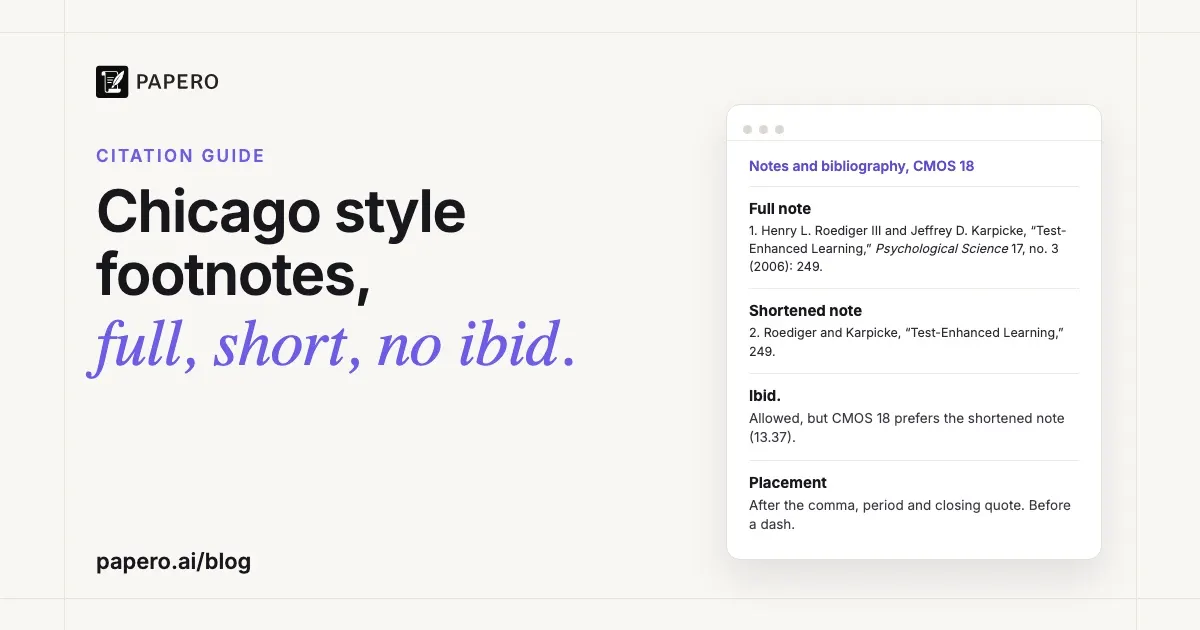
Chicago style footnotes put each citation at the bottom of the page, linked to the text by a superscript number. The first note for a source gives the author, title, publication details and page; later notes use a shortened form of author, short title and page. The 18th edition of The Chicago Manual of Style (2024) prefers that shortened form to “ibid.”
Key Takeaways
- A full note reads like a sentence: Author First Last, Title (Publisher, Year), page. The bibliography entry inverts the first author’s name and uses periods instead of commas and parentheses.
- After the first citation, use a shortened note: surname, a title of up to four words, page. CMOS 18 recommends this over “ibid.” because ibid. saves no space and can hide which source you mean.
- The note number goes after the punctuation and after a closing quotation mark, at the end of the clause or sentence. The one exception is a dash, which the number goes before.
- Use one note number per place. To cite two sources at once, put both in one note, separated by a semicolon.
Chicago footnote format by source type
The table shows the three forms of a citation for the source types students use most, built from the patterns in Chicago’s own sample citations (chicagomanualofstyle.org, 18th edition, read October 2026). The sources are real: Darwin’s Origin of Species (1859), a 2006 article in Psychological Science, and Chicago’s sample citations page itself.
| Source | Full note (first citation) | Shortened note | Bibliography entry |
|---|---|---|---|
| Book | 1. Charles Darwin, On the Origin of Species by Means of Natural Selection, or the Preservation of Favoured Races in the Struggle for Life (John Murray, 1859), 490. | 2. Darwin, Origin of Species, 490. | Darwin, Charles. On the Origin of Species by Means of Natural Selection, or the Preservation of Favoured Races in the Struggle for Life. John Murray, 1859. |
| Journal article | 1. Henry L. Roediger III and Jeffrey D. Karpicke, “Test-Enhanced Learning: Taking Memory Tests Improves Long-Term Retention,” Psychological Science 17, no. 3 (2006): 249, https://doi.org/10.1111/j.1467-9280.2006.01693.x. | 2. Roediger and Karpicke, “Test-Enhanced Learning,” 249. | Roediger, Henry L., III, and Jeffrey D. Karpicke. “Test-Enhanced Learning: Taking Memory Tests Improves Long-Term Retention.” Psychological Science 17, no. 3 (2006): 249–55. https://doi.org/10.1111/j.1467-9280.2006.01693.x. |
| Web page | 1. “Notes and Bibliography: Sample Citations,” The Chicago Manual of Style Online, University of Chicago Press, accessed October 19, 2026, https://www.chicagomanualofstyle.org/tools_citationguide/citation-guide-1.html. | 2. “Notes and Bibliography.” | University of Chicago Press. “Notes and Bibliography: Sample Citations.” The Chicago Manual of Style Online. Accessed October 19, 2026. https://www.chicagomanualofstyle.org/tools_citationguide/citation-guide-1.html. |
Three patterns hold across every row. The note uses commas and puts publication facts in parentheses, while the bibliography uses periods and drops the parentheses. The note cites the page you used, the bibliography the article’s full page range. And the bibliography inverts only the first author’s name.
Chicago footnote example in an essay
Here is a short essay paragraph with its footnotes, the way they would appear at the bottom of the page. The quotation and the claims come from the abstracts of the three articles cited, which sit on each article’s first page.
Students who test themselves remember more than students who reread, but only after a delay. In two experiments, restudying won on a test five minutes later, yet on the delayed tests “prior testing produced substantially greater retention than studying.”¹ Restudying also left students more confident that they would remember, which may explain why they keep choosing it.² The benefit is not limited to university students: in three experiments with children whose mean age was 10, the benefit held whatever their reading comprehension or processing speed.³ It may shrink, though, when the material has many parts that must be understood together.⁴
- Henry L. Roediger III and Jeffrey D. Karpicke, “Test-Enhanced Learning: Taking Memory Tests Improves Long-Term Retention,” Psychological Science 17, no. 3 (2006): 249, https://doi.org/10.1111/j.1467-9280.2006.01693.x.
- Roediger and Karpicke, “Test-Enhanced Learning,” 249.
- Jeffrey D. Karpicke et al., “Retrieval-Based Learning: Positive Effects of Retrieval Practice in Elementary School Children,” Frontiers in Psychology 7 (2016): 350, https://doi.org/10.3389/fpsyg.2016.00350.
- Tamara van Gog and John Sweller, “Not New, but Nearly Forgotten: The Testing Effect Decreases or Even Disappears as the Complexity of Learning Materials Increases,” Educational Psychology Review 27, no. 2 (2015): 247, https://doi.org/10.1007/s10648-015-9310-x.
Four details in that example are worth copying:
- Note 1 sits after the closing quotation mark and the period. That is where CMOS 13.29 puts it.
- Note 2 is a shortened note, not “Ibid.” Many students would write “Ibid.” here. Chicago prefers the shortened form, which is just as short and still names the source.
- Note 3 names only the first author. The article has three authors (Karpicke, Blunt and Smith). Chicago’s sample citations list only the first author in a note for three or more authors, followed by “et al.”, and list up to six in the bibliography.
- Note 3 gives an article number. Frontiers in Psychology articles carry an article number (350) in place of a journal page range. To point to a passage, add the page of the PDF before it, as Chicago’s own samples do for a PLOS ONE article: 7 (2016): 2, 350.
The blog shows the note numbers as superscripts in the text and as plain numbers in the notes. That matches Chicago: the in-text number is superscript, and the note itself begins with a full-size number followed by a period, according to Purdue OWL’s guide to the 18th edition.
Where does the footnote number go?
At the end of the clause or sentence that uses the source, after the punctuation mark. CMOS 13.29 says a note number “follows any punctuation mark except for the dash, which it precedes”, and that it normally follows a quotation, whether the quotation runs into the text or is set as a block. The number never goes inside the quotation marks.
| Situation | Correct | Wrong |
|---|---|---|
| End of a sentence | than studying.¹ | than studying¹. |
| After a comma | Restudying felt easier,¹ but | Restudying felt easier¹, but |
| After a quotation | retention than studying.”¹ | retention than studying¹.” |
| Before a dash | The number, then the dash | The dash, then the number |
| Two sources in one place | after a delay.¹ (both sources in note 1) | after a delay.¹ ² |
The last row is the “double footnote” question. A Chicago Q&A (18th edition) says that some styles allow more than one note reference at a time, but in Chicago style you should use only one, and cite several sources in that one note, separated by semicolons (CMOS 13.31).
Should you still use ibid. in Chicago style?
You can, but Chicago advises against it, and the advice is not new: Purdue OWL notes that CMOS recommends shortened citations for repeated references “as in earlier editions”. The 18th edition says that because ibid. “can obscure the identity of a source, Chicago recommends instead using shortened citations”, and adds that a shortened citation usually takes up less than a line, so ibid. saves no space (CMOS 13.37, as quoted by Douglas College Library). Purdue OWL’s guide to the 18th edition confirms that ibid. is “still discouraged by CMOS 18” but acceptable.
If your instructor asks for ibid., it refers only to the source in the note immediately before:
| Shortened notes (CMOS 18 preference) | With ibid. |
|---|---|
| 1. Roediger and Karpicke, “Test-Enhanced Learning,” 249. | 1. Roediger and Karpicke, “Test-Enhanced Learning,” 249. |
| 2. Roediger and Karpicke, “Test-Enhanced Learning,” 249. | 2. Ibid. |
| 3. Roediger and Karpicke, “Test-Enhanced Learning,” 252. | 3. Ibid., 252. |
| 4. Darwin, Origin of Species, 490. | 4. Darwin, Origin of Species, 490. |
The page numbers in notes 1 to 3 illustrate the pattern only. “Ibid.” alone means the same source and the same page; “Ibid., 252” means the same source at a new page. Because it points only to the note immediately before, a note after a different source has to name its source again, as note 4 does in both columns. APA and MLA have no use for ibid.: they cite in the text with author and page, so a repeated citation repeats the parenthesis. The glossary entry on ibid has the short definition.
Do you need a full note if you have a bibliography?
Not always. Purdue OWL’s reading of CMOS 18 is that in a paper with a bibliography, even the first note for a source can be shortened, because the bibliography holds the full details. Without a bibliography, the first note for each source must be full.
In practice, most coursework expects both a full first note and a bibliography, and that is the safer default unless your brief says otherwise. The bibliography is alphabetical by surname, with a hanging indent: the first line flush left and later lines indented 0.5 inch. Our guide to the hanging indent in Google Docs and Word shows how to set it without pressing Tab on every line.
How do you insert a footnote in Word or Google Docs?
Put the cursor right after the punctuation mark where the note belongs and insert a footnote; the program places the superscript number and opens the note at the bottom of the page. In Word, use References, then Insert Footnote, or press Ctrl+Alt+F on Windows and Cmd+Option+F on a Mac. In Google Docs, use Insert, then Footnote, or press Ctrl+Alt+F.
Both programs renumber notes automatically when you add or delete one, so never type note numbers by hand. Chicago allows footnotes or endnotes, as long as you use one consistently: footnotes appear at the bottom of each page, endnotes at the end of a chapter or of the whole paper. The glossary entries on the footnote and the endnote cover the difference.
Footnotes or author-date: which Chicago system?
Chicago has two systems. Notes and bibliography, the subject of this guide, is often used in the humanities, according to Purdue OWL. Author-date puts a short citation in parentheses in the text instead, as in (Roediger and Karpicke 2006, 249). Your brief or department decides which one you use; the two should not be mixed in one paper.
The block quotation rules differ slightly between the two as well. Our guide to block quotes in APA, MLA and Chicago shows the same long quotation from Darwin cited both ways. If your assignment is in APA instead, the rules for APA in-text citations replace footnotes entirely.
Where Papero fits
Papero is an AI writing workspace for students and researchers, and you can sign up free. According to the Papero homepage, it formats citations in APA 7, MLA 9, Chicago author-date, Harvard and IEEE, finds real papers to cite as you write, and exports to Word.
Papero does not support Chicago notes and bibliography. If your brief asks for footnotes, write them with your word processor’s footnote tool as shown above. If it accepts Chicago author-date, Papero can insert the in-text citations and build the reference list for you; on the free plan the list shows your entries blurred and is left out of exports, and Plus makes it readable (papero.ai/pricing). The glossary entry on Chicago style summarizes both systems.
Frequently Asked Questions
Does a footnote go before or after a comma?
After. In Chicago style the note number follows any punctuation mark, including a comma, a semicolon and a period, except a dash, which the number goes before (CMOS 13.29). Place it at the end of the clause that uses the source, not in the middle of a phrase.
Does the footnote go inside or outside the quotation marks?
Outside. The number follows the closing quotation mark and any punctuation that comes with it, as in the essay example above, where note 1 comes after the quotation, its period and the closing mark. It also follows a block quotation, placed after the block’s final punctuation.
What is a shortened footnote in Chicago style?
A short form used after the first citation of a source: the author’s surname, the main title shortened to four words or fewer if it is longer, and the page. For example: Roediger and Karpicke, “Test-Enhanced Learning,” 249. CMOS 13.33 describes this as the most common short form.
Do footnotes count toward the word count?
It depends on the brief. Word limits come from your assignment, not from the citation style, and departments differ on whether notes count, so check the guidelines or ask your instructor.
Can I use footnotes in APA or MLA?
Only for comments, not for citations. APA and MLA cite sources in the text, in parentheses. Both allow occasional content notes for extra explanation, but a source cited in a note must still appear in the reference list or works-cited list.
Sources
- The Chicago Manual of Style Online, “Notes and Bibliography: Sample Citations”, 18th edition (chicagomanualofstyle.org, accessed October 2026): https://www.chicagomanualofstyle.org/tools_citationguide/citation-guide-1.html
- The Chicago Manual of Style Online, Q&A on note number placement, citing CMOS 13.29, 18th edition (chicagomanualofstyle.org, accessed October 2026): https://www.chicagomanualofstyle.org/qanda/data/faq/topics/Punctuation/faq0020.html
- The Chicago Manual of Style Online, Q&A on citing several sources in one note, citing CMOS 13.31, 18th edition (chicagomanualofstyle.org, accessed October 2026): https://www.chicagomanualofstyle.org/qanda/data/faq/topics/Documentation/faq0425.html
- Douglas College Library, “Shortened Citations / Ibid.”, Chicago (18th ed.) Citation Style Guide, quoting CMOS 13.32, 13.33 and 13.37 (guides.douglascollege.ca, accessed October 2026): https://guides.douglascollege.ca/Chicago18/ShortenedCitations
- Purdue OWL, “Chicago Manual of Style 18th Edition”, notes and bibliography overview (owl.purdue.edu, accessed October 2026): https://owl.purdue.edu/owl/research_and_citation/chicago_manual_18th_edition/cmos_formatting_and_style_guide/chicago_manual_of_style_18th_edition.html
- Microsoft Support, “Keyboard shortcuts in Word” (support.microsoft.com, accessed October 2026): https://support.microsoft.com/en-us/office/keyboard-shortcuts-in-word-95ef89dd-7142-4b50-afb2-f762f663ceb2
- Google Docs Editors Help, “Keyboard shortcuts for Google Docs” (support.google.com, accessed October 2026): https://support.google.com/docs/answer/179738?hl=en
- Darwin, C. (1859). On the origin of species by means of natural selection, or the preservation of favoured races in the struggle for life. John Murray. First-edition facsimile on Wikisource: https://en.wikisource.org/wiki/On_the_Origin_of_Species_(1859)/Chapter_XIV
- Roediger, H. L., III, & Karpicke, J. D. (2006). Test-enhanced learning: Taking memory tests improves long-term retention. Psychological Science, 17(3), 249–255. https://doi.org/10.1111/j.1467-9280.2006.01693.x
- Karpicke, J. D., Blunt, J. R., & Smith, M. A. (2016). Retrieval-based learning: Positive effects of retrieval practice in elementary school children. Frontiers in Psychology, 7, Article 350. https://doi.org/10.3389/fpsyg.2016.00350
- van Gog, T., & Sweller, J. (2015). Not new, but nearly forgotten: The testing effect decreases or even disappears as the complexity of learning materials increases. Educational Psychology Review, 27(2), 247–264. https://doi.org/10.1007/s10648-015-9310-x