A signal phrase introduces a quotation, paraphrase or summary by naming its source, usually the author plus a verb: “Roediger and Karpicke found that”, “As Dunlosky and others note”. It tells the reader where your words stop and the source’s begin. The verb you choose also tells the reader what the source is doing: reporting, arguing, conceding or disputing.
Key Takeaways
- A signal phrase = the source’s name + a verb chosen for what the source actually does, placed before, inside or after the borrowed material.
- APA uses the past tense or present perfect (“found”, “has shown”), with the year after the name. MLA and Chicago use the present tense (“argues”), even for old works.
- Name the author in the signal phrase or in the parentheses, never both.
- Every quotation needs a signal phrase or a lead-in sentence. A quotation standing alone as its own sentence, with nothing introducing it, is the first mistake to check for.
Signal phrases: examples by what the source does
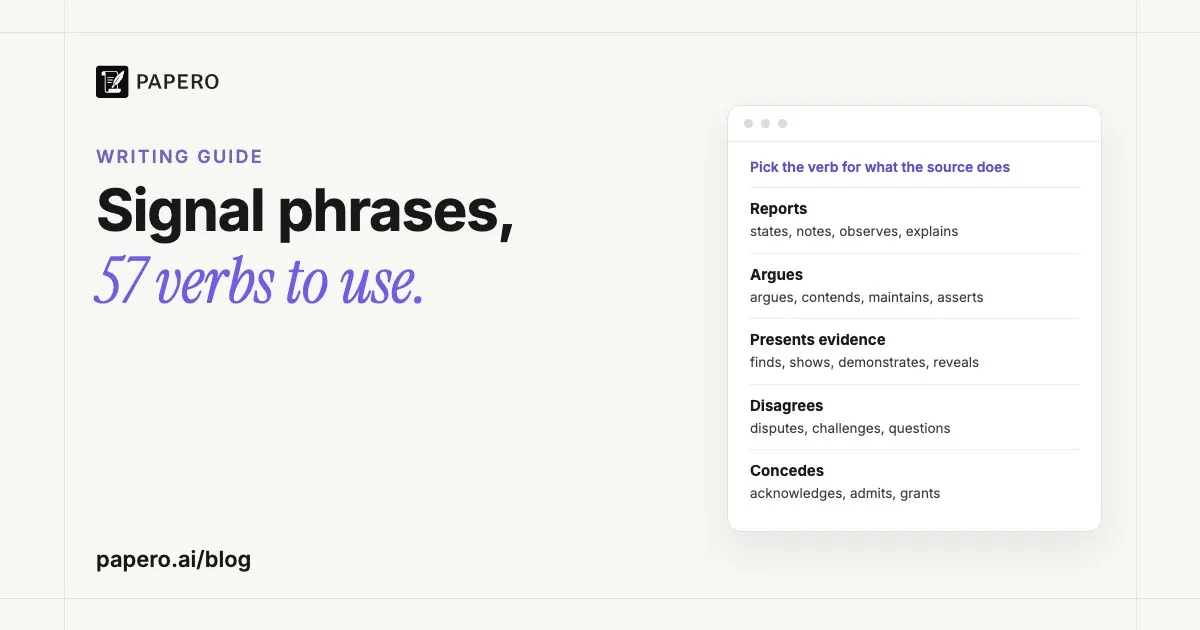
Here are 57 signal verbs grouped by meaning. Neutral verbs report; the others add a judgment about the source, so pick them only when the judgment is accurate. All are shown in the present tense; for APA, use the past tense or present perfect form.
| What the source does | Signal verbs |
|---|---|
| Reports neutrally | says, states, writes, reports, notes, observes, describes, explains, points out, comments, adds, remarks |
| Argues or claims | argues, claims, contends, maintains, asserts, insists, proposes, reasons, holds, posits |
| Presents evidence | finds, shows, demonstrates, reveals, establishes, documents, indicates, illustrates |
| Agrees with others | agrees, concurs, supports, confirms, echoes, endorses, corroborates |
| Disagrees | disputes, challenges, rejects, questions, refutes, denies, criticizes, objects |
| Suggests or predicts | suggests, implies, speculates, hypothesizes, predicts, estimates, cautions |
| Concedes a point | acknowledges, admits, concedes, grants, recognizes |
Two verbs need care. “Claims” can hint that you doubt the source, so use it when you mean that. “Refutes” means the author proved something wrong, not merely disagreed; when you are not sure, “disputes” or “challenges” is safer. The UNC Writing Center notes that different disciplines prefer different reporting verbs, and advises checking a dictionary for any verb you are unsure of.
A signal phrase does not have to be a name followed by a verb. These openers work too:
- According to Dunlosky et al. (2013), …
- In Kornell and Bjork’s study, …
- As Roediger and Karpicke put it, “…”
- In the words of the authors, “…”
- A 2008 study by Cepeda and colleagues found that …
What tense do you use for signal phrases?
It depends on the style. APA expects the past tense or present perfect when you refer to other researchers’ work: “Roediger and Karpicke (2006) found”, “researchers have shown”. MLA and Chicago expect the present tense, even for a work written long ago: “Darwin argues”. Whichever style you use, keep the tense consistent within a paragraph.
| Style | Tense | Example |
|---|---|---|
| APA | Past or present perfect | Cepeda et al. (2008) found that the best gap grew with the test delay. |
| MLA | Present | Kornell and Bjork report that participants rated massed study as more effective. |
| Chicago | Present | Ebbinghaus describes his experiments with nonsense syllables. |
The MLA Style Center explains the reasoning: a work exists in the present, so you discuss what it says in the present tense. It makes one exception. When your point is historical, about when or how a work was made or received, use the past: “Ebbinghaus published his memory experiments in 1885.”
APA allows a tense shift for a reason, too. Massey University’s summary of the styles notes that a change of tense can signal whether a finding is still relevant or out of date.
How do you punctuate a signal phrase?
Use a comma after the verb when the quotation follows directly, and no comma when “that” links them. Use a colon when a complete sentence introduces the quotation. If the signal phrase interrupts the quotation, set it off with commas on both sides. In every case, the citation goes after the closing quotation mark. The examples below are in APA style.
| Pattern | Example |
|---|---|
| Verb + comma | Kornell and Bjork (2008) reported, “Participants rated massing as more effective than spacing” (p. 585). |
| Verb + that, no comma | Roediger and Karpicke (2006) found that restudying “increased students’ confidence in their ability to remember the material” (p. 249). |
| Full sentence + colon | Roediger and Karpicke (2006) found that restudying had a side effect: it “increased students’ confidence in their ability to remember the material” (p. 249). |
| Interrupting | “Participants rated massing as more effective than spacing,” Kornell and Bjork (2008) reported, “even after their own test performance had demonstrated the opposite” (p. 585). |
The “that” pattern blends the quotation into your own sentence, so the quoted words have to fit your grammar. The UNC Writing Center lists all four patterns; it also notes that a colon announces that the quotation is the evidence for the sentence before it.
Signal phrases in APA vs MLA
Both styles let the signal phrase carry the author’s name, so the parentheses carry less. In APA the year goes right after the name and the page after the quotation. In MLA only the page goes in parentheses, at the end. The rest follows from those two rules.
| APA 7 | MLA 9 | |
|---|---|---|
| Quotation | Roediger and Karpicke (2006) found that restudying “increased students’ confidence in their ability to remember the material” (p. 249). | Roediger and Karpicke find that restudying “increased students’ confidence in their ability to remember the material” (249). |
| Paraphrase | Cepeda et al. (2008) found that the best review gap shrank, as a share of the delay, the longer the delay. | Cepeda and others show that the best review gap shrinks, as a share of the delay, the longer the delay (1095). |
| Three or more authors | Dunlosky et al. (2013) | Dunlosky and others |
| No page numbers | For a quotation, use a paragraph or section number | No parenthetical citation at all |
Two rows trip people up. For three or more authors, APA uses “et al.” in your sentence, but an MLA Style Center answer reserves “et al.” for parentheses and the works cited list and asks for “and others” in your prose. And in MLA, when the author is already named and the source has no page numbers, the citation is complete without parentheses. Both MLA answers were written for the eighth edition and remain the usual practice. Our guides to APA in-text citation, MLA in-text citation and the MLA works cited page have the full rules for each style.
Where does a signal phrase go?
At the start of the sentence is the default, and the clearest. Putting it in the middle or at the end changes the emphasis: the reader meets the finding first and its source second. Varying the position across a paragraph also keeps every sentence from opening “X argues that”.
- Start: Kornell and Bjork (2008) found that participants rated massed study as more effective, even when spacing worked better.
- Middle: Participants rated massed study as more effective, Kornell and Bjork (2008) found, even when spacing worked better.
- End: Participants rated massed study as more effective, even when spacing worked better, as Kornell and Bjork (2008) found.
A signal phrase is also how you show where a paraphrase ends. Without one, a reader cannot tell whether the sentence after a cited sentence is the source’s idea or yours. When two or three sentences in a row come from one source, name it in the first and use “the authors” or “the study” in the next, so the reader keeps track. This is the same move that turns a literature review from a list of summaries into a synthesis. In a rhetorical analysis essay, where most sentences quote one text, short signal phrases such as “Lincoln repeats” keep the quotations from piling up. A signal phrase introduces a paraphrase as well as a quotation: our paraphrasing examples rewrite eight real passages and cite each one.
Common signal phrase mistakes
The five mistakes that writing guides such as the UNC Writing Center and the MLA Style Center warn about most often are a quotation with no introduction, the author named twice, a tense that drifts within a paragraph, a verb that misstates what the source did, and a quotation left without comment. Each has a one-line fix.
- The dropped quotation. A quotation sitting alone as its own sentence, with nothing introducing it. The UNC Writing Center’s test: read the paragraph aloud and check whether a listener could tell where the quotation starts. Fix: add a signal phrase or a colon lead-in.
- The double name. “According to Kornell and Bjork, … (Kornell and Bjork 585).” The MLA Style Center marks this as incorrect. Fix: give the name once, in the sentence or in the parentheses.
- The tense shift. “Roediger and Karpicke found … while Dunlosky et al. argue …” in the same APA paragraph. Fix: match the style’s tense throughout.
- The loaded verb. “Smith admits that” when Smith admitted nothing. Fix: use a neutral verb unless the judgment is fair.
- The quotation with no comment. The UNC Writing Center reminds writers to explain why a quotation matters once it is in. Fix: follow it with a sentence of your own that connects it to your point.
Long quotations are introduced the same way, but they then go in a block quotation without quotation marks; our guide to block quotes in APA, MLA and Chicago shows the format. What to write after a quotation, short or long, is covered in our guide to the quote sandwich.
Where Papero fits
Papero is an AI writing workspace for students and researchers. It finds real papers for the sentence you are writing, looks sources up by DOI, and inserts in-text citations in APA 7, MLA 9 or seven other styles, including several sources in one citation.
Choosing the signal verb stays your job, because it is a judgment about what the source does, and only someone who has read the source can make it. The find sources page walks through the citation side, from a claim to its citation, and you can sign up free. The glossary entries on the signal phrase and the in-text citation have the short definitions.
Frequently Asked Questions
What is an example of a signal phrase?
“Roediger and Karpicke (2006) found that” is a signal phrase: the authors’ names, the year in APA style, and a verb that says what the source did. It introduces the quoted or paraphrased material that follows. Openers such as “According to Dunlosky et al. (2013)” and “As the authors put it” are signal phrases too.
Do you need a citation if you use a signal phrase?
Usually yes. In APA, the signal phrase carries the name and year, and a quotation still needs its page number in parentheses. In MLA, the signal phrase carries the name and the page goes in parentheses at the end. The one exception is MLA with a source that has no page numbers: naming the author in the sentence completes the citation.
What tense should signal phrases be in for MLA?
The present tense: “Kornell and Bjork report”, “Ebbinghaus describes”. MLA treats a work as existing in the present, however old it is. Use the past tense only for historical facts about a work, such as when it was published or how it was first received.
Can you start a sentence with “according to”?
Yes. “According to Dunlosky et al. (2013), …” is a standard signal phrase in APA; in MLA, write “According to Dunlosky and others, …” with no year. Do not repeat the author’s name in parentheses afterwards. If several sentences in a row use “according to”, vary them with a verb such as “reports” or “argues” so the paragraph does not read like a list.
Is “says” a good signal verb?
It is acceptable, but it tells the reader nothing about what the source is doing. Prefer a verb that does, such as “argues” for a claim, “finds” for a result or “concedes” for a point the author grants. Use “says” or “states” when the source really is just stating a fact.
Sources
- The Writing Center, University of North Carolina at Chapel Hill, “Quotations” (writingcenter.unc.edu, accessed October 2026): https://writingcenter.unc.edu/tips-and-tools/quotations/
- Massey University OWLL, “Subject-verb agreement and verb tenses” (verb tenses in APA, Chicago and MLA) (owll.massey.ac.nz, accessed October 2026): https://owll.massey.ac.nz/academic-writing/verb-tense.php
- Erika Suffern, “Using the Present Tense with Works; or, Othello Still Exists” (style.mla.org, accessed October 2026): https://style.mla.org/literary-present-tense/
- Modern Language Association, “In-Text Citations: An Overview” (style.mla.org, accessed October 2026): https://style.mla.org/in-text-citations-overview/
- MLA Style Center, “What should I include in parentheses if the author’s name is provided in a signal phrase and the source has no page numbers?” (eighth-edition answer) (style.mla.org, accessed October 2026): https://style.mla.org/citing-unpaginated-works/
- MLA Style Center, “When a work by three or more authors is mentioned in the text of a research paper…should the names of all the authors be included?” (eighth-edition answer) (style.mla.org, accessed October 2026): https://style.mla.org/when-a-work-by-three-or-more-authors-is-mentioned-in-the-text-of-a-research-paper-rather-than-in-a-parenthetical-citation-should-the-names-of-all-the-authors-be-included-or-only-the-first-one-foll/
- Cepeda, N. J., Vul, E., Rohrer, D., Wixted, J. T., & Pashler, H. (2008). Spacing effects in learning: A temporal ridgeline of optimal retention. Psychological Science, 19(11), 1095–1102. https://doi.org/10.1111/j.1467-9280.2008.02209.x
- Dunlosky, J., Rawson, K. A., Marsh, E. J., Nathan, M. J., & Willingham, D. T. (2013). Improving students’ learning with effective learning techniques: Promising directions from cognitive and educational psychology. Psychological Science in the Public Interest, 14(1), 4–58. https://doi.org/10.1177/1529100612453266
- Ebbinghaus, H. (1913). Memory: A contribution to experimental psychology (H. A. Ruger & C. E. Bussenius, Trans.). Teachers College, Columbia University. (Original work published 1885); scan on the Internet Archive: https://archive.org/details/memorycontributi00ebbiuoft
- Kornell, N., & Bjork, R. A. (2008). Learning concepts and categories: Is spacing the “enemy of induction”? Psychological Science, 19(6), 585–592. https://doi.org/10.1111/j.1467-9280.2008.02127.x
- Roediger, H. L., III, & Karpicke, J. D. (2006). Test-enhanced learning: Taking memory tests improves long-term retention. Psychological Science, 17(3), 249–255. https://doi.org/10.1111/j.1467-9280.2006.01693.x