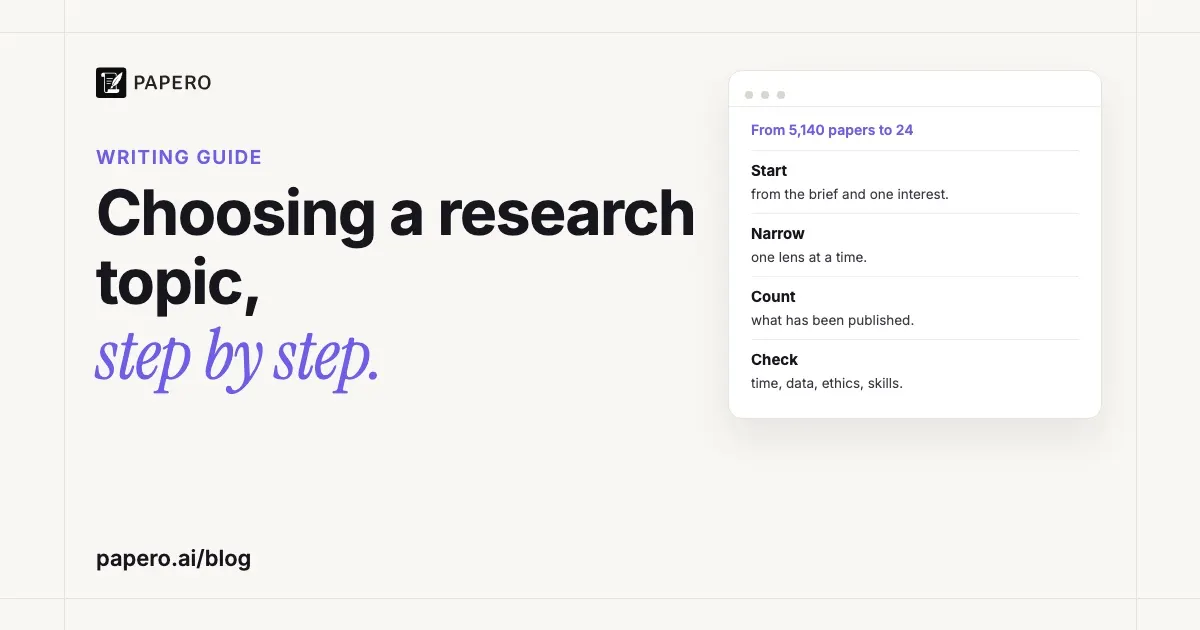
Here is how to choose a research topic: start from your assignment and one subject that interests you, read enough background to see what is already known, then narrow it by population, place, time or method until the published work on it is small enough to read and large enough to build on. Check that you have the time, data and skills to study it, and turn it into one working question. Below are the six steps, a worked example with real search counts, and what changes for a thesis.
Key Takeaways
- Narrow by one lens at a time (population, place, time, method, aspect) and check after each step how much has been published.
- The future research and limitations paragraphs of recent papers are the best source of topics: the authors say what is missing.
- A count of matching papers is a rough signal of size. Thousands means too broad; zero means try other words before you call it a gap.
- For a thesis, supervisor fit, the originality your degree expects and access to data over months matter as much as interest.
What makes a good research topic?
A good research topic fits the assignment, interests you enough to carry you through weeks of reading, and is narrow enough to cover properly in the space you have. It has enough published work to build on but leaves something open, and you have the time, data and skills to study it. Most weak topics fail on size or on feasibility, rarely on interest.
Spartanburg Community College’s library guide notes that “it is common and normal if your research topic changes as you start brainstorming and doing some background research on your topic.” The University of Southampton adds a test: is the topic “of academic significance, and not trivial”?
USC Libraries draws the line this guide follows: “a research topic is something to be understood; a research problem is something to be investigated.” Choosing a topic ends where a research question begins; our research question examples cover the wording and the FINER test.
How do you choose a research topic, step by step?
Work through six steps: start from the assignment and an interest, read background, narrow by one lens at a time, count what has been published, check feasibility, and write a working question to test on your instructor or supervisor. Expect to loop back. Any step can show that the topic is still too broad, and narrowing again in week two costs far less than finding the problem in week eight.
| Step | What you do | What you end with |
|---|---|---|
| 1. Start from the brief | List two or three interests that fit the assignment | A broad subject |
| 2. Read background | Course readings, one recent review | The main debates and terms |
| 3. Narrow | Restrict by population, place, time, method or aspect | A one-line topic |
| 4. Count | Note how many works match in a database | The topic’s size |
| 5. Check feasibility | Time, data, ethics, skills, sources, supervision | A topic you will finish |
| 6. Write a working question | Name a population and a measure or focus | A question to test |
Step 3 does most of the work. USC’s guide to narrowing a topic lists seven lenses (aspect, components, methodology, place, relationship, time and type, the last covering a class of people such as a population) and suggests applying one, then checking that the literature on the narrower version is “not too much, not too little”. Combining several at once, it warns, can leave too little research or data to support the study.
Where do good research topic ideas come from?
The richest source is the end of recent papers in your area: authors use their limitations and future research paragraphs to say what their study could not answer. Recent review articles do the same for a whole field. Course readings, a dataset you have access to, a problem from work or a placement, and findings that disagree with each other are the other dependable starting points.
Knowing how to find a research topic is mostly knowing where to read. USC’s guide says it directly: “Scholars often conclude their studies by noting implications for further research.” Here is one such sentence, from a 2019 study of sleep and grades in one introductory chemistry class at MIT (Okano et al., npj Science of Learning, CC BY 4.0):
Third, these findings occurred for a particular student population at MIT enrolled in a particular course, and future studies will need to examine the generalizability of these findings to other types of student populations and other kinds of classes.
It names two open directions: other students and other courses. Our guide to the limitations of a study shows how authors write these paragraphs, which helps you read them. A recent review usually ends with gaps of the kinds listed in the glossary entry on the research gap, and a fast-growing area, a research trend, often has questions nobody has answered yet. USC also lists personal experience, provided the findings would apply to others, and talking to practitioners.
A worked example: from an interest to a research question
This example is ours, built on the Okano sentence above. For each version of the topic we searched OpenAlex, a free and open index of scholarly works, and recorded how many works mention the terms in their title or abstract. Counts were measured on 31 October 2026 with the search.title_and_abstract parameter; the last column counts works published from 2021.
| Stage | Topic | Query | Works | Since 2021 |
|---|---|---|---|---|
| Interest | Sleep and how students do at university | None yet | ||
| Broad topic | Sleep and academic performance | sleep "academic performance" | 5,140 | 3,577 |
| Narrower | Sleep and academic performance in university students | sleep "academic performance" "university students" | 827 | 658 |
| Narrower still | The same, among commuters | sleep "academic performance" "university students" commuting | 4 | 3 |
| Narrow topic (widened again) | Sleep, commuting and academic performance, any students | sleep "academic performance" commuting | 24 | 21 |
| Too narrow (as worded) | The same, with sleep regularity as the measure | "sleep regularity" "academic performance" commuting | 0 | 0 |
At 5,140 works the broad topic is a whole field. Adding a population leaves 827, still more than one student could read. Adding commuting, one of the “other types of student populations” the Okano sentence asks for, leaves only 4, too few to compare with. So we loosened one lens again: without “university students”, the commuting search finds 24 works, 21 of them from 2021 on, few enough to read in a few days and enough to compare with. That loop back is step 3 working as intended. The last row finds nothing, which means either nobody has studied it or the papers use other words.
Our working question: Among first-year undergraduates who commute to campus, is a longer daily commute associated with shorter weeknight sleep and lower first-semester grades? It names a population, the measures and a time frame.
Two cautions from the same searches. Wording matters: “commuting” found 24 works but “commuter” found 4. And the broad search parameter, which also looks inside full texts, returned 86,004 works for the same broad query against 5,140 in titles and abstracts (and 339,182 without the quotation marks), so compare counts only from the same kind of search.
A short literature review of the 20 or 30 works your count turns up is the best test that the topic holds together.
How do you know if a research topic is too broad or too narrow?
A topic is too broad when you cannot read the main work on it, the sources point in many directions, and you cannot say in one sentence what you will find out. It is too narrow when there is almost nothing to compare with, or the answer would matter to one tiny group only. A count of matching papers is a quick, rough signal for both.
USC’s guides describe both failures. A broad topic gives you “too many information sources” and information “too general” to frame a study; a narrow one means you “can’t find enough information and what you do find is tangential or irrelevant.” Even then, USC advises, “don’t immediately abandon your efforts to investigate the problem because it could very well be an excellent topic to investigate.” Try broader terms, a neighbouring population or a longer time span first.
As a rough reading when you choose a research paper topic for one course: thousands of works means narrow again; a few dozen works, some of them recent, is often workable; zero means change the words before you change the topic.
How do you check that a research topic is feasible?
Ask six questions before you commit: will you finish in the time you have, will you get the data or participants, does it need ethics approval, do you have the skills for the method, are the key sources available to you, and is there someone to supervise it. A topic that fails one of these is not ready, however interesting it is.
| Check | Question to ask |
|---|---|
| Time | Will I collect, analyse and write up before the deadline, with a margin? |
| Data or participants | Do I have access, or who has to say yes, and by when? |
| Ethics approval | Does it involve people or personal data, and how long is review here? |
| Skills and methods | Do I know the method, or will I learn it in time? |
| Sources | Are the main papers in my library or open access? |
| Supervision | Will someone with expertise in this area advise me? |
Ethics review needs to be in the plan from the start. At the University of Michigan, research with human subjects needs IRB approval “BEFORE research (including subject recruitment) can begin”, and the average review takes one to two weeks for exempt review, two to four for expedited and four to eight for full board. If your method is still open, our comparison of qualitative vs quantitative research shows what each kind of study asks of you.
How is choosing a thesis or dissertation topic different?
To choose a thesis topic, follow the same steps with three extra checks: a supervisor who knows the area and agrees to it, the level of originality your degree expects, and access to data and sources that will last several months. A thesis runs longer and counts for more, so fit and feasibility weigh more than they do for a term paper.
Supervisor fit. Southampton’s guide says supervisors may talk through whether a subject suits your skills, say whether they are happy to supervise it, advise on resources and help refine the question, but students should not expect them to hand over a topic. Once your supervisor approves the topic, it usually goes into a proposal; our research proposal example shows a complete one, from title page to reference list.
Originality by level. The UK’s qualifications framework (QAA, 2024) asks a bachelor’s degree with honours to show an ability to “deploy accurately established techniques of analysis and enquiry”, a master’s degree “originality in the application of knowledge”, and a doctorate “the creation and interpretation of new knowledge, through original research or other advanced scholarship”. In practice, an undergraduate dissertation applies known methods well, while a PhD topic needs room for a contribution that would merit publication. Whether your degree calls the final project a thesis or a dissertation depends on the country and the university, as our comparison of thesis vs dissertation shows from universities’ own regulations.
Size and time. Southampton warns that new freedom tempts students to “take on more than you can cope with in the time available” and advises being “guided by the adage the narrower and more specific the better”. Plan for the slow parts: ethics review, access agreements, recruitment. Your introduction will later have to show the gap the topic fills, as our guide to writing a research paper introduction explains.
Where Papero fits
Papero is an AI writing workspace for students and researchers. Its Find papers page searches more than 250 million papers through OpenAlex, the index behind the counts above, so you can sort and filter results for a candidate topic and save the papers worth reading to your library without citing them yet.
Once you have uploaded the PDFs, Chat answers questions from your own files only and cites the passages it used, which helps when you are pulling out the future research paragraphs from a set of papers. The find sources page shows the search side, and you can sign up free. Choosing the topic stays your decision.
Frequently Asked Questions
How do I choose a research topic?
Start from your assignment and a subject that interests you, read background, then narrow it by population, place, time or method. Check how much has been published and whether you have the time, data and skills, then turn it into one working research question.
How do I choose a thesis topic?
Use the same steps as for any research topic, then check three more things: a supervisor with the right expertise will support it, it offers the originality your degree level expects, and you will have access to the data, participants and sources it needs for several months.
How do I know if my research topic is too broad?
A research topic is too broad if a database search returns thousands of papers, or if you cannot say in one sentence what you will find out. Narrow it by one lens, such as population, place, time or method, and search again.
What makes a good research topic?
A good research topic fits the assignment, interests you, and is narrow enough to cover in the space available. It has enough published work to build on, leaves a question open, and is possible with the time, data, ethics approval and skills you have.
Can I change my research topic?
Yes. Research topics often change during background reading. For a thesis, agree any major change with your supervisor early, because it affects ethics approval, data access and your timeline.
Sources
- Okano, K., Kaczmarzyk, J. R., Dave, N., Gabrieli, J. D. E., & Grossman, J. C. (2019). Sleep quality, duration, and consistency are associated with better academic performance in college students. npj Science of Learning, 4, Article 16. Licence: CC BY. https://doi.org/10.1038/s41539-019-0055-z
- OpenAlex. (n.d.). Search. OpenAlex Help Center. https://help.openalex.org/api/searching/
- Quality Assurance Agency for Higher Education. (2024). The frameworks for higher education qualifications of UK degree-awarding bodies (2nd ed.) [PDF]. https://www.qaa.ac.uk/docs/qaa/quality-code/the-frameworks-for-higher-education-qualifications-of-uk-degree-awarding-bodies-2024.pdf
- Spartanburg Community College Library. (2026). What makes a good research topic? In Choosing a research topic. https://libguides.sccsc.edu/chooseatopic/good-topic
- University of Michigan IRB-HSBS. (n.d.). IRB-HSBS tips for student researchers [PDF]. https://hrpp.umich.edu/wp-content/uploads/sites/4/2024/10/studentresearchers.pdf
- University of Southampton Library. (n.d.). Overview and planning. In Writing the dissertation: Guides for success. https://library.soton.ac.uk/writing_the_dissertation/overview_and_planning
- University of Southampton Library. (n.d.). Picking a topic. In Developing research questions. https://library.soton.ac.uk/research_questions/topic
- University of Southern California Libraries. (2026). Broadening a topic idea. In Organizing your social sciences research paper. https://libguides.usc.edu/writingguide/broadentopic
- University of Southern California Libraries. (2026). Narrowing a topic idea. In Organizing your social sciences research paper. https://libguides.usc.edu/writingguide/narrowtopic
- University of Southern California Libraries. (2026). The research problem/question. In Organizing your social sciences research paper. https://libguides.usc.edu/writingguide/introduction/researchproblem