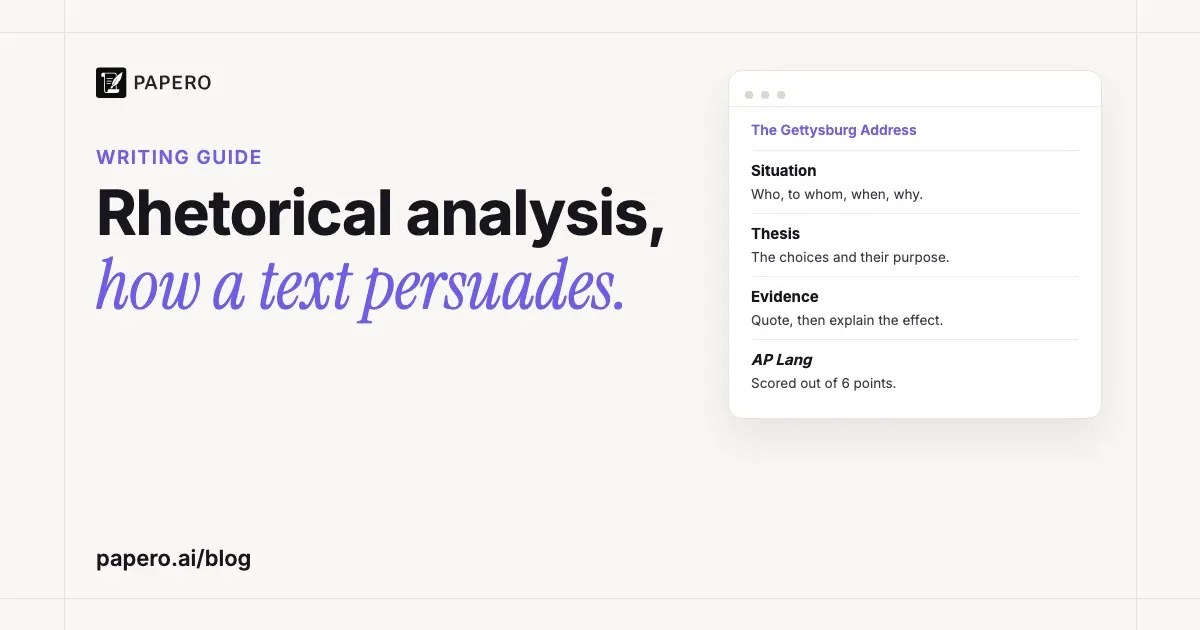
A rhetorical analysis essay explains how a writer or speaker tries to persuade an audience: which choices they make and why those choices work in that situation. The rhetorical analysis essay example below analyzes Abraham Lincoln’s Gettysburg Address in six paragraphs, with MLA citations and a note after each paragraph on what it is doing. The full speech is printed first, so you can check every quotation.
Key Takeaways
- A rhetorical analysis asks how a text persuades, not whether you agree with it. The thesis names the writer’s choices and the purpose they serve.
- Start with the rhetorical situation: who is speaking, to whom, when, where and why. Every choice you analyze makes sense only inside it.
- Each body paragraph takes one choice, quotes it, and explains what it does for the writer’s purpose. Naming a device without explaining its effect is labelling, not analysis.
- On the AP Lang exam, the rhetorical analysis is scored out of 6 points: 1 for the thesis, 4 for evidence and commentary, 1 for sophistication.
What is a rhetorical analysis essay?
A rhetorical analysis essay studies a speech, article or other text to explain how its author tries to achieve a purpose with a particular audience. It does not judge whether the argument is right. It identifies the choices the author makes, such as appeals, structure, repetition or word choice, and explains why each one works in that situation.
Purdue OWL describes every rhetorical situation as having five elements: a text, an author, an audience, purposes and a setting. The analysis starts there. Aristotle’s Rhetoric adds the three modes of persuasion most classes still teach: the first “depends on the personal character of the speaker; the second on putting the audience into a certain frame of mind; the third on the proof, or apparent proof, provided by the words of the speech itself.” These are usually called ethos, pathos and logos.
The appeals are a starting point, not a checklist. A strong analysis spends more time on specific choices, a repeated word or a contrast or what the author leaves out, than on labelling each sentence with an appeal. Papero’s glossary entry on rhetoric covers the terms in more depth. To see the same three appeals used rather than analysed, read our persuasive essay example, which labels the appeal behind each paragraph.
The text: the Gettysburg Address
Lincoln gave the address on November 19, 1863, at the dedication of the Soldiers’ National Cemetery at Gettysburg, Pennsylvania. He was the second speaker; Edward Everett, a famous orator, spoke for two hours before him (Library of Congress). Five known manuscript copies survive. This is the Bliss copy, the version most often reproduced, with Lincoln’s dashes shown as spaced dashes:
Four score and seven years ago our fathers brought forth on this continent, a new nation, conceived in Liberty, and dedicated to the proposition that all men are created equal.
Now we are engaged in a great civil war, testing whether that nation, or any nation so conceived and so dedicated, can long endure. We are met on a great battle-field of that war. We have come to dedicate a portion of that field, as a final resting place for those who here gave their lives that that nation might live. It is altogether fitting and proper that we should do this.
But, in a larger sense, we can not dedicate – we can not consecrate – we can not hallow – this ground. The brave men, living and dead, who struggled here, have consecrated it, far above our poor power to add or detract. The world will little note, nor long remember what we say here, but it can never forget what they did here. It is for us the living, rather, to be dedicated here to the unfinished work which they who fought here have thus far so nobly advanced. It is rather for us to be here dedicated to the great task remaining before us – that from these honored dead we take increased devotion to that cause for which they gave the last full measure of devotion – that we here highly resolve that these dead shall not have died in vain – that this nation, under God, shall have a new birth of freedom – and that government of the people, by the people, for the people, shall not perish from the earth.
The rhetorical situation
The rhetorical situation is the context a text answers to: its author, audience, purpose, setting and the text itself. Fill it in before you plan, because every claim in the essay depends on it. Lincoln’s choices only make sense once you know he spoke second, briefly, at a cemetery, in the middle of a war.
| Element | The Gettysburg Address |
|---|---|
| Author | Abraham Lincoln, president, during the Civil War |
| Audience | The crowd at the cemetery dedication, and the newspaper readers who would see the speech in print |
| Purpose | On the surface, to dedicate a cemetery; underneath, to recommit listeners to the war and say what it was for |
| Setting | November 19, 1863, a battlefield cemetery, after a two-hour oration by Edward Everett |
| Text | Ten sentences, about 270 words |
The newspaper audience is our inference; the speech does not mention it. Noticing a second audience like this is one way to show what the AP rubric calls “a complex understanding of the rhetorical situation”, as long as the essay presents it as an inference.
Rhetorical analysis outline
A rhetorical analysis outline has an introduction that sets the rhetorical situation and ends with a thesis naming the writer’s main choices, one body paragraph per choice in the order the thesis gives them, an optional paragraph on how the choices work together, and a conclusion that explains what they achieve. Each body paragraph needs a claim, a quotation and commentary.
| Paragraph | What goes in it | In the example |
|---|---|---|
| 1. Introduction | Rhetorical situation, purpose, thesis naming the choices | Lincoln at the cemetery; three choices |
| 2. Body 1 | First choice: claim, quotation, commentary | The timeline from 1776 and the language of birth |
| 3. Body 2 | Second choice | The repeated “dedicate” that moves the duty to the listeners |
| 4. Body 3 | Third choice | Modesty: “we” instead of “I”, and “say” against “did” |
| 5. Body 4 | Optional: how the choices combine | The final sentence and what the speech leaves out |
| 6. Conclusion | What the choices achieve together | The living, and what they owe |
Order the body paragraphs by the text’s own order or by importance. Here the order follows the speech, so the analysis also moves from past to present to future, as Lincoln does.
Rhetorical analysis essay example: why two minutes were enough
The essay is about 700 words, in MLA 9 style. Quotations from the speech need no parenthetical citation because Lincoln is named in the sentence and the speech has no page numbers; the other two sources are cited by title.
Paragraph 1: introduction
On November 19, 1863, Abraham Lincoln spoke at the dedication of the Soldiers’ National Cemetery at Gettysburg. He followed Edward Everett, a celebrated orator who had spoken for two hours (“Gettysburg Address”), and his own address runs to about 270 words. The occasion asks him to honor the dead. Lincoln uses it for something larger. Through a timeline that runs from the nation’s birth to its possible death, a repeated word that shifts the work of dedication from the speakers to the listeners, and a modesty that makes his own words seem small beside the soldiers’ deeds, he turns a cemetery dedication into a charge to finish the war for a principle first stated in 1776.
What it does: the first two sentences set the rhetorical situation: speaker, occasion, the speaker before him and the length. The third and fourth name the gap between the surface purpose and the real one. The thesis is the last sentence. It names three choices in the order the body will cover them and says what they achieve, which is what the AP rubric means by a “defensible thesis that analyzes the writer’s rhetorical choices”.
Paragraph 2: body, the timeline
Lincoln’s first move is to set the war inside a longer story. “Four score and seven years ago” counts back 87 years to 1776, and the phrase “dedicated to the proposition that all men are created equal” echoes the Declaration of Independence, which holds it “self-evident, that all men are created equal” (“Declaration of Independence”). By opening with the Declaration instead of the battle, Lincoln defines the nation by a principle. The language of birth supports that reading: the nation was “brought forth” and “conceived in Liberty,” and the speech’s last sentence asks for “a new birth of freedom.” Framed this way, the war is a test of whether something born in 1776 can survive, which is the question his second sentence asks outright: whether “that nation, or any nation so conceived and so dedicated, can long endure.”
What it does: the topic sentence states the choice as a claim. The quotations come with commentary on each one: what “four score and seven” counts back to, what the echo of the Declaration does, how the birth language connects the first sentence to the last. The paragraph ends by tying the choice to the speech’s purpose, the line of reasoning the rubric’s evidence row asks for. Our topic sentence examples quote this paragraph in full, beside examples from argument paragraphs to literature reviews.
Paragraph 3: body, the repeated “dedicate”
The second move is a change in who does the dedicating. Forms of “dedicate” appear six times in ten sentences. After two uses that describe the nation’s founding, the word turns to the crowd’s task that day: “We have come to dedicate a portion of that field.” Then Lincoln takes the task away from them in a three-part denial, “we can not dedicate – we can not consecrate – we can not hallow – this ground,” because the soldiers have already done it. When the word returns, it applies to the listeners themselves: “It is for us the living, rather, to be dedicated here to the unfinished work.” The word “here,” used eight times, keeps that duty tied to the field in front of them. The audience came to dedicate a cemetery and is asked to dedicate itself.
What it does: it analyzes a pattern across the whole text instead of one sentence, which is stronger evidence than a single quotation. The counts are checkable against the text above. The last sentence states the effect in plain words, so the reader does not have to work out why the repetition matters.
Paragraph 4: body, modesty
Lincoln builds his authority by playing it down. The speech never says “I”; it says “we” ten times, which places the president among the mourners instead of above them. Its most quoted contrast predicts its own failure: “The world will little note, nor long remember what we say here, but it can never forget what they did here.” Setting “say” against “did” and “we” against “they” lifts the soldiers above every speaker on the platform, including the one who had just spoken for two hours. The prediction proved wrong, but the modesty has a purpose. A speaker who claims his words do not matter makes the request that follows sound like the soldiers’ demand rather than his own.
What it does: this is the ethos paragraph, but it never uses the word. It explains how Lincoln’s credibility works in this situation, a president speaking at a cemetery, through two specific choices: the pronoun and the antithesis. Naming the device is less important than the last two sentences, which say why a modest speaker is more persuasive here.
Paragraph 5: body, the last sentence and what is missing
The final sentence gathers these choices into one demand. At 82 words it is almost a third of the speech, a chain of clauses joined by dashes that rises from “increased devotion” to the resolve “that these dead shall not have died in vain” and ends on a second three-part phrase: “government of the people, by the people, for the people.” Just as notable is what Lincoln leaves out. He never names Gettysburg, the Union, the Confederacy or slavery. Without those names, the speech speaks for no single battle or side, and its closing principle becomes a test for “any nation so conceived,” as Lincoln puts it at the start.
What it does: it shows how the earlier choices combine, which moves the essay from listing devices to explaining their relationship, one of the things the rubric’s sophistication point looks for. It also analyzes an absence. What a writer leaves out is a rhetorical choice too, and a claim about it is easy to check against the text.
Paragraph 6: conclusion
Lincoln has a few minutes and an occasion built for mourning. He uses the first sentence to remind his audience what the nation was founded on, the repeated “dedicate” to hand his listeners the work the dead had begun, and his own claimed insignificance to make that work feel owed to the soldiers rather than to him. Everett wrote to him the next day that he wished he had come “as near to the central idea of the occasion, in two hours, as you did in two minutes” (“Gettysburg Address”). For Lincoln, that central idea is the living, and what they still owe.
What it does: it restates the three choices with what the body showed about each, then adds one piece of evidence the reader has not seen, Everett’s letter, which confirms the reading from the speech’s first audience. The last sentence answers the introduction’s “something larger” directly.
Works Cited
“Declaration of Independence: A Transcription.” National Archives, www.archives.gov/founding-docs/declaration-transcript. Accessed 23 Oct. 2026.
“Gettysburg Address.” Library of Congress, www.loc.gov/exhibits/gettysburg-address/. Accessed 23 Oct. 2026.
Lincoln, Abraham. “The Gettysburg Address.” 19 Nov. 1863. Abraham Lincoln Online, www.abrahamlincolnonline.org/lincoln/speeches/gettysburg.htm. Accessed 23 Oct. 2026.
In a paper, Works Cited starts on a new page with a centered heading, and every entry has a hanging indent. Our guide to MLA Works Cited covers the entry format, and MLA in-text citation covers citing by title when a source has no author.
Rhetorical analysis thesis examples
A rhetorical analysis thesis names the author, the specific choices the essay will analyze and the purpose those choices serve. A thesis that only says the author “uses ethos, pathos and logos” earns little, because it names categories every text has instead of choices this text makes.
| Weak | Why it is weak | Stronger |
|---|---|---|
| “Lincoln uses ethos, pathos and logos to persuade his audience.” | True of almost any speech; names no choice | “Lincoln uses the Declaration’s language and a repeated ‘dedicate’ to turn a cemetery dedication into a call to finish the war.” |
| “The Gettysburg Address is a very effective speech.” | An opinion, with no choices and no purpose | “By claiming his words will be forgotten, Lincoln makes the soldiers’ sacrifice, not his speech, the source of the duty he asks for.” |
| “Lincoln talks about the soldiers who died.” | Summary, with no analysis | “Lincoln never names the Union or slavery, so his closing principle reads as a test for any democracy.” |
Each stronger version could be argued with. That is the test of a defensible thesis: a reader could disagree and you would have to show evidence. Our strong and weak thesis examples apply the same test to seven other kinds of essay.
AP Lang rhetorical analysis: how it is scored
On the AP English Language and Composition exam, question 2 is the rhetorical analysis: a passage of nonfiction prose of about 600 to 800 words, and an essay analyzing the writer’s rhetorical choices. It is scored out of 6 points in three rows, and the College Board recommends about 40 minutes for it.
| Row | Points | What earns them |
|---|---|---|
| A. Thesis | 0-1 | A defensible thesis that analyzes the writer’s rhetorical choices, not one that restates the prompt |
| B. Evidence and commentary | 0-4 | Specific evidence for every claim, and commentary that consistently explains how multiple choices contribute to the writer’s argument, purpose or message |
| C. Sophistication | 0-1 | Sophistication of thought or a complex understanding of the rhetorical situation, such as explaining the significance of the choices, the purpose of the passage’s complexities or tensions, or a consistently vivid, persuasive style |
The prompt wording is stable from year to year: background on the rhetorical situation, then “Read the passage carefully. Write an essay that analyzes the rhetorical choices [the writer] makes to [develop/achieve/convey] [his/her] [argument … /purpose … /message …].” Row B is where most of the points are, and its top band asks you to explain how “multiple rhetorical choices” contribute, so three well-explained body paragraphs are likely to score better than six that each name a device.
The rubric’s notes also list what does not earn the sophistication point, including sweeping openings such as “In a world where…” and hinting at other arguments without developing them. The example above is longer than most timed essays; under timed conditions, aim for the same structure with two or three body paragraphs. The synthesis essay, question 1, is scored on the same three rows, and our synthesis essay example maps an annotated essay to them.
How do you write a rhetorical analysis essay?
Read the text twice, map the rhetorical situation, pick the two to four choices that do the most work, write a thesis that names them and the purpose they serve, then give each choice a paragraph with a quotation and an explanation of its effect. Analyze, do not summarize: every quotation needs a sentence that says what it does.
- Read for purpose first. What does the author want this audience to think or do? Write it in one sentence before you look for devices.
- Map the situation. Author, audience, purpose, setting, text. Note anything unusual, such as Lincoln speaking second and briefly.
- Find patterns, not single lines. Repeated words, shifts in pronoun, contrasts, the order of ideas, what is left out.
- Draft the thesis. Author, choices, purpose, in one sentence.
- Quote short. A few words in your sentence, introduced with a signal phrase, beat a long block. Keep quotations to four lines or fewer; longer ones become block quotes.
- Explain every quotation. After each one, say what it does for the purpose. “This shows that” followed by the effect, in your own words.
- Conclude with the combined effect. Say what the choices achieve together, not a list of them. Our essay conclusion examples compare this one with endings for four other kinds of essay.
Write in the present tense when you discuss what the text does (“Lincoln repeats”), and in the past tense for historical events (“Lincoln spoke in 1863”). The example follows that rule.
Where Papero fits
Papero is an AI writing workspace for students and researchers. For a rhetorical analysis it helps with the planning and the citing: describe the assignment and Papero builds a two-level outline with a prompt under every heading, and you can add a speech transcript or a web page as a manual web page entry and cite it in MLA 9. In-text citations work on every plan; the full Works Cited is readable and exportable on Plus.
As you write, Papero suggests the next sentence within each section’s prompt, and Review’s proofread suggests spelling, grammar, punctuation and clarity fixes. Papero drafts only from your outline and prompts, so the reading of the text, the quotations you pick and what you say about them stay yours. The essay writing page shows the whole process, and you can sign up free.
Frequently Asked Questions
What are the three rhetorical appeals?
Ethos, pathos and logos. Aristotle described three modes of persuasion in speech: one depends on the speaker’s character (ethos), one on putting the audience in a certain frame of mind (pathos), and one on the proof the words themselves provide (logos). A rhetorical analysis uses them as starting points for explaining specific choices.
Do you have to use ethos, pathos and logos in a rhetorical analysis?
No. The AP rubric scores how well you explain the writer’s rhetorical choices, and the College Board’s course description lists appeals as only one kind of rhetorical feature, alongside structural choices and argumentative moves. An analysis can discuss a speaker’s credibility, for example, without ever writing “ethos.”
Should a rhetorical analysis summarize the text?
Only briefly, in the introduction, to give the reader the rhetorical situation. The body explains how the text persuades. On the AP rubric, responses that focus on summary typically earn 1 of the 4 evidence-and-commentary points, so after every quotation, say what the choice does for the writer’s purpose.
Can you use “I” in a rhetorical analysis essay?
Most teachers prefer the third person, because the essay is about the author’s choices, not your reaction. Write “Lincoln’s repetition moves the duty to the listeners” instead of “I think Lincoln’s repetition works.” If your assignment asks for your response to the text, follow the assignment.
How long is a rhetorical analysis essay?
It depends on the task. On the AP Lang exam, the College Board recommends about 40 minutes for the rhetorical analysis question, and the passage you analyze is about 600 to 800 words. A class assignment sets its own length; the rhetorical analysis essay example on this page is about 700 words.
Sources
- Library of Congress, “Gettysburg Address” exhibition (loc.gov, accessed October 2026): https://www.loc.gov/exhibits/gettysburg-address/
- Abraham Lincoln Online, “Gettysburg Address” (the Bliss copy and the other four manuscripts, accessed October 2026): https://www.abrahamlincolnonline.org/lincoln/speeches/gettysburg.htm
- National Archives, “Declaration of Independence: A Transcription” (archives.gov, accessed October 2026): https://www.archives.gov/founding-docs/declaration-transcript
- Aristotle, Rhetoric, Book I, Part 2, translated by W. Rhys Roberts (The Internet Classics Archive, MIT): https://classics.mit.edu/Aristotle/rhetoric.1.i.html
- Purdue OWL, “Elements of Rhetorical Situations” (owl.purdue.edu, accessed October 2026): https://owl.purdue.edu/owl/general_writing/academic_writing/rhetorical_situation/elements_of_rhetorical_situations.html
- College Board, AP English Language and Composition Course and Exam Description (free-response question 2 and its scoring guidelines): https://apcentral.collegeboard.org/pdf/ap-english-language-and-composition-course-and-exam-description.pdf