Et al. is short for the Latin et alii, “and others”. In a citation it replaces the names of co-authors after the first: (Martin et al., 2020) cites a work by Martin and two or more colleagues. Every major citation style uses it, but styles switch to it at different numbers of authors, and the cut-off in the reference list is usually not the one in the text.
Key Takeaways
- Et al. means “and others”. Only “al.” takes a period, because only the second word (alii, aliae or alia) is shortened: write et al., never et. al., and keep the period unless you write AMA style, which drops it.
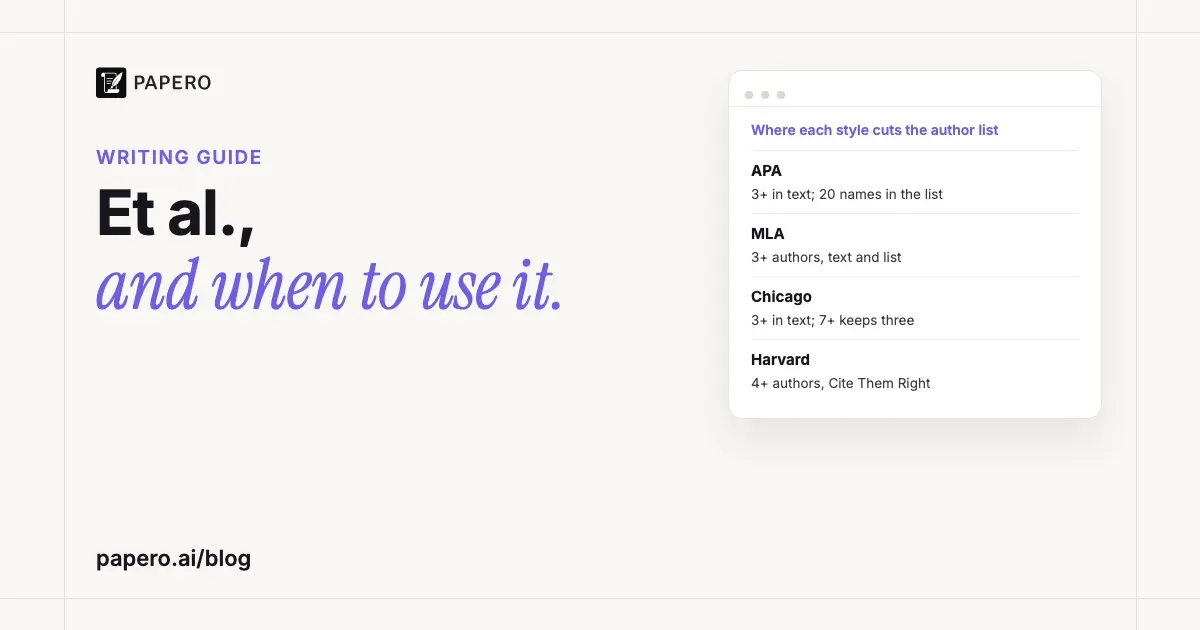
- APA, MLA and Chicago use et al. in the text for three or more authors; Harvard (Cite Them Right) waits for four.
- Reference lists differ more: MLA cuts to one name at three authors, AMA and Chicago keep three names once a work has seven or more, Vancouver keeps six, ACS keeps ten, and APA lists up to 20.
- APA does not italicize et al. Papero’s Cite Them Right and Nature style files do set it in italics in the reference list.
- A comma goes before et al. only when more than one name comes before it, or when the first name is inverted (Dunlosky, John, et al.).
What does et al. mean?
Et al. means “and others”. It abbreviates a Latin phrase that has three forms depending on who the others are: et alii (masculine), et aliae (feminine) or et alia (neuter), as Merriam-Webster’s entry explains. Because the abbreviation covers all three, writers never need to know the co-authors’ genders. In academic writing it stands for the authors or editors you leave out of a citation.
Merriam-Webster notes that some language guides limit et al. to people, although it is occasionally used for things. In a citation, that question does not arise: et al. always replaces names.
When to use et al. in each citation style
Use et al. once a work has more authors than your style names in full. The table gives each style’s two thresholds, one for citations in the text and one for the reference list, because in most styles they are different numbers. The last column shows what Papero’s free DOI to citation generator printed on 5 November 2026 for three real papers.
They are LeCun, Bengio and Hinton’s 2015 “Deep learning” (3 authors), He et al.’s 2016 ResNet paper (4 authors) and the 2021 AlphaFold paper in Nature (34 authors).
| Style | In the text | In the reference list | Tested: 3 / 4 / 34 authors |
|---|---|---|---|
| APA 7 | 3 or more: first author + et al. | Up to 20 names; 21 or more: first 19, “…”, last author | All / all / 19 names, “…”, Hassabis |
| MLA 9 | 3 or more: first author + et al. | 3 or more: first author + et al. | LeCun, Yann, et al. / He, Kaiming, et al. / Jumper, John, et al. |
| Chicago (CMOS 18) | 3 or more: first author + et al. | Up to 6 names; 7 or more: first 3 + et al. | All / all / Jumper, Evans, Pritzel, et al. |
| Harvard (Cite Them Right) | 4 or more: first author + et al. | 4 or more: first author + et al. (or all names) | All / He, K. et al. / Jumper, J. et al. |
| IEEE | Numbers; named in a sentence, 3 or more: et al. | Up to 6 names; 7 or more: first author + et al. | All / all / J. Jumper et al. |
| Vancouver (NLM) | Numbers | Up to 6 names; 7 or more: first 6 + et al. | All / all / six names, et al. |
| AMA 11 | Numbers; named in a sentence, 3 or more: et al | Up to 6 names; 7 or more: first 3 + et al | All / all / Jumper J, Evans R, Pritzel A, et al. |
| Nature | Numbers | Up to 5 names; 6 or more: first author + et al. | All / all / Jumper, J. et al. |
| ACS | Numbers; named in a sentence, 3 or more: et al. | Up to 10 names; 11 or more: first 10 + et al. | All / all / ten names; et al. |
Three things stand out in the tested column. MLA is the only style that shortened the three-author paper in the reference list. Only MLA and Harvard shortened the four-author ResNet paper. And the 34-author AlphaFold paper kept anywhere from one name (MLA, IEEE, Harvard, Nature) to 20 (APA: 19 names, an ellipsis and the last author).
How to use et al. in APA
In APA 7, give the first author’s surname and et al. for any work with three or more authors, from the very first citation: (Martin et al., 2020) in parentheses, Martin et al. (2020) in your sentence. Two-author works always name both authors, as in (Salas & D’Agostino, 2020).
The reference list works differently. APA lists every author up to 20, so the three- and four-author papers above appear in full. With 21 or more, give the first 19, an ellipsis and the final author, with no ampersand; the AlphaFold entry ends “Adler, J., … Hassabis, D. (2021)”. Our guide to the APA reference page shows that rule in a complete list.
APA’s own page on author-date citations lists exceptions, and the one that concerns et al. is this: when two works in your paper would shorten to the same et al. form, write out as many surnames as you need to tell them apart, then et al. The APA in-text citation guide works through that case and the others.
How to use et al. in MLA
MLA 9 uses the same three-author threshold in both places. A parenthetical citation names the first author and et al. before the page: (Dunlosky et al. 4). The works-cited entry gives the first author’s name, reversed, then a comma and et al.: Dunlosky, John, et al. That is why Papero’s MLA output cut even the three-author LeCun paper to “LeCun, Yann, et al.”
In your own sentences, an MLA Style Center answer written for the eighth edition prefers words to the abbreviation: write the first author’s name and “and others”, or all the names. Some guides, Purdue OWL among them, also show et al. in a signal phrase. Our MLA in-text citation guide covers both forms.
How to use et al. in Chicago
Chicago’s 18th edition (2024) shortened its reference lists. For three or more authors, its quick guide says to “list up to six in the reference list; for more than six authors, list the first three, followed by ‘et al.’ (‘and others’). In the text, list only the first, followed by ‘et al.’” The notes-bibliography system uses the same numbers, with notes in place of text citations.
So a seven-author article becomes (Snyder et al. 2025, 9–10) in the text and “Snyder, Carl D., Manuel Bedrossian, Casey Barr, et al.” in the reference list, Chicago’s own example. The 17th edition listed up to ten names, and guides written for it still rank, so check the edition before copying an example. Our Chicago bibliography guide lists the other 18th-edition changes. Papero formats Chicago in the author-date system only, without footnotes.
Et al. in Harvard, IEEE, Vancouver, AMA, Nature and ACS
The numbered styles hide most authors behind a number in the text, so et al. matters mainly in their reference lists, and the cut-offs vary from one name to ten. Harvard is the outlier among author-date styles: Cite Them Right waits for four authors before using et al. in the text.
Harvard. Cite Them Right is a version of Harvard that many UK universities teach, and Papero’s style file follows its 12th edition. It uses et al. in the text for four or more authors, so three authors are all named: (LeCun, Bengio and Hinton, 2015). For the reference list, Manchester Metropolitan University’s guide says Cite Them Right gives two options, and the guide itself recommends the first author followed by et al., which matches the in-text form.
IEEE. IEEE’s reference guide lists up to six names and puts the first author’s name and et al. in place of a longer list. In a sentence, use et al. for three or more names: He et al. [2]. The IEEE citation format guide quotes the rule.
Vancouver. NLM’s sample references list six authors, then et al. for seven or more, which is what Papero’s generator printed. NLM’s longer guide, Citing Medicine, lists every author by default and treats the cut as an option.
AMA. AMA lists all authors up to six and the first three plus et al for seven or more, and writes “et al” with no period of its own. The period you see after it in a reference ends the author list; when a group name follows, JAMA uses a semicolon there instead: “et al;”.
Nature. Nature’s formatting guide asks for all authors “unless there are more than five, in which case only the first author should be given, followed by ‘et al.’”
ACS. The ACS style used in Papero lists up to ten authors, then a semicolon and et al., so the AlphaFold entry stops at Potapenko, the tenth name.
How to punctuate and format et al.
Et al. has one period, after “al”, because “et” is a whole Latin word meaning “and” while “al.” is the shortened part. The usual mistakes move, add or drop that period (et. al., et. al, et al) or misspell the word (“et all”). AMA is the exception that writes “et al” with no period of its own.
Italics. APA does not italicize words and abbreviations of foreign origin that appear in an English dictionary, and et al. is in Merriam-Webster, so APA sets it in roman. Not every style agrees: the Cite Them Right and Nature style files Papero uses print et al. in italics in the reference list.
Commas. Merriam-Webster’s rule is that a comma comes before et al. only when more than one name is listed before it: “Jones, Perez, et al.” but “Carson et al.” A comma follows it only where “and others” would take one. Reference lists add one more case: when the first author’s name is inverted, as in MLA’s “Dunlosky, John, et al.”, the comma after the first name stays. APA’s parenthetical form puts the comma after et al., before the year: (Martin et al., 2020).
Two authors. Do not use et al. for two authors in APA, MLA, Chicago or Harvard. Name both every time.
What is the difference between et al. and et cetera?
Et al. stands in for people, and “etc.” (et cetera, “and the rest”) stands in for things. In citations only et al. appears, because what it replaces is always a list of names. In your own prose, a list that ends in “etc.” is usually better finished: name the items, or cut the clause.
Where Papero fits
Papero is an AI writing workspace for students and researchers. It finds real papers to cite for the sentence you are writing, looks sources up by DOI, PMID, arXiv ID or ISBN, and formats in-text citations and the reference list in nine styles: APA 7, MLA 9, Chicago author-date, Harvard, IEEE, Vancouver, AMA 11, Nature and ACS.
The et al. cut-offs in the table above are not written by a language model. Papero runs citeproc-js, an open-source citation engine, with a Citation Style Language file for each style, and the free DOI to citation generator uses the same engine. The thresholds live in those files, which is why the same 34-author paper keeps one, three, six, ten or 20 names depending on the style. The glossary entry on in-text citations covers the parenthetical and narrative forms, and the research paper writing page shows the whole workflow.
On the free plan, in-text citations work in full while the reference list shows your entries blurred; Plus makes it readable, copyable and exportable. Whatever produced a reference, check that the source exists and says what you cite it for. You can sign up free.
Frequently Asked Questions
What does et al. mean in a citation?
Et al. means “and others”, from the Latin et alii, et aliae or et alia. In a citation it replaces the names of the co-authors after the first, so (Martin et al., 2020) cites a work by Martin and at least two other authors. The full list of names goes in the reference list, up to the limit your citation style sets.
How many authors do you need to use et al. in APA?
Three. In APA 7, any work with three or more authors is cited with the first author’s surname and et al. from the first citation, as in (Martin et al., 2020). Two authors are always both named. In the APA reference list, every author is listed up to 20; et al. is not used there at all, and 21 or more authors become the first 19, an ellipsis and the last.
Is et al. italicized?
Not in APA, which does not italicize abbreviations of foreign origin that appear in an English dictionary, and et al. is in Merriam-Webster. Papero’s MLA and Chicago output prints it in roman too. Some reference-list styles do italicize it: the Cite Them Right (Harvard) and Nature style files Papero uses set et al. in italics. Follow the style your course or journal names.
Do you put a comma before et al.?
Only when more than one name comes before it, as in “Jones, Perez, et al.”, or when the first author’s name is inverted, as in the MLA works-cited form “Dunlosky, John, et al.” With a single name in normal order, there is no comma: Carson et al. In APA parenthetical citations, a comma follows et al. and comes before the year: (Martin et al., 2020).
Can you use et al. for two authors?
No. APA, MLA, Chicago and Harvard name both authors of a two-author work in every citation: (Salas & D’Agostino, 2020) in APA, (Kornell and Bjork 585) in MLA. Et al. starts at three authors in APA, MLA and Chicago text citations and at four in Cite Them Right Harvard. Numbered styles name both authors in a sentence too, as in “Kornell and Bjork [1]”.
How do you write et al. correctly?
Write et al. with a space between the words and one period, after “al”: et al. The forms et. al., et.al. and et all are wrong, and et al without a period belongs to AMA style. In MLA, APA and Chicago it is set in plain roman type, not italics.
Sources
- Merriam-Webster. “Et al.” Merriam-Webster.com Dictionary (Wayback Machine capture of May 28, 2026, accessed November 2026): https://www.merriam-webster.com/dictionary/et%20al.
- American Psychological Association. “Author–date citation system.” APA Style (Wayback Machine capture, accessed November 2026): https://apastyle.apa.org/style-grammar-guidelines/citations/basic-principles/author-date
- American Psychological Association. “Use of italics.” APA Style (Wayback Machine capture, accessed November 2026): https://apastyle.apa.org/style-grammar-guidelines/italics-quotations/italics
- The Chicago Manual of Style. “Author-Date Style,” Citation Quick Guide, 18th edition (chicagomanualofstyle.org, accessed November 2026): https://www.chicagomanualofstyle.org/tools_citationguide/citation-guide-2.html
- The Chicago Manual of Style. “Notes and Bibliography Style,” Citation Quick Guide, 18th edition (chicagomanualofstyle.org, accessed November 2026): https://www.chicagomanualofstyle.org/tools_citationguide/citation-guide-1.html
- Nature. “Formatting guide” (nature.com, accessed November 2026): https://www.nature.com/nature/for-authors/formatting-guide
- Manchester Metropolitan University Library. “Cite Them Right Harvard” (mmu.ac.uk, accessed November 2026): https://www.mmu.ac.uk/library/referencing-and-study-support/referencing/cite-them-right-harvard
- LeCun, Y., Bengio, Y., & Hinton, G. (2015). Deep learning. Nature, 521(7553), 436–444. https://doi.org/10.1038/nature14539
- He, K., Zhang, X., Ren, S., & Sun, J. (2016). Deep residual learning for image recognition. 2016 IEEE Conference on Computer Vision and Pattern Recognition (CVPR), 770–778. https://doi.org/10.1109/CVPR.2016.90
- Jumper, J., Evans, R., Pritzel, A., Green, T., Figurnov, M., Ronneberger, O., Tunyasuvunakool, K., Bates, R., Žídek, A., Potapenko, A., Bridgland, A., Meyer, C., Kohl, S. A. A., Ballard, A. J., Cowie, A., Romera-Paredes, B., Nikolov, S., Jain, R., Adler, J., … Hassabis, D. (2021). Highly accurate protein structure prediction with AlphaFold. Nature, 596(7873), 583–589. https://doi.org/10.1038/s41586-021-03819-2