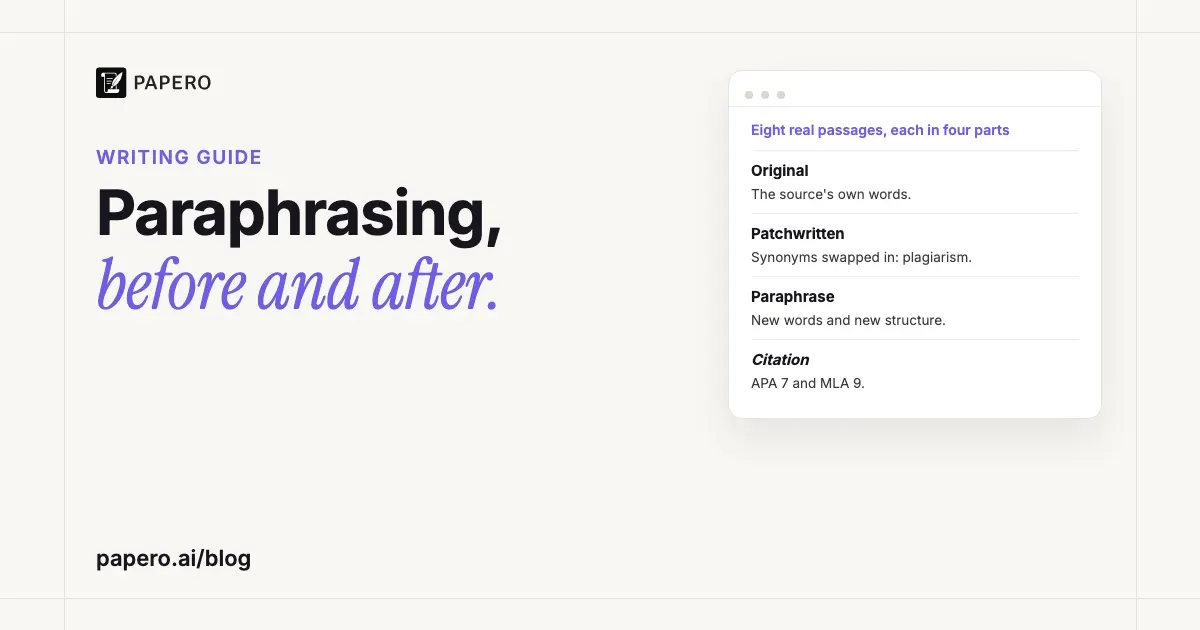
A paraphrase restates one passage from a source in your own words and your own sentence structure, keeps all of its meaning, and still carries a citation. The paraphrasing examples below take eight real passages, from Darwin and Adam Smith to a 2013 climate study, and show each one four ways: the original, a patchwritten version that fails, an acceptable paraphrase, and its APA 7 and MLA 9 citation.
Key Takeaways
- A paraphrase rebuilds the sentences, not just the vocabulary. Synonyms swapped into the source’s sentences are patchwriting, which a citation does not fix.
- The meaning has to survive intact: every hedge (“may”, “tend to”, “almost”), every number and every qualifier.
- Every paraphrase is cited: in APA 7 by author and year (page optional), in MLA 9 by author and the page or other numbered part, such as a chapter, when the source has one.
- Quote when the exact wording is the point; otherwise paraphrase.
What makes a good paraphrase?
A good paraphrase says exactly what the original says, no more and no less, in sentences the source did not write. It keeps the claim, its strength and its numbers; it changes the wording, the sentence structure and often the order of ideas; it keeps the technical terms a reader needs; and it names its source. Fail any one of these and the result is either inaccurate or copied.
The University of Toronto puts the structural rule plainly: “You must also create your own sentence structures.” Purdue OWL adds quotation marks around “any unique term or phraseology you have borrowed exactly from the source”.
Quoting vs paraphrasing vs summarizing
All three bring a source’s ideas into your paper, and all three need a citation. They differ in how close you stay to the source: a quotation copies its exact words, a paraphrase restates one passage at about the same level of detail in your own words, and a summary reduces a passage or a whole work to its main point.
| Quotation | Paraphrase | Summary | |
|---|---|---|---|
| Wording | The source’s exact words, in quotation marks | Your words and your sentence structure | Your words |
| How much of the source | A narrow segment | One passage | The main point of a passage or a whole work |
| Length | The same as the original | About as detailed, often a little shorter | Much shorter |
| Citation | Always, with a page or other location | Always; page optional in APA, needed in MLA when the source has pages | Always |
| Use it when | The exact wording is your evidence | The idea matters, the wording does not | Only the main point matters |
The definitions follow Purdue OWL and the University of Toronto. APA adds that student authors should paraphrase more than they quote, as published authors do. For the rare long quotation, our guide to block quotes in APA, MLA and Chicago shows the format. Whichever you use, introduce the source before it and explain it after it, the pattern known as the quote sandwich.
Paraphrasing examples from 8 real sources
Each example quotes a real passage exactly, from Project Gutenberg’s public-domain ebooks or from two open-access abstracts under a CC BY licence, then shows a patchwritten version that fails and an acceptable paraphrase in APA 7. The patchwritten and acceptable versions were written for this article.
None of these sources has page numbers in the version quoted (the ebooks, and the articles as web pages). APA’s rule for a republished book gives both years: the original and the ebook’s release. The MLA citations give the author and, for the books, the chapter: the ebooks have no page numbers but do number their chapters, and MLA asks for that kind of locator when a work has one. The two articles, read as web pages, have no numbered parts, so their MLA citations give the author alone. The paraphrases below name the author in the sentence, APA’s narrative form. In an MLA paper whose sentence already names the author, keep only the locator, (ch. 3), and for the two articles give no parentheses at all.
Biology: Darwin on small variations
Original (Charles Darwin, On the Origin of Species, 1859, chapter 3; Project Gutenberg eBook #1228):
Owing to this struggle for life, any variation, however slight and from whatever cause proceeding, if it be in any degree profitable to an individual of any species, in its infinitely complex relations to other organic beings and to external nature, will tend to the preservation of that individual, and will generally be inherited by its offspring.
Patchwritten (not acceptable): Because of this struggle for life, any variation, however small and whatever its cause, if it is in any way useful to an individual of a species, in its endlessly complex relations to other living beings and to the outside world, will tend to preserve that individual and will usually be passed on to its offspring.
Acceptable paraphrase: Darwin (1859/1998) argued that the competition to survive can make even the smallest variation count, whatever its origin. An organism that gains any advantage from it, in its tangled dealings with other living things and with its physical surroundings, will tend to survive, and its young will generally inherit the variation.
Citations and technique: APA (Darwin, 1859/1998); MLA (Darwin, ch. 3). One 57-word sentence becomes two, with the organism as the actor. “Variation” stays as the biological term; “tend to” and “generally” stay as Darwin’s own limits on the claim.
Economics: Adam Smith’s butcher, brewer and baker
Original (Adam Smith, The Wealth of Nations, 1776, book 1, chapter 2; Project Gutenberg eBook #3300):
It is not from the benevolence of the butcher, the brewer, or the baker that we expect our dinner, but from their regard to their own interest. We address ourselves, not to their humanity, but to their self-love, and never talk to them of our own necessities, but of their advantages.
Patchwritten (not acceptable): We do not expect our dinner from the kindness of the butcher, the brewer, or the baker, but from their concern for their own interest. We appeal not to their humanity but to their self-love, and we never talk to them about our needs, only about their advantages.
Acceptable paraphrase: Smith (1776/2002) observed that people count on the self-interest of those who sell them food and drink, not on their goodwill. To get a meal from a tradesman, we persuade him by showing what he stands to gain, and we leave our own needs out of the conversation.
Citations and technique: APA (Smith, 1776/2002); MLA (Smith, bk. 1, ch. 2). The three tradesmen become one general term, and the “not this, but that” pattern is turned round. If your essay analyses this famous line itself, quote it instead.
Political philosophy: Mill’s harm principle
Original (John Stuart Mill, On Liberty, 1859, chapter 1; Project Gutenberg eBook #34901):
That principle is, that the sole end for which mankind are warranted, individually or collectively, in interfering with the liberty of action of any of their number, is self-protection. That the only purpose for which power can be rightfully exercised over any member of a civilised community, against his will, is to prevent harm to others. His own good, either physical or moral, is not a sufficient warrant.
Patchwritten (not acceptable): The principle is that the only end for which people are justified, individually or collectively, in interfering with the freedom of action of any of their number is self-protection. The only purpose for which power can rightly be used over any member of a civilized society, against his will, is to prevent harm to others. His own physical or moral good is not a sufficient justification.
Acceptable paraphrase: Mill (1859/2011) held that self-protection is the one reason that can justify anyone, acting alone or as a group, in restricting how another person acts. A civilized society may use its power on members against their wishes only to stop them from harming others; their own benefit, physical or moral, is not reason enough.
Citations and technique: APA (Mill, 1859/2011); MLA (Mill, ch. 1). Two parallel “That the” sentences become a claim and its consequence, the passive “power can be rightfully exercised” becomes the active “a civilized society may use its power”, and “mankind are warranted” becomes “can justify anyone”.
Gender and politics: Wollstonecraft answers Rousseau (paraphrasing a quote)
Original (Mary Wollstonecraft, A Vindication of the Rights of Woman, 1792, chapter 4; Project Gutenberg eBook #3420):
“Educate women like men,” says Rousseau, “and the more they resemble our sex the less power will they have over us.” This is the very point I aim at. I do not wish them to have power over men; but over themselves.
Patchwritten (not acceptable): Rousseau says that if you educate women like men, the more they resemble men the less power they will have over them. This is exactly the point I am aiming at. I do not want women to have power over men, but over themselves.
Acceptable paraphrase: Wollstonecraft (1792/2002) embraced the very outcome Rousseau warned about. He had argued that the more closely an education like men’s made women resemble men, the less sway women would hold over men; she replied that self-government, not control of men, was the power she wanted women to have.
Citations and technique: APA (Wollstonecraft, 1792/2002); MLA (Wollstonecraft, ch. 4). The paraphrase starts from her position, not his words; the patchwritten version even keeps her “I”. You cite Wollstonecraft, whose argument it is. To discuss Rousseau’s own claim, APA advises reading his text, with a secondary citation only if you cannot.
Psychology: William James defines attention
Original (William James, The Principles of Psychology, vol. 1, 1890, chapter 11; Project Gutenberg eBook #57628):
Every one knows what attention is. It is the taking possession by the mind, in clear and vivid form, of one out of what seem several simultaneously possible objects or trains of thought. Focalization, concentration, of consciousness are of its essence.
Patchwritten (not acceptable): Everyone knows what attention is: the mind taking possession, in a clear and vivid form, of one of what seem to be several possible objects or trains of thought at the same time. Focusing and concentrating consciousness are its essence.
Acceptable paraphrase: James (1890/2018) took attention to be familiar to everyone and defined it as the mind seizing on one object or line of thought, clearly and vividly, from among several that appear to be available at once. Gathering consciousness to a single point in this way, he added, is what attention consists of.
Citations and technique: APA (James, 1890/2018); MLA (James, ch. 11). “Attention” and “consciousness” stay as the field’s terms; everything around them is rebuilt, and James’s “seem” survives as “appear”.
Nursing: Nightingale’s first rule
Original (Florence Nightingale, Notes on Nursing, 1859, chapter 1; Project Gutenberg eBook #12439):
The very first canon of nursing, the first and the last thing upon which a nurse’s attention must be fixed, the first essential to a patient, without which all the rest you can do for him is as nothing, with which I had almost said you may leave all the rest alone, is this: TO KEEP THE AIR HE BREATHES AS PURE AS THE EXTERNAL AIR, WITHOUT CHILLING HIM.
Patchwritten (not acceptable): The very first rule of nursing, the first and last thing a nurse’s attention must be fixed on, the first essential for a patient, without which everything else you can do for him is as nothing, is this: to keep the air he breathes as pure as the outside air, without chilling him.
Acceptable paraphrase: Nightingale (1859/2004) put fresh air at the top of a nurse’s duties: a patient should breathe air as clean as the air outdoors without being allowed to get cold. Nothing else a nurse does, she argued, is worth anything if this is neglected, and she came close to saying that a nurse who secured it could ignore the rest.
Citations and technique: APA (Nightingale, 1859/2004); MLA (Nightingale, ch. 1). The rule moves from the end to the start, and “I had almost said” survives as “came close to saying”. The patchwritten version drops that clause: an accuracy problem on top of the copying.
Medicine: Ioannidis on false findings
Original (John P. A. Ioannidis, “Why Most Published Research Findings Are False”, PLoS Medicine, 2005, abstract; CC BY):
There is increasing concern that most current published research findings are false. The probability that a research claim is true may depend on study power and bias, the number of other studies on the same question, and, importantly, the ratio of true to no relationships among the relationships probed in each scientific field.
Patchwritten (not acceptable): There is growing concern that most current published research findings are false. The probability that a research claim is true depends on study power and bias, the number of other studies on the same question, and especially the ratio of true to no relationships among the relationships tested in each field.
Acceptable paraphrase: Ioannidis (2005) started from a growing worry that the majority of recent published findings are wrong. Whether any one claim holds up, he argued, may turn on the statistical power of the study and its bias, on how many other studies have examined that question and, importantly, on how many of the relationships a field tests are real compared with how many are not.
Citations and technique: APA (Ioannidis, 2005); MLA (Ioannidis). The patchwritten version also drops “may”, turning a proposal into a fact. The acceptable one keeps the hedge and the technical terms, and puts “the ratio of true to no relationships” into plain words.
Climate science: Cook and colleagues on the consensus
Original (John Cook and 8 co-authors, “Quantifying the Consensus on Anthropogenic Global Warming in the Scientific Literature”, Environmental Research Letters, 2013, abstract; CC BY 3.0; AGW stands for anthropogenic global warming):
We find that 66.4% of abstracts expressed no position on AGW, 32.6% endorsed AGW, 0.7% rejected AGW and 0.3% were uncertain about the cause of global warming. Among abstracts expressing a position on AGW, 97.1% endorsed the consensus position that humans are causing global warming.
Patchwritten (not acceptable): They found that 66.4% of abstracts expressed no position on AGW, 32.6% endorsed it, 0.7% rejected it and 0.3% were uncertain about the cause. Among abstracts that took a position, 97.1% endorsed the consensus that humans are causing global warming.
Acceptable paraphrase: Of the climate-paper abstracts that Cook et al. (2013) rated and that stated a position on human-caused global warming, 97.1% agreed with the consensus that people are causing it. Of all the abstracts, 66.4% stated no position; overall, 32.6% endorsed the human cause, 0.7% rejected it and 0.3% were unsure what causes the warming.
Citations and technique: APA (Cook et al., 2013); MLA (Cook et al.), or “Cook and others report” in your sentence. Numbers are never rounded or recomputed, so all five percentages appear as published; the order changes instead, with 97.1% first.
Paraphrasing plagiarism examples: how to spot patchwriting
Patchwriting is copying a source’s sentences and changing a few words or swapping in synonyms. To spot it, line the version up against the original: if the clauses match one for one, in the same order, the structure is still the source’s. APA’s plagiarism guidance names it among the cases that plagiarism-checking software is used to find, and an MLA Style Center lesson states that patchwriting is not paraphrasing. A citation does not repair it.
All eight patchwritten versions above fail that test. The University of Toronto’s rejected paraphrase of Oliver Sacks ends with a correct page citation and still fails, because “most of these sentences do little more than substitute one phrase for another.”
The usual cause is writing with the source open. The MLA lesson tells instructors to watch for students who keep looking back at the source while they paraphrase, a habit it links to accidental patchwriting, and it notes that most patchwriting is unintentional. That is why the familiar advice to “use synonyms” misses: a synonym replaces a word, and the copying is in the sentences.
How to paraphrase, step by step
Read the passage until you can explain it without looking, then close it and write the idea from memory in your own sentences. Reopen the source and compare: check that every claim, hedge and number survived, that your sentences are built differently, and that any phrase you kept has quotation marks. Finish with a signal phrase and a citation.
- Understand it first. Purdue OWL’s first step is to reread the passage “until you understand its full meaning”.
- Note the point, not the sentences, with the source and page, as the University of Toronto suggests.
- Write from your notes, with the source closed.
- Change the structure as well as the words: start from a different part of the idea (Smith), split or merge sentences (Darwin), switch from passive to active (Mill), or turn a noun into a verb (“the preservation of that individual” into “will tend to survive”, Darwin).
- Check it against the original for a lost hedge, a changed number or a borrowed phrase.
- Name the source. Toronto advises referring to the author explicitly; our list of signal phrase verbs helps you pick a verb that matches what the source does.
How do you cite a paraphrase in APA and MLA?
In APA 7, give the author and year: (Ioannidis, 2005) or Ioannidis (2005). The page is optional: APA says you may add one when it would help readers find the passage in a long or complex work. In MLA 9, give the author and, when the source has page numbers, the page, with no comma between them: (Lester 46–47). A source without pages but with numbered chapters or sections takes that number after a comma: (Darwin, ch. 3).
| APA 7 | MLA 9 | |
|---|---|---|
| Basic citation | (Ioannidis, 2005) or Ioannidis (2005) | (Ioannidis), or the author named in your sentence |
| Page number | Optional; helpful in a long or complex work | Required when the source has page numbers |
| No page or other part numbers | Author and year are enough | No number; no parentheses if the author is named in the sentence |
| Republished classic | Both years: (Darwin, 1859/1998) | The author, plus a chapter or other division when there are no pages; list the edition you read |
| Paraphrase over several sentences | Cite at first mention; again in a new paragraph or when the source changes | Make clear where the borrowed idea ends |
MLA’s ninth-edition overview says that when part of a work is “quoted or paraphrased” and the work has page numbers or another way to locate it, “that location marker must be included in parentheses”. Our guides to APA in-text citation and MLA in-text citations cover the other cases, and the glossary defines the in-text citation.
Does a paraphrase need a citation?
Yes. APA tells writers to cite the original work whenever they paraphrase, and the MLA’s plagiarism guidance, adapted from the ninth edition of its handbook, counts “paraphrasing someone’s ideas or arguments” without proper credit as plagiarism. Rewording every sentence does not change whose idea it is. The one exception is common knowledge, and the safe rule is to cite whenever you are unsure.
Purdue OWL describes common knowledge as information documented in at least five credible sources, and its rule is “When in doubt, just cite.”
Common paraphrasing mistakes
Five mistakes cause most weak paraphrases: swapping synonyms into the source’s sentences, dropping a hedge, changing a number, mixing your own view into the source’s, and citing only once at the end of a long passage. The first is copying, the next two misreport the source, and the last two leave the reader unsure whose idea is whose.
- The synonym swap. Write from notes, not from the open source.
- The lost hedge. “May depend” becomes “depends”. List the source’s hedges and find each in your version.
- The changed number. 97.1% becomes “nearly all”. Copy numbers exactly.
- Your view inside the source’s. An eighth-edition MLA Style Center answer says to signal where a borrowed idea ends and your own begins; put your comment in a sentence of its own.
- One citation at the end of a long passage. Toronto notes that a reader of its rejected Sacks paraphrase might think the earlier sentences were not from Sacks. Name the author in the first sentence; a literature review, where nearly every sentence reports a source, depends on this.
Where Papero fits
Papero is an AI writing workspace for students and researchers. It helps you outline, draft and rewrite a paper, finds real papers to cite as you write and formats the references. For paraphrasing, it rewords passages of your own draft and flags sentences that still need a citation. The argument stays yours.
The Rewrite menu’s Paraphrase works on text you select in your own document, up to 3,000 characters, with the instruction to “express the same ideas in different words and sentence structures” while keeping the original meaning. It is for your own draft, such as a sentence you have rewritten three times, not a way to disguise someone else’s text; the glossary entry on the AI paraphraser covers what such tools do. A paraphrase of a source still needs its citation, and Review’s Claims check finds sentences that need one and offers papers to cite. The essay writing page shows the workflow, and you can start on the free plan.
Frequently Asked Questions
How do I start a paraphrase?
Start with a signal phrase that names the source, such as “Darwin argued that” (in APA, add the year: “Darwin (1859/1998) argued that”). It shows the reader where the borrowed idea begins. Then write the idea from your notes, with the original closed.
Why is paraphrasing so hard?
Because you have to understand the passage first. The University of Toronto notes that finding new words for ideas already well expressed can be hard, and that changing words should not be your chief aim. An MLA Style Center lesson adds that patchwriting is more likely with difficult texts. Writing from notes on the point makes it easier.
Is paraphrasing plagiarism?
Not when it is done properly and cited: Purdue OWL calls paraphrase a legitimate way to borrow from a source when it is accompanied by accurate documentation. It becomes plagiarism when the source is not credited, or when it is patchwriting, the source’s sentences with a few words changed.
Do you need a page number when paraphrasing in APA?
No. APA 7 requires the author and year for a paraphrase and makes the page optional, suggesting one when it would help readers find the passage in a long or complex work, such as a book. MLA 9 differs: it expects the page whenever the source has page numbers.
How do you paraphrase a quote?
Restate the line’s idea in your own sentence structure and cite the author whose work you read. With a famous line, such as Adam Smith’s remark about the butcher, the brewer and the baker, keep the meaning and drop the memorable wording; if the wording is what you are analysing, quote it instead.
Sources
- Purdue Online Writing Lab, “Paraphrase: Write It in Your Own Words” (owl.purdue.edu, accessed October 2026): https://owl.purdue.edu/owl/research_and_citation/using_research/quoting_paraphrasing_and_summarizing/paraphrasing.html
- Purdue Online Writing Lab, “Quoting, Paraphrasing, and Summarizing” (owl.purdue.edu, accessed October 2026): https://owl.purdue.edu/owl/research_and_citation/using_research/quoting_paraphrasing_and_summarizing/index.html
- Purdue Online Writing Lab, “Common Knowledge & Attribution” (owl.purdue.edu, accessed October 2026): https://owl.purdue.edu/owl/avoiding_plagiarism/common-knowledge_attribution.html
- American Psychological Association, “Paraphrases” (APA Style, 7th edition guidance) (apastyle.apa.org, accessed October 2026): https://apastyle.apa.org/style-grammar-guidelines/citations/paraphrasing
- American Psychological Association, “Plagiarism” (APA Style, 7th edition guidance) (apastyle.apa.org, accessed October 2026): https://apastyle.apa.org/style-grammar-guidelines/citations/plagiarism
- American Psychological Association, “Book References” (example 3, republished book) (apastyle.apa.org, accessed October 2026): https://apastyle.apa.org/style-grammar-guidelines/references/examples/book-references
- Modern Language Association, “In-Text Citations: An Overview” (ninth edition) (style.mla.org, accessed October 2026): https://style.mla.org/in-text-citations-overview/
- Modern Language Association, “Plagiarism and Academic Dishonesty” (adapted from the ninth edition of the MLA Handbook) (style.mla.org, accessed October 2026): https://style.mla.org/plagiarism-and-academic-dishonesty/
- Ted Roggenbuck, Emma Slotterback and Morgan Mickavicz, “Paraphrasing versus Patchwriting” teaching resource (style.mla.org, 2020, accessed October 2026): https://style.mla.org/paraphrasing-patchwriting/
- MLA Style Center, “Should I cite the digital or print edition of a book?” (style.mla.org, accessed October 2026): https://style.mla.org/cite-digital-and-oa-books/
- MLA Style Center, “What should I include in parentheses if the author’s name is provided in a signal phrase and the source has no page numbers or other kind of part number?” (eighth-edition answer) (style.mla.org, accessed October 2026): https://style.mla.org/citing-unpaginated-works/
- MLA Style Center, “If I cite a work that has no page numbers and I give the author’s name at the beginning of my sentence, how does the reader know where the author’s idea ends?” (eighth-edition answer) (style.mla.org, accessed October 2026): https://style.mla.org/clarifying-end-idea-from-source/
- Jerry Plotnick, University College Writing Centre, University of Toronto, “Paraphrase and Summary” (advice.writing.utoronto.ca, accessed October 2026): https://advice.writing.utoronto.ca/using-sources/paraphrase/
- Cook, J., Nuccitelli, D., Green, S. A., Richardson, M., Winkler, B., Painting, R., Way, R., Jacobs, P., & Skuce, A. (2013). Quantifying the consensus on anthropogenic global warming in the scientific literature. Environmental Research Letters, 8(2), Article 024024. https://doi.org/10.1088/1748-9326/8/2/024024 (CC BY 3.0)
- Darwin, C. (1998). On the origin of species by means of natural selection. Project Gutenberg. https://www.gutenberg.org/ebooks/1228 (Original work published 1859)
- Ioannidis, J. P. A. (2005). Why most published research findings are false. PLoS Medicine, 2(8), Article e124. https://doi.org/10.1371/journal.pmed.0020124 (CC BY 4.0)
- James, W. (2018). The principles of psychology (Vol. 1). Project Gutenberg. https://www.gutenberg.org/ebooks/57628 (Original work published 1890)
- Mill, J. S. (2011). On liberty. Project Gutenberg. https://www.gutenberg.org/ebooks/34901 (Original work published 1859)
- Nightingale, F. (2004). Notes on nursing: What it is, and what it is not. Project Gutenberg. https://www.gutenberg.org/ebooks/12439 (Original work published 1859)
- Smith, A. (2002). An inquiry into the nature and causes of the wealth of nations. Project Gutenberg. https://www.gutenberg.org/ebooks/3300 (Original work published 1776)
- Wollstonecraft, M. (2002). A vindication of the rights of woman. Project Gutenberg. https://www.gutenberg.org/ebooks/3420 (Original work published 1792)