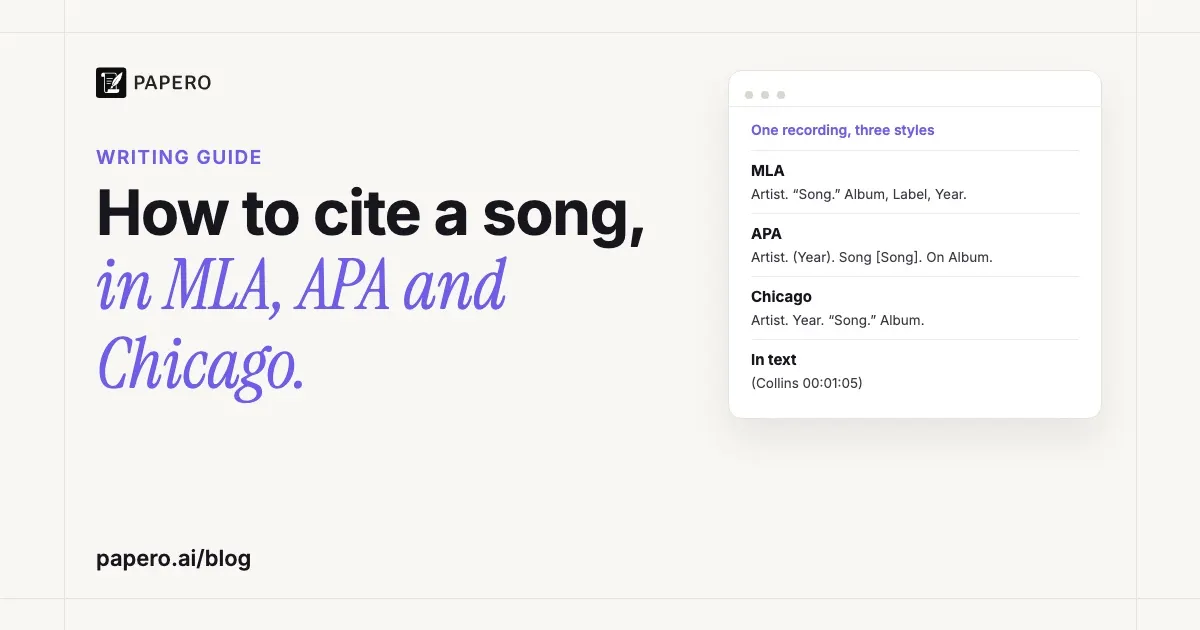
To cite a song, name the performer, put the song title in quotation marks, then give the album in italics, the record label and the year. MLA 9: Collins, Judy. “Amazing Grace.” Whales & Nightingales, Elektra, 1970. In the text, cite the performer, (Collins), and add the time your player shows when you quote or point to a moment: (Collins 00:01:05).
Key Takeaways
- The performer is the author in all three styles. APA puts the composer first for classical music, Chicago lets you start with the composer or the performer, and MLA lets you credit a songwriter after the song title.
- MLA and Chicago put the song title in quotation marks and the album in italics. APA writes the song title in plain sentence case, adds [Song], then “On” and the album in italics.
- A streamed song needs no URL in APA. MLA can add the service, such as Spotify or Apple Music, with the URL.
- In MLA, quote up to three lines of lyrics in your sentence with a slash between lines; set four or more lines apart as a block quotation, as you would with a poem.
- Point to a moment in a recording with a time: (Collins 00:01:05) in MLA, (Collins, 1970, 1:05) in APA and (Collins 1970, at 1:05) in Chicago.
How to cite a song in MLA, APA and Chicago
Every style needs the same facts: the performer, the song title, the album, the record label and the year. MLA and Chicago put the song in quotation marks and the album in italics; APA writes the song title in sentence case, adds [Song] and introduces the album with “On”. The table cites one real recording, Judy Collins’s “Amazing Grace” from her 1970 album Whales & Nightingales.
| Style | Works cited, reference or bibliography entry | In-text citation |
|---|---|---|
| MLA 9, from the album | Collins, Judy. “Amazing Grace.” Whales & Nightingales, Elektra, 1970. | (Collins), or with a time: (Collins 00:01:05) |
| MLA 9, streamed | Collins, Judy. “Amazing Grace.” Whales & Nightingales, Elektra, 1970. Apple Music, music.apple.com/us/album/amazing-grace/300204961?i=300205051. | (Collins 00:01:05) |
| APA 7 | Collins, J. (1970). Amazing grace [Song]. On Whales & nightingales. Elektra. | (Collins, 1970), or for a quotation (Collins, 1970, 1:05) |
| Chicago 18, author-date | Collins, Judy, vocalist. 1970. “Amazing Grace.” Track 13 on Judy Collins, Whales & Nightingales. Elektra EKS-75010. | (Collins 1970), or (Collins 1970, at 1:05) |
The details come from two sources we checked on November 3, 2026. MusicBrainz lists the 1970 US LP as Elektra EKS-75010, with “Amazing Grace” as track 13. Apple Music lists the album as Whales & Nightingales (with an ampersand), the same track number, and “℗ 1970 Elektra/Asylum Records”. The time 1:05 in the table stands for whatever your player shows when the passage you discuss begins. Read it off your own copy: MusicBrainz times the LP track at 4:04, while Apple Music’s stream runs 4:09.
The words are older than the recording. John Newton wrote them as a hymn, printed in 1779 in Olney Hymns, so they are in the public domain, which is why this guide can quote them at length below.
How do you cite a song in MLA?
List the performer or band as the author, then the song title in quotation marks. The album is the container: give its title in italics, then the record label and the year. A song released on its own, with no album, goes straight from the title to the label and the date. You can add a format, such as CD or Vinyl EP, at the end when it matters.
- A track on an album: Collins, Judy. “Amazing Grace.” Whales & Nightingales, Elektra, 1970.
- Streamed in an app: Collins, Judy. “Amazing Grace.” Whales & Nightingales, Elektra, 1970. Apple Music app.
- Streamed on a website: Collins, Judy. “Amazing Grace.” Whales & Nightingales, Elektra, 1970. Apple Music,
music.apple.com/us/album/amazing-grace/300204961?i=300205051. - A single with no album (the MLA’s example): U2. “You’re the Best Thing about Me.” Island Records, 2017.
The streaming patterns come from the MLA Style Center’s answer on song lyrics, last updated in November 2024: for an app, “include the app’s name in the final supplemental element”; for a website, add “the name of the website and the song’s URL in the second container”. Its CD example puts a comma after the album title, and we follow it. An older, eighth-edition answer calls the app “generally not necessary to specify”, so the plain album entry is still acceptable.
For a song heard on a compilation, cite the compilation and put the song’s original year after its title, as in the MLA’s example: Gaye, Marvin. “Can I Get a Witness.” 1963. The Very Best of Marvin Gaye, Motown, 2001. Most of these MLA answers were written for the eighth edition. Our guide to the MLA works cited page explains containers and the order of the core elements.
How do you cite a song in APA?
Start with the recording artist, then the year in parentheses. Write the song title in sentence case, not italics, and add [Song] in square brackets. Then write “On” and the album title in italic sentence case, and end with the record label. Separate two labels with a semicolon. A streamed song needs no URL unless the song is available in only one place online.
Collins, J. (1970). Amazing grace [Song]. On Whales & nightingales. Elektra.
The format comes from the APA Style blog’s post on songs (October 27, 2021), which points to section 10.13 of the Publication Manual: the author “is usually the recording artist, which may be an individual or group”. APA’s example with two labels: Coldplay & BTS. (2021). My universe [Song]. On Music of the spheres. Parlophone; Atlantic. The whole album is cited as Collins, J. (1970). Whales & nightingales [Album]. Elektra.
APA’s album post says “it is not necessary to specify how you listened to an album”, on Spotify, CD or vinyl, and “a URL is generally not needed, even if you retrieved the album online.” Add one only when that is “the only source”, such as an album released only on SoundCloud.
In the text, the parenthetical citation is (Collins, 1970) and the narrative one is Collins (1970). Our guide to APA in-text citations covers both forms and how to place them.
How do you cite a song in Chicago style?
Chicago lists a recording under its performer, author or other main contributor. In author-date style, the year follows the name, the song title goes in quotation marks, and “Track”, the track number and “on” introduce the album in italics. A record or disc keeps its catalog number after the label with no comma. Naming a streaming service is optional.
Collins, Judy, vocalist. 1970. “Amazing Grace.” Track 13 on Judy Collins, Whales & Nightingales. Elektra EKS-75010.
The rule is section 14.163 of the Chicago Manual of Style, 18th edition, as quoted in Oberlin College Library’s 18th-edition music guide: “Recordings on LP or disc typically include acquisition numbers, which follow the name of the publisher with no intervening comma.” The track pattern follows Monash University Library’s 18th-edition author-date guide, which shows a featured artist and a streaming service in one entry (see the featured-artist section below).
In the text, give the name and year, (Collins 1970), and put “at” before a time, as Oberlin’s example does: (clipping. 2019, at 1:02). A Chicago Q&A answer adds that “a song can usually be mentioned in the text (with attribution) rather than formally cited”, so a paper that only alludes to a song may need no entry at all; ask your instructor. Notes-bibliography follows the same section; Papero formats author-date only, so write such notes by hand.
How do you cite a song in text?
Start the citation with the first word of the list entry, which for a song is the performer. MLA uses the name alone, plus a time when you quote or point to a moment. APA adds the year, and for a quotation the time the quotation starts. Chicago adds the year and puts “at” before a time. Read the time off your player, in hours, minutes and seconds for MLA.
| Citation | MLA 9 | APA 7 | Chicago 18, author-date |
|---|---|---|---|
| The song as a whole | (Collins) | (Collins, 1970) | (Collins 1970) |
| A moment that starts at 1:05 | (Collins 00:01:05) | (Collins, 1970, 1:05) | (Collins 1970, at 1:05) |
| A span of time | (Collins 00:01:05–12) | the start time only: (Collins, 1970, 1:05) | no rule found, so give the start: (Collins 1970, at 1:05) |
Douglas College Library quotes the ninth-edition MLA Handbook (p. 250): “For works in time-based media, such as audio and video recordings, cite the relevant time or time span. Give the numbers of the hours, minutes, and seconds as displayed in your media player, separating the numbers with colons.” APA’s page on quotations without page numbers says to “provide a time stamp for the beginning of the quotation in place of a page number”, as in (Cuddy, 2012, 2:12).
When your sentence names the performer, the parentheses keep the rest: (00:01:05) in MLA, and Collins (1970) with the time after the quotation in APA. For a paraphrase a time is optional, though an eighth-edition MLA answer says one “could help your reader locate” the part you discuss.
How do you cite song lyrics?
Cite the source the words came from. Lyrics you heard are cited to the recording, with a time. Lyrics printed in liner notes, a book or sheet music are cited to that print, with a page. Lyrics copied from a lyrics website are cited to the website. In your sentence, quote lyrics the way you quote poetry: a slash with a space on each side between lines.
The MLA’s answer on formatting lyrics (2022) puts it plainly: “Format a quotation of song lyrics the same way you would format a quotation of poetry.” Songs have no line numbers, so the citation gives a time for a recording and a page for print.
The words of “Amazing Grace” were first printed in 1779 in Olney Hymns, as Hymn 41 of Book 1, titled “Faith’s review and expectation”. In the Internet Archive’s scan of that first edition, the hymn starts on page 53. Quoted from that page, keeping its spelling:
Newton’s speaker gives thanks for the grace “That sav’d a wretch like me! / I once was lost, but now am found” (53).
Newton, John. “Faith’s Review and Expectation.” Olney Hymns, in Three Books, W. Oliver, 1779, pp. 53–54.
The book’s preface says Newton marked each of William Cowper’s hymns with the letter C; this one has none. If you quote what Collins sings instead, cite her recording with a time and transcribe what you hear.
For a lyrics website, the MLA puts a description in the title slot: Beatles. Lyrics to “Revolution 1.” Genius, 2017, genius.com/The-beatles-revolution-i-lyrics. For an album’s booklet: Beatles. Booklet. The Beatles, EMI Records, 1968.
Our guide on how to cite a poem shows the double slash for a stanza break and how to mark an omitted line, both of which apply to lyrics.
How do you quote four or more lines of lyrics?
In MLA, set four or more lines apart as a block quotation, as you would verse: start on a new line, indent half an inch from the left margin, keep the original line breaks and leave out the quotation marks. The citation goes after the last line’s punctuation. APA counts words instead and blocks quotations of 40 words or more.
The first stanza of Newton’s hymn, from page 53 of the 1779 edition:
Amazing grace! (how sweet the sound)
That sav’d a wretch like me!
I once was lost, but now am found,
Was blind, but now I see. (Newton 53)
We print a modern s for the book’s long s. Our guide to block quotes in APA, MLA and Chicago compares the three thresholds.
Be careful with songs that are still under copyright. A Chicago Q&A answer warns authors who publish that the legalities of quoting lyrics, “even just a line or two”, “are very strict and complex.” A class paper is not a publication, but a short quotation with a citation is still the safer habit.
How do you cite a song on Spotify, Apple Music or YouTube?
Cite a streamed song the same way as the album track, and add the service only where the style asks for it. MLA can name the app at the end, or give the website and URL as a second container. APA leaves the service and the URL out. Chicago may name the service but does not require it. A music video is a video, so cite the upload.
Oberlin’s Chicago guide is direct about videos: “Even if all you write about a YouTube video is the music, it still should be cited like a video (CMOS 14.167).” Our guide on how to cite a YouTube video cites one real upload in all three styles, with timestamps and the rule for channel names.
Who is the author of a cover song?
The performer you heard. APA says to cite the version you listened to, without naming the original artist or the year the song first appeared. MLA also starts with the performer and lets you credit the songwriter after the song title. Chicago allows either the performer or the songwriter first, depending on which one your paper is about.
APA’s song post: “you don’t need to research the history of a song in order to cite it; just cite the version you heard.” Its cover example is Smith, A. (2015). I put a spell on you [Song]. On Nina revisited: A tribute to Nina Simone. Legacy. So Newton does not appear in the APA reference for Collins’s recording.
For MLA, an eighth-edition answer about a cover band puts the songwriter in the “Other contributors” element: Peter, Paul, and Mary. “Blowin’ in the Wind.” Music and lyrics composed by Bob Dylan, Warner Bros. Records, 1963. On an album track, we put the credit right after the song title, the slot the MLA uses for a translator of one song:
Collins, Judy. “Amazing Grace.” Lyrics by John Newton. Whales & Nightingales, Elektra, 1970.
In Chicago, section 14.163 says that if “the conductor or performer is the focus of the recording or is more relevant to the discussion than the composer or songwriter, either one may be listed first.” If your paper is about Newton’s text, start the entry with Newton.
How do you cite a song with a featured artist?
In APA, write the featured artist in parentheses after the main artist, after the word “featuring”. Chicago guides add “Featuring” and the name after the song title. The MLA Style Center has no answer on featured artists; we credit them after the song title, where the MLA puts other contributors to a song. APA’s in-text citation names the main artist only.
- APA 7 (APA’s example, a song with no album): BTS (featuring Megan Thee Stallion). (2021). Butter (Remix) [Song]. BigHit Music. In the text: (BTS, 2021).
- Chicago 18, author-date (Monash’s example): Rihanna [Robin Fenty], vocalist. 2007. “Umbrella.” Featuring Jay-Z. Spotify. Track 1 on Rihanna, Good Girl Gone Bad. Island Def Jam.
- MLA 9 (our application): BTS. “Butter (Remix).” Featuring Megan Thee Stallion, BigHit Music, 2021.
Two equal artists are joined with an ampersand instead, as in APA’s Coldplay & BTS.
How do you cite classical music or a live performance?
For classical music, APA names the composer as author, adds who recorded the piece in square brackets, and ends with the year the work was first published; the citation gives both years. MLA cites a concert you attended with the performer, a description such as Concert, the date and the venue. APA has no reference format for a performance nobody can replay.
APA’s classical examples:
- One piece, cited in the text as (Beethoven, 1804/2012): Beethoven, L. van. (2012). Symphony No. 3 in E-flat major [Song recorded by Staatskapelle Dresden]. On Beethoven: Complete symphonies. Brilliant Classics. (Original work published 1804)
- A whole album, cited in the text as (Handel, 1717/1966): Handel, G. F. (1966). Water music [Album recorded by The Hague Philharmonic Orchestra]. Nonesuch. (Original work published 1717)
An MLA answer, quoting the Chicago Manual of Style, italicizes operas and other long compositions and puts songs and shorter pieces in quotation marks.
For a concert, the MLA’s eighth-edition example is Astley, Rick. Concert. 6 Oct. 2016, Town Hall, New York City. APA cites works “that cannot be recovered by readers” as personal communications, in the text only; its list names live speeches, not concerts, so ask your instructor. A concert released as a live album is cited like any album.
How do you cite sheet music or lyrics printed in a book?
Cite a printed score like a book, with the composer, and the lyricist or librettist when there is one, as authors. APA adds a description in square brackets, such as [Musical score] or [Vocal score], and cites a song in an anthology like a chapter in an edited book, with the editor and the page range. MLA cites printed lyrics under their writer, with the page.
APA’s examples from its musical score page:
- A score: Brouwer, L. (1987). Cuban landscape with rain [Guitar score]. Les Editions Doberman-Yppan.
- A song in an anthology: Scarlatti, A. (1991). Le violette [The violets] [Musical score]. In J. G. Paton (Ed.), 26 Italian songs and arias: An authoritative edition based on authentic sources (Medium High Voice ed., pp. 50–55). Alfred Music. (Original work published 1694)
In MLA, lyrics printed in a script are cited under the songwriter: Sondheim, Stephen. “The Story of Lucy and Jessie.” Follies, by James Goldman, Theatre Communications Group, 2001, pp. 78–80. For a score, measure numbers can point “more precisely than page numbers”, says an MLA answer: (measures 275–93).
In Chicago, Memorial University Libraries’ 18th-edition music guide cites a score like a book (CMS 14.155): Rachmaninoff, Serge. 1993. Sonata No. 2, Op. 36. Boosey & Hawkes.
Where Papero fits
Papero is an AI writing workspace for students and researchers. It formats references in nine styles, including MLA 9, APA 7 and Chicago author-date; it does not produce Chicago footnotes, so write notes-bibliography citations by hand. Its manual entry form offers journal article, book, book chapter, web page and report. There is no song or recording type, so pick the closest one and fix the rest after you export.
For a track on an album, Book chapter comes closest. We entered “Amazing Grace” that way, with Collins as author, Whales & Nightingales as the book title, Elektra as publisher and 1970 as the year, and ran it through Papero’s formatter. The MLA entry came out exactly as MLA wants it: Collins, Judy. “Amazing Grace.” Whales & Nightingales, Elektra, 1970. APA printed Collins, J. (1970). Amazing Grace. In Whales & Nightingales. Elektra. So for APA, after you export, put the titles in sentence case, add [Song] and change “In” to “On”. Chicago printed Collins, Judy. 1970. “Amazing Grace.” In Whales & Nightingales. Elektra. There, replace “In” with “Track 13 on Judy Collins,” and add “vocalist” and the catalog number.
Entered as a Web page with Apple Music as the website, APA italicized the song title and left out [Song], so Book chapter is better even for a streamed song. A time typed into the citation’s “Page or location” box prints as a page in APA, (Collins, 1970, p. 1:05), so delete the “p.”; MLA prints what you type, so type 00:01:05; Chicago needs “at” before the time.
Papero is more useful for the scholarship a music essay cites around the song. The essay writing page shows how an essay is written and cited in Papero, and the glossary explains the works cited list and the in-text citation.
Frequently Asked Questions
Do you italicize a song title?
No. In MLA and Chicago, a song title goes in quotation marks and the album title goes in italics: “Amazing Grace,” Whales & Nightingales. In an APA reference, the song title is in plain sentence case followed by [Song], and only the album is italicized. Long musical works, such as operas, are italicized in MLA and Chicago.
Do you need a timestamp when citing a song?
You need one when you quote words from a recording or discuss a particular moment in it. MLA gives hours, minutes and seconds, such as (Collins 00:01:05). APA gives the time the quotation starts, such as (Collins, 1970, 1:05). Chicago puts “at” before the time. A citation of the song as a whole needs no time.
How do you cite a song that is not on an album?
Leave the album out. In MLA, the label and the date follow the song title, as in U2. “You’re the Best Thing about Me.” Island Records, 2017. In APA, drop the “On” part: the reference ends with the label after [Song]. Add a URL in APA only when the song is available in one place alone, such as an artist’s SoundCloud page.
Do you cite the singer or the songwriter?
Usually the singer, because you are citing the recording you heard. APA says to cite the version you heard, even for a cover. MLA starts with the performer and lets you name the songwriter after the song title. Chicago lets you start with either one, depending on whose work your paper discusses. For classical music, APA starts with the composer.
How do you cite song lyrics from a lyrics website?
Cite the website, not the recording. In MLA, put a description in the title slot, such as Lyrics to “Revolution 1.”, then the site’s name in italics, the date and the URL. Name the performer first if you know it. Quote the lyrics with a slash between lines, as you would a poem, and set four or more lines apart as a block quotation.
Sources
- American Psychological Association, A. Adams, “How to cite a single song or track reference,” APA Style blog (October 27, 2021, read November 2026 through the Internet Archive, capture of June 1, 2025): https://apastyle.apa.org/blog/song-or-track-references
- American Psychological Association, A. Adams, “How to cite a music album reference,” APA Style blog (November 10, 2021, read through the Internet Archive, capture of June 1, 2025): https://apastyle.apa.org/blog/music-album-references
- American Psychological Association, “Musical score references” (apastyle.apa.org, last updated 2020, read November 2026 through the Internet Archive): https://apastyle.apa.org/style-grammar-guidelines/references/examples/musical-score-references
- American Psychological Association, “Direct quotation of material without page numbers” (apastyle.apa.org, date created 2020, read November 2026 through the Internet Archive): https://apastyle.apa.org/style-grammar-guidelines/citations/quotations/no-page-numbers
- American Psychological Association, “Personal communications” (apastyle.apa.org, last updated July 2022, read November 2026 through the Internet Archive): https://apastyle.apa.org/style-grammar-guidelines/citations/personal-communications
- MLA Style Center, “How do I cite song lyrics?” (October 11, 2017, last updated November 1, 2024): https://style.mla.org/citing-song-lyrics/
- MLA Style Center, “How do I format a quotation of song lyrics?” (August 24, 2022): https://style.mla.org/formatting-song-lyrics/
- MLA Style Center, “How do I cite a song?” (eighth edition, October 9, 2017): https://style.mla.org/how-do-i-cite-a-song/
- MLA Style Center, “How do I cite a song that I downloaded from and listened to through iTunes?” (eighth edition, October 5, 2017): https://style.mla.org/cite-song-from-itunes/
- MLA Style Center, “If I am analyzing the lyrics of a song performed by a cover band, how do I credit the lyricist-composer?” (eighth edition, January 31, 2020): https://style.mla.org/lyricist-composer-song-cover-band/
- MLA Style Center, “How do I cite translated lyrics?” (eighth edition, February 9, 2021): https://style.mla.org/citing-translated-lyrics/
- MLA Style Center, “How do I quote lyrics from a duet in which the performers take turns singing?” (eighth edition, April 25, 2019): https://style.mla.org/quoting-lyrics-song-duet/
- MLA Style Center, “How do I cite lyrics I heard from a song in a musical?” (eighth edition, November 21, 2018): https://style.mla.org/citing-musical-lyrics-heard/
- MLA Style Center, “How do I cite published song lyrics from a musical?” (eighth edition, November 21, 2018): https://style.mla.org/citing-published-musical-lyrics/
- MLA Style Center, “How do I cite a performance I watch in person?” (eighth edition, October 7, 2016): https://style.mla.org/citing-performances/
- MLA Style Center, “How do I indicate that I am citing an album in 33 rpm format?” (eighth edition, September 25, 2019): https://style.mla.org/citing-album-formats/
- MLA Style Center, “How should the title of an opera waltz be styled?” (eighth edition, March 4, 2021): https://style.mla.org/styling-titles-opera-waltzes/
- MLA Style Center, “How do I cite measures from a musical score?” (eighth edition, January 10, 2019): https://style.mla.org/citing-measures-musical-score/
- MLA Style Center, “How do I cite a movie score?” (May 6, 2026): https://style.mla.org/citing-a-movie-score/
- MLA Style Center, “Should I include a time stamp for time-based media when I am paraphrasing rather than quoting?” (eighth edition, November 17, 2020): https://style.mla.org/time-stamps-paraphrasing/
- Douglas College Library, “MLA 9th Edition: Audiovisual” and “In-Text Citations”, quoting the MLA Handbook, 9th ed., p. 250 (last updated October 28, 2026): https://guides.douglascollege.ca/MLA-9/Audiovisual, https://guides.douglascollege.ca/MLA-9/InTextCitations
- Oberlin College Library, “Audio and Accompanying Liner Notes”, Music Citation Guide: Chicago 18th edition, quoting CMOS 14.163 (last updated October 26, 2026): https://libguides.oberlin.edu/music-chicago-18/audio
- Monash University Library, “Audiovisual and music scores”, Chicago 18th B (author-date) (last updated November 3, 2026): https://guides.lib.monash.edu/chicago-18-b-author-date/audiovisual-and-music-scores
- Memorial University Libraries, “Citing Music Resources in Chicago Style (18th edition): Author/Date Style Quick Guide” (PDF, revised September 2025): https://www.library.mun.ca/media/MUNLibrary/pdf/CitingMusicResourcesinChicagoStyle18th.pdf
- The Chicago Manual of Style Online, Chicago Style Q&A, “Citation, Documentation of Sources” (citing songs and poems; 17th edition answer, read through the Internet Archive, capture of April 21, 2026): https://www.chicagomanualofstyle.org/qanda/data/faq/topics/Documentation/faq0391.html
- The Chicago Manual of Style Online, Chicago Style Q&A, “Citation, Documentation of Sources” (quoting lyrics; 17th edition answer, read through the Internet Archive, capture of July 10, 2026): https://www.chicagomanualofstyle.org/qanda/data/faq/topics/Documentation/faq0018.html
- MusicBrainz, Judy Collins, Whales and Nightingales (1970 US LP, Elektra EKS-75010; accessed November 3, 2026): https://musicbrainz.org/release/55364bfe-deac-4635-9aad-22441de51a5c
- Judy Collins, Whales & Nightingales, Apple Music (track 13, “Amazing Grace”; ℗ 1970 Elektra/Asylum Records; accessed November 3, 2026):
https://music.apple.com/us/album/whales-nightingales/300204961 - John Newton, Olney Hymns, in Three Books (London: W. Oliver, 1779), first edition scanned by the Internet Archive (Hymn 41, Book 1, pp. 53–54; public domain): https://archive.org/details/bim_eighteenth-century_olney-hymns-in-three-bo_newton-john_1779