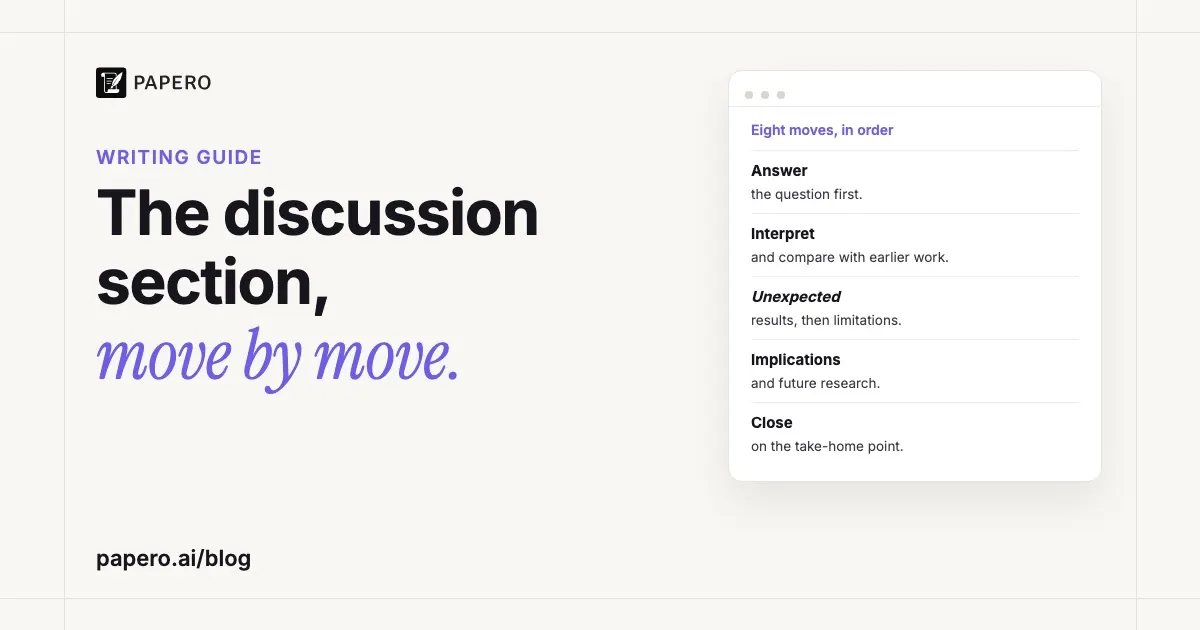
The discussion section of a research paper explains what your results mean. It opens by answering the research question in a sentence or two, then interprets the findings, compares them with earlier studies, explains anything unexpected, states the limitations, draws implications, names the next study and closes. Below are those eight moves and two published discussions, one quantitative and one qualitative, annotated part by part.
Key Takeaways
- Start with the answer to your research question, not with background. One sentence is often enough.
- Interpret, do not repeat. The results section reports what you found; the discussion says what it means and how sure you are.
- Compare with earlier work in both directions: say where other studies agree, and explain where they disagree.
- Every limitation needs a consequence: what it does to the confidence or reach of your findings.
- In a thesis, the discussion is a full chapter that returns to every research question and to the literature review.
What goes in the discussion section of a research paper?
A discussion makes the same moves in most fields: it restates the main finding, interprets it, sets it against earlier studies, deals with surprises, admits limitations, draws implications, points to future research and closes. James Madison University’s writing center describes the shape as narrow to broad, the inverse of an introduction, which narrows from a broad problem to one question.
| Move | What it answers | Length in JMU’s guide |
|---|---|---|
| 1. Restate the main finding | What is the answer to my question? | 1 sentence to 1 paragraph |
| 2. Interpret | What does it mean, and why? | 2 or more paragraphs |
| 3. Compare with earlier work | Do other studies agree? | 1 to 2 paragraphs |
| 4. Explain unexpected results | What did I not predict? | Part of the interpretation |
| 5. Limitations | How far can the reader trust this? | 1 to 3 paragraphs |
| 6. Implications | Who should do what differently? | 1 to 3 paragraphs |
| 7. Future research | What should be studied next? | 1 paragraph, with the close |
| 8. Close | What is the one thing to remember? | 1 paragraph, with future research |
In 1999 Docherty, a professor of rheumatology, and Smith, then editor of the BMJ, proposed a structured discussion because the discussion “is often the weakest part of the paper where careful explanation gives way to polemic.” Their suggested structure had five parts: a statement of principal findings, strengths and weaknesses of the study, strengths and weaknesses in relation to other studies, the meaning of the study, and unanswered questions and future research. A 2026 guide by Leboeuf-Yde and Gudex keeps almost the same list as six elements. The middle moves change order from paper to paper; the first and last stay put.
How do you write a discussion section, move by move?
Write the discussion after the results are final, and plan it from your research questions, not from your notes on other papers. Give each move a paragraph or a few sentences, and check that every claim points back to a result you reported. The advice for each move below comes from university writing guides and published guidance for authors.
1. Restate the main finding and answer the question
Docherty and Smith ask for “a restatement of the principal finding. Ideally, this should be no more than one sentence.” Name the answer, add the single most important number, and move on.
2. Interpret the findings
Say what the result means and why you think it happened. USC Libraries’ guide sets the order: “first state the answer, then the relevant results, then cite the work of others.” If your introduction ended on a gap in the literature, say here whether you filled it; our guide on how to write a research paper introduction shows how that gap is set up.
3. Compare with earlier work, agreeing and disagreeing
Leboeuf-Yde and Gudex ask for “just an indication of whether your results agree with, supplement, or contradict the findings of previous studies”, with possible reasons for any difference, not a second literature review. If a study you cited does not support your findings, USC’s guide says, “don’t ignore it”. The verbs for reporting other studies are in our guide to signal phrases.
4. Explain unexpected results
Give a surprise its own paragraph: describe it, offer the most likely explanation, then the alternatives. Docherty and Smith add a warning: “If you don’t know why your results are different from those of others then don’t pretend you do.”
5. Limitations
A limitation paragraph names a weakness in the design or data and says what it does to the findings: weakens a causal claim, narrows who the result applies to, or puts one measure in doubt. Weaknesses the authors admit, Leboeuf-Yde and Gudex note, “are generally accepted, considered, and ‘forgiven’, whereas flaws uncovered by the reader make the authors appear untrustworthy.” A short real one, from Example 1 below:
First, the sleep quality measures were made with proprietary algorithms. There is an evidence that the use of cardiac, respiratory, and movement information from Fitbit devices can accurately estimate sleep stages, but there is no published evidence that Fitbit’s 1~10 sleep quality scores represent a valid assessment of sleep quality.
It names one measure, and the consequence is plain: the sleep quality result rests on a score with no published validation. A bare list (“small sample, self-report, one university”) does none of that work. Our guide to the limitations of a study sets out the main types, a five-part way to write each one and more published examples.
6. Implications
Say who should act on the findings and how, in proportion to the design: a correlation supports “worth testing”, not “schools should”.
7. Future research
Name the next study, not “more research is needed”, and grow it from your limitations: if your design could not show cause, say which experiment could. Keep it short. Docherty and Smith call this “the part of the paper where authors often run amok”.
8. Close
End with the one sentence a reader should remember, claiming no more than your evidence shows. Leboeuf-Yde and Gudex point out that “many people read only the Title and the Conclusions of an article”.
Discussion section example 1: a quantitative study
This discussion is from Okano and colleagues (2019) in npj Science of Learning, published under a Creative Commons Attribution (CC BY 4.0) licence. Eighty-eight students in an introductory chemistry class wore activity trackers for a semester, and the team correlated their sleep with quiz and exam grades. The discussion is about 600 words in five paragraphs; its key sentences are quoted exactly, with reference numbers removed.
Paragraph 1: main finding, number, agreement.
This study found that longer sleep duration, better sleep quality, and greater sleep consistency were associated with better academic performance. A multiple linear regression revealed that these three sleep measures accounted for 24.44% of the variance in overall grade performance. Thus, there was a substantial association between sleep and academic performance. The present results correlating overall sleep quality and duration with academic performance are well aligned with previous studies on the role of sleep on cognitive performance.
The first sentence answers the research question with “associated with”, the right verb for a correlational design. The second gives the one number that matters, and the fourth agrees with earlier work. Our guide to correlation vs causation shows which verbs fit which designs.
Paragraph 2: a disagreement, interpreted.
Unlike a prior study, we did not find that sleep duration the night before an exam was associated with better test performance. Instead we found that both longer sleep duration and better sleep quality over the full month before a midterm were more associated with better test performance. Rather than the night before a quiz or exam, it may be more important to sleep well for the duration of the time when the topics tested were taught.
The paragraph to copy. It names the finding it contradicts, reports its own, and offers an interpretation hedged to fit the evidence. One slip to avoid: the paragraph’s final sentence, not quoted here, says better sleep “leads to improved performance”, leaning on earlier controlled studies; this correlational design could not show that by itself.
Paragraph 3: a secondary finding. Female students slept better and more regularly, “Consistent with some previous research”, and their grade advantage disappeared once sleep was statistically equated. A secondary finding belongs after the main one, as here.
Paragraph 4: limitations with consequences, and the next study.
Second, the relation between sleep and academic performance may be moderated by factors that can affect sleep, such as stress, anxiety, motivation, personality traits, and gender roles. Establishing a causal relation between sleep and academic performance will require experimental manipulations in randomized controlled trials, but these will be challenging to conduct in the context of real education in which students care about their grades. Third, these findings occurred for a particular student population at MIT enrolled in a particular course, and future studies will need to examine the generalizability of these findings to other types of student populations and other kinds of classes.
Three numbered limitations (the first is quoted under move 5), each with its cost: an unvalidated measure, moderating factors and so no causal claim, one course at one university. Here the paper concedes what paragraph 2’s “leads to” skipped over, and the future research grows out of the limitations.
Paragraph 5: the close. Two sentences, opening “In sum, this study provides evidence” and repeating the headline with its size, “about a quarter” of the variance. What is missing is an implications paragraph: advice for students is folded into paragraphs 2 and 3, where it is easy to miss.
Discussion section example 2: a qualitative study
A qualitative discussion makes the same moves but is organised by theme, uses participants’ words, and speaks of depth rather than generalisation. This example is from Edvardsen Tonheim and colleagues (2025) in BMC Medical Education, published under CC BY 4.0. They interviewed 14 health science master’s students about online group work and developed three themes with reflexive thematic analysis.
Quotes keep the authors’ spelling, with reference numbers removed. Our comparison of qualitative vs quantitative research explains why the two kinds of answer look so different.
Opening: the themes are the answer.
While each student in our study had their own unique experience with online group work, our analysis revealed multiple factors acting together as facilitators and barriers. The themes we developed are the central conditions that influenced the students’ experiences of online group work.
No numbers: the answer to a qualitative question is the set of themes, which the researchers say they “developed”, as their method expects.
Theme 1: agreement, then the local context. The authors agree with earlier work outright (“Consistent with our findings, previous research have recognised scheduling challenges as a main barrier to online group work”), then explain why the problem is sharper for adults returning after years of clinical practice, often with shift work. They also weigh the students’ own fix against its cost:
The students in our study agreed, suggesting compulsory assignments or attendance as key to boost participation. However, one should be aware of the trade-off in increasing obligation, as it would compromise the highly valued flexibility.
Theme 2: a study that qualifies the participants’ view. Students preferred fixed groups, and the authors add a study showing that the preference does not change learning outcomes: “Campbell et al. found that while students preferred fixed groups, no difference in learning outcomes was observed between fixed and random groups.”
Theme 3: participants’ words beside the literature.
Kwon et al. propose that students may attribute early successful group regulation to ‘good chemistry’ without understanding how and why this is achieved. Similarly, our study found that students with positive online group work experiences attributed it to ‘being lucky with the group’, struggling to identify specific reasons.
An interview phrase beside a published idea makes each more convincing.
Synthesis, strengths and limitations. A short paragraph shows how the three themes “mutually influence one another”. The methodological section claims one strength, being “the first to use individual interviews” on this question, then gives limitations with consequences: one man among the participants, one university, and a gift card that “may have introduced selection bias”. It is clear about scope: “we did not seek to generalise our results, but to gain in-depth knowledge of the master’s students’ perspectives”.
Implications. The paper’s separate “Conclusion and implications for practice” section ends with concrete proposals for course designers, among them fixed groups of three or four students and some mandatory elements in group assignments.
Signal phrases for each move
Readers find their way through a discussion by its signposts. The middle column is ours to adapt; the right column quotes the two examples above.
| Move | Phrases to adapt | Seen in the examples |
|---|---|---|
| Main finding | This study found that…; The results show that… | “This study found that longer sleep duration…” |
| Agreement | These results are consistent with…; In line with X… | “Consistent with our findings, previous research…” |
| Disagreement | In contrast to X, we found…; Unlike earlier studies… | “Unlike a prior study, we did not find…” |
| Interpretation | One explanation is that…; This suggests that… | “it may be more important to sleep well…” |
| Limitation | A limitation of this study is X, which means that… | “Several limitations of the present study may be noted.” |
| Future research | Future studies could test whether… | “future studies will need to examine the generalizability…” |
| Close | Taken together…; Overall, this study shows… | “In sum, this study provides evidence…” |
USC’s guide adds a tense rule: present tense for what findings mean and for established facts, past tense for what specific earlier studies found.
How is a discussion different from the results and the conclusion?
The results section reports what you found, with numbers or themes and no interpretation. The discussion explains what those findings mean and how they fit earlier work. The conclusion, where it is separate, states the take-home answer briefly with few statistics. Each section has one job, so text copied from one into the next adds length and no information.
| Results | Discussion | Conclusion | |
|---|---|---|---|
| Job | Report findings | Interpret and compare them | State the answer and why it matters |
| Numbers | All the key ones | The few that carry the argument | Few or none |
| Citations | Rare | Many | Few |
| Typical length | Set by your data | Six or seven paragraphs in an article | A paragraph or a short section |
The glossary entry on the results section covers the reporting side, and our guide on how to write a results section annotates the results of both papers discussed above. USC’s guide puts recommendations for further research in the discussion or the conclusion, not both. An essay conclusion follows different rules, set out in our guide on how to write a conclusion, and a lab report’s discussion is one short section, as in our lab report example.
How long should a discussion section be?
For a journal article or course paper, aim for about six or seven paragraphs. Şanlı and colleagues advise that the discussion should not run longer than the introduction, methods and results combined, and that no paragraph should exceed 200 words, which caps a seven-paragraph discussion near 1,400 words. JMU’s guide gives a range per move instead, from one sentence to two or more paragraphs.
The two examples sit on either side of that cap: about 600 words for the sleep study, about 2,300 under four subheadings for the interview study, plus a separate conclusion, where each theme gets its own comparison with the literature. Oxford’s MPLS Division puts the reader’s view plainly: readers “will thank you for a relevant and focused discussion that does not go for page after page!” If yours grows out of proportion, Leboeuf-Yde and Gudex name the usual causes: straying from your research objectives, repeating your background section, or spending too long on other studies.
How is a thesis or dissertation discussion chapter different?
In a thesis or dissertation, the discussion is a full chapter (one university’s master’s guidelines suggest 10 to 15 pages) that returns to every research question and to the literature review chapter. It interprets the findings against the theoretical framework set out there, draws theoretical and practical implications, and covers limitations and future research at greater length than an article would.
Those 10 to 15 pages come from the University of Kansas journalism school, out of a thesis of about 50 to 75, and its guidelines say the discussion “should circle back to the literature review”. A University of Florida journalism guide by Linda Childers Hon says to begin “by discussing your findings in relation to the theoretical framework introduced in the literature review”, and notes that students “skimp on this chapter” though it answers the “So what?” question. A doctoral thesis runs far longer, and its word cap depends on the university: our thesis and dissertation comparison quotes caps from 60,000 to 100,000 words.
Two rules change at thesis length. New literature is sometimes allowed: the Florida guide says you may need it, “particularly with qualitative research”. And the guides disagree about new results: Kansas says the chapter “can also introduce additional results”, while USC’s guide says “Do not introduce new results in the discussion section.” Ask your supervisor which rule your department follows. The glossary entry on the dissertation shows where the chapter sits.
What are the most common discussion section mistakes?
Most weak discussions repeat the results, claim more than the design allows, or leave out studies that disagree. The rest are failures of structure: a second introduction at the start, limitations listed with no consequence, and a close that speculates beyond the data. Each row pairs a mistake with its fix, drawn from the guides cited above.
| Mistake | What it looks like | Fix |
|---|---|---|
| Repeating the results | Every mean and p-value again | Restate the answer once, then interpret |
| New results | A new analysis first appears here | Move it to the results section |
| Causation from correlation | “Sleep improves grades” | “Better sleep was associated with better grades” |
| Ignoring contrary studies | Only the studies that agree | Name the disagreement and give reasons |
| Limitations with no consequences | “Small sample, one university” | Say what each one does to the findings |
| A second introduction | Two paragraphs of background first | Start with the main finding |
Oxford’s MPLS guide lists the same traps, including “beginning with a second introduction”, “repetition of all the results” and “overinterpretation of results”, and USC’s guide gives the repeated-results trap its own heading: “Don’t Write Two Results Sections!”
Where Papero fits
Papero is an AI writing workspace for students and researchers. Its outline builder can start a paper from a standard IMRaD structure, and the Discussion section comes with one prompt in three points: “What the findings mean for your question”, “How they compare with earlier work” and “Limitations and next steps”. Those cover moves 2, 3, 5 and 7 above, so you can draft under them and check that none is missing.
Find papers searches more than 250 million papers through OpenAlex when you need earlier studies to compare with, and Review’s Claims check finds sentences that need a citation. The research paper writing page shows the whole process, and you can sign up free. Deciding what your findings mean stays your job.
Frequently Asked Questions
How long should a discussion section be?
In a journal article or course paper, often six or seven paragraphs. One published guide advises keeping it shorter than the introduction, methods and results combined, with no paragraph over 200 words. In a master’s thesis the discussion is a full chapter, and one university’s guidelines suggest 10 to 15 pages.
What is the difference between a discussion and a conclusion?
A discussion interprets the findings, compares them with earlier studies and states the limitations. A conclusion gives the take-home answer and why it matters, in a paragraph or a short section, with few statistics. Some papers end the discussion with a concluding paragraph instead of a separate conclusion.
Can you add new results in the discussion section?
Usually not. Many writing guides say every result should first appear in the results section, and the discussion interprets only what was reported there. Some thesis guidelines allow additional results in the discussion chapter, so check your department’s rules with your supervisor.
What tense should a discussion section be written in?
Use the present tense for what your findings mean and for established knowledge, and the past tense for what you found and for what specific earlier studies found. For example: “We found that longer sleep was associated with higher grades, which suggests that sleep matters during learning.”
Sources
- Docherty, M., & Smith, R. (1999). The case for structuring the discussion of scientific papers. BMJ, 318(7193), 1224–1225. https://doi.org/10.1136/bmj.318.7193.1224
- Edvardsen Tonheim, L., Molin, M., Brevik, A., & Garnweidner-Holme, L. (2025). Experiences with online group work among master’s students in health sciences: A qualitative study. BMC Medical Education, 25, Article 1262. Licence: CC BY. https://doi.org/10.1186/s12909-025-07845-w
- Hon, L. C. (2007). Guidelines for writing a thesis or dissertation [PDF]. University of Florida College of Journalism and Communications. https://www.jou.ufl.edu/grad/forms/Guidelines-for-writing-thesis-or-dissertation.pdf
- James Madison University Writing Center. (n.d.). Discussion and conclusion sections for empirical research papers: An overview [PDF]. https://www.jmu.edu/uwc/files/link-library/empirical/discussion_section_overview.pdf
- Leboeuf-Yde, C., & Gudex, C. (2026). Practical guide to structuring the Discussion section in clinical and epidemiological studies. Chiropractic & Manual Therapies, 34, Article 45. Licence: CC BY. https://doi.org/10.1186/s12998-026-00645-z
- Okano, K., Kaczmarzyk, J. R., Dave, N., Gabrieli, J. D. E., & Grossman, J. C. (2019). Sleep quality, duration, and consistency are associated with better academic performance in college students. npj Science of Learning, 4, Article 16. Licence: CC BY. https://doi.org/10.1038/s41539-019-0055-z
- Şanlı, Ö., Erdem, S., & Tefik, T. (2013). How to write a discussion section? Turkish Journal of Urology, 39(Suppl. 1), 20–24. https://doi.org/10.5152/tud.2013.049
- University of Kansas William Allen White School of Journalism and Mass Communications. (n.d.). Thesis guidelines. https://journalism.ku.edu/thesis-guidelines
- University of Oxford MPLS Division. (n.d.). Discussion section. https://www.mpls.ox.ac.uk/training/resources-for-researcher-and-career-development/communication-skills/scientific-writing/discussion-section
- University of Southern California Libraries. (2026). 8. The discussion. In Organizing your social sciences research paper. https://libguides.usc.edu/writingguide/discussion