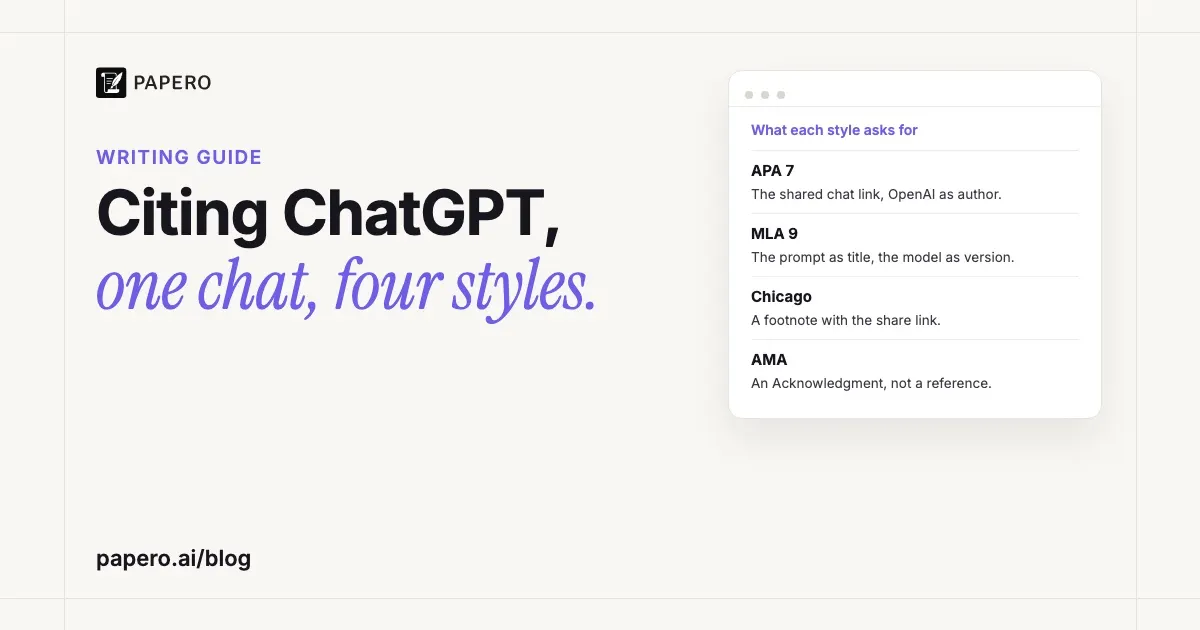
To cite ChatGPT in APA 7, share the chat and name OpenAI as the author, then give the date of the chat, its title in italics with [Generative AI chat], the tool and the shared link: OpenAI. (2025, August 21). High school grammar concepts [Generative AI chat]. ChatGPT. https://chatgpt.com/share/68a77b60-0ee4-800c-9acc-cd3fd573c311. In the text, write (OpenAI, 2025). MLA and Chicago use the same shared link, with the other details in a different order.
Key Takeaways
- In September 2025 APA added a format for a shared chat and stopped asking for version numbers such as “(Mar 14 version)”.
- MLA (August 2025) describes the prompt as the title, puts ChatGPT in the container, names the model and prefers the shared link.
- Chicago (Q&A revised for the 18th edition in September 2026) accepts a mention in your text for most writing, and a numbered note with the link from OpenAI’s Share button in student papers and research articles.
- AMA style has no reference entry for ChatGPT: JAMA wants AI use reported in the Acknowledgment section.
- Credit ChatGPT for words you quote or paraphrase (in AMA, in the Acknowledgment), disclose other help in a statement, and never cite ChatGPT as the source of a fact.
ChatGPT citation examples in APA, MLA, Chicago and AMA
The table cites one real conversation four ways: the ChatGPT chat the APA Style team shared in September 2025, answering the prompt “I’d like a list of grammar topics that a student should understand by the time they graduate from high school.” The APA entry is APA’s own; we built the other three from each guide’s rules.
| Style and guidance | Reference entry | In the text or note |
|---|---|---|
| APA 7 (APA Style blog, September 9, 2025) | OpenAI. (2025, August 21). High school grammar concepts [Generative AI chat]. ChatGPT. https://chatgpt.com/share/68a77b60-0ee4-800c-9acc-cd3fd573c311 | (OpenAI, 2025) or OpenAI (2025) |
| MLA 9 (MLA Style Center, August 13, 2025) | “I’d like a list of grammar topics that a student should understand by the time they graduate from high school” prompt. ChatGPT, model GPT-5, OpenAI, 21 Aug. 2025, chatgpt.com/share/68a77b60-0ee4-800c-9acc-cd3fd573c311. | (“I’d like a list”) |
| Chicago notes (CMOS Q&A, 18th edition, September 2026) | None shown in the current answer | 1. Text generated by ChatGPT, OpenAI, August 21, 2025, https://chatgpt.com/share/68a77b60-0ee4-800c-9acc-cd3fd573c311. |
| AMA 11 (JAMA Instructions for Authors, September 8, 2026) | None | Acknowledgment: The author used ChatGPT (GPT-5, OpenAI) on August 21, 2025, to list grammar topics a high school graduate should know, and takes full responsibility for the content. |
Two details come from opening the shared chat ourselves. Its data records the model as GPT-5 and the date as August 21, 2025, which is where the MLA entry’s version and date come from. And its page is now titled “High school grammar topics”, not the “concepts” APA printed; APA notes that most tools let users edit chat titles. Copy the title your chat shows on the day you cite it.
Harvard has no single official manual, so for Harvard follow your university’s version.
How do you cite ChatGPT in APA?
Since September 2025, APA cites a specific chat by its shared link: OpenAI as author, the full date of the chat, the chat’s title in italic sentence case followed by [Generative AI chat], then the tool or model name and the URL. The in-text citation is (OpenAI, 2025). Version numbers such as “Mar 14 version” are gone; add the model name only when you know it.
APA’s 2023 post on citing ChatGPT now says newer guidance replaced it and that it is kept “for archival purposes only.” Many guides still copy its entry, OpenAI. (2023). ChatGPT (Mar 14 version) [Large language model]. https://chat.openai.com/chat, which existed because, as that April 2023 post put it, a ChatGPT chat was “not retrievable by other readers.” The 2025 post explains that ChatGPT no longer shows version numbers.
APA keeps a second format for the tool in general: OpenAI. (2025). ChatGPT [Large language model]. https://chatgpt.com/. Use it when no single chat is worth pointing to, for example when ChatGPT helped you edit or translate your own writing. The year is when the tool was last updated, and the bracket names the kind of model; the glossary explains what a large language model is. APA’s model sentence for the text: “I used ChatGPT (OpenAI, 2025) to edit my paper and provide feedback on clarity and flow.”
Prompts stay out of the reference. Describe them in your text, an appendix or supplemental material where they help readers. Every reference also needs a matching citation in the body; our guide to APA in-text citations covers the parenthetical and narrative forms.
How do you cite ChatGPT in MLA?
MLA uses its template of core elements: a description of what you asked as the title of the source, ChatGPT in italics as the container, the model as the version, OpenAI as publisher, the date the text was generated, and the shared link. MLA does not treat the AI as the author. In the text, use the first words of the title: (“I’d like a list”).
The MLA Style Center revised its advice on August 13, 2025. It now prefers a “stable, shareable URL” to the conversation, with the tool’s general URL only when sharing is not available, and it puts the model name in the version element, as in “model GPT-4o”. Its 2023 examples, with “13 Feb. version” and chat.openai.com/chat, are the old form. MLA also accepts a shorter, general description, such as Grammar topics for high school graduates prompt, because one chat can run through several prompts. With the full prompt as the title, a quotation reads:
Asked for the grammar a graduating student should know, ChatGPT began with “a solid list of core grammar topics a student should understand by the end of high school” (“I’d like a list”).
For an AI image, MLA puts the same details in the figure caption, starting with “Fig. 1.” Our guide to the MLA Works Cited page covers the order and punctuation of the other entries. For the APA and Chicago versions of an AI image credit, see our guide to citing images.
How do you cite ChatGPT in Chicago?
Chicago asks you to credit ChatGPT whenever you use text it generated, but for most writing, naming the tool in your sentence is enough. For a student paper or research article, use a numbered note: “Text generated by ChatGPT, OpenAI, January 10, 2026, URL”, with the link copied from OpenAI’s Share button. Add the prompt to the note if your text does not give it.
That note format comes from the Chicago Manual of Style’s online Q&A, which Internet Archive copies show was rewritten for the 18th edition between September 11 and 23, 2026. If you edited the AI text, say so in your text or at the end of the note, for example “edited for style and content”. Our guide to Chicago style footnotes shows how notes are numbered and placed.
The old 17th-edition answer kept ChatGPT out of the bibliography unless you gave a publicly available link, and gave author-date writers a parenthetical: (ChatGPT, March 7, 2023). The current answer drops both points. The 18th edition has its own section 14.112, “Citing AI-generated content”, next to personal communications. If you write in Chicago author-date, ask your instructor whether a shared chat gets a reference list entry.
How do you cite ChatGPT in AMA?
AMA style does not cite ChatGPT as a numbered reference. JAMA’s instructions, updated September 8, 2026, say AI use for creating, revising or formatting content must be reported in the Acknowledgment section, or in Methods when AI is part of the research. They also say chatbots should not be used to generate or format references at all.
The acknowledgment names the tool, its version, the manufacturer, the dates of use and how the AI was used, and confirms the authors take responsibility for the content. The AMA Manual of Style (section 3.15.13, as quoted on the AMA Style Insider blog in November 2024) offers a model that begins: “The authors acknowledge using ChatGPT (GPT-3.5, OpenAI) for text editing to improve the fluency of the English language in the preparation of this manuscript on September 15, 2023.” For our chat: “The author used ChatGPT (GPT-5, OpenAI) on August 21, 2025, to list grammar topics a high school graduate should know, and takes full responsibility for the content.” Basic grammar and spelling checkers need no disclosure. Our guide to AMA citation format covers the rest of the style.
How to cite other AI tools (Claude, Gemini, Copilot)
Every chat tool follows the ChatGPT pattern: the company that made it is the author or publisher, the tool or model name replaces ChatGPT, and the link is that tool’s share link. APA’s own examples cite Anthropic for Claude Sonnet 4 and Google for Gemini 2.5 Flash, each with the date of the chat and [Generative AI chat].
- Anthropic. (2025, May 20). Essential grammar topics for high school graduates [Generative AI chat]. Claude Sonnet 4.
https://claude.ai/share/329173b2-ec93-4663-ac68-4f65ea4f166d - Google. (2025, May 22). High school grammar concepts overview [Generative AI chat]. Gemini 2.5 Flash.
https://g.co/gemini/share/a1306ce12929
Citing Copilot depends on where you used it. APA says you do not cite Copilot inside Microsoft Word, any more than you would cite spell-check. When Copilot or another AI search tool points you to sources, APA and MLA both say to open and cite those sources, not the AI’s summary. For AI-made tables and figures, APA uses a table or figure note. All of these are forms of generative AI, and the styles treat them alike.
Do you have to cite ChatGPT?
Yes. Every style above asks you to credit ChatGPT when you quote, paraphrase or include its output: APA and MLA with a reference, Chicago in your text or a note, and AMA in the Acknowledgment. Whether you may use it at all depends on your instructor, university or journal. APA’s answer is “yes, for some AI tools, for some purposes, and no, for others”, and AI used only as a search engine usually needs no citation.
Many courses allow some uses of ChatGPT and require you to declare them; some ban it. On authorship, journals and publication-ethics bodies agree: the Committee on Publication Ethics stated in February 2023 that AI tools cannot be authors because they “cannot take responsibility for the submitted work”, and that authors must disclose which tool they used and how. The glossary entry on publication ethics covers the wider authorship rules.
Citing ChatGPT vs disclosing AI use
A citation points to AI output you quoted or paraphrased. A disclosure describes help that left no quotable trace, such as brainstorming, outlining, editing or translating your own writing. MLA’s 2023 guidance sets out the split: cite the tool for content you use, and acknowledge “all functional uses of the tool” in a note or your text.
APA puts the disclosure in the Method section or the author note, with an in-text citation to the tool in the body; JAMA puts it in the Acknowledgment. MLA’s August 2025 post “Beyond Citation” calls acknowledgment “more comprehensive than” citation and says “generative AI output is not a source in the traditional sense.” In a September 2026 guest post on the APA Style blog, Vanessa Woods and Nicole Alea Albada made the case for a student “AI contribution statement”; the APA Style team notes that it is not a requirement unless an instructor or institution sets it.
What not to do
Do not cite ChatGPT as the source of a fact. MLA says its output “assembles information from sources based on predictive computation”, so find the real source, read it and cite that. Do not list ChatGPT as an author, present its text as your own, or let it write your reference list, which JAMA tells its authors not to do.
The fact rule matters most. In APA’s 2023 post, the author asked ChatGPT for sources behind its claims: of five references, one did not seem to exist, and its DOI belonged to a different article. Our guide to spotting fake AI references shows how to check every entry.
Where Papero fits
Papero is an AI writing workspace for students and researchers. Its AI use statement is for disclosing the help Papero gave you, not a source to cite: choose “Insert AI use statement” from the toolbar or document menu, or pick “AI use statement” from the slash menu, and Papero adds an editable English paragraph after the block you are in:
AI use statement: I used Papero (papero.ai), an AI writing assistant that runs on OpenAI language models, while writing this document. I used it for [say what for, for example suggesting sentences, rewriting passages, outlining or drafting sections]. Every citation refers to a source I chose, and I take full responsibility for the content, including any text the AI suggested.
You fill in the bracket, and choosing it again takes you to the statement you already have. It covers Papero only: if you also used ChatGPT, say so, and cite any chat you quote. Papero has no source type for an AI chat, so you write that reference yourself. Its citations come from scholarly records you choose, found through OpenAlex, looked up by DOI, PMID, arXiv ID or ISBN, or entered by hand, in nine styles including APA 7, MLA 9, Chicago author-date and AMA 11. The essay writing page shows the workflow, and you can sign up free.
Frequently Asked Questions
Can you cite ChatGPT in APA?
Yes. APA 7 cites a ChatGPT chat with OpenAI as the author, the date of the chat, the chat title in italics followed by [Generative AI chat], ChatGPT or the model name, and the chat’s shared link. The in-text citation gives OpenAI and the year of the chat, such as (OpenAI, 2025). APA added this chat format in September 2025, replacing the version-numbered format of its 2023 post.
Can you use ChatGPT to find sources to cite?
ChatGPT can suggest sources, but every reference it gives has to be checked, because chatbots sometimes invent references or attach real DOIs to the wrong papers. Open each source, read it, and cite the source itself rather than ChatGPT. JAMA also tells authors not to use chatbots to generate or format references.
Do you need the ChatGPT version number in a citation?
Not in APA, which dropped version numbers in September 2025 and asks for the model name, such as ChatGPT-5, only when known. MLA’s August 2025 guidance names the model in the version element, for example “model GPT-4o”. Examples showing “Mar 14 version” or “13 Feb. version” follow the older 2023 guidance.
Can ChatGPT be listed as an author?
No. COPE, JAMA and APA say an AI tool cannot be an author, and MLA advises against treating the tool as the author in a citation. COPE’s reason is that an AI tool cannot take responsibility for the work. In APA, OpenAI appears as the author of a ChatGPT chat, and the human writer stays responsible for every word.
Sources
- Timothy McAdoo, Samantha Denneny and Chelsea Lee, “Citing generative AI in APA Style: Part 1: Reference formats” (APA Style blog, September 9, 2025, accessed October 2026 through the Internet Archive): https://apastyle.apa.org/blog/cite-generative-ai-references
- Timothy McAdoo, Samantha Denneny and Chelsea Lee, “Citing generative AI in APA Style: Part 2: AI as a search engine and AI integrated into common software” (APA Style blog, September 9, 2025): https://apastyle.apa.org/blog/cite-generative-ai-search-software
- Timothy McAdoo, Samantha Denneny and Chelsea Lee, “Citing generative AI in APA Style: Part 3: Is AI “allowed” in APA Style?” (APA Style blog, September 9, 2025): https://apastyle.apa.org/blog/cite-generative-ai-allowed
- Timothy McAdoo, “How to cite ChatGPT” (APA Style blog, April 7, 2023, last updated September 15, 2025, kept for archival purposes): https://apastyle.apa.org/blog/how-to-cite-chatgpt
- Vanessa Woods and Nicole Alea Albada, “Moving beyond the crisis of AI use: The case for an AI contribution statement” (APA Style blog, September 15, 2026): https://apastyle.apa.org/blog/ai-contribution-statement
- MLA Style Center, “How do I cite generative AI in MLA style? (Updated and Revised)” (August 13, 2025, accessed October 2026 through the Internet Archive): https://style.mla.org/citing-generative-ai-updated-revised/
- MLA Style Center, “How do I cite generative AI in MLA style?” (March 2023, with a note pointing to the 2025 revision): https://style.mla.org/citing-generative-ai/
- MLA Style Center, “Beyond Citation: Describing AI Use in Your Work” (August 13, 2025): https://style.mla.org/describing-ai-use/
- The Chicago Manual of Style Online, Chicago Style Q&A, “Citation, Documentation of Sources” (answer on citing AI-generated content, 18th edition, revised September 2026; the earlier 17th-edition answer read in Internet Archive copies to September 11, 2026): https://www.chicagomanualofstyle.org/qanda/data/faq/topics/Documentation/faq0422.html
- The Chicago Manual of Style, 18th edition, chapter 14 contents (section 14.112, “Citing AI-generated content”): https://www.chicagomanualofstyle.org/book/ed18/part3/ch14/toc.html
- JAMA Network, “Instructions for Authors”, Use of AI in Publication and Research (last updated September 8, 2026, accessed October 2026 through the Internet Archive): https://jamanetwork.com/journals/jama/pages/instructions-for-authors
- Jennifer Sakhnovsky, “Can JAMA Network Authors Use Generative Artificial Intelligence to Create Content?” (AMA Style Insider, November 27, 2024): https://amastyleinsider.com/blog/2024/11/27/can-jama-network-authors-use-generative-artificial-intelligence-to-create-content
- Committee on Publication Ethics, “Authorship and AI tools”, COPE position statement (February 13, 2023): https://publicationethics.org/guidance/cope-position/authorship-and-ai-tools
- OpenAI, ChatGPT shared chat “High school grammar topics” (August 21, 2025), the example chat from APA’s Part 1 post, opened October 30, 2026:
https://chatgpt.com/share/68a77b60-0ee4-800c-9acc-cd3fd573c311