A research question is the one question a study is built to answer. A good one names who or what you are studying and what you want to find out, and its wording points to a method. Below are research questions quoted word for word from 15 published studies, sorted by study design, with notes on what made each answerable, plus rewrites of weak questions and the FINER test.
Key Takeaways
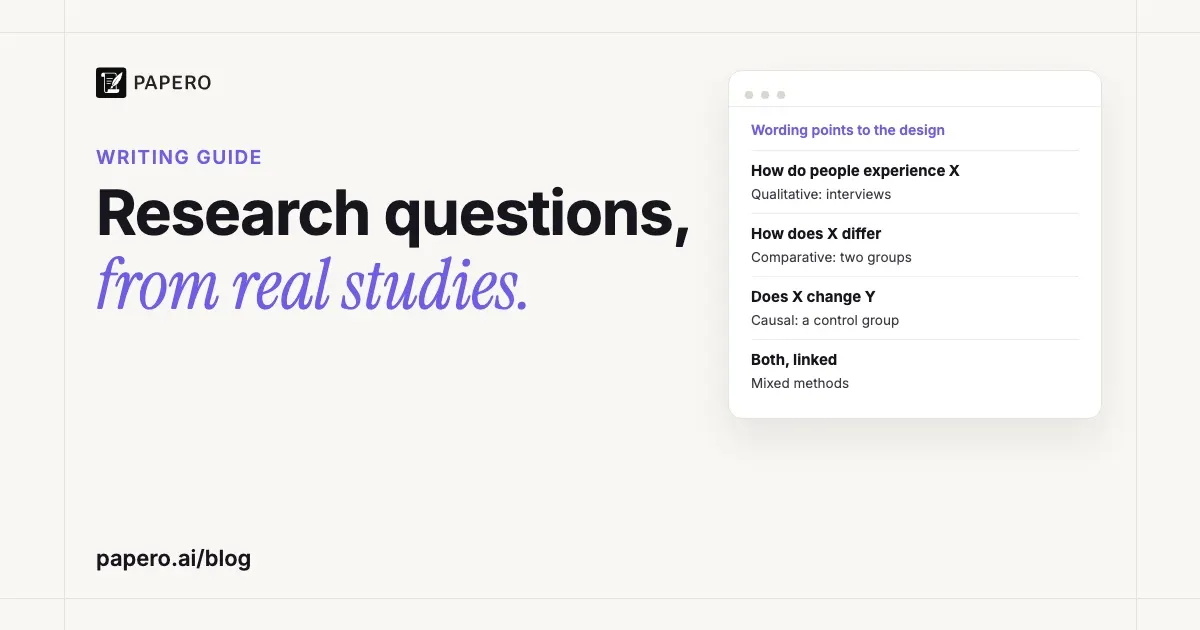
- The opening words of a research question signal the design. “How do … experience” leads to interviews; “differ between” leads to a comparison; “Does X increase Y more than Z” needs a control group.
- Most of the published questions below name their population or setting in the question itself (heart patients, breast cancer survivors, children in two kinds of preschool); the rest rely on the sentences around them.
- Several of the published questions can be answered yes or no. A closed question works when it names the comparison and the outcome.
- A broad question is a starting point, not a mistake. In one Barcelona study, citizens voted for a broad question and a workshop turned it into a study design with daily measurements.
- The FINER criteria (feasible, interesting, novel, ethical, relevant) come from Hulley and colleagues’ textbook Designing Clinical Research and work as a final check in any field.
What makes a good research question?
A good research question can be answered with evidence you are able to collect. It is one sentence, it names a population or a setting, it names the thing you will observe or measure, and it does not contain its own answer. Its wording also commits you to a design: a “how” or “what” question about experiences calls for qualitative data, while a question about amounts, differences or effects calls for numbers.
The table shows how the wording of a question points to a design. Each row names a published example from further down.
| If the question asks | It is usually | Typical data | Published example below |
|---|---|---|---|
| How do people experience or describe X? | Qualitative | Interviews, focus groups, documents | Heart patients and activity data |
| What, how much or how often? | Quantitative, descriptive | Surveys, counts, records | What children eat from a school lunch |
| How does X differ between groups? | Quantitative, comparative | Measures from two or more groups | Activity in two kinds of preschool |
| Is X associated with Y, or does X predict Y? | Quantitative, relationship (correlational) | Measures of both variables in one sample | Implicit bias and voting |
| Does X change Y, compared with Z? | Quantitative, causal | An experiment or trial with a comparison condition | Flipped classroom and grammar accuracy |
| Both a number and an explanation of it | Mixed methods | One quantitative and one qualitative strand | Play2Sleep and infant night wakings |
The glossary entry on the research question defines the term and walks through the steps from a topic to a question. This guide is about what finished questions look like in real studies. Every example in the next three sections is quoted from the abstract of an open-access paper published under a CC BY licence; the examples written for this article are in later sections and labelled as such. In most of these abstracts the question comes early, right after the background, in the “aim or question” slot our abstract example guide maps out. How the two approaches differ beyond the question, in sampling, data, analysis and write-up, is set out in our guide to qualitative vs quantitative research.
Qualitative research question examples
Qualitative research questions ask how people experience, describe or make sense of something, or how a text or a debate frames it. They usually start with “how” or “in what ways”, they name one group and one experience, and they do not predict an answer. The four below, from health, family studies, medical education and sociology, show the range: two use interviews, one uses interviews with a theory as a lens, and one analyses newspaper articles alongside stakeholder interviews.
1. Health. Andersen et al. (2020) asked:
“How do patients with heart disease experience activity data in relation to self-care and chronic illness?”
What makes it answerable: the group (patients with heart disease), the thing they experience (activity data) and the context (self-care) are all named. The study gave 27 patients with an implanted cardioverter-defibrillator a wearable activity tracker and interviewed them two or three times, 66 interviews in all. The answer came as three dimensions of experience: knowing, feeling and evaluating.
2. Family studies and psychology. Radina et al. (2019) used a named theory, the Theory of Health-Related Family Quality of Life, to frame this question:
“In what ways do breast cancer survivors describe their experiences regarding changes in emotional closeness among family members following their breast cancer diagnosis?”
What makes it answerable: “in what ways do … describe” tells the reader the data are the participants’ own accounts. “Following their breast cancer diagnosis” fixes the time frame. The authors interviewed 22 survivors and analysed the transcripts thematically.
3. Medical education. Guckian et al. (2025) interviewed UK medical students:
“How do medical students conceptualise quality of learning on social media?”
What makes it answerable: it is short because the abstract defines the population around it. The team surveyed 118 students across 25 UK medical schools, then interviewed 13 of them. “Conceptualise” asks for the students’ own idea of quality instead of measuring quality against an outside standard.
4. Sociology. Samuel and Lucivero (2022) studied the public ethics debate around the UK’s COVID-19 contact tracing app:
“how did UK national newspaper news articles and grey literature frame the ethical issues about the app, and how did stakeholders associated with the development and/or governance of the app reflect on this?”
What makes it answerable: the first half names a body of documents (national newspaper articles and grey literature), so the data are texts, not people. The second half adds stakeholder interviews to check the first. A qualitative question can study what was written as well as what people say.
Quantitative research question examples
Quantitative research questions ask about amounts, differences, relationships or effects that can be measured and counted. They name the variables and the population, and each one implies a statistical analysis. The four kinds below go from describing one group to testing a cause, and each needs a stronger design than the one before it.
Descriptive questions
A descriptive question asks what is there, how much or how often, without comparing groups or testing a cause.
“What and how much do children consume from a self-served school lunch and how do they evaluate the lunch?”
This is the first research question of the Healthy School Lunch study in the Netherlands (van Kleef et al., 2020), a published study design. What makes it answerable: “what and how much” can be counted. The protocol measures it with lunch photos and questionnaires at baseline, three months and six months, in children aged 8 to 12.
“What is the level of perceived publication pressure in the four academic institutions in Amsterdam and does the pressure to publish differ between academic ranks and disciplinary fields?”
Haven et al. (2019) put a descriptive question and a comparative one in one sentence. What makes it answerable: “level” is measured with a named instrument, the revised Publication Pressure Questionnaire, and the groups to compare (ranks and fields) are named in advance. A named instrument should also come with published evidence that it measures consistently and accurately; our guide on reliability and validity in research shows how to report it.
Comparative questions
A comparative question asks whether, or how, an outcome differs between two or more groups that already exist.
“How does total outdoor PA differ among children attending traditionally designed versus newly designed preschools, and across different types of outdoor play environments?”
Fröberg et al. (2025), studying the built environment of Swedish preschools, use “PA” for physical activity. What makes it answerable: the two groups are defined, and the outcome was measured with accelerometers worn by 106 children aged 3 to 5 in six preschools. The authors also stated a hypothesis: that children in traditionally designed preschools would be more active. The result went the other way on total activity, and the research question was still answered. A question stays answerable whatever the result; a hypothesis takes a side, as our hypothesis examples guide shows with five published ones.
“Are Black and Hispanic adults with disabilities at increased risk of unmet healthcare needs compared to Black and Hispanic adults without disabilities according to the 2018 National Health Interview Survey?”
Dorsey Holliman et al. (2023) asked this in a study of health inequities. What makes it answerable: the data source is part of the question. Naming an existing national survey tells the reader the study is a secondary analysis, and it fixes the year, the population and the definition of each variable.
Relationship (correlational) questions
A relationship question asks whether two or more variables move together, or how much of one is explained by the others. It does not claim that one causes the other.
“Do measures of implicit racial and gender biases predict political attitudes and voting better than measures of explicit prejudice?”
Calvert et al. (2022) asked this of a broadly representative sample of 1,076 U.S. citizens. What makes it answerable: “predict … better than” sets up a direct contest between two kinds of measure. The answer was that implicit bias added little once explicit prejudice and demographic characteristics were controlled. None of the variables in this question was assigned by the researchers; for how they are named in that case, see variables in an observational study.
“to what extent can individual, climate and publication factors explain the variance in frequently perceived research misbehaviors?”
Haven et al. (2021) surveyed 1,298 academic researchers in Amsterdam. What makes it answerable: “to what extent” asks for a size, not a yes or no, and the three groups of factors were each measured with an instrument. Together they explained 34% of the variance, and climate factors explained the most (22%).
Causal questions
A causal question asks whether changing one thing changes another. To answer it you need a comparison condition, and ideally you decide who gets which condition.
“Does the suggested model of flipped classroom teaching strategy increase the learners’ accuracy in the use of grammar in the target language more than the non-flipped active-learning strategy used?”
This is the first of two research questions in Birova et al. (2023), an education study with 55 pre-service English teachers in Slovakia. What makes it answerable: the comparison condition is named (the non-flipped strategy) and so is the outcome (grammar accuracy), measured with a pre-test and a post-test in a control group and an experimental group. The second question asked the same about listening skills. Listening improved significantly; grammar did not.
“We asked whether the response of grasslands to repeat extreme drought events is modified by elevated CO2, and if so, what are the underlying mechanisms?”
Manea and Leishman (2014) grew small grassland communities of 10 grass species under ambient and elevated CO2 and put them through repeated droughts. What makes it answerable: the researchers controlled both causes, CO2 and drought, which is what makes a causal answer possible. The “if so” clause plans a follow-up question in advance, a good habit when the first answer would raise an obvious second one. Which designs can answer a causal question, and which can only show an association, is set out in our overview of types of research methodology.
Mixed methods research question examples
A mixed methods study often states three questions: one quantitative, one qualitative, and one that says how the two strands fit together. The third question is what separates mixed methods from two studies stapled together. Both examples below come from health research on children and families.
The Play2Sleep study protocol (Keys et al., 2018) states all three:
“Does one dose of Play2Sleep delivered during a home visit with mothers and fathers of infants aged 5 months reduce night wakings at age 7 months?”
“What are parental perceptions of family experiences, processes, and contexts related to Play2Sleep and infant sleep?”
“How do parental perceptions of family experiences, processes, and contexts related to infant sleep explain the effectiveness of Play2Sleep?”
What makes it answerable: the first question is a causal one, answered by a randomized controlled trial; the second is answered with family interviews; the third says the interviews will be used to explain the trial result. That order matches the design the authors name, explanatory sequential: numbers first, then the qualitative strand to explain them.
The CHARMING study (Morgan et al., 2023), a physical activity programme for girls aged 9 and 10 in South Wales, asked two shorter questions in one sentence:
“is it feasible and acceptable to recruit role models? and what are the perceived barriers and facilitators to the inclusion of peer role models within the intervention?”
What makes it answerable: the first half is answered by counts and observation logs; the second by interviews with teachers and community role models and focus groups with older and younger girls. Feasibility questions like this one are common before a full trial, and a student project evaluating a small programme can borrow the same pair. It has no linking question; a process evaluation like this often omits one.
How do you turn a weak research question into a strong one?
Find what you could not measure or observe, and replace it with something you could. Weak questions usually have one of five problems: the scope is too wide, the key word is a judgement, the answer is a literature summary, no measure is named, or no population is named. Each rewrite below fixes one problem and keeps the original interest.
The examples in this table were written for this article.
| Weak question | Problem | Stronger version |
|---|---|---|
| How has climate change affected the world? | No one study could answer it | How has the date of the first autumn frost in one region changed between 1980 and 2020, according to local weather-station records? |
| Is homework good for students? | “Good” is a judgement, not a measure | How does the number of hours of homework assigned per week relate to the hours Year 9 students sleep on school nights? |
| What do studies say about remote work? | The answer is a literature review, not a study | How do employees who moved to fully remote work at one company describe changes in their contact with colleagues? |
| Does music help studying? | Which music, which task, measured how? | Do undergraduates recall more words from a 30-word list studied in silence than from a list studied with instrumental music playing? |
| Why do small shops close? | No population or place | What reasons do owners of independent shops that closed on one high street between 2020 and 2025 give for closing? |
A real case shows the same narrowing done in public. In a citizen science project in Barcelona (Gignac et al., 2022), residents proposed research topics, and 556 of them voted on a shortlist of questions. The winner, with 27% of the votes, was:
“How does air pollution together with noise and green/blue spaces affect mental health?”
That is broad: three exposures and an outcome with no population or time frame. The next step was a workshop where citizens chose a design, an observational study in which participants record daily repeated measures of cognitive and mental health that the team relates to air pollution concentrations. The study design did the narrowing that the wording left open, which is what your method section has to do whenever your question is broader than your data. If you are a step earlier, with an interest but no topic yet, our guide on how to choose a research topic narrows one topic stage by stage.
How do you check a research question? The FINER criteria
Run the finished question through five checks known as FINER: is it feasible, interesting, novel, ethical and relevant? The criteria come from Designing Clinical Research by Hulley and colleagues, which introduces them in its chapter on conceiving the research question. They were written for clinical research, but each letter applies to a student project in any field.
| Letter | Ask yourself | For a student project |
|---|---|---|
| Feasible | Can I get enough participants or data, in the time and with the skills and money I have? | Count the people or records you can reach before you finalise the wording |
| Interesting | Does the answer matter to me, my supervisor and my readers? | You will spend months on it; a dull question shows in the write-up |
| Novel | Does it add something: a new setting, population or method? | Search the literature first; a replication in a new place counts |
| Ethical | Would an ethics committee approve it? | Questions about minors, health or illegal behaviour usually need ethics approval, which takes time |
| Relevant | Will the answer affect practice, policy or later research? | Say who would use the answer in the last line of your introduction |
In clinical research, a question that passes FINER is often written in PICOT form: population, intervention, comparison, outcome and time. De and Singh (2019) describe FINER as deciding whether a question is worth asking and PICOT as the format for writing it. The Play2Sleep trial question above has four of the five parts: parents of 5-month-old infants, the Play2Sleep visit, night wakings, and age 7 months. The comparison, standard public health nursing information, is named only in the methods. Once a question passes both checks, it becomes the last line of your introduction, as line D of our research paper outline template shows. Two published introductions that build up to their aim or research questions are annotated in our guide on writing a research paper introduction.
Research question examples for students, by field
Student research questions should be answerable within one term with data you can collect or access yourself. That usually means one setting, one group you can reach, and a measure that already exists, such as a questionnaire, a public dataset or an archive. The examples below were written for this article as starting points; replace the place and the group with your own.
| Field | Research question | Type |
|---|---|---|
| Sociology | How do students who work part-time in retail describe fitting shift schedules around coursework? | Qualitative |
| Sociology | Do students who commute report fewer hours per month in campus clubs than students who live on campus? | Comparative |
| Psychology | Is the number of hours first-year students sleep on weeknights associated with their stress scores during exam weeks? | Relationship |
| Psychology | Does a two-minute breathing exercise before a timed arithmetic task reduce errors compared with sitting quietly for two minutes? | Causal |
| Education | How many minutes a week do students in one Year 10 class read for pleasure outside school, and in which formats? | Descriptive |
| Environmental science | How does the amount of litter per 100 metres differ between streets with public bins and streets without them in one town centre? | Comparative |
| Health | How do adults who stopped using a step-counting app explain why they stopped? | Qualitative |
| History and media | How did local newspapers in one city report the closure of public library branches between 2010 and 2020? | Qualitative (documents) |
Before you settle on one, check what has already been published on it. A literature review is where the gap your question fills gets shown, and a question with no gap is the “novel” check failing. For a document-based question like the newspaper one, decide early whether the articles are your evidence or your background: the same newspaper report can be a primary or a secondary source depending on the question.
Where Papero fits
Papero is an AI writing workspace for students and researchers. When you describe a research paper, the outline builder can start from a standard IMRaD template, and the prompt under the Introduction heading lists three things: “The problem and why it matters”, “What is already known, and the gap” and “Your research question or aim”. The Results prompt then asks for “The main findings, in the order of your questions”, which keeps the paper organised around the question you wrote.
For the novelty check, Find papers searches more than 250 million papers through OpenAlex, and you can save any result to your library without citing it. The research paper writing page shows the whole process from outline to Word export. The question and the decision about what would answer it stay yours.
Frequently Asked Questions
What is an example of a good research question?
“How do patients with heart disease experience activity data in relation to self-care and chronic illness?” is a published one (Andersen et al., 2020). It names a population, the thing they experience and the context, and it can be answered with interviews. The researchers answered it by interviewing 27 patients who wore an activity tracker for up to a year.
What are the main types of research questions?
Qualitative questions ask how people experience or describe something. Quantitative questions come in four kinds: descriptive (how much or how often), comparative (how groups differ), relationship (whether variables move together) and causal (whether changing one thing changes another). Mixed methods studies often combine a quantitative and a qualitative question with a third that links them.
What is the difference between a qualitative and a quantitative research question?
A qualitative research question asks how or why, about experiences, meanings or texts, and is answered with words: interviews, focus groups or documents. A quantitative research question asks how much, how often, whether groups differ or whether one variable affects another, and is answered with numbers and a statistical test. The wording should match the data you plan to collect.
Can a research question be a yes or no question?
Yes, if it names the comparison and the outcome. “Does a two-minute breathing exercise reduce errors on a timed task compared with sitting quietly?” can be answered yes or no and still guides a full study. A yes or no question fails when nothing in it could be measured, as in “Is homework good?”. Adding “to what extent” turns a closed question into one about size.
How many research questions should a study have?
Most student projects need one main research question, sometimes with two or three sub-questions. Each question needs its own data and analysis, so every extra question adds work. Published studies often state a primary and a secondary question, and mixed methods studies often state three: one quantitative, one qualitative and one that connects them.
Sources
All quoted research questions are from abstracts of articles published under the Creative Commons Attribution 4.0 licence (CC BY 4.0), read through Europe PMC in October 2026.
- Andersen, T. O., Langstrup, H., & Lomborg, S. (2020). Experiences with wearable activity data during self-care by chronic heart patients: Qualitative study. Journal of Medical Internet Research, 22(7), Article e15873. https://doi.org/10.2196/15873
- Birova, L., Ruiz-Cecilia, R., & Guijarro-Ojeda, J. R. (2023). Flipped classroom in EFL: A teaching experience with pre-service teachers. Frontiers in Psychology, 14, Article 1269981. https://doi.org/10.3389/fpsyg.2023.1269981
- Calvert, G. A., Evans, G., & Pathak, A. (2022). Race, gender, and the U.S. presidency: A comparison of implicit and explicit biases in the electorate. Behavioral Sciences, 12(1), Article 17. https://doi.org/10.3390/bs12010017
- De, D., & Singh, S. (2019). Basic understanding of study types and formulating research question for a clinical trial. Indian Dermatology Online Journal, 10(3), 351–353. https://doi.org/10.4103/idoj.idoj_56_19
- Dorsey Holliman, B., Stransky, M., Dieujuste, N., & Morris, M. (2023). Disability doesn’t discriminate: Health inequities at the intersection of race and disability. Frontiers in Rehabilitation Sciences, 4, Article 1075775. https://doi.org/10.3389/fresc.2023.1075775
- Fröberg, A., Eskilsson, T., Manni, A., & Markström, J. (2025). Outdoor physical activity in traditional and newly designed preschools: A cross-sectional study. BMC Public Health, 25, Article 2173. https://doi.org/10.1186/s12889-025-23455-z
- Gignac, F., Righi, V., Toran, R., Errandonea, L. P., Ortiz, R., Nieuwenhuijsen, M., Creus, J., Basagaña, X., & Balestrini, M. (2022). Co-creating a local environmental epidemiology study: The case of citizen science for investigating air pollution and related health risks in Barcelona, Spain. Environmental Health, 21, Article 11. https://doi.org/10.1186/s12940-021-00826-8
- Guckian, J., Edwards, S., Rees, E. L., & Burford, B. (2025). Social media quality in undergraduate medical education: A reconceptualisation and taxonomy. The Clinical Teacher, 22(1), Article e13825. https://doi.org/10.1111/tct.13825
- Haven, T., Tijdink, J., Martinson, B., Bouter, L., & Oort, F. (2021). Explaining variance in perceived research misbehavior: Results from a survey among academic researchers in Amsterdam. Research Integrity and Peer Review, 6, Article 7. https://doi.org/10.1186/s41073-021-00110-w
- Haven, T. L., Bouter, L. M., Smulders, Y. M., & Tijdink, J. K. (2019). Perceived publication pressure in Amsterdam: Survey of all disciplinary fields and academic ranks. PLOS ONE, 14(6), Article e0217931. https://doi.org/10.1371/journal.pone.0217931
- Hulley, S. B., Cummings, S. R., Browner, W. S., Grady, D. G., & Newman, T. B. (2013). Designing clinical research (4th ed.). Lippincott Williams & Wilkins. Its FINER criteria are summarised, with this citation, in Mitchell et al. (2020) below.
- Keys, E., Benzies, K. M., Kirk, V., & Duffett-Leger, L. (2018). Using play to improve infant sleep: A mixed methods protocol to evaluate the effectiveness of the Play2Sleep intervention. Frontiers in Psychiatry, 9, Article 109. https://doi.org/10.3389/fpsyt.2018.00109
- Manea, A., & Leishman, M. R. (2014). Leaf area index drives soil water availability and extreme drought-related mortality under elevated CO2 in a temperate grassland model system. PLOS ONE, 9(3), Article e91046. https://doi.org/10.1371/journal.pone.0091046
- Mitchell, R. D., O’Reilly, G. M., Phillips, G. A., Sale, T., & Roy, N. (2020). Developing a research question: A research primer for low- and middle-income countries. African Journal of Emergency Medicine, 10(Suppl. 2), S109–S114. https://doi.org/10.1016/j.afjem.2020.05.004
- Morgan, K., Van Godwin, J., Cannings-John, R., Hallingberg, B., Moore, G., Pell, B., Whiteley, H., & Hawkins, J. (2023). A mixed-methods process evaluation of the feasibility and acceptability of involving community and peer role models within a physical activity intervention for primary-school-aged girls (the CHARMING study). BMC Public Health, 23, Article 1950. https://doi.org/10.1186/s12889-023-16826-x
- Radina, M. E., Deer, B. L., Herriman, R. A., Jagpal, A., Dodd, M. M., Kawamura, K. L., & Clark, L. C. (2019). Elucidating emotional closeness within the Theory of Health-Related Family Quality of Life: Evidence from breast cancer survivors. BMC Research Notes, 12, Article 312. https://doi.org/10.1186/s13104-019-4354-5
- Samuel, G., & Lucivero, F. (2022). Framing ethical issues associated with the UK COVID-19 contact tracing app: Exceptionalising and narrowing the public ethics debate. Ethics and Information Technology, 24(1), Article 5. https://doi.org/10.1007/s10676-022-09628-z
- van Kleef, E., Rongen, F. C., Vingerhoeds, M. H., Dijkstra, S. C., & Seidell, J. C. (2020). Improving dietary intake during lunch through the provision of a healthy school lunch at Dutch primary schools: Design of a pretest-posttest effectiveness study. BMC Public Health, 20, Article 662. https://doi.org/10.1186/s12889-020-08807-1