Below is an APA format example you can model page by page: a short APA 7 student paper with a title page, a first page of text that repeats the title in bold, Level 1 and Level 2 headings, a paraphrase and a quotation with its page number, and a References page. After each page, a short list names every element and the APA rule behind it.
Key Takeaways
- An APA 7 student paper has three parts in a fixed order: the title page (page 1), the text (from page 2) and the references, which start on a new page. An abstract is added only when the instructor asks.
- The whole paper is double-spaced, with 1-inch margins, one legible font, paragraphs flush left with a 0.5-inch first-line indent, and a page number at the top right of every page.
- Page 2 repeats the paper title, bold and centered, and goes straight into the introduction. There is no “Introduction” heading.
- Student and professional papers differ mainly on the title page and in the running head. Citations and references follow the same rules in both.
- APA leaves length to your instructor, and recommends a word count over a page count.
APA 7 student paper format at a glance
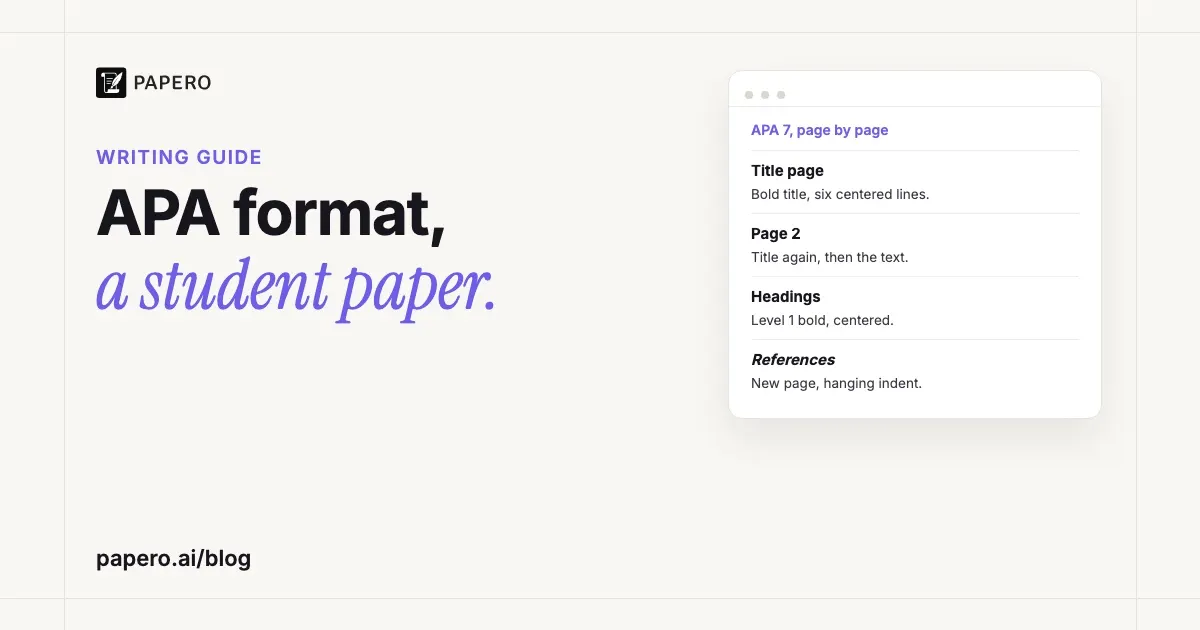
A student paper in APA 7 uses 1-inch margins, double spacing throughout, one legible font such as 12-point Times New Roman or 11-point Calibri, and left-aligned paragraphs with a 0.5-inch first-line indent. The page number sits at the top right of every page, starting at 1 on the title page. The text starts on page 2, and the references start on a new page.
| Element | APA 7 rule for a student paper | Where APA says it |
|---|---|---|
| Margins | 1 inch on every side | Margins page; Student Paper Setup Guide |
| Font | One legible font throughout, such as 12-pt Times New Roman, 12-pt Aptos or 11-pt Calibri | Font page; Setup Guide |
| Line spacing | Double-spaced everywhere, references included; no extra space before or after paragraphs | Setup Guide |
| Paragraphs | Flush left with a ragged right margin, no full justification, first line indented 0.5 in. | Setup Guide |
| Page header | Page number at the top right of every page; the title page is page 1; no running head | Page Header page |
| Title page | Title, author, affiliation, course, instructor, due date | Title Page Setup page |
| First page of text | Title repeated at the top; no “Introduction” label | Setup Guide; Headings page |
| Headings | Level 1 centered and bold; Level 2 flush left and bold; title case | Headings page |
| References | New page, “References” label bold and centered | Setup Guide |
| Page order | Title page, text, references | Order of Pages page |
APA’s Order of Pages guidance lists more possible parts (abstract, footnotes, tables, figures and appendices), but a typical student paper uses only three. For the style as a whole, see the glossary entry on APA style.
APA sample paper: a student paper, page by page
The sample paper below was written for this guide. The student, university, course and instructor are invented; the five studies it cites are real, and every claim about them matches the study’s published abstract. It is a short literature review of about 700 words. Each white block is one manuscript page, with approximate page breaks.
APA’s own annotated samples are a PDF with notes in callouts around a reduced page and Word files with the notes as comments, both hard to read on a phone. Here the notes follow each page. If your course uses MLA instead, our MLA format example lays out a full MLA paper the same way.
Page 1: the title page
1
Can a Walk in Nature Restore Attention? Evidence From Recent Research
Samira K. Haddad
Department of Psychology, Westbrook University
PSY 215: Health Psychology
Dr. Elliot Brennan
December 3, 2026
What to notice on page 1 (APA’s Title Page Setup guidance, Publication Manual Section 2.3):
- Page number: 1, at the top right of the header. Student papers have no running head unless the instructor asks for one.
- Title: three to four lines down, centered, bold, with major words capitalized.
- One blank line between the title and the author name, and none between the lines below it.
- Affiliation, course, due date: department and university separated by a comma; course number, a colon and the course name; the date in your country’s format.
Everything except the title is in regular type. Our APA title page guide covers each line, and the professional version, in more detail.
Page 2: the first page of text
2
Can a Walk in Nature Restore Attention? Evidence From Recent Research
Most students know the feeling of reading the same paragraph three times late in a study session. One remedy costs nothing: go outside and spend some time in a park. Attention restoration theory holds that time in natural surroundings can help people recover their ability to concentrate (Ohly et al., 2016). If the theory holds, a walk among trees would be one of the cheapest study aids available.
In this paper, I review experimental, survey, and meta-analytic evidence on two outcomes that matter to students: attention and mood. I argue that the evidence for mood benefits is more consistent than the evidence for attention benefits, although both are strong enough to justify a short walk outside during a long day of study.
Nature and Attention
Experimental Evidence
Berman et al. (2008) tested attention restoration theory in two experiments. Walking in nature, or only viewing pictures of nature, improved performance on two measures of directed attention: a backwards digit-span task and the Attention Network Task. The authors explained the result through the kind of stimulation each setting offers. Nature, they wrote, “modestly grabs attention in a bottom-up fashion, allowing top-down directed-attention abilities a chance to replenish” (Berman et al., 2008, p. 1207). City streets, by contrast, seize attention forcefully and require directed attention, to dodge traffic for instance, so they leave less room for recovery.
What to notice on page 2. This page carries most of APA’s text rules.
- Repeated title: bold and centered at the top of the first page of text (Student Paper Setup Guide).
- No “Introduction” heading: the opening paragraphs are understood to be the introduction, and the repeated title acts as a de facto Level 1 heading (Headings page, Publication Manual Sections 2.26 and 2.27).
- Paragraphs: flush left, ragged right, first line indented 0.5 in. with Tab or paragraph settings (not the space bar), no extra space between paragraphs (Setup Guide).
- First person: “I review” and “I argue” are fine. APA’s annotated student sample uses the first person and labels it with Section 4.16.
- Headings: “Nature and Attention” is Level 1, centered and bold; “Experimental Evidence” is Level 2, flush left and bold. Both are in title case, with no blank line above or below.
- Narrative citation: Berman et al. (2008) puts the authors in the sentence and the year in parentheses. Three or more authors take “et al.” from the first citation.
- Paraphrase: (Ohly et al., 2016) has no page number, because APA does not require one for a paraphrase.
- Short quotation: under 40 words, so it runs into the sentence in quotation marks, with the page in the same sentence’s citation (Quotations page, Sections 8.25 to 8.35).
The last sentence on page 2 keeps paraphrasing Berman et al. without a new citation, which APA allows while the context makes the source clear. “Nature and Attention” and “Experimental Evidence” use two of APA’s five heading levels; our guide to APA headings shows all of them.
Page 3: a second Level 2 heading and more sources
3
Systematic Review Evidence
A later review has been more cautious. Ohly et al. (2016) searched seven databases and included 31 studies that compared natural with other settings and used objective measures of attention. Their meta-analyses found significant benefits of natural environments on three measures, Digit Span Forward, Digit Span Backward, and Trail Making Test B, but the remaining 10 meta-analyses did not show marked benefits. The reviewers also pointed to small numbers of studies, small samples, and varied outcomes, and they concluded that it remains uncertain which aspects of attention exposure to nature may affect. The attention evidence is therefore promising but narrow.
Nature and Mood
The evidence for mood is broader. McMahan and Estes (2015) combined 32 studies with a total of 2,356 participants and found that exposure to natural environments was associated with a moderate increase in positive affect and a smaller, yet consistent, decrease in negative affect relative to comparison conditions. The size of the positive effect varied with how emotion was measured, the type of exposure, where the study took place, and the mean age of the sample.
Experimental work suggests one route by which this could happen. Bratman et al. (2015) asked healthy participants to take a 90-min walk in either a natural or an urban setting. After the nature walk, participants reported less rumination, a maladaptive, self-focused pattern of thought linked to a higher risk of depression, and showed less activity in the subgenual prefrontal cortex, a region earlier studies had linked to rumination; the urban walk had no such effects.
What to notice on page 3.
- A second Level 2 heading: “Systematic Review Evidence” pairs with “Experimental Evidence”. APA asks for two or more subsections or none, like an outline, so a lone Level 2 would break the rule.
- A Level 1 section with no subsections: “Nature and Mood” is allowed to stand alone. Sections of equal importance take the same level (Setup Guide).
- Two authors, narrative form: McMahan and Estes (2015) spells out “and”; in parentheses it becomes (McMahan & Estes, 2015) (Author–Date Citation System page).
Our guide to APA in-text citation covers the other cases you will meet, from group authors to secondary sources.
Page 4: survey evidence and the conclusion
4
Survey data point the same way at the population level. In a nationally representative sample of 19,806 people in England, those who had spent at least 120 min in nature in the previous week were more likely to report good health or high well-being than those who had spent none, with the benefits peaking at 200 to 300 min per week (White et al., 2019). It did not matter whether the time came in one long visit or several short ones. Because these data are correlational, however, they cannot show that nature causes better well-being.
Implications for Students
The research supports a modest version of the popular claim. Time in nature goes with better mood and well-being in meta-analytic and survey data, and one experiment links it to less rumination. Its effect on attention appears in experiments but holds for only some measures when studies are pooled. Most experiments also test a single, brief exposure, and the one large study of weekly exposure is correlational. For students, a walk in a park during a study break is a low-cost way to lift mood and step away from rumination, but it should not be expected to fix concentration on its own. Future studies could measure what matters most to students directly: whether a walk outside improves performance on the coursework that follows it.
What to notice on page 4.
- Final Level 1 heading: “Implications for Students” names what the section does, as APA’s Headings page asks: descriptive and concise.
- End-of-sentence citation: the period follows the closing parenthesis, as after (White et al., 2019).
- Page break: the references start on a new page even if this one has space left (Setup Guide, Final Checks).
Page 5: the References page
5
References
Berman, M. G., Jonides, J., & Kaplan, S. (2008). The cognitive benefits of interacting with nature. Psychological Science, 19(12), 1207–1212. https://doi.org/10.1111/j.1467-9280.2008.02225.x
Bratman, G. N., Hamilton, J. P., Hahn, K. S., Daily, G. C., & Gross, J. J. (2015). Nature experience reduces rumination and subgenual prefrontal cortex activation. Proceedings of the National Academy of Sciences, 112(28), 8567–8572. https://doi.org/10.1073/pnas.1510459112
McMahan, E. A., & Estes, D. (2015). The effect of contact with natural environments on positive and negative affect: A meta-analysis. The Journal of Positive Psychology, 10(6), 507–519. https://doi.org/10.1080/17439760.2014.994224
Ohly, H., White, M. P., Wheeler, B. W., Bethel, A., Ukoumunne, O. C., Nikolaou, V., & Garside, R. (2016). Attention restoration theory: A systematic review of the attention restoration potential of exposure to natural environments. Journal of Toxicology and Environmental Health, Part B, 19(7), 305–343. https://doi.org/10.1080/10937404.2016.1196155
White, M. P., Alcock, I., Grellier, J., Wheeler, B. W., Hartig, T., Warber, S. L., Bone, A., Depledge, M. H., & Fleming, L. E. (2019). Spending at least 120 minutes a week in nature is associated with good health and wellbeing. Scientific Reports, 9, Article 7730. https://doi.org/10.1038/s41598-019-44097-3
What to notice on page 5. Five sources cited in the text, five entries in the list, and no extras.
- Label and order: “References”, bold and centered at the top of a new page; entries alphabetical by first author, so Berman precedes Bratman.
- Hanging indent: 0.5 in., set with paragraph settings rather than Enter and Tab, and the list double-spaced within and between entries (Setup Guide).
- Journal entries: article title in sentence case and plain type; journal name and volume italic, issue in plain type in parentheses, and the comma after the journal name outside the italics, as in APA’s journal article examples.
- Article number: the Scientific Reports paper has no page range, so “Article” and the number take its place.
- DOIs:
https://doi.org/links at the end, with no period after them.
The spelling “wellbeing” in the White entry is the journal’s own, and APA asks you to keep a title’s original spelling. Our APA reference page guide covers books, webpages, missing dates and the ordering rules for harder cases.
What is the difference between a student and a professional APA paper?
A student paper is written for a course; a professional paper is a manuscript for a journal. The differences sit mostly on the title page and in the page header: a student paper lists the course, instructor and due date and has no running head, while a professional paper adds an author note and a running head. Citations, references, headings and spacing are the same.
| Element | Student paper | Professional paper |
|---|---|---|
| Title, author names, affiliation | Yes; affiliation is where you study | Yes; affiliation is where the research was done |
| Course, instructor, due date | Yes | No |
| Author note | No | Yes, bottom half of the title page |
| Running head | Only if the instructor asks | Yes, on every page |
| Abstract | Only if the instructor asks | Follow the journal’s instructions |
| Citations and references | APA 7 rules | Same rules |
| Margins, font, spacing, headings | APA 7 rules | Same rules |
Purdue OWL’s note on its sample papers agrees: the differences “mostly extend to the title page and running head”, and citation practices do not differ. When you do need a running head, it is a shortened title of 50 characters or fewer, in capital letters, flush left in the header.
Does an APA student paper need an abstract or a running head?
Neither, by default. APA’s sample papers page says an abstract and keywords are not required for student papers, although an instructor may ask for them in longer or more complex papers. APA’s Page Header guidance says student papers do not include a running head unless the instructor or institution requests one. The page header holds the page number only.
If your instructor does ask for an abstract, it goes on its own page between the title page and the text, which then starts on page 3. Our abstract example guide shows three abstracts and the APA abstract page.
How long should an APA paper be?
As long as the assignment says. Length is set by your instructor, not by APA. APA’s Font page notes that instructors and publishers vary in how they specify length, and because different fonts take up different amounts of space, it recommends judging length by word count rather than page count wherever possible.
For scale, the sample above has about 700 words of text: roughly three double-spaced pages, five pages with the title page and references. If a brief gives a page count, ask whether it includes those two pages.
Common mistakes in APA format papers
Each of the formatting errors below is ruled out by APA’s own guidance, and each takes seconds to fix once you know where to look. Check the finished file, not only the draft, because a template or a paragraph setting can bring them back:
- An “Introduction” heading at the top of page 2. The repeated title does that job.
- “Running head:” in the header of a student paper, a leftover from older templates. APA 7 says not to type that label, and student papers need no running head at all.
- Full justification. APA wants paragraphs aligned left with a ragged right margin.
- Extra space between paragraphs, whether blank lines or a “space after” paragraph setting, and blank lines above or below headings.
- A single subsection under a Level 1 heading. Use two or more, or none.
- The references starting on the same page as the text, instead of on a new page.
- The comma after a journal name in italics. Italicize the journal name and the volume separately, with a plain comma between them: Psychological Science, 19(12).
APA’s setup guide adds that instructors’ guidelines supersede APA Style, so read the assignment brief last.
Where Papero fits
Papero is an AI writing workspace for students and researchers. It helps you outline, draft and rewrite a paper, finds real papers to cite as you write, and formats in-text citations and the reference list in nine styles, APA 7 among them. The argument stays yours.
When your document is set to APA 7 and you export it to Word in the manuscript layout, you get the layout described above: 12-point Times New Roman, double spacing, 1-inch margins and a half-inch first-line indent (you can change the font, size and margins in page setup), with page numbers at the top right. The title page, on by default, puts your title in bold three double-spaced lines down, a blank line, then your name, institution, course and instructor (each only when entered) and the date, centered. The title repeats above the text on page 2, headings follow APA’s levels, and References starts a new page under a bold, centered label with a 0.5-inch hanging indent. Type your due date in the dialog’s Date field; a blank field prints the day you export.
On the free plan, in-text citations work in full, while the reference list shows your real entries blurred and is left out of copies and exports; Plus makes it readable and exportable. The research paper writing page shows how a paper moves from outline to Word manuscript, and you can sign up free.
Frequently Asked Questions
What is an example of APA format?
An APA format example is a paper laid out to APA 7 rules: a title page with the bold title and author details, a page number at the top right of every page, double-spaced text in one legible font with 1-inch margins, the title repeated at the top of page 2, bold headings by level, author-date citations such as (Berman et al., 2008), and a References page with hanging indents.
What pages does an APA student paper include?
Three parts, in this order: a title page (page 1), the text (starting on page 2) and the reference list (starting on a new page after the text). An abstract is added only if the instructor asks, and tables, figures or appendices only if the assignment calls for them.
Do you write “Introduction” in an APA paper?
No. APA treats the opening paragraphs as the introduction, so they get no label. Repeat the paper title, bold and centered, at the top of the first page of text and start the introduction below it. Use the label only if your instructor asks for it.
Is an APA paper double-spaced?
Yes. APA 7 double-spaces the entire paper: the title page, the text, headings, block quotations and the reference list. Do not add extra space before or after paragraphs or blank lines around headings. On the title page, apart from the blank lines above the title, the only blank line is the one between the title and the author name.
Where can I find APA’s official sample papers?
On the Sample Papers page of the APA Style website (apastyle.apa.org). It offers an annotated student paper and an annotated professional paper as PDFs, the same papers as Word files, and templates for paper types such as literature reviews and annotated bibliographies. Purdue OWL also publishes student and professional samples.
Sources
- American Psychological Association, “Sample Papers” (apastyle.apa.org, last updated January 2026; read from the Internet Archive copy of September 2, 2026, because apastyle.apa.org blocks automated requests): https://apastyle.apa.org/style-grammar-guidelines/paper-format/sample-papers
- American Psychological Association, Student Sample Paper With Annotations (PDF, reproduced from the Publication Manual, 7th ed.; read from the Internet Archive copy of September 4, 2026): https://apastyle.apa.org/style-grammar-guidelines/paper-format/student-annotated.pdf
- American Psychological Association, Student Paper Setup Guide, 7th edition (PDF, last updated October 8, 2025; read from the Internet Archive copy of August 10, 2026): https://apastyle.apa.org/instructional-aids/student-paper-setup-guide.pdf
- American Psychological Association, “Title Page Setup” (apastyle.apa.org, last updated July 2022; read from an Internet Archive copy, October 2026): https://apastyle.apa.org/style-grammar-guidelines/paper-format/title-page
- American Psychological Association, “Headings” (apastyle.apa.org, last updated July 2022; read from an Internet Archive copy, October 2026): https://apastyle.apa.org/style-grammar-guidelines/paper-format/headings
- American Psychological Association, “Page Header” (apastyle.apa.org, last updated July 2022; read from an Internet Archive copy, October 2026): https://apastyle.apa.org/style-grammar-guidelines/paper-format/page-header
- American Psychological Association, “Font” (apastyle.apa.org, last updated February 2026; read from an Internet Archive copy, October 2026): https://apastyle.apa.org/style-grammar-guidelines/paper-format/font
- American Psychological Association, “Margins” (apastyle.apa.org, last updated July 2022; read from an Internet Archive copy, October 2026): https://apastyle.apa.org/style-grammar-guidelines/paper-format/margins
- American Psychological Association, “Order of Pages” (apastyle.apa.org, last updated November 2024; read from an Internet Archive copy, October 2026): https://apastyle.apa.org/style-grammar-guidelines/paper-format/order-pages
- American Psychological Association, “Quotations” (apastyle.apa.org, last updated July 2022; read from an Internet Archive copy, October 2026): https://apastyle.apa.org/style-grammar-guidelines/citations/quotations
- American Psychological Association, “Paraphrases” (apastyle.apa.org, last updated July 2022; read from an Internet Archive copy, October 2026): https://apastyle.apa.org/style-grammar-guidelines/citations/paraphrasing
- American Psychological Association, “Author–Date Citation System” (apastyle.apa.org; read from an Internet Archive copy, October 2026): https://apastyle.apa.org/style-grammar-guidelines/citations/basic-principles/author-date
- American Psychological Association, “Journal Article References” (apastyle.apa.org; read from an Internet Archive copy, October 2026): https://apastyle.apa.org/style-grammar-guidelines/references/examples/journal-article-references
- Purdue OWL, “APA Sample Paper” (owl.purdue.edu, accessed October 2026): https://owl.purdue.edu/owl/research_and_citation/apa_style/apa_formatting_and_style_guide/apa_sample_paper.html
- Berman, M. G., Jonides, J., & Kaplan, S. (2008). The cognitive benefits of interacting with nature. Psychological Science, 19(12), 1207–1212. https://doi.org/10.1111/j.1467-9280.2008.02225.x
- Bratman, G. N., Hamilton, J. P., Hahn, K. S., Daily, G. C., & Gross, J. J. (2015). Nature experience reduces rumination and subgenual prefrontal cortex activation. Proceedings of the National Academy of Sciences, 112(28), 8567–8572. https://doi.org/10.1073/pnas.1510459112
- McMahan, E. A., & Estes, D. (2015). The effect of contact with natural environments on positive and negative affect: A meta-analysis. The Journal of Positive Psychology, 10(6), 507–519. https://doi.org/10.1080/17439760.2014.994224
- Ohly, H., White, M. P., Wheeler, B. W., Bethel, A., Ukoumunne, O. C., Nikolaou, V., & Garside, R. (2016). Attention restoration theory: A systematic review of the attention restoration potential of exposure to natural environments. Journal of Toxicology and Environmental Health, Part B, 19(7), 305–343. https://doi.org/10.1080/10937404.2016.1196155
- White, M. P., Alcock, I., Grellier, J., Wheeler, B. W., Hartig, T., Warber, S. L., Bone, A., Depledge, M. H., & Fleming, L. E. (2019). Spending at least 120 minutes a week in nature is associated with good health and wellbeing. Scientific Reports, 9, Article 7730. https://doi.org/10.1038/s41598-019-44097-3