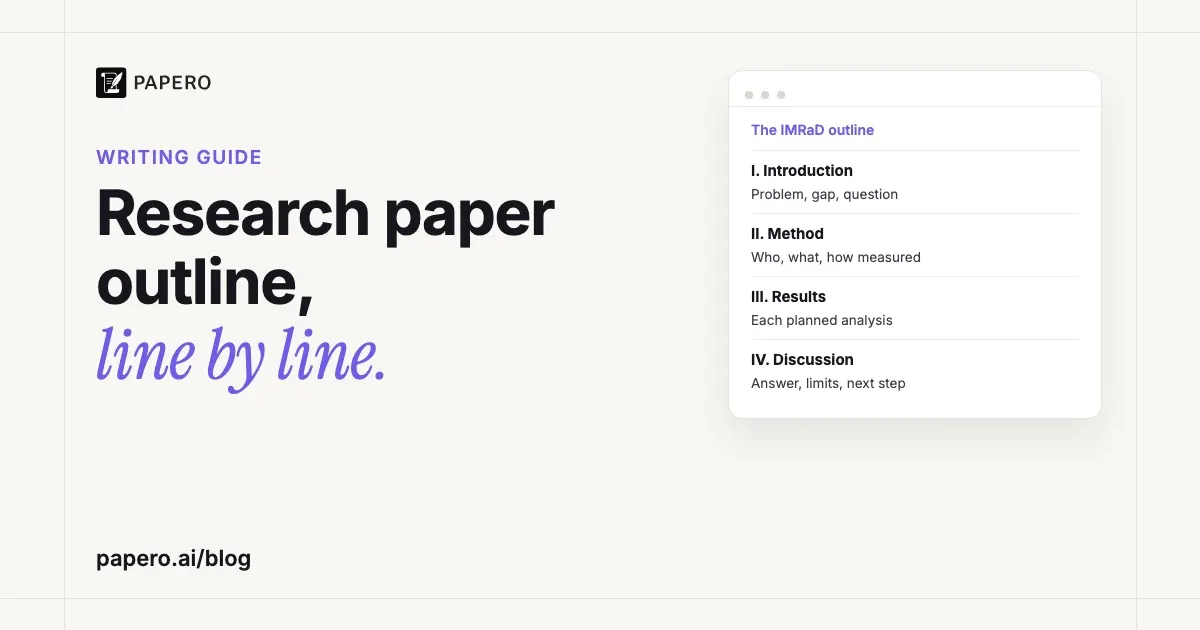
A research paper outline lists the sections of your paper in order, with the point each section makes and the sources or data behind it. Most research papers take one of two shapes: an empirical study that follows IMRaD (Introduction, Method, Results, Discussion), or a thesis-driven paper built from sources, with an introduction, body sections that each defend one point, and a conclusion. Below are a template for each, a filled-in example, and the three outline formats compared.
Key Takeaways
- Decide the shape first. A paper that reports data, your own or an existing dataset, follows IMRaD; a paper that argues from published sources follows thesis, points, conclusion.
- Every line in the outline should say what that part of the paper claims or reports, not only its topic. “Method: participants” is a heading; “Method: 120 students from two sections, assigned by section” is an outline line.
- Attach a source or a data point to each line while the outline is short. A line with no source is a research task you have found early.
- Outline numbering is for planning. Headings in an APA paper carry no numbers or letters, so the numerals come out when you draft.
What are the parts of a research paper outline?
The parts follow the paper. An empirical paper has a title page, an abstract, an introduction that ends on the research question or hypothesis, a method section, results, a discussion and a reference list. A thesis-driven paper replaces method, results and discussion with body sections, one per supporting point, and ends on a conclusion. The outline gives each part a line or two saying what it will contain.
| Section | What it does | What to write in the outline |
|---|---|---|
| Title page | Identifies the paper | Working title; leave the rest for the final format |
| Abstract | Summarises the whole paper | “Write last” and nothing else for now |
| Introduction | States the problem, what is known, the gap and your question | One line each for the problem, two or three key studies, the gap, and the question or hypothesis |
| Method | Says exactly what you did | Participants or materials, design, procedure, measures, analysis |
| Results | Reports what you found, without interpretation | Each planned analysis, in the order of your questions, and the table or figure that shows it |
| Discussion | Explains what the results mean | The answer to the question, comparison with earlier work, limitations, next step |
| References | Lists every source cited | Grows as you add sources to the lines above |
IMRaD is the default for empirical papers in the sciences and social sciences. In a survey of four leading medical journals, Sollaci and Pereira (2004) found that the structure appeared in the 1940s, reached 80% of articles in the 1970s and was the only pattern used for original papers by the 1980s. If your assignment reports an experiment, a survey or any data you collected, assume IMRaD unless the brief says otherwise. The glossary entry on the research paper compares this structure with an essay’s.
Two rows in the table need little planning yet. Beyond a working title, the title page has a fixed layout, set out in our guide to the APA title page and its layout, and the abstract is written last, from the finished paper: our abstract example guide shows how to build one, one or two sentences per part.
Research paper outline template (IMRaD)
Use this template when you are reporting a study: an experiment, a survey, an observation or an analysis of existing data. Copy it, replace every bracket, and keep each line to one sentence. Write the method lines in the most detail, because they are the part you will follow when you run the study.
- Title page: [working title that names the variables and the population]
- Abstract: write last, from the finished paper
- I. Introduction
- A. Problem: [why the topic matters, in one sentence]
- B. What is known: [author, year]: [finding]; [author, year]: [finding]
- C. Gap: [what those studies leave open]
- D. Research question or hypothesis: [one sentence]
- II. Method
- A. Participants or materials: [who or what, how many, how chosen]
- B. Design: [what is compared, and how groups are formed]
- C. Procedure: [what happens, in order]
- D. Measures: [what you record and how]
- E. Analysis: [the test or method for each question]
- III. Results
- A. [first question]: [planned analysis], [table or figure]
- B. [second question]: [planned analysis], [table or figure]
- IV. Discussion
- A. Answer: what the results say about the question
- B. Comparison: agreement or disagreement with [author, year]
- C. Limitations: [the main one or two]
- D. Next step: [what a follow-up study should test]
- References: every source named above
Two things in this template are easy to get wrong. The introduction ends on the question or hypothesis, not on a summary of the literature, so line D is where the whole introduction is heading. And the results lines name analyses, not findings: you outline the paper before you have results, so the outline says what you will test and how you will show it. Once the data are in, our guide on how to write a results section shows how those lines become paragraphs. Our examples of research questions show how to word line D for each kind of study. In a science course the same four sections carry a lab report, as our annotated lab report example shows. Our guide on how to write a research paper introduction annotates two published introductions that build up to their aim or questions.
Research paper outline template (thesis-driven)
Use this template for a paper that argues a position or explains a topic from published sources, the kind many first-year courses call a research paper. It follows the classic thesis, points, conclusion order. Each body section defends one point, and every point needs at least one source, so the outline doubles as a check on your research.
- I. Introduction
- A. Hook: a fact or case that shows the topic matters
- B. Context: what the reader needs to follow the paper
- C. Thesis: [your position or main claim] because [point 1], [point 2] and [point 3]
- II. Point 1: [claim, as a full sentence]
- A. Evidence: [author, year]: [what they found]
- B. Evidence: [author, year]: [what they found]
- C. Explanation: how the evidence supports the claim
- D. Link: how the claim supports the thesis
- III. Point 2: same pattern as point 1
- IV. Point 3: same pattern as point 1
- V. Counterargument: the strongest objection, its evidence, and your answer
- VI. Conclusion
- A. Thesis restated in new words
- B. What the three points show together
- C. What remains open, or what should change
- References: every source named above
San Diego State University’s basic research paper outline uses the same introduction, body points and conclusion order, with one useful note on the introduction: write it last. The introduction promises what the body delivers, and you only know what the body delivers once it exists. Line I.C, the thesis, is still the one to settle first, even if the introduction around it is written last: the glossary entry on the thesis statement shows what makes one arguable. If your paper takes a side on a debate, our argumentative essay outline expands the counterargument section into a full rebuttal.
Research paper outline example
Here is the IMRaD template filled in for a student study on practice quizzes in an introductory psychology course. The studies in the introduction are real and listed in the sources; the method describes a study the student plans to run, so the results lines name analyses rather than findings. That is what an outline written before data collection looks like.
Working title: Weekly Practice Quizzes and Retention in an Introductory Psychology Course
- I. Introduction
- A. Problem: many students prepare for exams by rereading, which feels productive but is a weak way to remember material.
- B. What is known: Roediger and Karpicke (2006): students who took recall tests on prose passages remembered more after two days and one week than students who restudied, although restudying won after five minutes. Dunlosky et al. (2013): practice testing received a high utility rating and rereading a low one in a review of ten learning techniques. Adesope et al. (2017): across studies, practice tests beat restudying, and the size of the benefit depended on features of the tests and of the studies.
- C. Gap: because the benefit varies with how the tests are given, it is worth checking whether a short, unsupervised weekly online quiz works in this course.
- D. Hypothesis: students who take a weekly practice quiz will score higher on an end-of-term retention test than students who complete a weekly rereading assignment of equal length.
- II. Method
- A. Participants: about 120 students in two sections of the same course, taught by the same instructor.
- B. Design: one section takes a 10-question online quiz with feedback each week; the other completes a rereading assignment of the same length. Sections are assigned to conditions by coin toss.
- C. Procedure: weeks 2 to 11, one quiz or reading assignment per week; retention test in week 13.
- D. Measures: a 40-question multiple-choice retention test on material from weeks 2 to 11; prior GPA as a control.
- E. Analysis: compare test scores between sections, adjusting for prior GPA (ANCOVA).
- III. Results
- A. Mean retention scores by condition: table with means, standard deviations and the adjusted difference.
- B. Effect size and confidence interval for the difference.
- IV. Discussion
- A. Answer: whether the quiz section scored higher, and by how much.
- B. Comparison: with the delayed-test results in Roediger and Karpicke (2006) and the pooled effect in Adesope et al. (2017).
- C. Limitations: with one section per condition, any difference could come from the sections rather than the quizzes, and the analysis cannot separate the two; one instructor; one course.
- D. Next step: randomise students within sections, or vary quiz frequency.
Look at what the outline already decided. The hypothesis in I.D names the comparison that the design in II.B creates and the measure in II.D records, and the limitation in IV.C follows from the design choice in II.B. When those lines line up in the outline, they will line up in the paper. The limitations of a study guide shows how a line like IV.C becomes a paragraph that states what the weakness does to the findings. Our guide to hypothesis examples shows how to word line I.D for other kinds of study, and the literature review example shows how lines I.B and I.C grow into full paragraphs. When the literature review is a paper of its own, our literature review outline gives templates organised by theme, period, method or theory.
Alphanumeric, decimal or full-sentence outline?
Purdue OWL describes three outline formats. Alphanumeric outlines use Roman numerals, capital letters, Arabic numerals and lowercase letters, in that order. Decimal outlines number every level (1, 1.1, 1.1.1), which shows how each line relates to the whole. Full-sentence outlines use the alphanumeric layout but require a complete sentence at every level. For most coursework, use alphanumeric unless your instructor sets another format.
| Format | Looks like | Best for |
|---|---|---|
| Alphanumeric | I. Introduction / A. Problem / 1. Rereading is common | Most coursework; the default when no format is set |
| Decimal | 1 Introduction / 1.1 Problem / 1.1.1 Rereading is common | Long papers and theses, where you refer to sections by number |
| Full sentence | I. Students often prepare by rereading, which is a weak way to remember material. | Outlines your instructor will grade, and the lines whose wording matters most |
You can mix them sensibly: alphanumeric structure, with full sentences for the thesis or hypothesis and for each section’s main claim, and phrases for the rest. If your instructor collects the outline, follow their format exactly.
Whatever format you use, never split a level into one part: if section II has an A, it needs a B. APA’s heading guidance relies on the same rule, telling writers to avoid a single subsection heading “just like in an outline”. When a point has only one sub-point, merge them. APA headings carry none of these numerals. Our APA headings guide shows how the outline levels become heading levels in the finished paper.
How do you write a research paper outline?
Start from the purpose, the audience and a working thesis (for a study, your research question), as Purdue OWL advises. Then list every idea you want to include, group related ones, order the groups from general to specific, and give each group a heading. Finally, check each line for a claim and a source before you start drafting.
Step by step:
- Write the question or thesis as one sentence. Everything else in the outline exists to answer or support it. If you have no topic yet, start with our guide on how to choose a research topic.
- Choose the shape. Your own data: IMRaD. Published sources only: thesis-driven.
- Dump, then group. List your notes and sources, then sort them under the sections they belong to. A source that fits nowhere is either off-topic or a sign you are missing a section.
- Order within each section. Known before unknown in the introduction; procedure in time order in the method; results in the order of your questions.
- Turn headings into claims. Rewrite each line so it says what that part argues or reports.
- Check the joins. Read the outline top to bottom. Each section should set up the next, and the discussion or conclusion should answer exactly the question or thesis in the introduction. Two published discussions that open by doing so are annotated in our guide to writing a discussion section.
Our rule of thumb is one to two pages for a 3,000 to 5,000-word paper. Past three pages usually means you are drafting in the outline; under half a page usually means the lines are topics, not claims.
Where Papero fits
Papero is an AI writing workspace for students and researchers. Its outline builder starts a new paper from a standard IMRaD template, from headings it suggests for your topic, or with no headings at all. The IMRaD template gives four headings, Introduction, Methods, Results and Discussion, each with a three-line prompt: for the introduction, the problem and why it matters, what is already known and the gap, and your research question or aim.
The suggested headings come from your description of the paper: the builder asks for four to eight main sections, each with up to four subsections and its own prompt, and leaves out a References section, since the reference list comes from the citations you insert. Two adjustments for APA: rename “Methods” to “Method”, and in the finished paper drop the “Introduction” heading, since APA says not to begin a paper with one; the paper title serves as that heading. The research paper writing page shows the outline and drafting steps, and you can sign up free. Papero suggests and formats; the question, the design and the argument stay yours.
Frequently Asked Questions
What are the 7 parts of a research paper?
For an empirical paper in APA style, the seven parts are the title page, abstract, introduction, method, results, discussion and references. Some papers add appendices, tables and figures at the end. A thesis-driven research paper keeps the title page, introduction, conclusion and references, and replaces method, results and discussion with body sections that each defend one point.
Should the references be in a research paper outline?
Yes: list them as you go, not at the end. Put the author and year on each line that uses a source, then collect those sources into a working reference list below the outline. That way every claim in the outline is tied to a source before you draft, and the final reference list is mostly done when you finish.
How long should a research paper outline be?
As a rule of thumb, one to two pages for a 3,000 to 5,000-word paper: one line per paragraph or subsection, with a source on each evidence line. If the outline runs past three pages, you are probably drafting in it. If it fits on half a page, the lines are probably topics rather than claims.
Do you include the thesis statement in the outline?
Yes, written out in full at the end of the introduction section. In a thesis-driven paper it is the most important line, and every body point should support it. In an IMRaD paper the research question or hypothesis takes the same place.
Should you write the abstract from the outline?
No. Write the abstract last, from the finished paper, because it reports results and conclusions you do not have at the outline stage. In the outline, the abstract line just says “write last”.
Sources
- Adesope, O. O., Trevisan, D. A., & Sundararajan, N. (2017). Rethinking the use of tests: A meta-analysis of practice testing. Review of Educational Research, 87(3), 659–701. https://doi.org/10.3102/0034654316689306
- American Psychological Association, “Headings” (Style and Grammar Guidelines, last updated July 2022; read from the Internet Archive copy of October 12, 2026, because apastyle.apa.org blocks automated requests): https://apastyle.apa.org/style-grammar-guidelines/paper-format/headings
- Dunlosky, J., Rawson, K. A., Marsh, E. J., Nathan, M. J., & Willingham, D. T. (2013). Improving students’ learning with effective learning techniques: Promising directions from cognitive and educational psychology. Psychological Science in the Public Interest, 14(1), 4–58. https://doi.org/10.1177/1529100612453266
- Purdue OWL, “Types of Outlines and Samples” (owl.purdue.edu; read from the Internet Archive copy, October 2026): https://owl.purdue.edu/owl/general_writing/the_writing_process/developing_an_outline/types_of_outlines.html
- Purdue OWL, “Why and How to Create a Useful Outline” (owl.purdue.edu; read from the Internet Archive copy, October 2026): https://owl.purdue.edu/owl/general_writing/the_writing_process/developing_an_outline/how_to_outline.html
- Roediger, H. L., III, & Karpicke, J. D. (2006). Test-enhanced learning: Taking memory tests improves long-term retention. Psychological Science, 17(3), 249–255. https://doi.org/10.1111/j.1467-9280.2006.01693.x
- San Diego State University, Basic Research Paper Outline (PDF, accessed October 2026): https://interwork.sdsu.edu/sites/default/files/2025-04/Research-Paper-Outline.pdf
- Sollaci, L. B., & Pereira, M. G. (2004). The introduction, methods, results, and discussion (IMRAD) structure: A fifty-year survey. Journal of the Medical Library Association, 92(3), 364–367. https://pmc.ncbi.nlm.nih.gov/articles/PMC442179/