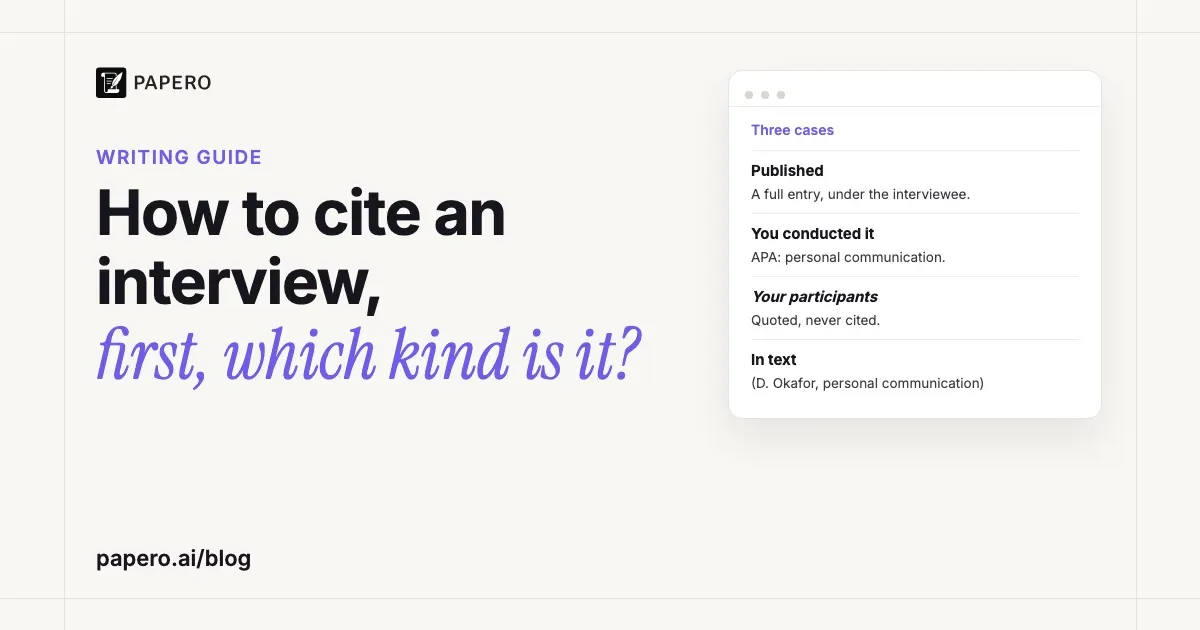
How to cite an interview depends on which kind you have: a published interview, one you conducted, or one with a participant in your own study. A published interview gets a full entry, in MLA under the person interviewed: Buolamwini, Joy. “‘If You Have a Face, You Have a Place in the Conversation about AI,’ Expert Says.” Interview conducted by Tonya Mosley. Fresh Air, NPR, 28 Nov. 2023, then the URL. An interview you conducted is, in APA, cited only in the text.
Key Takeaways
- Decide the case first: published, conducted by you, or a participant in your own research. APA cites an interview you conducted as a personal communication, but never your research participants.
- MLA and Chicago list a published interview under the interviewee, with “Interview conducted by” (MLA) or “Interview by” (Chicago) and the interviewer.
- APA cites a published interview in the format it appeared in, under whoever that format names: a radio host, a magazine writer, the channel that uploaded a video.
- An interview you conducted gets no APA reference entry: (D. Okafor, personal communication, October 14, 2026). Chicago author-date usually cites it in the text only; MLA allows an entry or a note.
- Quotations from your own participants get no entry at all: describe the interviews in your method and use pseudonyms where you promised them.
How to cite an interview: which of three cases do you have?
Start with where the interview lives. If a reader can find it, in a magazine, on a radio show’s website, in a podcast, a video or an archive, it is published and gets a full entry in all three styles. If only you have it, it is a personal interview. If you ran it to collect data for your own study, the speaker is a research participant, and APA treats that as a third case.
| Case | MLA 9 | APA 7 | Chicago 18 author-date |
|---|---|---|---|
| Published (print, online, radio, podcast, video, archive) | Entry under the interviewee; “Interview conducted by” and the interviewer when the source does not make it clear | Entry in the format of the source, under whoever that format names, often the host or the article’s writer | Entry under the interviewee, with “Interview by” and the interviewer |
| An interview you conducted | An entry (Okafor, Dana. Interview. Conducted by Jordan Price, 14 Oct. 2026.) or a note saying where the quotations come from | No reference entry: (D. Okafor, personal communication, October 14, 2026) | Usually in the text only: (Dana Okafor, interview by author, October 14, 2026) |
| Participants in your own study | No MLA answer covers it; describe the interviews in your method and add a note | Not a personal communication and no reference entry: describe the interviews in the Method section and quote participants directly | In the text only, as a Chicago answer on research interviews advises (17th edition) |
Dana Okafor, Jordan Price and “Mara” are invented names for the examples. The interview in the first row is real, and the next section cites it in full.
The second and third rows are the difference most citation sites blur. APA’s personal communications page lists “personal interviews” among works readers cannot recover, then adds: “Do not use a personal communication citation for quotes or information from participants whom you interviewed as part of your own original research; instead, quote those participants directly.” Another APA page explains that their quotations “are part of your original research”, so they get no reference entry either. The test is the job the person does in your paper. A librarian you phone for a fact about her library’s archive is a source. Twelve students you interview about study habits, under a consent form, are your data.
How do you cite a published interview?
Cite it from the place it was published, then decide who goes first. MLA and Chicago put the person interviewed in the author position and add the interviewer after the title. APA cites the interview in the format of the source it appeared in, so a radio interview is listed under its host, and you name the interviewee in your own sentence.
The table cites one real interview: the computer scientist Joy Buolamwini on NPR’s Fresh Air, interviewed by the host Tonya Mosley, posted on November 28, 2023, with audio running 37:58. The Chicago Manual of Style’s quick guide uses it as its interview example.
| Style | List entry | In the text |
|---|---|---|
| MLA 9 | Buolamwini, Joy. “‘If You Have a Face, You Have a Place in the Conversation about AI,’ Expert Says.” Interview conducted by Tonya Mosley. Fresh Air, NPR, 28 Nov. 2023, www.npr.org/2023/11/28/1215529902/unmasking-ai-facial-recognition-technology-joy-buolamwini. | (Buolamwini), or nothing in parentheses when your sentence names her |
| APA 7 | Mosley, T. (2023, November 28). “If you have a face, you have a place in the conversation about AI,” expert says [Radio broadcast]. NPR. https://www.npr.org/2023/11/28/1215529902/unmasking-ai-facial-recognition-technology-joy-buolamwini | (Mosley, 2023), plus a time stamp for a quotation from the audio |
| Chicago 18 author-date | Buolamwini, Joy. 2023. “‘If You Have a Face, You Have a Place in the Conversation About AI,’ Expert Says.” Interview by Tonya Mosley. Fresh Air, NPR, November 28. Audio, 37:58. https://www.npr.org/2023/11/28/1215529902/unmasking-ai-facial-recognition-technology-joy-buolamwini. | (Buolamwini 2023) |
We checked NPR’s page on November 3, 2026: headline, byline, date and the 37:58 audio. The transcript opens “TONYA MOSLEY, HOST: This is FRESH AIR.”, which is why APA’s radio rule, “Provide the name of the announcer as the author,” puts her first. NPR’s headline uses single quotation marks; MLA and Chicago keep them single inside their own double ones, and in APA’s italic title, which has no outer quotation marks, we wrote them as double. Chicago’s capital A in “About” is copied from its example.
Who is the author of an interview citation?
In MLA and Chicago, nearly always the person interviewed. Chicago’s quick guide says, “Interviews are usually cited under the name of the interviewee rather than the interviewer,” and an MLA answer written for the ninth edition says, “MLA style names the interviewee as the author of individual interviews.” APA follows the format the interview appeared in: the host or announcer for a broadcast, the byline for an article.
The difference shows when a database disagrees with MLA. MLA’s own example of an interview in a journal is:
Pamuk, Orhan. “Implementing Disform: An Interview with Orhan Pamuk.” Interview conducted by Z. Esra Mirze. PMLA, vol. 123, no. 1, Jan. 2008, pp. 176–80.
Crossref and OpenAlex both list Mirze as the only author, so a tool that looks up the DOI starts the entry with Mirze. For MLA or Chicago, move Pamuk into the author slot. For APA, keep the byline:
Mirze, Z. E. (2008). Implementing disform: An interview with Orhan Pamuk. PMLA, 123(1), 176–180.
https://doi.org/10.1632/pmla.2008.123.1.176
A caution about APA: its site has an “Interview references” page, but apastyle.apa.org blocks automated readers and the Internet Archive’s only two copies are blank, so we could not read it. Our APA rules come from its pages for the formats interviews appear in, its archival and personal communications pages, and the University of Auckland’s APA 7 guide: “If the interview has been published, reference according to the format you viewed it in.”
How do you cite an interview in MLA?
Follow the MLA template with the interviewee as the author. Give the interview’s title in quotation marks, or the description Interview when it has none. If it sits inside a larger work, add “Interview conducted by” and the interviewer after the title, then the container, such as the magazine, show or book, and its details. The in-text citation is the interviewee’s surname, with a page when there is one.
Two patterns from MLA Style Center answers:
- In a book of interviews: Stoppard, Tom. “Dialogue with Tom Stoppard.” Interview conducted by Joseph McCulloch. Tom Stoppard in Conversation, edited by Paul Delaney, U of Michigan P, 1994, pp. 38–45.
- Untitled, not inside another work: Walcott, Derek. Interview. Conducted by Susan Lang, 22 Oct. 2002.
MLA’s general answer on interviews dates from 2016 but cites sections 5.23 and 5.28 of the MLA Handbook, ninth-edition numbering; the Stoppard answer was written for the eighth. Two people interviewed together share one entry, and two interviews with one person get short titles: (Stoppard, “Dialogue” 44).
When the interviewer is obvious, MLA leaves “Interview conducted by” out, as in its example of an interview posted to YouTube by Jimmy Kimmel Live. Our guide to citing a YouTube video covers the uploader rules for any video interview.
How do you cite an interview in APA?
Use the reference format of the source the interview appeared in: a magazine or newspaper article, a podcast episode, a radio broadcast or a video. The author is whoever that format names, so a radio interview goes under the host and a magazine Q&A under the writer in its byline. Name the interviewee in your sentence. An interview only you heard is a personal communication instead.
A radio broadcast takes the announcer, the full date, the italic story title and [Radio broadcast], as in the Mosley entry. A podcast episode takes the host with “(Host)” after the name, the episode title in plain type, [Audio podcast episode], then “In” and the italic show title. A magazine or journal article takes its authors and its DOI or URL, as in the Mirze entry. A video takes the account that uploaded it.
In the text, cite that entry’s author and year: (Mosley, 2023). To quote audio or video, APA asks for “a time stamp for the beginning of the quotation in place of a page number,” as in its example (Cuddy, 2012, 2:12). Our guide to APA in-text citation covers the narrative and parenthetical forms.
How do you cite an interview in Chicago style?
In Chicago author-date, list the interviewee as the author, then the year, the interview’s title in quotation marks, “Interview by” and the interviewer, the program or publication in italics, and the date. A recording adds the format and the running time. The text citation is the surname and year, as in (Buolamwini 2023). An unpublished interview is usually cited in the text only.
The Fresh Air entry in the table is copied from Chicago’s 18th-edition quick guide, which points to sections 14.108 to 14.110 of the Manual. Its notes-bibliography version:
- First note: 1. Joy Buolamwini, “‘If You Have a Face, You Have a Place in the Conversation About AI,’ Expert Says,” interview by Tonya Mosley, Fresh Air, NPR, November 28, 2023, audio, 37:58,
https://www.npr.org/2023/11/28/1215529902/unmasking-ai-facial-recognition-technology-joy-buolamwini. - Shortened note: 2. Buolamwini, interview.
How do you cite a personal interview you conducted?
In APA, cite it in the text only, as a personal communication, with the person’s initials and surname and the exact date; it gets no reference entry. In MLA, either create a works-cited entry under the interviewee’s name with the description Interview, or add a note saying where the quotations come from. Chicago author-date usually cites it in the text only, naming the person and the date.
Say you, Jordan Price, interviewed a school librarian, Dana Okafor, on October 14, 2026.
APA 7. Write (D. Okafor, personal communication, October 14, 2026). APA asks for “the initial(s) and surname of the communicator” and “as exact a date as possible”, and for this citation “only when a recoverable source is not available”: if Okafor’s point is in a published report, cite the report.
MLA 9. A January 2025 MLA answer gives two methods. One is a note, which for our example would read: All quotations from Dana Okafor are from an interview I conducted on 14 October 2026. The other is an entry: Okafor, Dana. Interview. Conducted by Jordan Price, 14 Oct. 2026. Do not cite your recording or give time stamps, “since the recording is only accessible to you.” For an interviewee who asks to stay anonymous, an eighth-edition answer says to skip the entry and give the method and date in an endnote.
Chicago 18 author-date. Write (Dana Okafor, interview by author, October 14, 2026). Chicago’s quick guide cites personal communications “in the text only” and names the medium, as in (Sam Gomez, Facebook direct message to author, August 1, 2024). Monash University’s 18th-edition guide gives the pattern (Interviewee Surname, description, Month DD, YYYY) and adds that “each person cited must be fully identified in the text.”
Ask before you name someone. APA tells writers citing an Indigenous person’s knowledge to “ensure that the person agrees to have their name included in your paper”, a courtesy that suits anyone you quote by name.
How do you cite interviews with research participants?
In APA, you do not cite them as sources: quotations from people you interviewed for your own study are part of your original research, so they get no reference entry and are not personal communications. Describe the interviews in your method section, say in the text that the quotations come from participants, and protect identities as your consent agreement promised.
APA’s page on quoting participants lists three ways to disguise them: “assign pseudonyms to participants, obscure identifying information, and/or present aggregate information.” Its example introduces “Rafael” (64 years old, retired pilot). In an invented study of how students revise, a results paragraph might read:
Most participants described revision as something that happened late, if at all. “Mara” (second-year nursing student) said she reread her drafts only when a deadline moved: “I fix commas. I don’t change the argument.”
No citation follows Mara’s words, and no entry names her. The method section carries what a citation would: who took part, how they were recruited, and how the interviews were run, recorded and analysed. Our guide to writing a methodology section walks through a real qualitative interview study, and the consent and anonymity promises belong to research ethics.
Chicago differs. Asked about semi-structured research interviews in author-date, its editors answered, for the 17th edition, “The best approach is to cite the interviews in the text only”, with forms such as (Thomas interview 1989). We found no MLA answer on participants; a note saying that all participant quotations come from your interviews does the same job.
How do you cite an interview in text?
Name the person who spoke in your sentence, quote them, and put the citation for the entry in parentheses. In MLA and Chicago the entry is under the interviewee, so the name in your sentence and the name in the citation match. In APA a broadcast is listed under its host, so the speaker and the cited name differ, and that is correct.
One sentence from the Fresh Air interview, as NPR’s story and transcript print it:
- APA 7: Buolamwini told Fresh Air that anyone with a face has a place in the conversation about AI (Mosley, 2023).
- MLA 9: Buolamwini argues that “if you have a face, you have a place in the conversation about AI.” Her name is in the sentence and the page has no numbers, so no parenthesis is needed.
- Chicago 18 author-date: “If you have a face, you have a place in the conversation about AI” (Buolamwini 2023).
For a print interview, the MLA’s Pamuk answer shows the page form: Orhan Pamuk has said that the war in Iraq “made life for democrats in this part of the world harder” (179). If your sentence also names the interviewer, repeat the entry’s name: (Pamuk 179). Our guide to MLA in-text citation covers sources without page numbers. An eighth-edition MLA answer also lets you cut “er” and “um” from a personal interview, if a note says the quotations “have been lightly edited for concision and readability.”
How do you cite an oral history or an interview transcript?
An oral history kept in an archive counts as published, because a reader can ask to hear it. APA lists the interviewee as the author, puts the interviewer in the description, and names the collection and the archive. A transcript is cited like the interview it records; for a broadcast, APA changes the bracketed description to say transcript.
APA’s archival page gives this example, cited as (Smith, 1989):
Smith, M. B. (1989, August 12). Interview by C. A. Kiesler [Tape recording]. President’s Oral History Project, American Psychological Association, APA Archives, Washington, DC, United States.
APA notes that archival formats are “not presented in the seventh edition” of the Publication Manual; they appear only on its website. In MLA, an oral history reprinted in a reader is cited from that book, under the interviewee: Deloria, Vina. “Vina Deloria, Native American Author and Teacher.” The Studs Terkel Reader: My American Century, New Press, 1997, pp. 34–37 (an eighth-edition example). Chicago’s quick guide has no archive example; put the interviewee first and add the collection and repository.
For a transcript, APA changes only the description. NPR publishes the Fresh Air transcript on its own page:
Mosley, T. (2023, November 28). “If you have a face, you have a place in the conversation about AI,” expert says [Radio broadcast transcript]. NPR.
https://www.npr.org/transcripts/1215529902
Interviews, oral histories and transcripts are primary sources; our guide to primary vs secondary sources explains when that label changes.
How do you cite an email interview or a translated interview?
An interview by email or a messaging app is still a personal interview. APA cites it in the text as a personal communication, MLA names the format in the description, and Chicago author-date names the medium inside the text citation. For a translated interview, cite the translation you read; if you translated the words yourself, APA treats your version as a paraphrase.
- APA 7: emails and direct messages are on APA’s list of personal communications: (D. Okafor, personal communication, October 20, 2026).
- MLA 9: an eighth-edition answer puts the format in the description: Smith, Helen. E-mail interview. Conducted by Rachel Green, 6 June 2017.
- Chicago 18 author-date: following the quick guide’s direct-message pattern, (Dana Okafor, email to author, October 20, 2026).
An APA Style blog post from November 2022 says that “your translation is considered a paraphrase, not a direct quotation,” so leave out the quotation marks and cite the author and date. In MLA, a published translation names its translator after the title, as in the MLA’s entry for a German Moby-Dick: “Translated by Matthias Jendis, Carl Hanser Verlag, 2001.”
Where Papero fits
Papero is an AI writing workspace for students and researchers. It formats references in nine styles, including MLA 9, APA 7 and Chicago author-date; it does not produce Chicago footnotes, so write notes-bibliography citations by hand. Papero has no interview source type. For an interview published online, the closest manual type is Web page: the title, the people, the website, the publisher, the year and the link.
We entered the Fresh Air interview that way, with Buolamwini as the author, Fresh Air as the website and NPR as the publisher, and ran it through Papero’s formatter. The MLA entry comes out as:
Buolamwini, Joy. “‘If You Have a Face, You Have a Place in the Conversation about AI,’ Expert Says.” Fresh Air, NPR, 2023,
https://www.npr.org/2023/11/28/1215529902/unmasking-ai-facial-recognition-technology-joy-buolamwini.
After you export, add “Interview conducted by Tonya Mosley.” after the title, and add the day and month before the year, because the form’s Year box takes a year only. The Chicago entry also lacks “Interview by Tonya Mosley.”, “November 28”, “Audio, 37:58” and italics on Fresh Air. For APA, enter the host as the author and NPR as the website with no publisher, and Papero prints:
Mosley, T. (2023). “If you have a face, you have a place in the conversation about AI,” expert says. NPR.
https://www.npr.org/2023/11/28/1215529902/unmasking-ai-facial-recognition-technology-joy-buolamwini
Add “November 28” and [Radio broadcast] by hand. One source holds one list of authors, so enter the people your document’s style puts first. A DOI lookup fills the authors from the scholarly record, so the PMLA interview arrives under Mirze: right for APA (retype its title in sentence case, since Papero prints titles as stored), while for MLA or Chicago you edit the source and put Pamuk in the author fields. The “Page or location” box is formatted as a page, so a time stamp typed there prints as “p. 12:05” in APA.
Personal communications need nothing in your library; type the citation into your sentence. Quotations from your own participants need no source either. The research paper writing page shows the IMRaD outline Papero builds for an empirical paper, and the glossary defines qualitative research and the in-text citation.
Frequently Asked Questions
Does a personal interview go in the reference list?
In APA, no. An interview you conducted is a personal communication: cite it in the text with the person’s initials, surname and exact date, such as (D. Okafor, personal communication, October 14, 2026), and leave it out of the reference list. Chicago author-date usually cites it in the text only. MLA allows either a note or a works-cited entry, such as Okafor, Dana. Interview. Conducted by Jordan Price, 14 Oct. 2026.
Who is the author when you cite an interview?
In MLA and Chicago, the person interviewed, with the interviewer after “Interview conducted by” (MLA) or “Interview by” (Chicago). In APA, the author is whoever the source’s format names: the host of a radio show or podcast, the writer of a magazine or journal article, or the channel that uploaded a video. Name the interviewee in your own sentence.
How do you cite an interview in APA in text?
For a published interview, give the author and year of its reference entry, such as (Mosley, 2023) for a radio interview listed under its host, plus a time stamp for a quotation from audio or video. For an interview you conducted, write (D. Okafor, personal communication, October 14, 2026), with the exact date and no reference list entry.
Are research interviews personal communications in APA?
No. APA says not to use a personal communication citation for participants you interviewed as part of your own original research. Quote them directly, say in the text that they are participants, give them no reference list entry, and describe the interviews in your method section. Use pseudonyms or remove identifying details when you promised confidentiality.
How do you cite a podcast or radio interview?
In MLA and Chicago, list the guest who was interviewed as the author, then the episode or segment title in quotation marks, the host after “Interview conducted by” (MLA) or “Interview by” (Chicago), the show in italics, the network and the date. In APA, the host is the author, with [Radio broadcast] or [Audio podcast episode] after the title.
Sources
- American Psychological Association, “Personal communications” (apastyle.apa.org, created 2019, last updated July 2022, Publication Manual 7th ed., section 8.9; read November 2026 through the Internet Archive, capture of October 30, 2026): https://apastyle.apa.org/style-grammar-guidelines/citations/personal-communications
- American Psychological Association, “Quotations from research participants” (apastyle.apa.org, created 2019, Publication Manual 7th ed., section 8.36; read through the Internet Archive, capture of May 19, 2026): https://apastyle.apa.org/style-grammar-guidelines/citations/quoting-participants
- American Psychological Association, “Radio broadcast references” and “Transcript of an audiovisual work references” (apastyle.apa.org, created 2020; read through the Internet Archive, captures of October 20, 2026): https://apastyle.apa.org/style-grammar-guidelines/references/examples/radio-broadcast-references, https://apastyle.apa.org/style-grammar-guidelines/references/examples/transcript-audiovisual-work-references
- American Psychological Association, “Podcast references” (created 2020, capture of October 30, 2026) and “Magazine article references” (created 2020, capture of September 16, 2026), read through the Internet Archive: https://apastyle.apa.org/style-grammar-guidelines/references/examples/podcast-references, https://apastyle.apa.org/style-grammar-guidelines/references/examples/magazine-article-references
- American Psychological Association, “Archival documents and collections” (apastyle.apa.org, created 2019; read through the Internet Archive, capture of September 30, 2026): https://apastyle.apa.org/style-grammar-guidelines/references/archival
- American Psychological Association, “Direct quotation of material without page numbers” (apastyle.apa.org; read through the Internet Archive, capture of June 1, 2025): https://apastyle.apa.org/style-grammar-guidelines/citations/quotations/no-page-numbers
- American Psychological Association, “Interview references” (not readable: the site blocks automated readers, and both Internet Archive captures, December 2025 and April 2026, are blank): https://apastyle.apa.org/style-grammar-guidelines/references/examples/interview-references
- A. Adams, “How to cite your own translations,” APA Style blog (November 21, 2022; read through the Internet Archive): https://apastyle.apa.org/blog/cite-your-own-translations
- University of Auckland Libraries, “APA 7th: Interview” (last updated July 20, 2026, accessed November 2026): https://auckland.libguides.com/apa7th/interview
- MLA Style Center, “How do I document an interview in MLA style?” (first published June 7, 2016, since revised; accessed November 2026): https://style.mla.org/interview-in-mla-style/
- MLA Style Center, “How do I cite an interview that I recorded?” (January 15, 2025): https://style.mla.org/citing-recorded-interview/
- MLA Style Center, “Can I name an interviewee as the author of a collection of interviews?” (ninth edition, 2022): https://style.mla.org/interviewee-as-author/
- MLA Style Center, “How do I cite an interview when the interviewee has been attributed in my prose?” (eighth edition, February 14, 2018): https://style.mla.org/interviewee-mentioned-in-my-prose/
- MLA Style Center, “How do I cite interviews of the same interviewee taken from two different interview collections?” (eighth edition, March 2, 2021): https://style.mla.org/interviews-in-book-collections/
- MLA Style Center, “If more than one person is interviewed in the same interview, do I create separate entries for each person or treat them as coauthors in a single entry?” (eighth edition, October 17, 2018): https://style.mla.org/two-interviewees-same-interview/
- MLA Style Center, “How do I cite an interview found on YouTube?” (May 26, 2020): https://style.mla.org/an-interview-found-on-youtube/
- MLA Style Center, “How do I cite a personal interview when the interviewee wishes to remain anonymous?” (eighth edition, April 5, 2018): https://style.mla.org/citing-anonymous-interviewee/
- MLA Style Center, “Is it OK to edit out speech tics such as ‘er’ and ‘um’ when I quote from a personal interview?” (eighth edition, January 15, 2019): https://style.mla.org/interviews-speech-tics/
- MLA Style Center, “How do I cite an oral history interview republished in a reader or textbook?” (eighth edition, October 1, 2019): https://style.mla.org/citing-oral-history-in-textbook/
- MLA Style Center, “How do I cite an interview conducted by e-mail?” (eighth edition, December 17, 2018): https://style.mla.org/e-mail-interview/
- MLA Style Center, “How do I quote English-language sources in a foreign-language paper?” (eighth edition, May 6, 2020; the Moby-Dick entries): https://style.mla.org/english-language-quotations/
- The Chicago Manual of Style Online, “Notes and Bibliography: Sample Citations” and “Author-Date: Sample Citations”, 18th edition (read November 2026 through the Internet Archive, captures of October 2026): https://www.chicagomanualofstyle.org/tools_citationguide/citation-guide-1.html, https://www.chicagomanualofstyle.org/tools_citationguide/citation-guide-2.html
- The Chicago Manual of Style Online, Chicago Style Q&A, “Citation, Documentation of Sources” (semi-structured interviews in author-date; 17th edition answer, read through the Internet Archive): https://www.chicagomanualofstyle.org/qanda/data/faq/topics/Documentation/faq0065.html
- Monash University Library, “Interviews and personal communication”, Chicago 18th (B) Author-Date (accessed November 2026): https://guides.lib.monash.edu/chicago-18-b-author-date/interviews-and-personal-communication
- Tonya Mosley, “‘If you have a face, you have a place in the conversation about AI,’ expert says,” Fresh Air, NPR, November 28, 2023 (story page with audio, 37:58, and its transcript; accessed November 3, 2026): https://www.npr.org/2023/11/28/1215529902/unmasking-ai-facial-recognition-technology-joy-buolamwini, https://www.npr.org/transcripts/1215529902
- Mirze, Z. E. (2008). Implementing disform: An interview with Orhan Pamuk. PMLA, 123(1), 176–180 (record checked in Crossref and OpenAlex, November 2026): https://doi.org/10.1632/pmla.2008.123.1.176