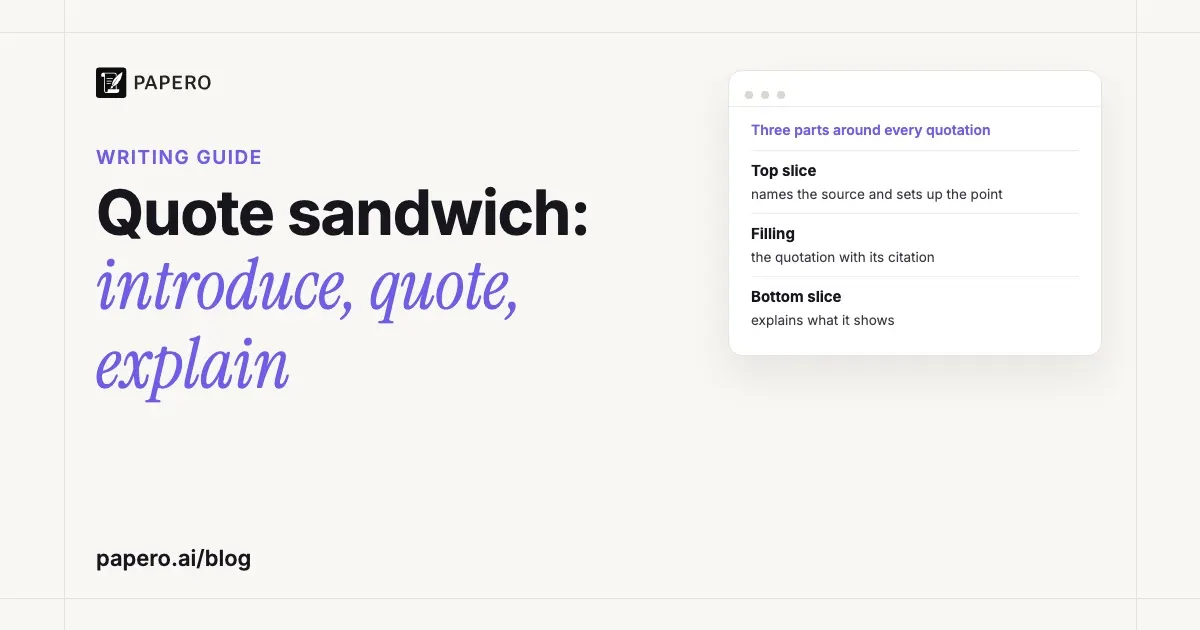
A quote sandwich puts every quotation between words of your own: a sentence or clause before it that introduces the source and sets up the point, and one or more sentences after it that explain what the quotation means and how it supports your argument. The quotation, with its citation, is the filling. The slice after the quote is the one inexperienced writers most often skip.
Key Takeaways
- Three parts: the top slice introduces the quotation, the filling is the quotation with its citation, and the bottom slice explains it in your own words.
- The bottom slice does the arguing. Our working rule: make it at least as long as the quotation.
- Carnegie Mellon’s handout adds a fourth move before the top slice: state the point the quotation will support.
- The same quotation can support two different arguments. What you write around it decides which.
- A quotation with nothing around it is what They Say / I Say calls a “hit-and-run” quotation, and it is the mistake the sandwich exists to fix.
What is a quote sandwich?
A quote sandwich is a way to fit a quotation into a paragraph so the reader always knows who is speaking and why the words matter. The top slice names the source and prepares the reader. The filling is the quoted words with their citation. The bottom slice explains them, ties them to your claim and shows that you understood them. Remove either slice and the quotation has to argue for you, which it cannot do.
| Part | What it does | Typical length | Starter phrases |
|---|---|---|---|
| Top slice | Names the source, gives context, signals what the quote will show | One sentence or a clause | As X puts it, … / X complicates the matter when she writes, … / In her 2011 study, X warns that … |
| Filling | The source’s exact words, then the citation | As short as the point allows | “…” (Author page) in MLA; “…” (Author, Year, p. #) in APA, or only the page when the top slice names the source |
| Bottom slice | Restates, interprets and connects the quote to your claim | One to three sentences | In other words, … / The essence of X’s argument is that … / This matters because … |
The sandwich metaphor is usually credited to Gerald Graff and Cathy Birkenstein’s They Say / I Say, a college writing textbook published by W. W. Norton. Pat Thomson, reviewing its second edition, sums up their “quotation sandwich” as an introduction, the quotation and then an explanation. Carnegie Mellon’s handout on direct quotations credits its sandwich diagram to a 2005 blog post by Brian Russell, and it adds a fourth move before the top slice, “Present the argument”, so the reader knows the point before the source appears.
Quote sandwich example in MLA
Here is a three-part example on Frederick Douglass’s 1845 Narrative, quoted from the Project Gutenberg text. That file has no page numbers, so the citation gives the chapter instead. In MLA, the filling ends with the author and page in parentheses, or only the page (here, the chapter) when the top slice names the author. The slices are labelled.
[Top slice] Douglass marks his fight with Edward Covey, a farmer known for breaking the will of enslaved young men, as the turning point of the Narrative, and he signals it before the fight begins: [Filling] “You have seen how a man was made a slave; you shall see how a slave was made a man” (ch. 10). [Bottom slice] The sentence reverses its own words: “man” and “slave” trade places in the second half. With “you have seen” and “you shall see,” Douglass divides his story into two movements, so the fight he is about to describe reads as the moment the story changes direction, not as one more scene of cruelty.
Three things make it work. The top slice gives the context (who Covey is and why the fight matters) and the claim the quotation supports (the fight is the turning point). Because the sentence names Douglass, the citation needs only the location: (ch. 10). And the bottom slice does something the quotation cannot do for itself: it points at the reversed word order and says what that order does.
The works cited entry for this source:
Douglass, Frederick. Narrative of the Life of Frederick Douglass, an American Slave. 1845. Project Gutenberg, 12 Jan. 2006, www.gutenberg.org/ebooks/23.
For the rest of MLA’s in-text rules, including citing by chapter or line instead of page, see our guide to MLA in-text citation.
Quote sandwich example in APA
The same three parts work in APA. When the top slice names the authors, the year goes in parentheses right after their names and the page follows the quotation; when it does not, all three go after the quotation: (Osborne & Patterson, 2011, p. 627). This example quotes a 2011 article in Science Education and names its authors in the top slice.
[Top slice] Science-education research often uses “argument” and “explanation” as if the two words named one thing. Osborne and Patterson (2011) object to that confusion, warning that [Filling] “a lack of clarity of fundamental concepts is problematic for a field” (p. 627). [Bottom slice] In other words, the authors treat explanation and argument as different jobs. A student who does not know which of the two a rubric rewards cannot tell what a good answer looks like, and a teacher who blurs them is grading against two standards at once.
The top slice here does two jobs: it states the problem in the writer’s own words, and the signal verb “warning” tells the reader the authors see a risk. The quotation is one clause, which is all the point needs. The reference list entry:
Osborne, J. F., & Patterson, A. (2011). Scientific argument and explanation: A necessary distinction? Science Education, 95(4), 627–638. https://doi.org/10.1002/sce.20438
The same article drew a reply from one of the authors of the science-class framework covered in our guide to claim, evidence and reasoning.
One quote, two sandwiches
The same quotation can prove different things, depending on the slices you put around it. Change the claim in the top slice and the reading in the bottom slice, and the filling starts to support a new point. Here is the Douglass sentence again, with the same citation, this time supporting a claim about freedom instead of the book’s structure.
[Top slice] For Douglass, becoming a man does not wait for legal freedom; he describes reaching it while he is still enslaved. [Filling] “You have seen how a man was made a slave; you shall see how a slave was made a man” (ch. 10). [Bottom slice] The fight he introduces here takes place in August 1833, and he does not escape until 1838. In the scene where a slave “was made a man,” his legal status has not changed. What has changed is that he will no longer submit.
The first sandwich used the quotation to make a point about the book’s structure. This one uses it to make a point about freedom. The filling is identical. The dates come from the Narrative itself, which dates the start of the episode to August 1833 (in the same paragraph) and 1838 for the escape (chapter 11). Carnegie Mellon’s handout makes the same demonstration with a textbook quotation about King Tut’s tomb, which it frames once to argue that popular media distort ancient Egypt and once to argue that archaeology keeps it part of modern culture.
How do you write the bottom slice?
Start by restating the quotation in plainer words, then say what in it supports your claim, then connect it back to your paragraph’s point. The bottom slice is where you show the reader what you see in the quotation that they might not. One sentence is a minimum, and two or three are common in a body paragraph; as a working rule, make the bottom slice at least as long as the quotation.
Four moves, which you can combine:
- Restate it. “In other words, Douglass is saying that…” This proves you understood the words and catches readers who did not.
- Zoom in on a word or phrase. “The word ‘made’ matters here because…” Point to the exact language that does the work.
- Connect it to your claim. “This is why the fight, not the escape, is the book’s turning point.” Say out loud what the quotation proves for your thesis.
- Set its limits. “This shows how Douglass framed the fight, not how others saw it.” Saying what a quotation cannot prove makes the rest of your reading more credible.
They Say / I Say offers templates for this slice. A classroom handout adapted from the book reproduces several of them: “In other words, X believes…”, “In making this comment, X argues that…”, “X is insisting that…” and “The essence of X’s argument is that…”. Thomson’s review quotes a similar set. Use them as scaffolding, then vary them, because a paragraph where every quotation is followed by “In other words” reads like a form.
If your bottom slice only repeats the quotation in different words, it has done the first move and stopped. Add the second or third.
How do you write the top slice?
Name the source and tell the reader what to listen for. A bare “According to X” or “X states” is acceptable but flat. A verb that says what the author is doing, such as “warns”, “concedes” or “complicates”, previews your reading before the quotation arrives. The handout adapted from They Say / I Say gives the same advice: introduce a quotation by stating the author’s position or tone, and your analysis is “more effectively previewed”.
The top slice also carries the grammar. A quotation joined to your sentence with “that” must fit your syntax; a full sentence before a quotation ends with a colon; a short signal phrase takes a comma. Our guide to signal phrases lists 57 signal verbs by meaning, with the tense APA and MLA expect and the punctuation for each pattern.
Common quote sandwich mistakes
Five common problems are a quotation with no top slice, a quotation with no bottom slice, a quotation that is too long for its point, a bottom slice that only repeats the quote, and a paragraph that ends on the quotation. Each one leaves the reader to do work the writer should have done.
- The hit-and-run quotation. Thomson describes Graff and Birkenstein’s term for a quotation dropped into the text “as if it can speak for itself”: no introduction, no explanation, no link to the argument. The classroom handout calls the same thing a dangling quote.
- The open-faced sandwich. A top slice and a quotation, then the next point. The reader is left to decide what the quotation proved.
Three more are easy to miss. Too much filling means quoting more than the point needs: quote only the words that carry it and paraphrase the rest; the classroom handout also suggests that, in most cases, quotations should make up only about ten percent of a paper. An echo is a bottom slice that says the same thing as the quotation, only longer, so go one step further and say what the quotation shows. And a paragraph whose last sentence is a quotation hands the final word to someone else: end on your bottom slice instead, then write the next topic sentence.
Does a paraphrase or a block quote need a sandwich?
Yes. A paraphrase still needs a signal phrase before it and your own comment after it, or the reader cannot tell where the source’s idea ends and yours begins. A long quotation that goes in a block keeps both slices too: the top slice usually ends with a colon, and the bottom slice is a new line of your own after the block.
The longer the quotation, the more the bottom slice has to do, because the reader has more words to sort through. Our guide to block quotes in APA, MLA and Chicago shows the block format, and the paraphrasing examples rewrite eight real passages with their citations.
The sandwich also applies to quotations from your own research data. Thomson makes the point about interview transcripts: a participant’s words do not speak for themselves either, because the researcher solicited, transcribed and edited them. Introduce who is speaking and in what context, then say what the extract shows.
Where Papero fits
Papero is an AI writing workspace for students and researchers. Its chat answers questions about the PDFs in your library and cites the passages it used, with the page when it is certain, so you can go back to the exact sentence you want to quote. Citation search finds real papers for the sentence you are writing, and Papero inserts the in-text citation in APA 7, MLA 9 or seven other styles.
The slices stay yours. Papero can find the source and format the citation, but the claim before a quotation and the reading after it are the part of the paragraph a grader is marking. The essay writing page shows where Papero helps, and the glossary entries on the body paragraph and the block quote have short definitions.
Frequently Asked Questions
What are the three parts of a quote sandwich?
The top slice, the filling and the bottom slice. The top slice is your sentence introducing the source and the point. The filling is the quotation with its citation. The bottom slice is your explanation of what the quotation means and how it supports your argument.
How long should the explanation after a quote be?
At least one full sentence, and in a body paragraph usually two or three. Our working rule is to make the explanation at least as long as the quotation. A long quotation needs more explanation, not less, because the reader has more words to interpret.
Can you start a paragraph with a quote?
You can, but it usually weakens the paragraph. The first sentence of a body paragraph is where readers expect your point. Start with a topic sentence in your own words, then introduce the quotation with a phrase that names the source, so the reader knows what it is evidence for before they read it.
Does every quote need a quote sandwich?
Yes, in substance: every quotation needs an introduction and an explanation, though not always a separate sentence for each. A short phrase can sit inside your own sentence, with the introduction and the comment around it in one line. What every quotation needs is a clear source and a clear reason for being there.
What is a hit-and-run quotation?
A quotation dropped into a paragraph with no introduction and no explanation, as if it could speak for itself. Gerald Graff and Cathy Birkenstein use the term in They Say / I Say, and the quote sandwich is their fix for it.
Sources
- Pat Thomson, “the quotation sandwich” (patthomson.net, August 13, 2011; accessed November 2026), a review of G. Graff and C. Birkenstein, They Say / I Say (2nd ed., W. W. Norton, 2010): https://patthomson.net/2011/08/13/the-quotation-sandwich/
- Mr. Corbin (US history teacher’s classroom site), “The Quote Sandwich (Adapted from They Say/I Say, pp. 41-5)” (wcorbin.net, accessed November 2026): https://www.wcorbin.net/uploads/3/8/1/9/38190097/the_quote_sandwich.pdf
- Carnegie Mellon University, “Using Source Material For Your Purposes” (direct quotations handout) (cmu.edu, accessed November 2026): https://www.cmu.edu/student-success/other-resources/handouts/comm-supp-pdfs/direct-quotations-using-source-material.pdf
- Douglass, Frederick. Narrative of the Life of Frederick Douglass, an American Slave. 1845. Project Gutenberg eBook #23, released January 12, 2006: https://www.gutenberg.org/ebooks/23
- Osborne, J. F., & Patterson, A. (2011). Scientific argument and explanation: A necessary distinction? Science Education, 95(4), 627–638. https://doi.org/10.1002/sce.20438