An APA in-text citation gives the author’s surname and the year of publication, either in parentheses, as in (Roediger & Karpicke, 2006), or in your sentence, as in Roediger and Karpicke (2006). A direct quotation adds the page: (Roediger & Karpicke, 2006, p. 249). Every in-text citation must match one entry in your reference list.
Key Takeaways
- Two formats: parenthetical (Author, year) with a comma inside the parentheses, and narrative, Author (year), with the year in parentheses after the name.
- One or two authors: name them every time, joined by “&” in parentheses and “and” in your sentence. Three or more: first author plus “et al.” from the very first citation.
- Quotations always need a page number or, for sources without pages, a paragraph or section. Paraphrases do not, though a page helps in a long work.
- Cite an idea when you introduce it, not in every sentence. APA’s own checklist warns against overcitation.
APA in-text citation examples
The table covers the cases students meet most, in APA 7, checked against APA’s In-Text Citation Checklist and Purdue OWL’s APA pages in October 2026. Where a row uses a real source, the source is in the reference list further down; rows marked “pattern” show the shape without inventing a source.
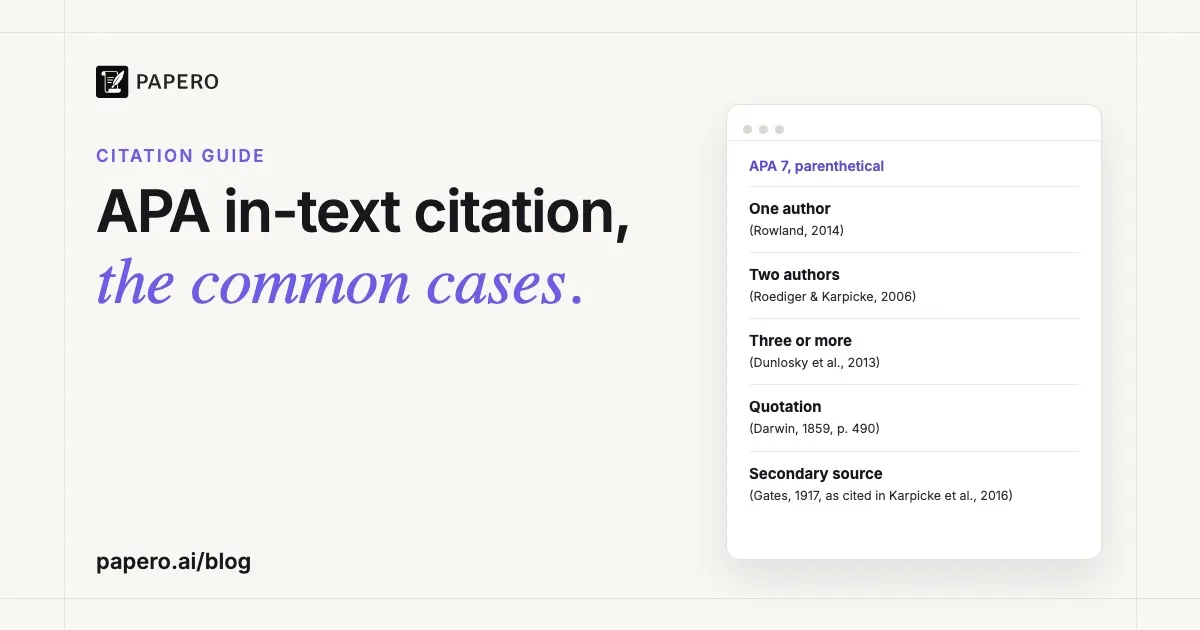
| Case | Parenthetical | Narrative |
|---|---|---|
| One author | (Rowland, 2014) | Rowland (2014) |
| Two authors | (Roediger & Karpicke, 2006) | Roediger and Karpicke (2006) |
| Three or more authors | (Dunlosky et al., 2013) | Dunlosky et al. (2013) |
| Group author, first citation | (American Psychological Association [APA], 2020) | American Psychological Association (APA, 2020) |
| Group author, later citations | (APA, 2020) | APA (2020) |
| Quotation with a page | (Darwin, 1859, p. 490) | Darwin (1859) … (p. 490) |
| Quotation without pages | (Karpicke et al., 2016, Introduction section, para. 3) | Karpicke et al. (2016) … (Introduction section, para. 3) |
| Two or more works | (Agarwal et al., 2021; Rowland, 2014) | Agarwal et al. (2021) and Rowland (2014) |
| Secondary source | (Gates, 1917, as cited in Karpicke et al., 2016) | Gates (1917, as cited in Karpicke et al., 2016) |
| No author (pattern) | (Title of Web Page, 2024) | Title of Web Page (2024) |
| No date (pattern) | (Surname, n.d.) | Surname (n.d.) |
| Same author, same year (pattern) | (Surname, 2020a, 2020b) | Surname (2020a) |
| Personal communication (pattern) | (A. Surname, personal communication, March 3, 2026) | A. Surname (personal communication, March 3, 2026) |
Two rules in that table cause most of the lost marks. “Et al.” is used from the first citation for three or more authors in the 7th edition, and has a period only after “al”. And the “&” belongs only inside parentheses; in your own sentence, write “and”.
Parenthetical vs narrative citations
A parenthetical citation puts the author and year in parentheses, usually at the end of the clause: (Rowland, 2014). A narrative citation makes the author part of your sentence and puts only the year in parentheses: Rowland (2014) found. APA’s checklist asks for a comma between author and year in the parenthetical form, and the year in parentheses right after the name in the narrative form.
Use the narrative form when the author matters to your point, for example when you compare two researchers or introduce a claim you will dispute. Use the parenthetical form when the finding matters more than who found it. Most papers mix both, and a paragraph that names the author in every sentence reads like a list of summaries rather than an argument.
How do you cite multiple authors in APA?
Name one or two authors in every citation; for three or more, give the first author’s surname followed by “et al.” from the first citation onward. Purdue OWL notes the one exception: if two of your sources would shorten to the same “et al.” form, write out as many names as you need to tell them apart.
Group authors, such as associations and government agencies, are spelled out in full. If the group has a familiar abbreviation, give it in square brackets in the first parenthetical citation, then use the abbreviation alone. Purdue OWL adds that you should not abbreviate when two of your sources would share the same abbreviation.
When a parenthesis holds two or more works, list them in the order they appear in your reference list, which means alphabetically, and separate them with semicolons: (Agarwal et al., 2021; Rowland, 2014). Two works by the same author in the same year take the letters a, b and so on after the year, in both the citation and the reference list.
When do you need a page number in APA?
Always for a direct quotation, and optionally for a paraphrase. A quotation takes “p.” for one page and “pp.” for a range, with an en dash between the numbers: (p. 249) or (pp. 249–250). In a narrative citation, the page goes in its own parentheses after the quotation: Roediger and Karpicke (2006) noted that restudying “increased students’ confidence in their ability to remember the material” (p. 249).
Sources without page numbers, such as web pages and articles read in an HTML version, use another locator: a paragraph number, a section heading, or both, as in (Karpicke et al., 2016, Introduction section, para. 3) for the HTML version of that article. Purdue OWL warns against using the page numbers of a printed web page or Kindle location numbers.
For a paraphrase, the author and year are enough. Purdue OWL notes that APA encourages a page or range when it would help the reader find the passage in a long work, such as a book. Quotations of 40 words or more go in a block quotation, with the citation after the final punctuation; our guide to block quotes in APA, MLA and Chicago shows the format.
How do you cite a source you found in another source?
Name the original work and cite the source you actually read, with “as cited in”: (Gates, 1917, as cited in Karpicke et al., 2016). Only the source you read, Karpicke et al. (2016), goes in your reference list. Purdue OWL advises reading and citing the original whenever you can, and using a secondary citation only when the original is out of reach.
The Gates example is a real one. Karpicke, Blunt and Smith (2016) describe a 1917 experiment by Gates in which children practised recitation. A student writing about the history of retrieval practice who cannot get the 1917 original would cite it this way.
How often should you cite in APA?
Cite a source when you first use its idea, and again when you return to it after another source, a change of topic or a new paragraph. APA’s In-Text Citation Checklist calls repeated citation of the same long paraphrase “overcitation”, and asks for one citation when the idea is introduced, without repeating it unless the topic, source or paragraph changes.
Undercitation is the bigger risk. Every idea, finding or piece of information that is not yours and not common knowledge needs a citation. The checklist also asks you to check that every in-text citation matches exactly one reference list entry, spelled the same way, with the same year, and that every reference is cited at least once.
APA in-text citation example paragraph
Here is a short paragraph with five citations in mixed forms, followed by its reference list. The studies and the quotation are real; the quotation comes from the abstract on the article’s first page.
Rereading feels productive, but it is one of the weaker ways to study. In a review of 10 learning techniques, Dunlosky et al. (2013) rated practice testing and distributed practice as high utility, and rereading and highlighting as low utility. The advantage of testing appears after a delay: students who restudied a passage did better on a test 5 minutes later, but students who had been tested remembered substantially more after 2 days and after 1 week (Roediger & Karpicke, 2006). Recall tests produce larger benefits than recognition tests (Rowland, 2014), and the effect has been found in children as well as university students (Karpicke et al., 2016). Roediger and Karpicke (2006) also found that restudying “increased students’ confidence in their ability to remember the material” (p. 249), which may be why students keep choosing it.
References
Dunlosky, J., Rawson, K. A., Marsh, E. J., Nathan, M. J., & Willingham, D. T. (2013). Improving students’ learning with effective learning techniques: Promising directions from cognitive and educational psychology. Psychological Science in the Public Interest, 14(1), 4–58. https://doi.org/10.1177/1529100612453266
Karpicke, J. D., Blunt, J. R., & Smith, M. A. (2016). Retrieval-based learning: Positive effects of retrieval practice in elementary school children. Frontiers in Psychology, 7, Article 350. https://doi.org/10.3389/fpsyg.2016.00350
Roediger, H. L., III, & Karpicke, J. D. (2006). Test-enhanced learning: Taking memory tests improves long-term retention. Psychological Science, 17(3), 249–255. https://doi.org/10.1111/j.1467-9280.2006.01693.x
Rowland, C. A. (2014). The effect of testing versus restudy on retention: A meta-analytic review of the testing effect. Psychological Bulletin, 140(6), 1432–1463. https://doi.org/10.1037/a0037559
Notice that the third sentence cites Roediger and Karpicke in parentheses, and the last sentence cites them again narratively because the quotation needs its own page. The reference list is alphabetical and uses a hanging indent, which this page cannot show.
How is MLA in-text citation different?
MLA uses the author’s surname and the page, with no comma and no year: (Darwin 490). APA uses the surname and year, and adds the page only when you quote or point to a passage: (Darwin, 1859, p. 490). MLA also uses “and” between two authors rather than “&”. If your class uses Chicago with footnotes instead, the citation moves out of the sentence entirely; see our guide to Chicago style footnotes.
Where Papero fits
Papero is an AI writing workspace for students and researchers, and you can sign up free. According to the Papero homepage, it finds real papers to cite for the sentence you are writing, looks sources up by DOI, inserts in-text citations, including several sources in one citation, and formats them in APA 7, MLA 9, Chicago author-date, Harvard or IEEE.
On the free plan, in-text citations work in full, and the reference list shows your real entries blurred; Plus makes it readable and exportable (papero.ai/pricing). Page numbers for quotations are still yours to add, because only you know which page you quoted. The glossary entries on the in-text citation and APA style have the short definitions.
Frequently Asked Questions
Is it p. or pp. in an APA citation?
Use “p.” for a single page and “pp.” for a range of pages, with an en dash between the first and last page: (Surname, 2020, p. 12) for one page, (Surname, 2020, pp. 12–13) for two. The same rule applies in narrative citations, where the page goes in its own parentheses after the quotation.
Do you need an in-text citation for every sentence?
No. Cite a paraphrased idea when you introduce it, and repeat the citation only when you change source, topic or paragraph, as APA’s In-Text Citation Checklist puts it. If several sentences in a row draw on the same source and it is clear they do, one citation is enough.
How do you cite a website with no author in APA?
Use the title in place of the author, in title case. A stand-alone web page has an italic title in the reference list, so it is italic in the citation too: (Title of Web Page, 2024). Purdue OWL states the rule: if the title is italic in the reference list, italicize it in the text; titles of parts of a larger work, such as an article or chapter, go in quotation marks instead. If there is no date either, write “n.d.”: (Title of Web Page, n.d.). If an organization published the page, it is usually the author, so cite the organization’s name instead.
Do you use et al. for two authors in APA?
No. “Et al.” stands for more than one person, so for two authors you name both every time: (Roediger & Karpicke, 2006). Use “et al.” only for three or more authors, from the first citation. Purdue OWL notes that if “et al.” would stand for only one name, you write that name instead.
Where does the period go in an APA in-text citation?
After the closing parenthesis for a normal run-in citation: (Rowland, 2014). With a short quotation, the closing quotation mark comes first, then the citation, then the period. Block quotations of 40 words or more are the exception: the period ends the quotation and the citation follows it, with no period after.
Sources
- APA Style, In-Text Citation Checklist, 7th edition (apastyle.apa.org, accessed October 2026): https://apastyle.apa.org/instructional-aids/in-text-citation-checklist.pdf
- Purdue OWL, “In-Text Citations: The Basics” (APA) (owl.purdue.edu, accessed October 2026): https://owl.purdue.edu/owl/research_and_citation/apa_style/apa_formatting_and_style_guide/in_text_citations_the_basics.html
- Purdue OWL, “In-Text Citations: Author/Authors” (APA) (owl.purdue.edu, accessed October 2026): https://owl.purdue.edu/owl/research_and_citation/apa_style/apa_formatting_and_style_guide/in_text_citations_author_authors.html
- Agarwal, P. K., Nunes, L. D., & Blunt, J. R. (2021). Retrieval practice consistently benefits student learning: A systematic review of applied research in schools and classrooms. Educational Psychology Review, 33(4), 1409–1453. https://doi.org/10.1007/s10648-021-09595-9
- Darwin, C. (1859). On the origin of species by means of natural selection, or the preservation of favoured races in the struggle for life. John Murray. First-edition facsimile on Wikisource: https://en.wikisource.org/wiki/On_the_Origin_of_Species_(1859)/Chapter_XIV
- Dunlosky, J., Rawson, K. A., Marsh, E. J., Nathan, M. J., & Willingham, D. T. (2013). Improving students’ learning with effective learning techniques: Promising directions from cognitive and educational psychology. Psychological Science in the Public Interest, 14(1), 4–58. https://doi.org/10.1177/1529100612453266
- Karpicke, J. D., Blunt, J. R., & Smith, M. A. (2016). Retrieval-based learning: Positive effects of retrieval practice in elementary school children. Frontiers in Psychology, 7, Article 350. https://doi.org/10.3389/fpsyg.2016.00350
- Roediger, H. L., III, & Karpicke, J. D. (2006). Test-enhanced learning: Taking memory tests improves long-term retention. Psychological Science, 17(3), 249–255. https://doi.org/10.1111/j.1467-9280.2006.01693.x
- Rowland, C. A. (2014). The effect of testing versus restudy on retention: A meta-analytic review of the testing effect. Psychological Bulletin, 140(6), 1432–1463. https://doi.org/10.1037/a0037559