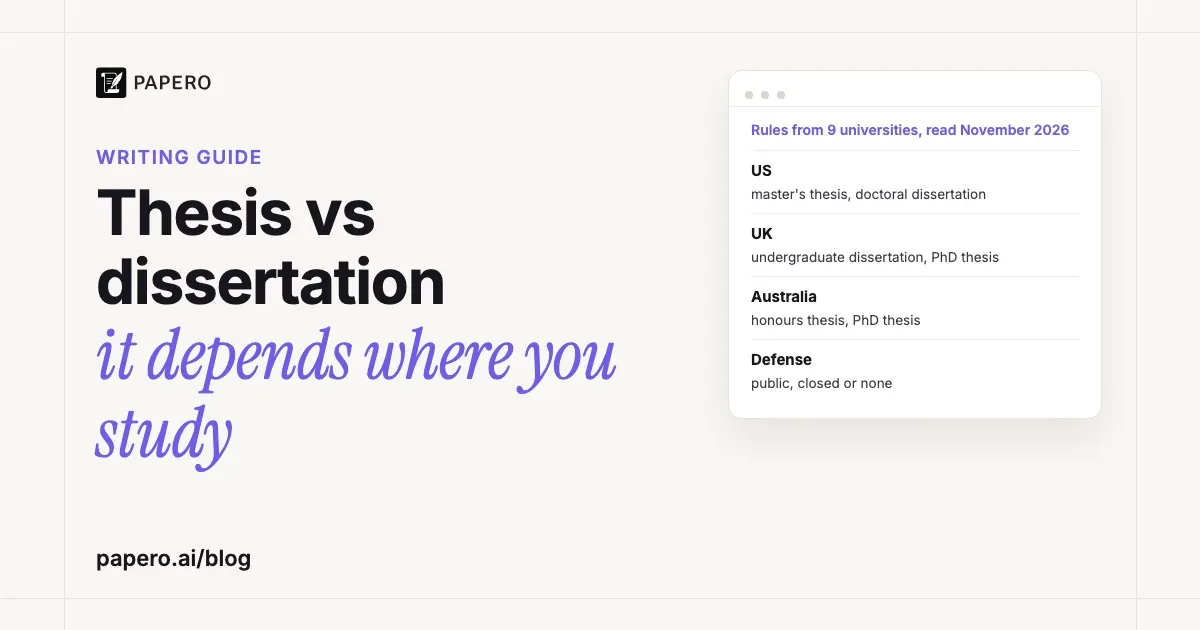
In the US, a thesis usually ends a master’s degree and a dissertation ends a PhD. In the UK and Australia the words often run the other way: the doctoral work is a thesis, and a dissertation is the long project of an undergraduate or taught master’s degree. What decides the name is your university’s regulations, which also set the length, the oral exam and who examines it.
Key Takeaways
- The difference between a thesis and a dissertation is mostly vocabulary. Both are long, supervised, independent research projects; which word you hear depends on the country and the university.
- US graduate schools such as UC Berkeley and the University of Michigan file master’s theses and doctoral dissertations. UK and Australian universities such as Oxford, Cambridge and Melbourne examine PhD theses, and UK undergraduates write dissertations.
- Length limits are set by each university, sometimes by each department. Cambridge alone uses 80,000 words, 60,000 words and a 275-page limit for the PhD in different departments.
- A defense is not universal. Michigan requires a public oral defense, UK vivas are usually closed, and Melbourne made a viva compulsory only for doctoral candidates who started in 2025 or later.
- A thesis statement is a single sentence stating an essay’s main claim. A thesis is the whole document.
What is the difference between a thesis and a dissertation?
A thesis and a dissertation are both extended pieces of original research written under supervision and examined as a whole. The difference lies in which degree each word names, and that changes with the country. US universities use “thesis” for the master’s and “dissertation” for the doctorate. British and Australian universities call the doctorate a thesis and use “dissertation” for shorter degree projects.
The table sets out the thesis vs dissertation rules we read in universities’ own regulations and, for the UK, the QAA’s. Each cell names the institution behind the rule, because no country has a single national standard for length.
| United States | United Kingdom | Australia | |
|---|---|---|---|
| Doctoral work is called | Dissertation (Berkeley, Michigan) | Thesis (Oxford DPhil, Cambridge PhD, QAA) | Thesis (Melbourne) |
| Master’s work is called | Thesis (Berkeley Plan I) | Dissertation on a taught master’s (Oxford MSt); thesis on a research master’s (Cambridge MSc, MLitt) | Thesis (Melbourne MPhil and Masters by Research) |
| Undergraduate work is called | Senior thesis (Harvard engineering and applied sciences) | Dissertation (Manchester, Warwick) | Honours thesis (ANU) |
| Length of the doctoral work | No overall word limit in the Berkeley or Michigan rules we read | Up to 100,000 words (Oxford DPhil in History); 80,000 (Cambridge Geography); 60,000 (Cambridge Computer Science) | Maximum 100,000 words, about 80,000 expected (Melbourne) |
| Originality expected of a doctorate | An original, doctoral-level research project (Michigan) | An original contribution to knowledge (QAA) | Original knowledge that makes a significant contribution (Melbourne) |
| Oral exam | Public defense required (Michigan); at the committee’s discretion in most programs (Berkeley Plan B) | Closed viva with at least one external examiner (QAA) | Viva compulsory for candidates who started in 2025 or later (Melbourne) |
| Who examines | A committee: at least four members (Michigan), three or five (Berkeley) | Two or three examiners, at least one external (QAA) | Two external examiners (Melbourne) |
| Where it is published | Institutional repository: Deep Blue (Michigan, ProQuest optional), eScholarship plus ProQuest (Berkeley) | Institutional repository: Apollo (Cambridge, since 2017) | Not covered in the pages we read |
Is a thesis for a master’s and a dissertation for a PhD?
In the United States, usually yes. UC Berkeley’s Guide to Graduate Policy splits master’s degrees into Plan I, which ends in a thesis, and Plan II, which ends in a comprehensive exam or a capstone project. Doctoral students file a dissertation. The University of Michigan’s Rackham Graduate School publishes a Dissertation Handbook for doctoral candidates only.
Plan I “requires a minimum of 20 semester units of upper division and graduate courses, and completion of a thesis”, and the Graduate Division keeps separate filing guides for master’s theses and doctoral dissertations. A Berkeley master’s thesis goes to the University Library, while a doctoral dissertation is uploaded through ProQuest and “published online in the UC system’s scholarship repository and made available within ProQuest/UMI” once the degree is conferred.
Michigan works the same way at the doctoral level. Its handbook (July 2023 edition) makes the final PDF “the official copy of record” for Deep Blue, the University Library’s digital archive, and lets students “opt out of submitting it to ProQuest”. US undergraduates write theses too: Harvard’s School of Engineering and Applied Sciences runs a senior thesis for undergraduates, submitted through ProQuest ETD.
Why do UK and Australian universities call the PhD a thesis?
It is a convention set in each university’s regulations, not a national rule: in the UK and Australia “thesis” names the work of a research degree, and “dissertation” the long project on a taught one. The UK’s Quality Assurance Agency describes the doctorate as a thesis defended at an oral examination, and Oxford, Cambridge and Melbourne all use that word in their doctoral rules.
The QAA’s Characteristics Statement for doctoral degrees (February 2020) uses “thesis” throughout and says the final assessment ends with “an oral examination (‘viva’ or ‘viva voce’), at which the candidate defends the thesis”. Oxford’s course page for the DPhil in History asks for “a substantial thesis of not more than 100,000 words”. Oxford’s MSt in English (1550-1700), a taught master’s, has students “research and write a dissertation”.
The convention has shifted even inside one university. In the 2016 edition of Cambridge’s Statutes and Ordinances, the PhD regulations said candidates “shall submit their dissertations”. In the 2019 edition, the same clause reads “shall submit their theses”, and the section heading changed from “by dissertation” to “by thesis”.
Australia uses “thesis” lower down too. Melbourne examines PhD, MPhil and Masters by Research theses, and the Australian National University’s College of Asia and the Pacific sets a word limit for the Honours thesis.
How long is a thesis or a dissertation?
As long as your university and department say, and no longer. A UK undergraduate dissertation in History runs to 9,000 or 10,000 words at Warwick and Manchester. In the UK and Australian doctoral rules we read, the ceiling runs from 60,000 to 100,000 words. The US graduate school rules we read set no overall word limit for either a thesis or a dissertation.
- Cambridge, Department of Geography: a thesis must not exceed “80,000 words for the PhD degree and 60,000 words for the MSc or MLitt degree, including the summary/abstract”, without the Degree Committee’s permission. Bibliography and appendices do not count.
- Cambridge, Computer Science and Technology: the PhD limit is 60,000 words “including tables and footnotes, but excluding appendices, bibliography, photographs and diagrams”.
- Cambridge, Department of Earth Sciences: no word count at all, but a limit of 275 numbered pages, of which no more than 225 are text, appendices, illustrations and bibliography.
- Oxford, DPhil in History: not more than 100,000 words.
- Melbourne: “The maximum allowed thesis length is 100,000 words” for a doctorate, with about 80,000 expected for a PhD and 50,000 to 80,000 for a PhD including publications. MPhil theses have a 50,000-word maximum and about 40,000 expected.
- ANU College of Asia and the Pacific: an Honours thesis of at most 20,000 words, including footnotes, tables and maps.
The QAA explains why the numbers vary so much. In mathematics, a candidate “may have developed an elegant formula” and the rest of the thesis “may be relatively short”, while “In more discursive subjects, the thesis may be as long as 100,000 words.” Word limits are policed: Cambridge’s Earth Sciences and Geography committee warns that a thesis over its limit “may not be examined until its length complies with the prescribed limit”.
Do you have to defend a thesis or a dissertation?
It depends on the university. Michigan requires an oral defense open to the public. Most Berkeley doctoral programs leave a final defense to the committee. UK universities usually hold a closed viva. Melbourne made a viva compulsory for doctoral candidates who started in 2025 or later. Some master’s theses, such as Melbourne’s, have no oral exam at all.
United States. Rackham’s handbook states that “oral defenses must be public events” and that “Dissertation committees must have at least four members”. Berkeley runs two doctoral plans. Plan A has a five-member committee and a mandatory final oral defense, while “Most doctoral programs follow Plan B, which requires a three-member committee to evaluate the dissertation. A final defense may be required at the discretion of the committee.”
United Kingdom. The QAA describes “the closed oral examination, with two or even three examiners”, and requires at least one external examiner at each doctoral viva.
Australia. Melbourne has examined doctoral theses on paper alone: its examiner guidance of 21 May 2025 says, “There is currently no oral examination component at the University of Melbourne.” That changes with the 2025 intake: its examination pages say that candidates who commenced from 2025 onwards “must have a viva” unless a waiver is approved, held before “a formal panel of two external examiners”, usually by video conference. Earlier starters choose.
Whatever the name, the doctoral bar is originality. The QAA requires “an original contribution to knowledge”, and Melbourne’s criteria ask that the thesis “demonstrate that the candidate has generated original knowledge”. Master’s and undergraduate projects are judged against lower expectations; our guide on how to choose a research topic quotes the UK framework’s wording for each degree level.
Is a thesis the same as a thesis statement?
No. A thesis statement is one sentence in an essay or paper that states the main argument. A thesis is a whole document submitted for a degree. A thesis or dissertation does state a central claim, as research questions or an argument in the first chapter, but that is not what “thesis statement” refers to.
The University of North Carolina Writing Center describes a thesis statement as “usually a single sentence near the beginning of your paper (most often, at the end of the first paragraph) that presents your argument to the reader”. Searches mix the two up because “thesis” on its own also means a claim. If you came here to write that one sentence, our thesis statement examples give 30 of them by essay type.
What about a capstone or a project instead of a thesis?
A capstone is a final project that replaces the thesis on some master’s degrees. At Berkeley, Plan II master’s students take more coursework, 24 units against Plan I’s 20, and finish with “a comprehensive final examination or, if approved by the Graduate Council, a capstone project” instead of a thesis. The program decides what the capstone involves.
Berkeley allows students to collaborate, but “joint or group work is not acceptable as the basis for awarding graduate degrees”. If a PhD is in your plans, a thesis gives you practice in running a study from question to write-up; our overview of types of research methodology covers the designs a thesis can use. If your program asks for a proposal first, our research proposal example annotates a complete one for a master’s thesis in public health, from title page to references.
A third format exists at doctoral level: the thesis by publication. Melbourne allows published work “within the thesis”, and Berkeley accepts publishable papers “only if you incorporate that text into a larger argument that binds together the whole dissertation or thesis”. Each paper keeps the structure of a journal article, as set out in a research paper outline, and new introductory, transitional and concluding sections bind the papers together.
Where Papero fits
Papero is an AI writing workspace for students and researchers, and it works the same whether your regulations say thesis or dissertation. You can start each chapter from an outline with a prompt for every section, keep every source in one library, and cite in any of nine styles: APA 7, MLA 9, Chicago author-date, Harvard, IEEE, Vancouver, AMA 11, Nature and ACS.
Papero keeps a version at most every 10 minutes while you write, plus up to 20 named versions per document for up to 30 days, so the draft your supervisor commented on is easy to find. Review runs a source check, proofreading and a claims check before you submit. The thesis writing page shows the chapter workflow, and the glossary entry on the dissertation covers its usual structure. The word limit, the research and the argument stay yours.
Frequently Asked Questions
Is a PhD a thesis or a dissertation?
Both words are used. In the US, a PhD ends in a dissertation, as at UC Berkeley and the University of Michigan. In the UK and Australia, the PhD ends in a thesis, as at Oxford, Cambridge and Melbourne. Use the word in your own university’s regulations.
Is a master’s thesis the same as a dissertation?
In the US, a master’s thesis is the shorter project and a dissertation is the doctoral one. In the UK, a taught master’s degree such as Oxford’s MSt ends in a dissertation, while a research master’s such as Cambridge’s MSc or MLitt ends in a thesis. Check which word your own university’s regulations use.
Which is longer, a thesis or a dissertation?
Whichever one is the doctoral work. A US dissertation is longer than a US master’s thesis, and a UK PhD thesis is longer than a UK dissertation. Cambridge’s Geography department allows 80,000 words for a PhD thesis, while Manchester’s BA History dissertation is 10,000 words.
Do you need a dissertation for a PhD?
Yes, for a research doctorate, though your university may call it a thesis. Every university we checked in the US, UK and Australia requires one. The UK’s QAA says every doctorate must demonstrate “an original contribution to knowledge”, which UK universities assess through the thesis, or an equivalent portfolio, and an oral examination.
What is the difference between a capstone, a thesis and a dissertation?
A capstone is a final project that, like a comprehensive exam, replaces the thesis on some master’s degrees, such as Berkeley’s Plan II. A thesis, in the US, is a master’s research project. A dissertation, in the US, is the doctoral research project that must make an original contribution. In the UK and Australia, the last two words are often swapped.
Sources
- Australian National University, College of Asia and the Pacific. (n.d.). CAP word limit and penalty guidelines. Accessed November 1, 2026. https://asiapacific.anu.edu.au/cap-word-limit-and-penalty-guidelines
- Harvard John A. Paulson School of Engineering and Applied Sciences. (n.d.). Senior thesis. Accessed November 1, 2026. https://www.seas.harvard.edu/computer-science/undergraduate-program/research-opportunities/senior-thesis
- Quality Assurance Agency for Higher Education. (2020). Characteristics statement: Doctoral degree (3rd ed.). https://www.qaa.ac.uk/docs/qaa/quality-code/doctoral-degree-characteristics-statement-2020.pdf
- Rackham Graduate School, University of Michigan. (2023). The dissertation handbook: A guide to submitting your doctoral dissertation and completing your doctoral degree requirements (July 2023). https://rackham.umich.edu/wp-content/uploads/2020/09/dissertation-handbook.pdf
- UC Berkeley Graduate Division. (n.d.). Guide to graduate policy. Accessed November 1, 2026. https://grad.berkeley.edu/policy/fullguide
- UC Berkeley Graduate Division. (n.d.). Thesis writing and filing and Dissertation writing and filing. Accessed November 1, 2026. https://grad.berkeley.edu/academic-progress/thesis/ and https://grad.berkeley.edu/academic-progress/dissertation/
- University of Cambridge. (2016 and 2019). Statutes and ordinances, Chapter VII: Doctor of Philosophy, Master of Science, Master of Letters, and Master of Philosophy by dissertation (2016) and by thesis (2019). https://www.admin.cam.ac.uk/univ/so/2016/chapter07-section12.html and https://www.admin.cam.ac.uk/univ/so/2019/chapter07-section13.html
- University of Cambridge, Degree Committee for the Faculty of Earth Sciences and Geography. (n.d.). Rules and regulations for PhD. Accessed November 1, 2026. https://www.dcesg.physsci.cam.ac.uk/current-student/phd/phdregs
- University of Cambridge, Department of Computer Science and Technology. (n.d.). Writing up and word count. Accessed November 1, 2026. https://www.cst.cam.ac.uk/local/phd/writingup
- University of Cambridge, Open Research. (n.d.). Theses. Accessed November 1, 2026. https://www.openresearch.cam.ac.uk/theses
- University of Manchester. (n.d.). History dissertation: Course unit details, BA History (2027 entry). Accessed November 1, 2026. https://www.manchester.ac.uk/study/undergraduate/courses/2027/00255/ba-history/all-content/HIST30970
- University of Melbourne, Graduate Research. (2025). Information for examiners of PhD and doctoral theses (last updated May 21, 2025) and Information for examiners of MPhil and masters by research theses (last updated January 22, 2025). Accessed November 1, 2026 through the Internet Archive. https://gradresearch.unimelb.edu.au/__data/assets/pdf_file/0006/5149734/1-Examiner-Info-PhD-and-Doctoral-exam-by-thesis_21-May-2025.pdf and https://gradresearch.unimelb.edu.au/__data/assets/pdf_file/0004/5149741/3-Examiner-Info-MPhil-and-Masters-by-Research-Theses-210525.pdf
- University of Melbourne, Graduate Research. (n.d.). Examination overview and My viva examination. Accessed November 1, 2026 through the Internet Archive (captures of November 22, 2025). https://gradresearch.unimelb.edu.au/examination/my-viva-examination
- University of North Carolina at Chapel Hill, The Writing Center. (n.d.). Thesis statements. Accessed November 1, 2026. https://writingcenter.unc.edu/tips-and-tools/thesis-statements/
- University of Oxford. (n.d.). DPhil in History and MSt in English (1550-1700), graduate course pages. Accessed November 1, 2026 through the Internet Archive (captures of May 2026). https://www.ox.ac.uk/admissions/graduate/courses/dphil-history and https://www.ox.ac.uk/admissions/graduate/courses/mst-english-1550-1700
- University of Warwick. (n.d.). HI3S2-30 Dissertation, module catalogue 2025/26. Accessed November 1, 2026. https://courses.warwick.ac.uk/modules/2025/HI3S2-30