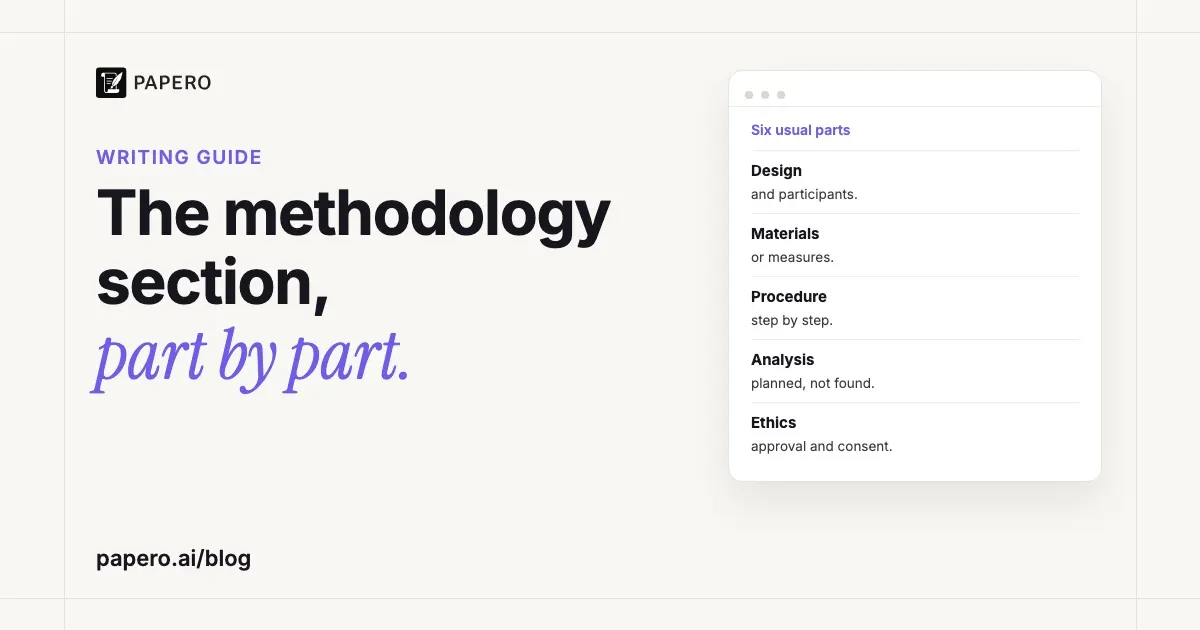
A methodology section tells readers what you did, in enough detail that another researcher could repeat it: the study design, who took part and how they were recruited, the materials and measures, the procedure, how the data were analysed, and the ethics approval. Write it in the past tense, in the order things happened. This guide shows how to write a methodology section part by part, with two published examples annotated excerpt by excerpt.
Key Takeaways
- A methods section has six usual parts: design, participants and recruitment, materials or measures, procedure, data analysis, and ethics. Short papers merge some of them, but leave none out without a reason.
- The reporting checklist for your design is the best list of what to include: JARS-Quant or JARS-Qual (APA), CONSORT for trials, STROBE for observational studies, SRQR or COREQ for qualitative work.
- Say how you chose your sample size: a power analysis in a quantitative study, a stated rationale in a qualitative one.
- Results stay out of the methods. Report what you measured and how, not what you found.
- A thesis methodology chapter adds the reasoning: why this approach suits the question, what the alternatives were, and the limits of the method.
What goes in a methodology section?
A methodology section answers “What did you do?” in the order you did it. Most have six parts: the design, the participants and how they were recruited, the materials and measures, the procedure, the data analysis, and the ethics approval. Each part has a matching item in the reporting checklists that journals ask authors to complete, so the checklist for your design doubles as a list of what to write.
| Subsection | What to report | Where the checklists ask for it |
|---|---|---|
| Design | Experimental, observational, qualitative or mixed; groups or conditions | JARS-Quant “Conditions and Design”; CONSORT item 9; STROBE item 4 |
| Participants | Eligibility, recruitment, sample size and how it was set, who dropped out | JARS-Quant “Sample Size, Power, and Precision”; CONSORT 12a and 16a; STROBE item 10; COREQ items 10-13 |
| Materials and measures | Each instrument by name, items, scale, reliability | JARS-Quant “Measures and Covariates” and “Psychometrics”; CONSORT item 14 |
| Procedure | What happened, step by step, and how participants were assigned | JARS-Quant “Data Collection”; CONSORT items 13 and 17-20; COREQ items 17-23 |
| Data analysis | Tests or qualitative approach, software, missing data, exclusions | JARS-Quant “Analytic Strategy” and “Data Diagnostics”; CONSORT 21a-21d; COREQ items 24-27 |
| Ethics | Review board, approval number, consent | JARS-Quant “Sampling Procedures”; JARS-Qual “Recruitment Process” |
James Madison University’s writing center lists the same parts, adds “Setting” where the location matters, and notes that “Most Method sections are organized chronologically”, from recruitment to analysis. The Papero glossary entry on the methodology section gives the short definition; this guide covers how to write each part.
Which reporting guideline applies to your study?
Pick the checklist by your field and your study design. Psychology and many social science departments follow APA’s Journal Article Reporting Standards: JARS-Quant for quantitative studies, JARS-Qual for qualitative ones. Health and medical journals use the EQUATOR Network guidelines: CONSORT for randomised trials, STROBE for observational studies, and SRQR or COREQ for qualitative research. Read the one that fits before you start writing.
| Your study | Guideline | Size |
|---|---|---|
| Quantitative, psychology or social sciences | APA JARS-Quant | Table 1 for every design, plus modules by design |
| Qualitative, psychology or social sciences | APA JARS-Qual | Table 1 for primary research |
| Randomised trial | CONSORT 2025 | 30 items; methods are items 8-21 |
| Cohort, case-control or cross-sectional study | STROBE | 22 items; methods are items 4-12 |
| Any qualitative design | SRQR | 21 items |
| Interviews and focus groups | COREQ | 32 items in three domains |
CONSORT 2025 replaced CONSORT 2010, which its authors say “should no longer be used”. None of these lists fix the order of your headings: the SRQR authors write that their items “should not be viewed as prescribing a rigid format or standardized content.” If you are unsure which family your design belongs to, our guide to qualitative vs quantitative research sorts the common designs.
How to write a methodology section, part by part
Write each part so a reader could act on it. JMU’s guide describes the section as “a set of instructions (written in past tense) for a reader who wishes to replicate your study.” Test every sentence against that reader: if someone repeating the study would need it, it stays; if not, cut it or move it to an appendix.
Design. Open with one sentence that names the design and its groups, such as this one we wrote for the Walsh et al. study below: This preregistered experiment randomly assigned students to one of four conditions for about eight days. For an experiment, name the independent and dependent variables and say whether conditions were manipulated or observed, which JARS-Quant asks for directly.
Participants and recruitment. Report who was eligible, how they were recruited, what they received for taking part, how many you aimed for and how many you ended with. JARS-Quant asks for the “intended sample size”, the “achieved sample size, if different”, and how the number was set, including any power analysis. Qualitative work has its own rule: JARS-Qual says “There is no agreed-upon minimum number of participants for a qualitative study. Rather, the author should provide a rationale for the number of participants chosen.” The glossary entry on sample size explains power analysis. If you drew your sample within subgroups such as year groups or regions, our guide to stratified sampling shows what to report about the strata and the allocation.
Materials and measures. Name every instrument, cite its source, and give its number of items, its response scale and its reliability in your sample. JARS-Quant asks you to define all measures, “including measures collected but not included in the report.” Full questionnaires go in an appendix or supplement.
Procedure. Describe what happened to a participant, in order, from consent to debriefing: how they were assigned, what instructions they received, how long each step took. CONSORT item 13 asks for the intervention “with sufficient details to allow replication”. In a qualitative study, this is where the interview guide, the setting and the length of the sessions go.
Data analysis. Name the tests or the qualitative approach, the software, and the rules you set before seeing the data: exclusions, missing data, transformations. Say which analyses were planned and which were exploratory. Interpretation waits for the discussion; as the University of Southern California’s guide puts it, “analyzed, not interpreted!”
Ethics. Give the review board, the approval number and how consent was obtained. JMU’s guide asks: “If your study was approved by an Institutional Review Board, what number did it assign to your project?” One or two sentences is enough in a journal article; a thesis expects more.
Methods section example 1: a quantitative experiment
Walsh, Regan, Okabe-Miyamoto and Lyubomirsky (2024) tested whether cutting back on smartphone use improves well-being. Students were randomly assigned to restrict digital media, restrict social media, restrict their water use, or change nothing, for about eight days; 338 made it into the final analysis. The paper is published in PLOS ONE under a Creative Commons Attribution (CC BY) licence. The excerpts are quoted exactly from its Method section, with citation numbers removed.
Participants and eligibility.
“We recruited undergraduate students from the psychology department’s online participant pool at a large public university. The study required the following eligibility criteria: Participants had to be at least 18 years old, read and write English fluently, own an iPhone running iOS 12 or later with Screen Time, and use social media at least four to six times per week. Students received course credit as compensation for their participation.”
Recruitment source, every eligibility criterion and the compensation in three sentences, which covers the JARS-Quant “Inclusion and Exclusion” and “Sampling Procedures” items. The same paragraph then names the review board, gives its approval number and states that “Written consent was obtained.”
Sample size, planned and achieved.
“We aimed to recruit 100 participants per condition (target N = 400). A total of 414 participants completed at least one survey (Time 1/pretest).”
Next comes each preregistered exclusion rule with the number excluded under it (three people, for example, gave the same answer to 15 questions), then the final sample of 338 and a sensitivity power analysis: “the smallest effect we could detect with 80% power and a one-tailed test was r = .17.” The authors also report where they departed from their plan: “Overall, we followed all our preregistered data exclusions except the proposed SRSI question exclusion.” CONSORT item 10 asks for this kind of disclosure. A design that follows people over several waves reports its participant numbers, and the reason for each loss, at every wave, as the guide to longitudinal research and attrition shows.
Procedure: assignment and the control group.
“Participants were assigned to condition using a Qualtrics randomizer block in the survey flow, with the “Evenly Present Elements” option deselected to maintain genuinely random assignment.”
“To confirm that restriction alone (e.g., putting effort into doing something worthwhile and feeling good about it) was not driving effects, our first control condition was a Water Diet (active control) group (n = 115), in which participants were directed to restrict their water use.”
The first sentence names the software and the exact randomizer option, so another lab could reproduce the assignment. The second says what the control group did and why it exists.
Measures.
“We used the Satisfaction With Life Scale (SWLS) to assess participants’ current satisfaction with their life in general. The SWLS consists of five items (e.g., “In most ways my life is close to my ideal,” “I am satisfied with my life”), which are rated on 7-point Likert-type scales (1 = strongly disagree, 7 = strongly agree). SWLS reliabilities ranged from ω = .85 to .88 across timepoints.”
Name, number of items, two example items, the response scale and the reliability in this sample: the JARS-Quant “Instrumentation” and “Psychometrics” items in three sentences. Every other measure in the paper follows the same pattern.
Analysis. The analytic plan was preregistered and labels the Digital Diet versus Social Diet comparison as exploratory. One sentence covers the data diagnostics: variables “that were right-skewed and kurtotic were log-transformed before running analyses.” The Method reports no well-being findings; those start under Results.
Methods section example 2: a qualitative interview study
Newlands and colleagues (2025) asked doctoral students about peer support for mental health. Nineteen students took part in focus groups or individual interviews, and the team analysed the transcripts with reflexive thematic analysis. The paper is published in PLOS ONE under a CC BY licence; the excerpts are quoted exactly from its Methods, with citation numbers removed.
Guideline and ethics.
“The study adhered to the Consolidated Criteria for Reporting Qualitative Research (COREQ) guidelines.”
“This study received ethical approval from the UCL Research Ethics Committee (REC Number: 22129/002). All participants provided written informed consent and were fully briefed on the study’s aims, procedures, and their right to withdraw at any time without consequence.”
Naming the checklist tells reviewers which standard to apply. The ethics statement has the committee, the approval number and the consent, including the right to withdraw.
Sampling and recruitment.
“Doctoral students were recruited from one university department in the south of England using convenience sampling. […] Recruitment advertisements were distributed through departmental emails, posters, and links to an online survey. Eligible participants were current doctoral students proficient in English.”
This covers COREQ items 10 (sampling) and 11 (method of approach). What the paper does not give is a reason for stopping at 19 participants: it never mentions saturation or gives any other rationale for its sample size, although COREQ item 22 asks whether saturation was discussed and JARS-Qual asks for a rationale for the number of participants. The authors do list the single department and the convenience sample as limitations in their discussion. What a single-department convenience sample can and cannot support, and how to word that limitation, is the subject of our guide to convenience sampling.
Data collection.
“Focus groups lasted between 1 hour 43 minutes and 1 hour 50 with an average of 1 hour 47 minutes. Interviews ranged from 30 minutes to 1 hour with an average of 41 minutes. All focus groups and interviews were audio-recorded and later transcribed verbatim.”
Duration (COREQ item 21) and recording (item 19), given as a range and an average, the form JARS-Qual uses in its own example. Earlier in the subsection the authors say the sessions ran on MS Teams, name who facilitated each one, and put the interview schedule in the supplementary materials.
Analysis.
“The analysis was conducted using NVivo software to assist with coding and theme development. Two MSc students (TM and IP) independently coded the data, and discrepancies were resolved through discussion and comparison.”
Before this, the authors name the approach (Braun and Clarke’s reflexive thematic analysis) and list the steps from first reading to final themes in three sentences. That is a bare minimum. The SRQR authors complain that papers mention an “iterative process” with “minimal description of the nature of the iterations,” and a fuller account would say what changed between rounds. Software (COREQ item 27) and the number of coders (item 24) are both here.
Reflexivity. A separate subsection explains that the interviewers were second-year doctoral students in the same institute as the participants, and how the team handled that: “formal analysis was conducted by the MSc students (TM and IP) with no prior connection to participants.” This is COREQ’s first domain, research team and reflexivity, and JARS-Quant has no matching item. Sections like this help explain why JARS-Qual notes that “an average qualitative Method section typically is longer than an average quantitative Method section.” When the results quote participants, APA does not cite them as personal communications or give them reference entries; our guide to citing interviews shows how to quote them instead.
Should the methods section be in past tense?
Yes. Write the methods in the simple past, because you are reporting what happened: “Participants completed the survey”, not “Participants complete the survey” and not the lab-manual imperative “Complete the survey.” The one exception is a research proposal, where nothing has happened yet, so the methods are written in the future tense, as in JMU’s example: “We will recruit participants via…”
UNC’s Writing Center gives the two acceptable forms, “5 g of the solid were added to the solution” or “We added 5 g of the solid to the solution”, and warns against the “recipe” style copied from a lab manual. On voice, it notes that “Increasingly, especially in the social sciences, using first person and active voice is acceptable in scientific reports.” The two examples above show both: Walsh and colleagues write “We recruited”, while Newlands and colleagues mostly use the passive. Southampton’s dissertation guide asks only that you stay consistent. Our lab report example applies the same tense rules to a short materials and methods section.
What is the difference between methods and methodology?
Methods are the techniques and steps you used: the questionnaire, the interviews, the regression. Methodology is the reasoning behind them: why those techniques suit the research question, and the assumptions they rest on. A journal article’s Methods section is mostly the first; a thesis methodology chapter has to cover both. The two words are often used interchangeably, but in a thesis the difference matters.
USC’s research guide draws the same line, citing Schneider: a method “refers to the technical steps taken to do research”, while the methodology “refers to a discussion of the underlying reasoning why particular methods were used.” Southampton’s guide adds that a methodology is “particularly interested in the philosophical underpinning that shapes the research process.” The designs a methodology chooses between, and what each one lets you claim, are compared in our overview of types of research methodology.
How is a dissertation methodology chapter different?
A thesis or dissertation methodology chapter does everything a journal Methods section does, then argues for it. It restates the research questions, explains the research philosophy where the department expects one, justifies each choice against the alternatives, discusses validity and reliability, covers ethics in more depth, and states the limitations of the method. Markers grade the reasoning as well as the description.
The University of Southampton’s guide to the dissertation methodology says markers want to see why you made each choice, not only what you did, and orders the chapter from the outside in:
- Introduction. Restate the problem and research questions, then summarise the design in one line. Southampton’s example: “This study adopted qualitative research through a series of semi-structured interviews with seven experienced industry professionals.”
- Research philosophy, such as positivism or interpretivism, which the guide says is “sometimes featured in a methodology chapter, but not always”.
- Approach and method: qualitative, quantitative or mixed, the instrument, and briefly why you rejected an alternative.
- Data collection and analysis, as in a journal article, citing literature where it supports a choice.
- Validity and reliability, in a section of its own or with each decision.
- Ethics: consent and how it was recorded, the right to withdraw, confidentiality, and data storage.
- Limitations, which “tend to be logistical issues relating to time, scope and access”. The guide warns against hiding them and against overstressing them.
The same guide adds that the chapter is not a review of every method other researchers used, and that a questionnaire or a list of interview questions commonly goes in an appendix. Limitations named here come back at the end of the thesis, as our guide to writing a discussion section explains, and our guide to the limitations of a study shows how to state what each one does to the findings. Check your department’s expectations with your supervisor before you fix the headings.
What are the most common methods section mistakes?
Most mistakes are omissions: a sample size with no justification, an analysis that is never described, no ethics statement, a control group with no stated purpose. The other is writing results into the methods. Each row pairs a mistake with its fix and, where one exists, the source that asks for it.
| Mistake | Fix |
|---|---|
| Results in the methods (“scores improved after training”) | Say what you measured and how; UNC: “you shouldn’t write what the results were” |
| No analysis plan | Name each test or approach, the software, and the exclusion and missing-data rules |
| No ethics statement | Committee, approval number, how consent was obtained |
| Sample size with no reason | A power analysis (CONSORT 16a, STROBE 10), or a rationale for the number of participants (JARS-Qual) |
| “Data were collected until saturation” and nothing more | Say how saturation was defined and recognised |
| A recipe copied from the lab manual | A past-tense account of what you did |
| A method that does not fit the question | Tie each choice back to the research question |
The SRQR authors describe the saturation problem directly: “authors often state that data collection occurred until saturation, with no mention of how they defined and recognized saturation.” USC calls the last row “One of the most common deficiencies found in research papers”.
A methodology section template
Use this outline as a first draft, then rename and merge headings to match your journal or department. Fill in every row, even if the answer is one sentence, and keep the order: readers expect design first and analysis near the end, because that is the order in which a study runs.
| Subsection | Fill in |
|---|---|
| Design | This study used a [design] with [groups or conditions] to test [question or hypothesis]. |
| Participants | [Number] [population] were recruited from [source] between [dates]. Eligibility: [criteria]. Target sample: [n], based on [power analysis or rationale]. Final sample: [n], after [exclusions or dropouts, with reasons]. |
| Materials and measures | [Instrument] ([source]) has [k] items rated on [scale]; reliability in this sample was [value]. Full instrument: Appendix [X]. |
| Procedure | Participants [step 1], then [step 2]. Assignment to groups was by [method]. Sessions lasted [time] and took place [where]. |
| Data analysis | Data were analysed with [test or approach] in [software]. [Exclusion rule]. Missing data were handled by [method]. |
| Ethics | The study was approved by [committee] ([approval number]). [Written or verbal] consent was obtained from all participants. |
For a qualitative study, add a reflexivity subsection (who collected and analysed the data, and their relationship to the participants) and replace the power analysis with your reason for the number of participants. In a full paper the methods follow the introduction, as our research paper outline template shows.
Where Papero fits
Papero is an AI writing workspace for students and researchers. Its outline builder offers a standard IMRaD structure with a prompt for each section, and the Methods prompt lists “Design, participants or materials”, “Procedure and measures” and “How the data were analysed”, which run from design to analysis, as the template above does.
Find papers searches more than 250 million papers through OpenAlex, which helps you find and cite the source of each instrument and technique, and Review’s Claims check flags sentences that need a citation. For a longer project, the thesis writing page shows how chapter outlines and one source library fit together, and you can sign up free. Deciding what you did, and explaining why, stays your job.
Frequently Asked Questions
What are the parts of a methodology section?
A methodology section usually has six parts: study design, participants and recruitment, materials or measures, procedure, data analysis, and ethics approval. Short papers merge some of them, and qualitative studies often combine data collection and analysis and add a subsection on reflexivity.
How long should a methodology section be?
A methodology section should be long enough for another researcher to repeat the study and no longer. Qualitative methods sections tend to run longer than quantitative ones, because the researcher’s role and each analytic decision need explaining. Full questionnaires and interview guides belong in an appendix or supplement.
Is the methodology section written in past or future tense?
The methodology section of a finished study is written in the past tense, because it reports what was done. A research proposal describes methods that have not happened yet, so its methods section is written in the future tense, for example “We will recruit participants through the department’s participant pool.”
Do you include results in the methodology section?
No. The methodology section says what was measured and how, and the results section reports what was found. A sentence such as “scores improved after the intervention” belongs in the results, while “scores were recorded before and after the intervention” belongs in the methods.
Sources
- American Psychological Association. (2020). Journal article reporting standards for quantitative research (JARS-Quant), Table 1: Information recommended for inclusion in manuscripts that report new data collections regardless of research design [PDF]. APA Style. https://apastyle.apa.org/jars/quant-table-1.pdf
- American Psychological Association. (2024). Journal article reporting standards for qualitative research (JARS-Qual), Table 1: Information recommended for inclusion in manuscripts that report primary qualitative research [PDF]. APA Style. https://apastyle.apa.org/jars/qual-table-1.pdf
- Hopewell, S., Chan, A.-W., Collins, G. S., Hróbjartsson, A., Moher, D., Schulz, K. F., Tunn, R., Aggarwal, R., Berkwits, M., Berlin, J. A., Bhandari, N., Butcher, N. J., Campbell, M. K., Chidebe, R. C. W., Elbourne, D., Farmer, A., Fergusson, D. A., Golub, R. M., Goodman, S. N., . . . Boutron, I. (2025). CONSORT 2025 statement: Updated guideline for reporting randomised trials. BMJ, 389, Article e081123. https://doi.org/10.1136/bmj-2024-081123
- James Madison University Writing Center. (n.d.). Method sections for empirical research papers: An overview [PDF]. https://www.jmu.edu/uwc/files/link-library/empirical/method_section_overview.pdf
- Newlands, F., Markan, T., Pomfret, I., Davey, E., King, T., Roach, A., Wagstaff, M., Osborn, T. G., Shafran, R., Livermore, P., de Haan, M., Wolstencroft, J., & Bennett, S. (2025). “A PhD is just going to somehow break you”: A qualitative study exploring the role of peer support for doctoral students. PLOS ONE, 20(6), Article e0325726. Licence: CC BY. https://doi.org/10.1371/journal.pone.0325726
- O’Brien, B. C., Harris, I. B., Beckman, T. J., Reed, D. A., & Cook, D. A. (2014). Standards for reporting qualitative research: A synthesis of recommendations. Academic Medicine, 89(9), 1245–1251. https://doi.org/10.1097/ACM.0000000000000388
- Tong, A., Sainsbury, P., & Craig, J. (2007). Consolidated criteria for reporting qualitative research (COREQ): A 32-item checklist for interviews and focus groups. International Journal for Quality in Health Care, 19(6), 349–357. https://doi.org/10.1093/intqhc/mzm042
- University of North Carolina at Chapel Hill Writing Center. (n.d.). Scientific reports. https://writingcenter.unc.edu/tips-and-tools/scientific-reports/
- University of Southampton Library. (n.d.). Methodology. In Writing the dissertation: Guides for success. https://library.soton.ac.uk/writing_the_dissertation/methodology
- University of Southern California Libraries. (n.d.). 6. The methodology. In Organizing your social sciences research paper. https://libguides.usc.edu/writingguide/methodology
- von Elm, E., Altman, D. G., Egger, M., Pocock, S. J., Gøtzsche, P. C., & Vandenbroucke, J. P. (2007). The Strengthening the Reporting of Observational Studies in Epidemiology (STROBE) statement: Guidelines for reporting observational studies. PLOS Medicine, 4(10), Article e296. https://doi.org/10.1371/journal.pmed.0040296
- Walsh, L. C., Regan, A., Okabe-Miyamoto, K., & Lyubomirsky, S. (2024). Does putting down your smartphone make you happier? The effects of restricting digital media on well-being. PLOS ONE, 19(10), Article e0306910. Licence: CC BY. https://doi.org/10.1371/journal.pone.0306910