A narrative essay tells a story to make a point. The narrative essay example below is a complete six-paragraph essay about a science fair project that failed the night before the fair. After each paragraph, a short note says what that paragraph is doing, so you can reuse the same moves in your own story. The parts of a story and an outline template come first.
Key Takeaways
- A narrative essay is a story with a purpose: the events lead to a point, and the point is the essay’s thesis even when no single sentence states it outright.
- A narrative essay told as a story needs the parts of one: an introduction, a plot, characters, a setting, a climax and a conclusion.
- First-person writing is normal in a narrative essay, which sets it apart from most other essays.
- The ending reflects on what the events meant. A narrative that stops when the action stops leaves the reader to guess why it was told.
What is a narrative essay?
A narrative essay tells a story, usually from the writer’s own life, and uses it to make a point. It has the parts of a short story, with a plot, characters, a setting and a climax, but it ends by reflecting on what the experience showed. Personal, first-person writing is expected, so “I” is welcome.
Purdue OWL describes narrative essays as “often anecdotal, experiential, and personal” and sets one condition above the rest: “The essay should have a purpose. Make a point! Think of this as the thesis of your story.” A sequence of events with no point reads like a diary entry.
The OWL lists the parts a narrative written as a story must include, and the example below has all of them:
| Part | What it is | In the example |
|---|---|---|
| Introduction | Drops the reader into the story and sets the tone | Forty cups of soil, no sprouts, a poster that already claims a result |
| Characters | The people the story is about | The narrator, her dad, a judge |
| Setting | Where and when it happens | A kitchen and a garage the night before a science fair |
| Plot | The events, in an order the reader can follow | Why she chose the project, then the night of the failure |
| Climax | The turning point | The thermometer in the garage at one in the morning |
| Conclusion | What the events meant | A result you did not want is still a result |
Narrative essay outline
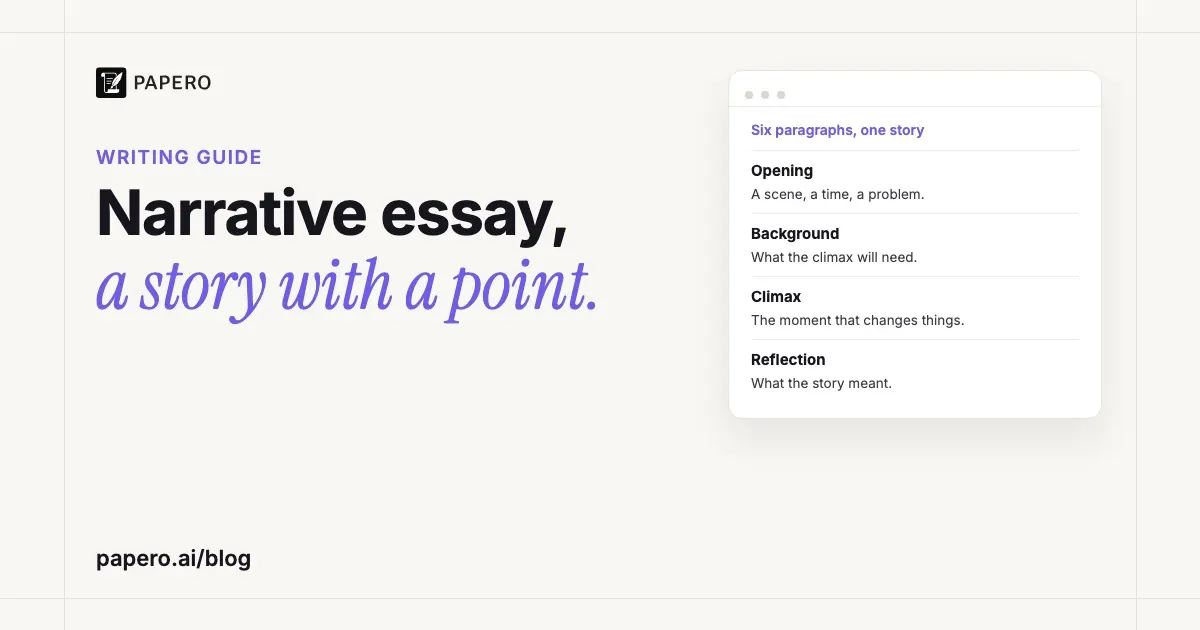
A narrative essay outline has six parts: an opening scene that starts in the middle of the action, the background the reader needs, the rising tension, the climax, what happened after it, and a reflection on what it meant. Plan each part as one paragraph and write the point you want to make at the top before you draft.
| Paragraph | What goes in it | In the example |
|---|---|---|
| 1. Opening scene | A specific moment, the setting and the problem | 11:40 p.m., no sprouts, the poster |
| 2. Background | How the narrator got here, and the mistake planted early | Choosing a “safe” project; the cups in the garage |
| 3. Rising action | The pressure and the choice it creates | The temptation to invent the data; her dad’s question |
| 4. Climax | The moment that changes things | The garage thermometer reads 9 degrees |
| 5. Falling action | What happens because of it | The fair, the judge’s question, no prize |
| 6. Reflection | The point the story makes | Ask why it failed before deciding how to hide it |
Notice that the point is written down before the draft. It decides which details stay: the garage shelf beside the door earns its place because it leads to the climax.
Narrative essay example: what the beans taught me
This narrative essay example is about 600 words, in six paragraphs, each followed by a note on what it does. We wrote it for this guide, and the events and people are invented, so the structure can be shown without anyone’s real story. A narrative essay for a class is usually true.
Paragraph 1: opening scene
At 11:40 on the night before the county science fair, I lifted the plastic wrap off forty paper cups and found forty cups of wet soil. Not one bean had come up. For three weeks I had watered them on schedule, half with tap water and half with rainwater I collected in my mother’s stockpot, and I had a poster board that already said, in glued-on letters, “Rainwater Grows Stronger Plants.” The board was right there on the kitchen table, waiting for a result that did not exist.
What it does: it starts in the middle of the action, at an exact time, instead of with background. The first two sentences set the scene and the problem; the poster adds the conflict, because the narrator has already announced a result she does not have. The point of the story is not stated yet, which gives the reader a reason to keep going. Our glossary entry on the hook covers other ways to open an essay, and our hook examples set this one beside others for narrative, personal and college essays.
Paragraph 2: background
I had picked the project because it seemed safe. My older brother had won second place two years earlier with a project on paper airplanes, and I wanted something with a clear answer. I had read somewhere that rainwater was better for plants, and I decided what my graph would show before I planted a single seed. I planted the beans on a Sunday, labelled each cup with masking tape and kept a notebook of watering times. What I did not keep track of was the temperature of the garage, where the cups sat on a shelf beside the door.
What it does: it gives the background the opening skipped, and only the background the story needs. Two details matter later: the narrator chose her answer before the experiment, and the cups sat in the garage. The last sentence plants the second detail without explaining it, so the climax pays it off.
Paragraph 3: rising action
Standing at the table, I worked out my options. I could tell my teacher I had nothing. I could stay home. Or I could do what I was already half doing in my head: draw bar graphs from the numbers I had expected, then say the plants had died after I measured them. My dad came in for a glass of water, looked at the cups and asked what had happened. “They didn’t grow,” I said. He asked why. I said I didn’t know, and he said, “Then that’s your project,” and went back to bed.
What it does: it raises the stakes by turning the problem into a choice, and the third option shows the narrator’s character honestly. Dialogue does work here that summary could not: the dad’s four words set up the climax, and the paragraph ends on them without comment.
Paragraph 4: climax
I did not sleep much. At one in the morning I went out to the garage with a thermometer from the bathroom cabinet and read it by the light of my phone: 9 degrees Celsius. I looked up how warm the soil needs to be for beans to sprout, and every guide I found put it well above that. The beans had not failed. The garage had. I peeled the letters off the poster, wrote a new title in marker, “Why My Beans Didn’t Grow,” and made a table that showed forty cups, two kinds of water and zero sprouts, with the garage temperature underneath.
What it does: this is the turning point, and it follows from what came before: the garage from paragraph 2, the dad’s question from paragraph 3. The short sentences “The beans had not failed. The garage had.” slow the reader down at the moment the narrator understands. The new poster title shows the change through an action instead of a statement about feelings.
Paragraph 5: falling action
At the fair, my board was the only one with a zero on it. Most visitors walked past. One judge, a woman with reading glasses on a cord, stopped and asked what I would change. I told her I would move the cups inside, run a small test first to check that the seeds could sprout at all, and only then compare the two kinds of water. She wrote something down and moved on. I did not win anything. I did get a note in my folder the next week that said, “Good scientific thinking,” and it is still taped inside my desk drawer.
What it does: it shows the consequences without turning them into a triumph. The narrator does not win, which keeps the story believable, and the judge’s question lets her show what she learned in her own words. The note in the drawer moves the story into the present and prepares the reflection.
Paragraph 6: reflection
I used to think an experiment that did not work was a waste of three weeks. Now I think the waste would have been the bar graph I almost drew that night. A result I did not want was still a result, and it told me something real about the garage that no graph about rainwater could have. Whenever a plan falls apart now, in a lab or anywhere else, I try to ask my dad’s question before I ask how to hide it: why didn’t it grow?
What it does: it states the point the story has been building toward, the essay’s thesis, and the reader now trusts it because the events earned it. It contrasts the narrator’s view before and after, then widens the lesson beyond the science fair. The last line returns to the dad’s question from paragraph 3, so the ending echoes the question that set up the climax instead of adding something new.
Personal narrative essay example: what changes?
A personal narrative essay is a narrative essay about something that happened to you, told in the first person, and the example above is written as one. Narrative essays assigned in school are often personal narratives. The term matters most for college applications, where the personal essay is often a short personal narrative written to a prompt.
The Common App’s first-year prompts for 2026-2027 include one that asks for a narrative directly: “Recount a time when you faced a challenge, setback, or failure. How did it affect you, and what did you learn from the experience?” The example essay answers exactly that shape: the failure is the beans, the effect is the new poster, and the lesson is the reflection. For an application, the same structure applies with two changes: the story must be true, and the reflection should say something about who you are now, because the reader is deciding whether to admit you.
Narrative vs descriptive vs expository essays
A narrative essay tells events in order to make a point, a descriptive essay creates a vivid picture of a person, place or object, and an expository essay explains a topic with evidence. The quickest test is what the reader takes away: a lesson from a story, an impression of something, or an explanation of how or why.
| Narrative | Descriptive | Expository | |
|---|---|---|---|
| Purpose | Tell a story that makes a point | Make the reader see and feel something | Explain how or why something happens |
| Organized by | Time and events | Space or senses | Points supporting a thesis |
| “I” | Expected | Common | Usually avoided |
| Evidence | The events themselves | Concrete detail | Sources, cited |
| Ends with | A reflection | A final impression | The thesis revisited |
The same experience can feed more than one type. The science fair could become an expository essay example on why seeds need warm soil, with sources instead of scenes, or an argument that schools should reward failed experiments, structured like our argumentative essay outline. Some assignments also ask for analysis instead of a story: the rhetorical analysis essay example shows that genre. For an essay written to change the reader’s mind, with each appeal labelled, see our persuasive essay example.
How do you write a narrative essay?
Pick one specific experience that changed how you think, decide the point before you draft, start in the middle of the action, tell the events in an order the reader can follow, and end by reflecting on what they meant. Use concrete detail and a little dialogue, and cut anything that does not lead to the climax or the point.
- Choose a small moment. One night, one conversation or one decision makes a better essay than a whole summer. The example’s main scene is one night and the next day.
- Write the point first. One sentence on what the story shows. You may never put that sentence in the essay, but it decides what stays.
- Open in a scene. A time, a place and a problem in the first two sentences. Background can come in the second paragraph.
- Plant what the climax needs. If the turning point depends on a detail, mention the detail early, without explaining it.
- Show the change through action. Peeling letters off a poster says more than “I felt different.”
- Use dialogue sparingly. A few lines that move the story, set in quotation marks with a new paragraph for each speaker in longer exchanges.
- Reflect, then stop. The last paragraph says what the experience meant. Purdue OWL’s advice applies to the whole essay: do not leave the reader guessing about the purpose of your narrative.
Transition words in a narrative are mostly about time: “at one in the morning”, “the next week”, “now”. They keep the reader oriented when the story jumps. Our essay introduction example covers openings for other kinds of essays.
Where Papero fits
Papero is an AI writing workspace for students and researchers, built mainly for cited academic writing, so a narrative essay uses only part of it. The part that helps is planning: describe the assignment and Papero builds a two-level outline with a prompt under every heading, or you can choose no headings and write straight through.
As you write, the Rewrite menu can shorten, simplify or fix the grammar of a selected passage, and Review’s proofread suggests spelling, grammar, punctuation and clarity fixes. Papero drafts only from your outline and prompts, and it cannot know what happened to you, so in a personal narrative the events, the details and the reflection have to come from you. The essay writing page shows what Papero does for an essay and where it stops, and you can sign up free.
Frequently Asked Questions
Can you use “I” in a narrative essay?
Yes. A narrative essay is usually told by the person it happened to, so the first person is normal. Purdue OWL says the first-person pronoun “I” is welcomed in narrative essays, with one warning: do not overuse it. Vary your sentence openings so that not every sentence starts with “I”.
Does a narrative essay need a thesis?
Yes, in the form of a point: a narrative essay needs one, and that point works as its thesis. Unlike an argumentative essay, it rarely states the point in the first paragraph; the point usually appears in the reflection at the end. Purdue OWL puts it plainly: the essay should have a purpose, and the narrator should make a point.
How long is a narrative essay?
There is no standard length; the assignment sets it. A class narrative essay is often five or six paragraphs, and the narrative essay example on this page is about 600 words. College applications set their own word limits, so check each one before you draft.
What tense should a narrative essay be in?
Most narrative essays use the past tense, because the events already happened. The present tense can make a scene feel immediate, but whichever you choose, keep it consistent within a scene. The reflection at the end often moves into the present because it describes how you think now.
What is the difference between a narrative essay and a short story?
A narrative essay is usually true, told by the person it happened to, and it ends by reflecting on what the events meant. A short story is fiction and can leave its meaning unstated. A narrative essay written for a class should tell something that really happened.
Sources
- Purdue OWL, “Narrative Essays” (owl.purdue.edu, accessed October 2026): https://owl.purdue.edu/owl/general_writing/academic_writing/essay_writing/narrative_essays.html
- Common App, “First-year essay prompts” for 2026-2027 (commonapp.org, accessed October 2026): https://www.commonapp.org/apply/essay-prompts