An annotated bibliography is a list of sources in which each citation is followed by a short paragraph, the annotation, that summarizes the source and judges how useful it is. The example below annotates four real studies on retrieval practice in APA 7, then shows the same kind of entry in MLA 9. Each annotation runs about 100 to 150 words.
Key Takeaways
- Every entry has two parts: a citation formatted exactly as it would be in your reference list, and an annotation paragraph indented below it (0.5 inch in APA and Chicago, 1 inch in MLA 9, according to Purdue OWL).
- A good annotation does three jobs in about 150 words: says what the source did, judges how far you can trust it, and says how you will use it. Most weak annotations only do the first.
- Annotations are not abstracts. An abstract describes; an annotation describes and evaluates, in your words.
- An annotated bibliography is usually the step before a literature review: the review groups the same sources by theme and argues across them.
What does an annotated bibliography look like?
Each entry starts with a full citation with a hanging indent, followed by the annotation as its own paragraph, indented as a block. Entries are listed in the same order as a reference list, usually alphabetical by first author. The page is titled “Annotated Bibliography”, and the whole document is double-spaced unless your instructor says otherwise.
The rules that differ by style, read from each style’s guidance and the guides that interpret it in October 2026:
| Element | APA 7 | MLA 9 |
|---|---|---|
| Citation | Same as the reference list entry | Same as the works-cited entry |
| Citation indent | Hanging indent, 0.5 in | Hanging indent, 0.5 in |
| Annotation indent | Whole paragraph 0.5 in from the left margin (Purdue OWL) | Whole paragraph 1 in from the left margin (Purdue OWL, for MLA 9) |
| Length | Not fixed; about 150 words is common (Cornell University Library) | Generally no more than one paragraph (MLA Style Center, 8th-edition guidance) |
| Page title | Annotated Bibliography | Annotated Bibliography or Annotated List of Works Cited (MLA Style Center, 8th-edition guidance) |
| Order | Alphabetical by first author, as in a reference list | Alphabetical by author or title, by date, or by subject (MLA Style Center, 8th-edition guidance) |
| Spacing | Double-spaced throughout | Double-spaced throughout |
Two things in that table catch people out. Purdue OWL’s guidance is that the annotation is indented as a block, so it sits clearly under its citation; the MLA Style Center’s older, 8th-edition advice began a full-sentence annotation with a paragraph indent instead, which is why MLA briefs differ. Instructors’ briefs also vary more here than for a reference list, so when the brief and a guide disagree, follow the brief.
Annotated bibliography example (APA 7)
The four sources below are real, and every fact in the annotations comes from the published article or its abstract, checked in October 2026. We wrote the annotations for this article, for an imagined student essay on whether students should replace rereading with self-testing. The hanging indent on the citations and the block indent on the annotations do not survive on a web page, so read the examples for content and order, then set the indents in your word processor.
Annotated Bibliography
Agarwal, P. K., Nunes, L. D., & Blunt, J. R. (2021). Retrieval practice consistently benefits student learning: A systematic review of applied research in schools and classrooms. Educational Psychology Review, 33(4), 1409–1453. https://doi.org/10.1007/s10648-021-09595-9
This systematic review asks whether retrieval practice helps in real classrooms, not only in laboratories. The authors used a narrower definition of classroom research than earlier reviews, screened nearly 2,000 abstracts, and coded 50 experiments (49 effect sizes, 5,374 students). Fifty-seven percent of the effects were medium or large, across education levels, subjects and test formats. The method is transparent and the article is open access, which makes its claims easy to check. Its main limit is one the authors state themselves: only 6% of the experiments were run outside Western, educated, industrialized, rich and democratic (WEIRD) countries. I will use it as the main evidence that the effect holds in school settings, and quote that 6% figure when I discuss who the research covers.
Karpicke, J. D., & Blunt, J. R. (2011). Retrieval practice produces more learning than elaborative studying with concept mapping. Science, 331(6018), 772–775. https://doi.org/10.1126/science.1199327
Karpicke and Blunt compared retrieval practice with concept mapping, a study method that already asks students to work actively with the material. Retrieval practice produced more learning, on science texts of the kind used in science education, on questions that required inferences, and even when the final test asked students to draw a concept map. The comparison is the strength here: the control condition is a demanding strategy rather than passive rereading. The paper is a short report of four pages, so the methods are compressed, and it should be read alongside the larger reviews. In my essay it answers the obvious objection that any active study method would work as well as testing.
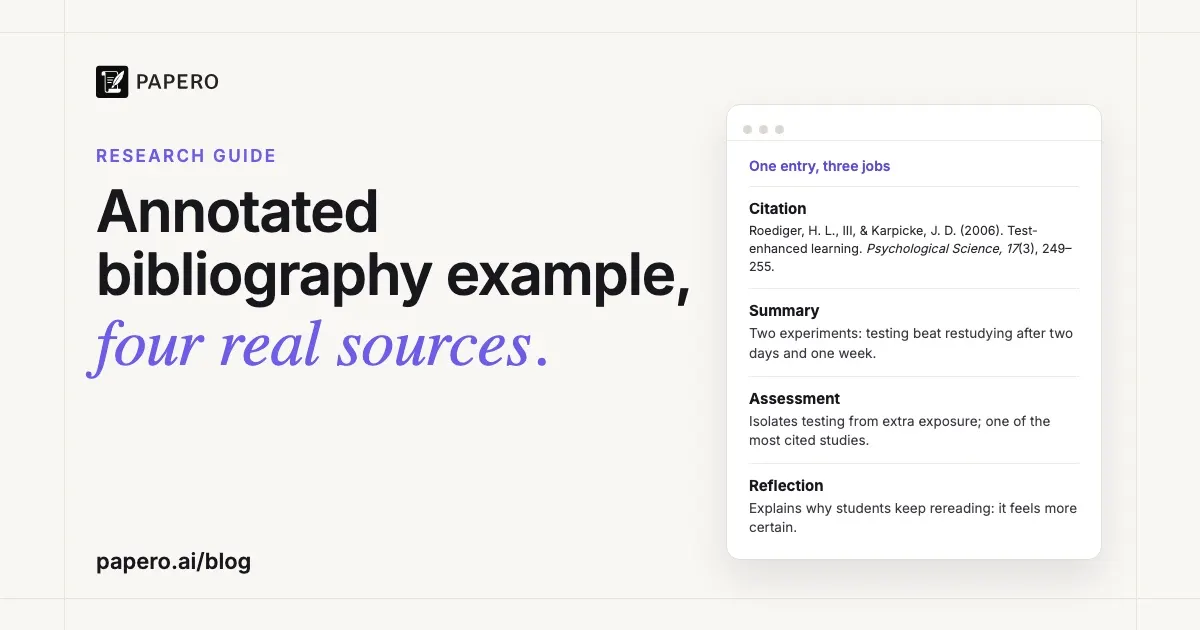
Roediger, H. L., III, & Karpicke, J. D. (2006). Test-enhanced learning: Taking memory tests improves long-term retention. Psychological Science, 17(3), 249–255. https://doi.org/10.1111/j.1467-9280.2006.01693.x
In two experiments, students read prose passages and then either took free-recall tests without feedback or restudied the passages the same number of times. On a test five minutes later, restudying did better. After two days and after one week, the tested students retained substantially more. Restudying also made students more confident that they would remember the material. The study is one of the most cited in this area (more than 2,800 citations in OpenAlex in October 2026) and its design isolates testing from extra exposure. The confidence finding is the part I will use most, because it explains why students keep rereading even though it works less well over time.
van Gog, T., & Sweller, J. (2015). Not new, but nearly forgotten: The testing effect decreases or even disappears as the complexity of learning materials increases. Educational Psychology Review, 27(2), 247–264. https://doi.org/10.1007/s10648-015-9310-x
This article introduces a special issue on the limits of the testing effect. Van Gog and Sweller argue that the benefit shrinks, and may disappear, as material becomes more complex, meaning that a task contains many elements a learner must process together. They point out that research from a century ago had already suggested this and that the finding was nearly forgotten. It is a position paper that frames a set of studies rather than a new experiment, so it is an argument to weigh, not a result to cite as settled. It gives my essay its counterargument: retrieval practice may help less with the complex material students find hardest.
How does each annotation work?
Every annotation above follows the same three-part order: summarize, assess, reflect. Purdue OWL describes these three moves, and Cornell University Library asks for at least one sentence that evaluates the author’s authority or background, comments on the intended audience, compares the work with another you have cited, or explains how it illuminates your topic.
Here is the Roediger and Karpicke annotation taken apart:
| Part | What it does | Sentences in the example |
|---|---|---|
| Summary | What the authors did and found | From “In two experiments” to “more confident that they would remember the material” |
| Assessment | How far you can trust it, and why | The sentence beginning “The study is one of the most cited in this area” |
| Reflection | What you will do with it | The last sentence, beginning “The confidence finding is the part I will use most” |
The assessment sentence is where marks are won or lost. “This is a useful source” says nothing. A sentence that names a design choice, a sample, a limitation or a comparison with another entry shows that you read the source rather than its abstract.
One source, annotated three ways
Instructors sometimes ask for one kind of annotation only. The same source, the van Gog and Sweller article, looks like this in each form.
Descriptive (summary only). Introduces a special issue on the testing effect and argues that its benefit decreases, and may disappear, as learning materials become more complex. Notes that research from a century ago had already suggested this.
Evaluative. A position paper rather than a new experiment: it frames the studies in a special issue and revives an older finding. Its claim depends on how complexity is defined, and a reply in the same journal (Karpicke & Aue, 2015) disputes both the definition and the conclusion, so it should be cited as one side of an open debate.
Reflective. Gives my essay its main counterargument. If retrieval practice helps less with complex material, my recommendation needs a condition: test yourself on facts and concepts first, and do not expect the same gain on problems with many interacting parts.
A descriptive annotation can be written from the abstract. The evaluative and reflective ones cannot, which is why instructors ask for them.
The same entry in MLA 9
In MLA, the citation follows the works-cited format, and Purdue OWL’s reading of MLA 9 indents the annotation 1 inch as a block. The MLA Style Center’s 8th-edition guidance adds that annotations can be short phrases or full sentences, and that they should not quote the author or recount each step of the argument.
Roediger, Henry L., III, and Jeffrey D. Karpicke. “Test-Enhanced Learning: Taking Memory Tests Improves Long-Term Retention.” Psychological Science, vol. 17, no. 3, 2006, pp. 249–55, https://doi.org/10.1111/j.1467-9280.2006.01693.x.
Two experiments compare free-recall testing with restudying prose passages. Restudying wins on a test after five minutes, but testing produces substantially better retention after two days and one week, while restudying makes students more confident. The design separates the effect of testing from extra exposure to the material, which makes it a strong base for the claim that self-testing beats rereading for long-term learning.
Notice the differences in the citation: full first names, the title in title case and quotation marks, “vol.” and “no.” for the journal, and a shortened page range. The annotation itself does the same three jobs as the APA version, in fewer words.
How do you write an annotated bibliography?
Write it in five steps, one source at a time, and write each annotation the day you read the source, while you still remember what it did and how it fits your question.
- Fix your question first. Annotations judge relevance, and relevance needs a question. “Does self-testing beat rereading for long-term learning?” makes every annotation sharper than “memory and studying”.
- Choose sources that disagree. Cornell’s guide advises choosing works that give a variety of perspectives. Four sources that all say the same thing make a weak bibliography; the van Gog and Sweller entry is what makes the example above useful.
- Cite the source in your style before you annotate it. Copy the DOI and check author names and the year against the article itself. A citation built from memory or from a chatbot is the most common source of errors (see the FAQ below).
- Read beyond the abstract. The methods section is where you find the sample, the comparison condition and the limits. That is the material for your assessment sentence.
- Write summary, assessment, reflection, in that order. Aim for about 150 words. Cut any sentence that would fit under a different source.
Annotated bibliography vs literature review vs abstract
These three get confused because they all summarize sources. They differ in who writes them and what they are for.
| Annotated bibliography | Literature review | Abstract | |
|---|---|---|---|
| Unit | One paragraph per source | Themes across many sources | One paragraph per paper |
| Written by | You, about other people’s work | You, about other people’s work | The paper’s own authors |
| Evaluates? | Yes, source by source | Yes, by comparing sources | No, it describes |
| Organised by | Source, usually alphabetical | Theme or argument | The paper’s own structure |
Cornell’s guide puts the line between the first and last columns plainly: abstracts are purely descriptive, annotations are descriptive and critical. Our guide to abstract examples shows what an abstract does, and the literature review example uses the four sources above, and six more, to show how annotations turn into themed paragraphs.
Where Papero fits
Papero is an AI writing workspace for students and researchers, and you can sign up free. According to the Papero homepage, it keeps every source you add in one library, imports BibTeX and RIS files exported from Zotero, Mendeley, EndNote or Google Scholar, and formats references in APA 7 and MLA 9, among other styles. Its search results mark retracted papers and preprints, which is worth knowing before you write an assessment sentence about a source.
Papero will not judge your sources for you. The judgement in each annotation, whether a study’s design holds up and how it fits your question, is the part an instructor is grading. The glossary entry on the annotated bibliography has the short definition.
Frequently Asked Questions
How long is an annotation in an annotated bibliography?
There is no fixed length, but about 150 words is common, and that is the figure Cornell University Library gives. The MLA Style Center says an annotation should generally be no more than one paragraph. Purdue OWL notes that annotations range from a couple of sentences to a couple of pages depending on purpose, so follow your brief when it sets a number.
Do annotations need in-text citations?
Usually not. The annotation sits directly under the full citation, so the source is already identified. The MLA Style Center advises that annotations should not quote the author or cite evidence. If an annotation compares the source with another entry, name that entry briefly, as the example above does with (Karpicke & Aue, 2015).
Is an annotated bibliography in alphabetical order?
Usually, yes. APA and MLA annotated bibliographies follow the reference-list order, alphabetical by the first author’s surname. The MLA Style Center also allows ordering by title, by date of publication or by subject, which can suit a bibliography that traces how a debate developed.
Can ChatGPT write an annotated bibliography?
Not reliably. In a study of short literature reviews generated by ChatGPT, 55% of the GPT-3.5 citations and 18% of the GPT-4 citations referred to works that do not exist (Walters & Wilder, 2023). An annotation of a source you have not read cannot assess it either. Find and read the sources yourself, then write the annotations.
What is the difference between an annotation and an abstract?
An abstract is written by a paper’s authors and describes the paper. An annotation is written by you and both describes and evaluates the source, including how it fits your project. Copying or lightly rewording an abstract is not an annotation, and many instructors treat it as plagiarism.
Sources
- Cornell University Library, “How to Prepare an Annotated Bibliography” (guides.library.cornell.edu, accessed October 2026): https://guides.library.cornell.edu/annotatedbibliography
- Purdue OWL, “Annotated Bibliographies” (owl.purdue.edu, accessed October 2026): https://owl.purdue.edu/owl/general_writing/common_writing_assignments/annotated_bibliographies/index.html
- Purdue OWL, “Annotated Bibliography Samples” (annotation indents for MLA 9, APA and Chicago) (owl.purdue.edu, accessed October 2026): https://owl.purdue.edu/owl/general_writing/common_writing_assignments/annotated_bibliographies/annotated_bibliography_samples.html
- MLA Style Center, “What guidance should I give my students for preparing an annotated bibliography?”, 8th-edition guidance (style.mla.org, accessed October 2026): https://style.mla.org/annotated-bibliographies/
- MLA Style Center, “Should I double-space between paragraphs in my annotated bibliography?”, 8th-edition guidance (style.mla.org, accessed October 2026): https://style.mla.org/annotation-and-paragraphs/
- Agarwal, P. K., Nunes, L. D., & Blunt, J. R. (2021). Retrieval practice consistently benefits student learning: A systematic review of applied research in schools and classrooms. Educational Psychology Review, 33(4), 1409–1453. https://doi.org/10.1007/s10648-021-09595-9
- Karpicke, J. D., & Aue, W. R. (2015). The testing effect is alive and well with complex materials. Educational Psychology Review, 27(2), 317–326. https://doi.org/10.1007/s10648-015-9309-3
- Karpicke, J. D., & Blunt, J. R. (2011). Retrieval practice produces more learning than elaborative studying with concept mapping. Science, 331(6018), 772–775. https://doi.org/10.1126/science.1199327
- Roediger, H. L., III, & Karpicke, J. D. (2006). Test-enhanced learning: Taking memory tests improves long-term retention. Psychological Science, 17(3), 249–255. https://doi.org/10.1111/j.1467-9280.2006.01693.x
- van Gog, T., & Sweller, J. (2015). Not new, but nearly forgotten: The testing effect decreases or even disappears as the complexity of learning materials increases. Educational Psychology Review, 27(2), 247–264. https://doi.org/10.1007/s10648-015-9310-x
- Walters, W. H., & Wilder, E. I. (2023). Fabrication and errors in the bibliographic citations generated by ChatGPT. Scientific Reports, 13, Article 14045. https://doi.org/10.1038/s41598-023-41032-5
- OpenAlex citation count for Roediger and Karpicke (2006), accessed October 2026: https://api.openalex.org/works/https://doi.org/10.1111/j.1467-9280.2006.01693.x