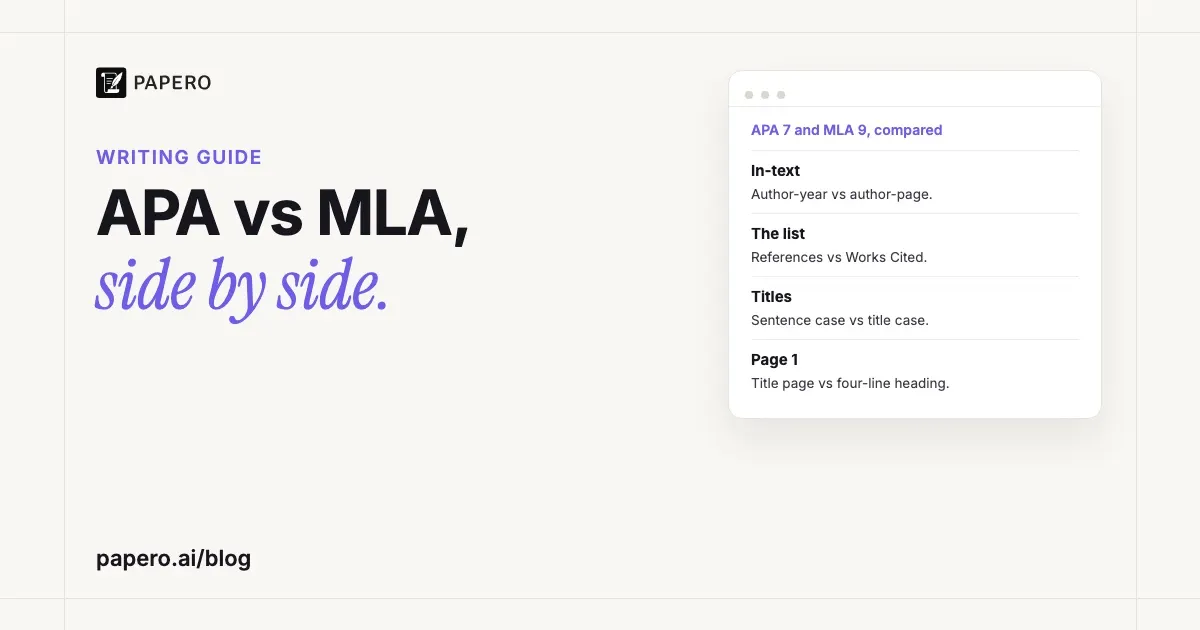
APA and MLA differ most in what the in-text citation gives. APA 7 cites the author and the year, adding the page for a quotation: (Kornell & Bjork, 2008, p. 585). MLA 9 cites the author and the page: (Kornell and Bjork 585). APA is the style of psychology, nursing, business and related fields; MLA belongs to literature, languages and the other humanities. The lists, titles and first page differ too.
Key Takeaways
- In the text, APA gives author and year, plus a page for quotations. MLA gives author and page: no comma, no “p.”, no year.
- APA’s list is References: initials, the date second, titles in sentence case. MLA’s is Works Cited: full first names, the date near the end, titles in title case.
- An APA paper opens with a title page; an MLA paper opens with a four-line heading on page 1.
- Both styles use DOIs. The idea that MLA skips them predates its 2016 edition.
What is the difference between APA and MLA?
APA and MLA are two citation and formatting styles with the same job: showing where every borrowed idea came from. APA, from the American Psychological Association, puts the year in its citations, which suits fields where the age of a study matters. MLA, from the Modern Language Association, points to the page, which suits work that returns to the exact passage. This APA vs MLA table follows APA 7 and MLA 9.
| APA 7 | MLA 9 | |
|---|---|---|
| Used in | Psychology, nursing, business, communications, engineering and related fields | Literature, language arts, cultural studies and other humanities |
| In-text citation | (Kornell & Bjork, 2008) | (Kornell and Bjork 585) |
| Page in the citation | Required for a quotation, written p. 585 | For any passage of a source with pages, as a bare number |
| Two authors in the text | Ampersand in parentheses, “and” in a sentence | “and” in both |
| List at the end | References, bold and centered | Works Cited, centered, not bold |
| Names in the list | Surname and initials, up to 20 authors: Kornell, N., & Bjork, R. A. | Full names; three or more become et al.: Kornell, Nate, and Robert A. Bjork. |
| Order of elements | Author. (Date). Title. Source. | Author. Title. Container, contributors, version, number, publisher, date, location. |
| Date | In parentheses after the author; (n.d.) if none | After the publisher, or after the issue number for a journal article; no n.d. placeholder |
| Title capitalization | Sentence case for articles and books; title case for journals | Title case for every title |
| Article titles | Plain, no quotation marks | In quotation marks |
| Volume, issue, pages | 19(6), 585–592 | vol. 19, no. 6, 2008, pp. 585–92 |
| DOIs | For every work that has one, print or online; no period after | Preferred location for a work read online; a period follows |
| University presses | Full name: University of Chicago Press | Shortened: U of Chicago P |
| First page | A separate title page | A four-line heading above a centered title |
| Page header | Student papers: page number only, top right | Surname and page number, top right |
| Headings | Five fixed levels; Level 1 centered and bold | No fixed format per level; consistent, flush left |
| Where they agree | Double spacing, 1-inch margins, readable font, 0.5-inch hanging indent, alphabetical list, first author plus et al. for three or more authors in the text | Same |
How do APA and MLA in-text citations differ?
An APA citation gives the author’s surname and the year, separated by a comma, and adds the page for a quotation: (Kornell & Bjork, 2008, p. 585). An MLA citation gives the surname and the page with nothing between them: (Kornell and Bjork 585). APA joins two names with an ampersand inside parentheses; MLA always writes “and”. At three or more authors, both styles switch to the first author and “et al.”
One quotation from the first page of Kornell and Bjork’s 2008 study, cited both ways:
APA 7: Participants “rated massing as more effective than spacing, even after their own test performance had demonstrated the opposite” (Kornell & Bjork, 2008, p. 585).
MLA 9: Participants “rated massing as more effective than spacing, even after their own test performance had demonstrated the opposite” (Kornell and Bjork 585).
A section near the end of MLA in-text citation sets both styles’ in-text rules side by side in a table.
How do you cite the same source in APA and MLA?
Keep the same facts and rearrange them. APA moves the year to second place, cuts first names to initials, writes the title in sentence case and leaves an article title unmarked. MLA keeps full first names, writes every title in title case, puts an article title in quotation marks and moves the year toward the end. Below, one book and one journal article are cited in both styles.
The book is the 1996 third edition of Thomas S. Kuhn’s classic, checked against Crossref and Library of Congress data:
| Style | Book entry | In-text |
|---|---|---|
| APA 7 | Kuhn, T. S. (1996). The structure of scientific revolutions (3rd ed.). University of Chicago Press. https://doi.org/10.7208/chicago/9780226458106.001.0001 | (Kuhn, 1996) |
| MLA 9 | Kuhn, Thomas S. The Structure of Scientific Revolutions. 3rd ed., U of Chicago P, 1996. | (Kuhn) |
APA adds the book’s DOI even if you read a printed copy, because it wants a DOI on every work that has one. MLA describes the copy you read: a print book ends with the year, and an online copy would add the DOI. Our guide on how to cite a book adds editions, translations and edited books, with Chicago beside APA and MLA.
The article is Kornell and Bjork’s study of spacing, checked against Crossref and PubMed:
| Style | Article entry |
|---|---|
| APA 7 | Kornell, N., & Bjork, R. A. (2008). Learning concepts and categories: Is spacing the “enemy of induction”? Psychological Science, 19(6), 585–592. https://doi.org/10.1111/j.1467-9280.2008.02127.x |
| MLA 9 | Kornell, Nate, and Robert A. Bjork. “Learning Concepts and Categories: Is Spacing the ‘Enemy of Induction’?” Psychological Science, vol. 19, no. 6, 2008, pp. 585–92, https://doi.org/10.1111/j.1467-9280.2008.02127.x. |
Apart from the surnames, the journal name and the DOI, every part changes. Our guides to the APA reference page and the MLA works cited page cover each list in full. For a source with no pages, our guide on how to cite a movie puts one film in both styles, with time stamps in place of page numbers.
How is an APA paper laid out differently from an MLA paper?
An APA student paper starts with a separate title page: the bold title three to four lines down, then your name, department and university, course, instructor and due date, all centered. Its header holds only the page number. An MLA paper has no title page: page 1 opens with four lines (your name, instructor, course and date) and a centered title, and every header shows your surname and the page number.
APA sets five heading levels, each with a fixed format, from Level 1 centered and bold to Level 5 indented in bold italics. MLA 9 fixes no format per level: section 1.5 of the MLA Handbook, as the MLA Style Center explains, asks that headings of the same level look alike, and a 2018 Style Center post recommends flush-left headings without numbers unless your discipline numbers its sections. Purdue OWL’s MLA page says the opposite, that MLA recommends numbered sections; follow the MLA and your instructor. Our guide to the APA title page shows a student title page line by line, and our MLA sample paper shows the heading and header in place.
Which one should I use, APA or MLA?
Use the style your instructor, department or journal names; that instruction overrides any general advice. When the choice is open, follow the field: APA for psychology and the other social and behavioral sciences, plus nursing, business, communications and related fields; MLA for English, languages, literature and cultural studies. Keep to one style per paper, so every citation and the list at the end follow the same rules.
Some courses in medicine and the health sciences ask for neither. JAMA and the other journals of the American Medical Association use AMA style, a numbered system explained in AMA citation style. Chemistry has its own numbered system, set out in our guide to ACS style citations.
Are APA 7 and MLA 9 the current editions?
Yes. As of October 2026, APA Style is in its seventh edition, whose Publication Manual came out in October 2019 (it is cited with a 2020 date), and the MLA Handbook is in its ninth edition, published in April 2021. Many APA vs MLA comparison pages still teach older rules, so check that a guide names APA 7 and MLA 9 before you copy its examples.
Three claims from older guides no longer hold. MLA does use DOIs: its summary of the eighth edition (2016) says DOIs are encouraged, MLA 9 writes them with https://doi.org/ (section 5.93), and a sample essay the MLA published in 2024 ends its first works-cited entry with one. MLA does give dates: it leaves the year out of in-text citations, but every works-cited entry gives the date when the source has one, and what the eighth edition dropped is the n.d. placeholder. And APA 7 no longer lists every author the first time: it uses “et al.” for three or more authors from the first citation, revised from the sixth edition.
Where Papero fits
Papero is an AI writing workspace for students and researchers. You pick a citation style for each document, and Papero formats the in-text citations and the reference list in it; APA 7 and MLA 9 are two of its nine styles. Each citation is stored as a link to its source, not as typed text, so changing the style reformats every citation and the list.
In the double-spaced manuscript layout of the Word export, a document set to APA 7 or MLA 9 follows that style’s page layout: page numbers at the top right, with your surname in MLA, APA’s heading levels, a centered References or Works Cited heading on a new page, and for MLA the four-line heading above the title. On the free plan the reference list shows your entries blurred; Plus makes it readable and exportable. The essay writing page shows the workflow, the glossary has short entries on MLA style and APA style, and you can sign up free.
Frequently Asked Questions
What are the common referencing styles?
The Royal Literary Fund’s essay guide for UK students names four widely used referencing systems: MLA, APA, Harvard and MHRA. Chicago, with footnotes or author-date citations, is also widely used, and the journals of the American Medical Association use AMA style. Your assignment sheet or the journal you submit to tells you which one to use.
How do you cite three authors in APA and MLA in-text?
In both styles, give the first author’s surname and “et al.” from the first citation. APA adds the year, as in (Martin et al., 2020), and MLA adds the page when you cite a passage, as in (Franck et al. 327). In the reference list, APA names every author up to 20, while an MLA works-cited entry gives the first author and “et al.”
Does MLA use DOIs?
Yes. MLA 9 gives a DOI as the location of a work you read online, preferred over a permalink or URL, and writes it as a link beginning https://doi.org/. MLA has encouraged DOIs since its eighth edition in 2016. APA 7 goes further and includes a DOI for every work that has one, even when you read a printed copy.
Sources
- American Psychological Association, “Author–date citation system” (apastyle.apa.org, created 2019, accessed October 2026 through the Internet Archive): https://apastyle.apa.org/style-grammar-guidelines/citations/basic-principles/author-date
- American Psychological Association, “Quotations” (apastyle.apa.org, updated July 2022): https://apastyle.apa.org/style-grammar-guidelines/citations/quotations
- American Psychological Association, “Elements of reference list entries” (apastyle.apa.org, updated October 2025): https://apastyle.apa.org/style-grammar-guidelines/references/elements-list-entry
- American Psychological Association, “DOIs and URLs” (apastyle.apa.org, updated July 2022): https://apastyle.apa.org/style-grammar-guidelines/references/dois-urls
- American Psychological Association, “Sentence case capitalization” and “Title case capitalization” (apastyle.apa.org, updated July 2022): https://apastyle.apa.org/style-grammar-guidelines/capitalization/sentence-case
- American Psychological Association, “Reference list setup” (apastyle.apa.org, created October 2024): https://apastyle.apa.org/style-grammar-guidelines/paper-format/reference-list
- American Psychological Association, “Title page setup”, “Page header”, “Headings”, “Font”, “Margins” and “Line spacing” (apastyle.apa.org, accessed October 2026 through the Internet Archive): https://apastyle.apa.org/style-grammar-guidelines/paper-format
- Chelsea Lee, “The transition to seventh edition APA Style” (APA Style blog, October 1, 2019, accessed October 2026 through the Internet Archive): https://apastyle.apa.org/blog/transition-seventh-edition
- American Psychological Association, “About APA Style” (apastyle.apa.org, accessed October 2026): https://apastyle.apa.org/about-apa-style
- Susan Doose, “A Closer Look at MLA Style” (ninth-edition rules with MLA Handbook section numbers) (style.mla.org, accessed October 2026): https://style.mla.org/closer-look-at-mla-style/
- Modern Language Association, “In-Text Citations: An Overview” (style.mla.org, 2021): https://style.mla.org/in-text-citations-overview/
- MLA Style Center, “I am citing a paginated journal article that appears online. Should I include the page range, the URL, or the DOI?” (style.mla.org, accessed October 2026): https://style.mla.org/page-range-and-doi/
- MLA Style Center, “What’s New in the Eighth Edition” (style.mla.org, accessed October 2026): https://style.mla.org/whats-new/
- MLA Style Center, Erika Suffern, “Parallel Headings in Research Papers” (style.mla.org, 2022, on MLA Handbook 9th ed., section 1.5): https://style.mla.org/parallel-headings/
- MLA Style Center, “How do I style headings and subheadings in a research paper?” (style.mla.org, 2018): https://style.mla.org/styling-headings-and-subheadings/
- Rachelle Dumayas, “Should Deaf Children Get Cochlear Implants?”, MLA sample essay (style.mla.org, 2024): https://style.mla.org/app/uploads/sites/6/2024/08/Dumayas_Cochlear-Implants.pdf
- Purdue OWL, “MLA General Format”, “MLA Works Cited Page: Basic Format”, “MLA Works Cited Page: Books” and “MLA In-Text Citations: The Basics” (owl.purdue.edu, accessed October 2026): https://owl.purdue.edu/owl/research_and_citation/mla_style/mla_formatting_and_style_guide/mla_general_format.html
- Purdue OWL, “MLA Style Introduction” (owl.purdue.edu, accessed October 2026): https://owl.purdue.edu/owl/research_and_citation/mla_style/mla_style_introduction.html
- Royal Literary Fund, “MLA, APA, Harvard or MHRA?” (rlf.org.uk, accessed October 2026): https://www.rlf.org.uk/resources/mla-apa-harvard-or-mhra/
- Kuhn, T. S. (1996). The structure of scientific revolutions (3rd ed.). University of Chicago Press. https://doi.org/10.7208/chicago/9780226458106.001.0001
- Kornell, N., & Bjork, R. A. (2008). Learning concepts and categories: Is spacing the “enemy of induction”? Psychological Science, 19(6), 585–592. https://doi.org/10.1111/j.1467-9280.2008.02127.x