An expository essay explains a topic with evidence: what it is, how it works or why it happens. The expository essay example below is a complete five-paragraph essay on why spaced study beats cramming, with real APA citations. After each paragraph, a short note says what that paragraph is doing, so you can reuse the structure on any topic.
Key Takeaways
- An expository essay explains; an argumentative essay persuades. Both have a thesis, but an expository thesis states what the essay will explain, not a side to defend.
- The standard shape is five paragraphs: an introduction ending in the thesis, three body paragraphs with one idea each, and a conclusion.
- Every body paragraph opens with a topic sentence, gives evidence and connects back to the thesis.
- The conclusion revisits the thesis in light of the evidence and brings in no new sources or claims.
What is an expository essay?
An expository essay investigates an idea and explains it clearly with evidence, through definition, example, comparison or cause and effect. It is a common classroom and exam genre. It still has a thesis: a precise statement of what the essay will explain, which every body paragraph then supports.
Purdue OWL’s definition is stricter than most: the writer evaluates evidence and “set[s] forth an argument concerning that idea”. That is the part students tend to miss. An expository essay is not a list of facts on a topic. It makes a claim about how or why something works, and the claim is one a reader would accept on the evidence, not one they would dispute on values.
Purdue OWL lists four common methods: comparison and contrast, definition, example, and cause and effect. The essay below uses cause and effect. The glossary entry on expository writing covers the wider mode, from textbooks to lab reports. For the comparison method, our compare and contrast essay example works through two Shakespeare sonnets, outlined both block and point-by-point.
Expository essay outline
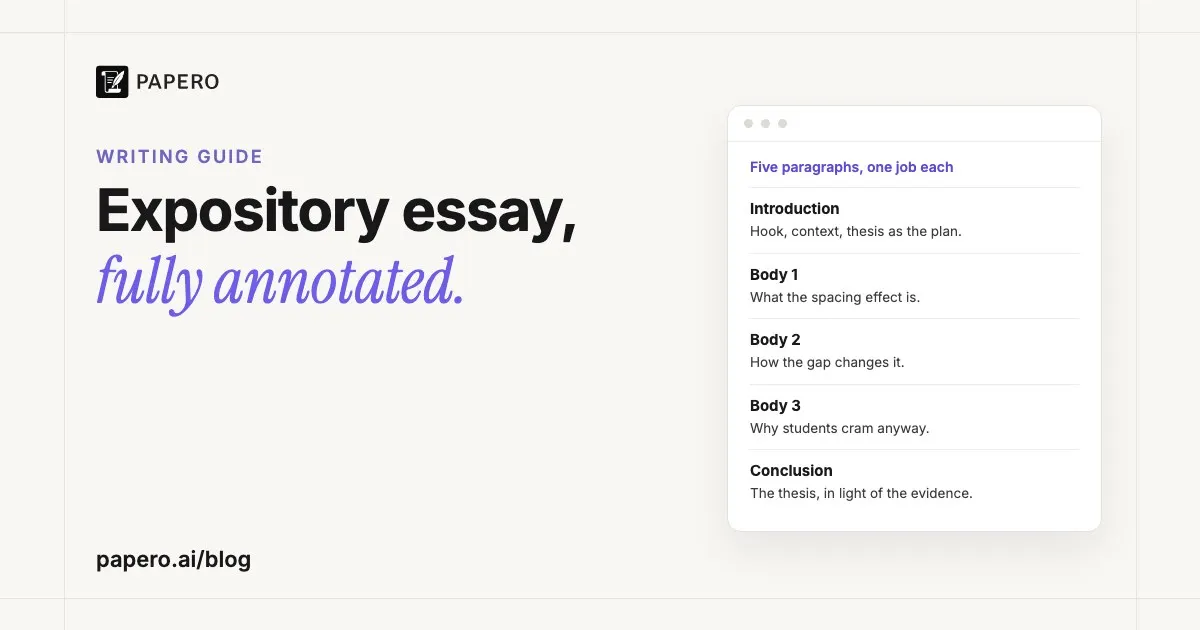
An expository essay outline has five parts: an introduction that ends with the thesis, three body paragraphs that each take one point of the thesis with a topic sentence, evidence and a link back, and a conclusion that revisits the thesis. Fill it in before you write; each row becomes one paragraph.
| Paragraph | What goes in it | In the example |
|---|---|---|
| 1. Introduction | Hook, context, thesis as the last sentence | Students cram; thesis names three things to explain |
| 2. Body 1 | Topic sentence, evidence, link to thesis | What the spacing effect is |
| 3. Body 2 | Topic sentence, evidence, link to thesis | How the gap between sessions changes it |
| 4. Body 3 | Topic sentence, evidence, link to thesis | Why students cram anyway |
| 5. Conclusion | Thesis revisited, what the evidence adds up to | Spacing works, but it does not feel like it works |
The body paragraphs follow a deliberate order. The example moves from what happens to how it varies to why people ignore it, so each paragraph needs the one before it. If you can shuffle your body paragraphs without anything breaking, the essay is probably a list.
Expository essay example: why spaced study beats cramming
The essay is about 550 words. Its citations are in APA 7, and every study is real; the claims come from each article’s abstract, which you can check through the DOIs in the reference list.
Paragraph 1: introduction
Most students prepare for an exam the same way: one long session the night before. Memory researchers call this massed practice, and its alternative, spreading the same study time across several sessions, distributed or spaced practice. The difference between the two is one of the most studied questions in learning research. Spaced study produces better long-term memory than cramming, the best gap between sessions depends on how long the material needs to be remembered, and students keep cramming mainly because it feels more effective than it is.
What it does: the first sentence describes a situation the reader recognizes. The second sentence defines the terms before they are used, and the third says why the question matters. The thesis comes last and names three points in the order the body will explain them, which makes it the essay’s plan as well as its claim. Our essay introduction example covers hooks and thesis placement in more depth.
Paragraph 2: body, what the spacing effect is
The spacing effect is the finding that the same amount of study produces better retention when it is divided into separate sessions. Kornell and Bjork (2008) summarized it in one line: “compared with massing, spacing enhances long-term recall” (p. 585). It has also been tested many times. A meta-analysis by Cepeda et al. (2006) located 839 assessments of distributed practice in 317 experiments, reported in 184 articles, and compared massed presentations with spaced learning episodes. In a review of 10 study techniques, Dunlosky et al. (2013) gave distributed practice their highest utility rating, because its benefits held for learners of different ages and abilities and across many kinds of tests, even in real classrooms. Spacing, in other words, beats cramming in classrooms as well as in the laboratory.
What it does: the topic sentence is a definition, which is how cause-and-effect essays often begin: the reader has to know what the effect is before learning what drives it. Each source does a different job: the short quotation states the finding, the meta-analysis shows how much evidence exists, and the review shows the effect survives outside the lab. The last sentence ties it back to the thesis. Our topic sentence examples set this one beside thirty others, grouped by the job each paragraph does.
Paragraph 3: body, how the gap changes the effect
The length of the gap matters as much as the decision to space. Cepeda et al. (2008) taught a set of facts to more than 1,350 people, reviewed the facts after a gap of up to 3.5 months, and tested the participants up to a year later. At any given test delay, a longer gap first improved final scores and then slowly reduced them, so there was a best gap for each delay. That best gap was about 20 to 40% of the time between the review and a test a week later, but only about 5 to 10% when the test came a year later. For a test a week after the review, that works out to a gap of roughly one to three days; for a test a year after it, roughly three to five weeks.
What it does: this paragraph adds the “how” that the first body paragraph left open. It reports the study’s design before its result, so the numbers mean something, then translates the percentages into days a student can use. That conversion is the writer’s own arithmetic, not a claim from the source, and the sentence says “works out to” to mark it.
Paragraph 4: body, why students cram anyway
If spacing works this well, the puzzle is why students cram. Part of the answer is that cramming feels like learning. Kornell and Bjork (2008) had participants study paintings by different artists, either one artist’s paintings in a row or mixed with other artists’, and then identify the artists of new paintings. Spacing helped, yet participants “rated massing as more effective than spacing, even after their own test performance had demonstrated the opposite” (p. 585). Dunlosky et al. (2013) likewise noted that students report relying heavily on rereading and highlighting, two techniques the review rated low in utility. A session of massed review leaves material feeling familiar, and familiarity is easy to mistake for memory.
What it does: it opens with a question the reader is already asking, then answers it in the next sentence, so the question works as a transition rather than as filler. The direct quotation is kept because its exact wording, “even after”, carries the surprise, and the signal phrase before it names the authors so the reader knows whose words they are. A quotation needs a page number in APA; our guide to APA in-text citation covers why.
Paragraph 5: conclusion
Spacing beats cramming because the same hours of study last longer when they are divided, a result supported by hundreds of experiments and by classroom research. The gains depend on timing: the further away the test, the longer the best gap between sessions. What keeps students from spacing their study is not a lack of evidence but the fact that cramming feels productive in the moment. Seen this way, the most useful thing to know about spaced study may be that it will feel less effective than it is.
What it does: it restates the three points in the thesis’s order, but with what the body established, which is what Purdue OWL means by readdressing the thesis “in light of the evidence”. It brings in no new study and no new claim. The last sentence draws the three points together into one practical idea, which is the only kind of addition a conclusion should make.
References
Cepeda, N. J., Pashler, H., Vul, E., Wixted, J. T., & Rohrer, D. (2006). Distributed practice in verbal recall tasks: A review and quantitative synthesis. Psychological Bulletin, 132(3), 354–380. https://doi.org/10.1037/0033-2909.132.3.354
Cepeda, N. J., Vul, E., Rohrer, D., Wixted, J. T., & Pashler, H. (2008). Spacing effects in learning: A temporal ridgeline of optimal retention. Psychological Science, 19(11), 1095–1102. https://doi.org/10.1111/j.1467-9280.2008.02209.x
Dunlosky, J., Rawson, K. A., Marsh, E. J., Nathan, M. J., & Willingham, D. T. (2013). Improving students’ learning with effective learning techniques: Promising directions from cognitive and educational psychology. Psychological Science in the Public Interest, 14(1), 4–58. https://doi.org/10.1177/1529100612453266
Kornell, N., & Bjork, R. A. (2008). Learning concepts and categories: Is spacing the “enemy of induction”? Psychological Science, 19(6), 585–592. https://doi.org/10.1111/j.1467-9280.2008.02127.x
In a paper, the reference list starts on a new page and every entry has a hanging indent, which this page cannot show.
Expository vs argumentative essay
An expository essay explains how or why something happens and needs no counterargument; an argumentative essay takes a position someone could oppose and must answer the strongest objection. The quickest test is the thesis. An expository thesis can be checked against evidence; an argumentative thesis can be disputed by a reasonable person who reads the same evidence.
| Expository | Argumentative | |
|---|---|---|
| Purpose | Explain how or why | Persuade the reader to accept a position |
| Thesis | “Spaced study improves memory, and the best gap depends on the delay” | “Schools should replace cramming with spaced review” |
| Counterargument | Not required | Required, then answered |
| Evidence | Shows the explanation is accurate | Shows the position is better than the alternatives |
| Tone | Neutral, third person | Formal, committed to one side |
The same research can feed either essay. The example above explains the spacing effect; turn it into a recommendation that someone could oppose, and it becomes an argument. Our argumentative essay outline shows that structure, with the counterargument paragraph an expository essay leaves out. Tell your own experience of cramming for an exam as a story instead, and it becomes a narrative essay, which our narrative essay example walks through.
How do you write an expository essay?
Narrow the topic to a question you can answer in five paragraphs, find two or three credible sources, write a thesis that answers the question in one sentence, outline one body paragraph per point, then draft. Keep yourself out of it: no “I think”, no opinions, and no claim without evidence behind it.
- Turn the topic into a question. “Memory” is a topic; “why does spaced study work better than cramming?” is a question with an answer.
- Find the evidence first. Read before you settle on a thesis. A thesis written before the research tends to bend the evidence to fit.
- Write the thesis as a plan. Name the points in the order the body will cover them, as the example does. Our thesis statement examples set this thesis beside 29 others, sorted by essay type.
- Give each body paragraph one job. One topic sentence, the evidence, a closing link to the thesis. Purdue OWL’s rule is one general idea per paragraph.
- Use transitions that show logic. “The length of the gap matters as much as the decision to space” and “If spacing works this well, the puzzle is why students cram” open their paragraphs by saying how each follows from the last.
- Conclude without new material. Purdue OWL is explicit: no new information in the conclusion. Our guide on how to write a conclusion sets this essay’s ending beside four others.
Five paragraphs is a common format, not a rule. Purdue OWL calls the five-paragraph approach common but “by no means the only formula”, and a longer assignment has more body paragraphs.
Where Papero fits
Papero is an AI writing workspace for students and researchers, and it plans an essay like this one from a description: describe the assignment and Papero builds a two-level outline with a prompt under every heading, and a hint says what your description still needs so the outline fits the task.
As you write, Papero suggests the next sentence within each section’s prompt and finds real papers to cite, and it formats the citations in APA 7 or eight other styles. It drafts only from your outline and prompts, so the explanation and the final wording stay yours, and every suggested sentence is yours to check. The essay outline page shows the planning step, and you can sign up free.
Frequently Asked Questions
How many paragraphs is an expository essay?
Usually five: an introduction, three body paragraphs and a conclusion. That is the common classroom format, but it is not a fixed rule. A longer assignment keeps the same parts and adds body paragraphs, one per point, so a 1,500-word expository essay might have six or seven.
Can you use “I” in an expository essay?
Generally no. An expository essay explains a topic from the evidence, so it is written in the third person, without “I think” or “I believe”. Personal experience belongs in a narrative or reflective essay. If your assignment explicitly asks for your own observations, follow the assignment.
Does an expository essay need a thesis statement?
Yes. The thesis is a single sentence, usually the last one in the introduction, that states what the essay will explain. Purdue OWL warns that without a clear thesis, narrowed to the assignment and placed in the first paragraph, it is very hard to write an effective essay at all.
What is the difference between expository and informative essays?
The terms are often used interchangeably, and many teachers treat them as the same assignment. Where a difference is drawn, an informative essay reports facts on a topic, while an expository essay also explains how or why, with a thesis that connects the facts into one explanation.
Do expository essays need citations?
Yes, whenever you use facts, figures or ideas from a source. Exam essays are the usual exception: Purdue OWL notes that expository essays are often written with little or no preparation, so they do not typically allow for much statistical or factual evidence. For a researched essay, cite every source in the style your class uses, such as APA or MLA.
Sources
- Purdue OWL, “Expository Essays” (owl.purdue.edu, accessed October 2026): https://owl.purdue.edu/owl/general_writing/academic_writing/essay_writing/expository_essays.html
- Cepeda, N. J., Pashler, H., Vul, E., Wixted, J. T., & Rohrer, D. (2006). Distributed practice in verbal recall tasks: A review and quantitative synthesis. Psychological Bulletin, 132(3), 354–380. https://doi.org/10.1037/0033-2909.132.3.354
- Cepeda, N. J., Vul, E., Rohrer, D., Wixted, J. T., & Pashler, H. (2008). Spacing effects in learning: A temporal ridgeline of optimal retention. Psychological Science, 19(11), 1095–1102. https://doi.org/10.1111/j.1467-9280.2008.02209.x
- Dunlosky, J., Rawson, K. A., Marsh, E. J., Nathan, M. J., & Willingham, D. T. (2013). Improving students’ learning with effective learning techniques: Promising directions from cognitive and educational psychology. Psychological Science in the Public Interest, 14(1), 4–58. https://doi.org/10.1177/1529100612453266
- Kornell, N., & Bjork, R. A. (2008). Learning concepts and categories: Is spacing the “enemy of induction”? Psychological Science, 19(6), 585–592. https://doi.org/10.1111/j.1467-9280.2008.02127.x