A persuasive essay tries to move its reader to agree and, usually, to act. The persuasive essay example below is a complete six-paragraph essay arguing that high schools should start no earlier than 8:30 a.m. After each paragraph, a note names the appeal or technique it uses. An outline of the same essay comes first, and two alternative introductions follow it.
Key Takeaways
- A persuasive essay takes one side and aims to change what the reader thinks or does, so it ends with a clear request, not just a restated opinion.
- Aristotle’s three modes of persuasion still describe the toolkit: the writer’s credibility (ethos), the reader’s feelings (pathos) and the reasoning and evidence (logos). Strong essays mix all three.
- Every fact in a persuasive essay still needs a source. The example below names its sources in the sentence and lists them at the end of this page.
- A persuasive essay may skip the other side, but answering the strongest objection usually makes it more convincing, which is why the example does.
- Turning a persuasive essay into an argumentative one means more evidence, a fair treatment of the opposing view and much less emotional appeal.
What is a persuasive essay?
A persuasive essay states a position and uses reasoning, evidence and appeals to the reader’s values to win agreement or action. It is written for a specific audience, often someone with the power to decide, and it ends by asking for something. Its standard shape is an introduction with a thesis, three or more body paragraphs, and a conclusion with a call to action.
The appeals go back to Aristotle’s Rhetoric, which describes three modes of persuasion: “The first kind depends on the personal character of the speaker; the second on putting the audience into a certain frame of mind; the third on the proof, or apparent proof, provided by the words of the speech itself.” Purdue OWL’s page on rhetorical strategies adds that “a good argument will generally use a combination of all three appeals to make its case.” Our glossary entry on persuasive writing defines the appeals and the common techniques; this page shows them working inside one essay. To see the same appeals taken apart in a famous speech, read our rhetorical analysis essay example.
Persuasive essay outline example
A persuasive essay outline lists, paragraph by paragraph, the job each part does and the appeal it leans on. Write the thesis and the call to action first, give each body paragraph one reason, and put your strongest reason or your answer to the main objection just before the conclusion. This is the outline of the example essay below.
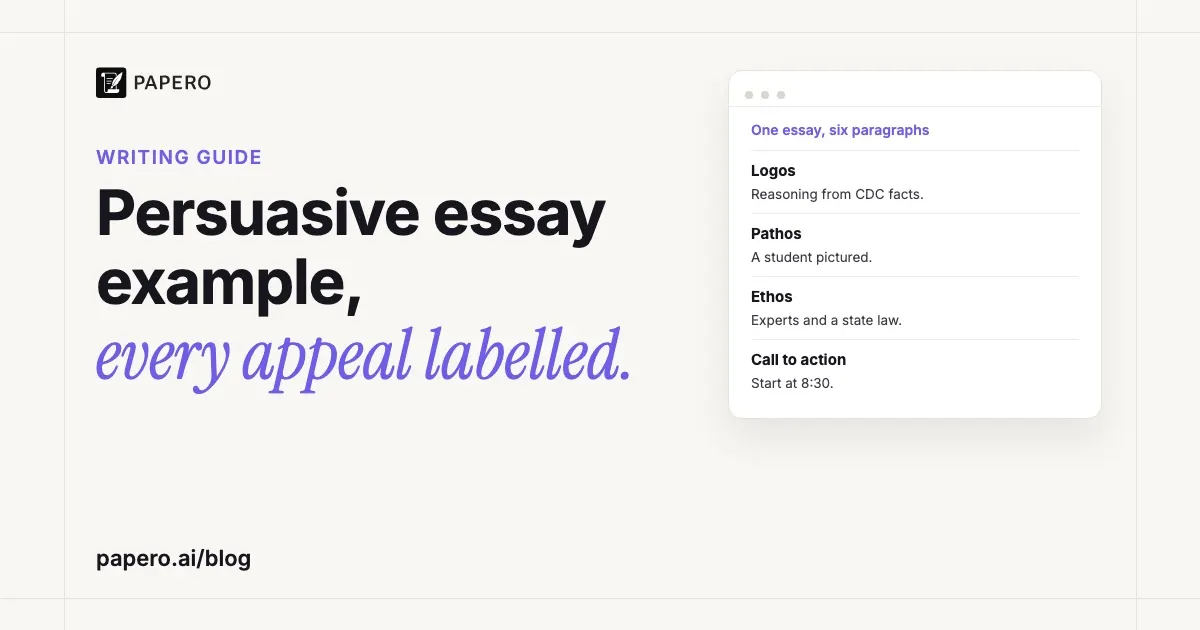
| Paragraph | What goes in it | Main appeal | In the example |
|---|---|---|---|
| 1. Introduction | Hook, the problem in two facts, thesis with three reasons | Pathos, then logos | A mismatch between the sleep teenagers need and the schedule they get |
| 2. Reason 1 | Why early bells cause the problem | Logos | Teenage body clocks shift later; school start time sets wake time |
| 3. Reason 2 | What the problem costs | Pathos, backed by logos | Health risks from the CDC; a first-period student pictured |
| 4. Reason 3 | Who supports the change and proof it has been done | Ethos | AAP recommendation, other medical groups, California’s state law |
| 5. Objection and answer | The strongest case against, stated fairly, then answered | Ethos and logos | Buses, traffic and sports schedules |
| 6. Conclusion | The three reasons joined, then the request | Pathos and a call to action | Adopt an 8:30 start and publish a transport plan |
Two choices in this outline matter more than the rest. The thesis names three reasons, so the reader knows the route before the first body paragraph. And the objection gets a paragraph of its own, placed late, so the essay answers it after the reader has already seen the case for change.
Persuasive essay example: start high school at 8:30
This persuasive essay example is about 700 words, in six paragraphs, each followed by a note on what it does. We wrote it for this guide. It is addressed to a school board, and the district it speaks to is not a real one, but every fact in it comes from CDC pages and reports or from California law, as listed in the Sources at the end. It is here to study, not to submit.
Paragraph 1: introduction
If a doctor told you how much sleep your teenager needs and then you built a daily schedule that made that amount almost impossible to get, you would call the schedule a mistake. That is what an early first bell does. The American Academy of Sleep Medicine recommends 8 to 10 hours of sleep a day for 13- to 18-year-olds, yet the CDC reports that, according to data from 2025, 75 percent of students are not getting adequate sleep. Our district can fix part of this with one decision. Starting our high schools no earlier than 8:30 a.m. would work with the way teenagers’ bodies keep time, protect their health and learning, and follow the advice of the country’s leading medical groups.
What it does: the opening analogy is a light emotional appeal: it asks parents on the board to imagine the problem as their own. The third sentence switches to logos, setting a recommendation from a named medical body against a CDC figure, so the gap is a fact, not a feeling. The thesis comes last and names three reasons in the order the body will take them. For more ways to open, see our guide to essay introduction examples.
Paragraph 2: reason 1, the body clock
Teenagers who stay up late are often blamed for it, but biology is part of the story. A CDC report explains that during puberty, biological rhythms commonly shift so that adolescents “become sleepy later at night and need to sleep later in the morning.” A sixteen-year-old who cannot fall asleep before eleven is following a body clock, not choosing to be tired. The same report adds that “during the school week, the chief determinant of wake times is school start time.” Put those two facts together and the conclusion follows: while the first bell rings early, most teenagers will be short of sleep however good their habits are. Families can set bedtimes and turn screens off at night. Only the board can move the bell.
What it does: this is the logos paragraph, built as a short chain of reasoning: two sourced premises, then the conclusion they lead to. The first sentence answers a likely objection (teenagers are just lazy) before anyone raises it. The quotations come with a signal phrase naming the source, which our guide to signal phrases covers. The final two sentences narrow the responsibility to the reader, which sets up the request in the conclusion.
Paragraph 3: reason 2, what lost sleep costs
Lost sleep is not a harmless complaint. The CDC warns that children and adolescents who do not get enough sleep have a higher risk of obesity, type 2 diabetes, poor mental health and injuries, and are more likely to have attention and behavior problems that can lead to poor academic performance. Picture a student in a first-period chemistry class after six hours of sleep, trying to follow a lesson she will be tested on next week, or the same student driving herself to school in the dark, still half awake. She has done exactly what the schedule asked of her. The schedule is what failed her.
What it does: this is the pathos paragraph, but it earns the emotion with evidence first: the list of risks is the CDC’s, not the writer’s. The student is a hypothetical picture, clearly framed with “picture”, not an invented case presented as real. Purdue OWL notes that one person’s story can make an argument more persuasive than numbers alone because it puts a human face on them, and it warns that emotion should support the claim, never distract from it. The short closing sentences shift the blame from the student to the schedule, which is the essay’s whole point.
Paragraph 4: reason 3, the experts agree and it has been done
This is not a fringe idea. In 2014 the American Academy of Pediatrics recommended that “middle and high schools should aim for a starting time of no earlier than 8:30 a.m.,” and the CDC notes that the American Medical Association and the American Academy of Sleep Medicine have since supported later start times too. Most schools had a long way to go: in a CDC analysis of the 2011-12 school year, only 17.7 percent of public middle and high schools started at 8:30 a.m. or later. Yet the change can be made at scale. California’s Education Code now requires the school day at high schools in non-rural districts to begin no earlier than 8:30 a.m., and at middle schools no earlier than 8:00 a.m., a rule that took effect by July 1, 2022, or later where a labor contract ran longer. If a whole state can move the bell, one district can.
What it does: this is the ethos paragraph. The writer borrows credibility from three medical associations instead of claiming expertise, and quotes the recommendation word for word. The 17.7 percent figure works two ways: it shows how unusual late starts were, and it makes the California law more striking. The last sentence is an argument from a larger case to a smaller one, a quick form of reasoning that is easy to remember.
Paragraph 5: the objection and the answer
The strongest case against a later start is practical. A CDC report lists the common barriers: higher transportation costs because bus schedules change, more traffic for students and staff, and harder scheduling for after-school activities, especially sports. These are real costs, and the board should plan for them openly rather than wish them away. But they are scheduling problems, and schedules can be rewritten. A teenager’s body clock cannot. California now requires every non-rural district to work around these same obstacles, and that requirement is still in force. A district that budgets for new bus routes and works with coaches on practice times can solve the logistics. No memo about bedtimes can solve chronic sleep loss.
What it does: a persuasive essay may leave the other side out, but this one states the objection in its strongest form, using the CDC’s own list. That builds ethos: Purdue OWL advises writers to “respect the reader by stating the opposing position accurately.” The paragraph concedes the cost (“these are real costs”) before answering it, so the answer sounds reasonable instead of dismissive. The contrast between schedules and body clocks repeats the essay’s main idea in a new form.
Paragraph 6: conclusion and call to action
The science of teenage sleep, the cost of losing it and the advice of pediatricians all point the same way. We ask our students to arrive ready to learn, and we owe them a schedule that makes that possible. I urge the board to adopt an 8:30 a.m. start for our high schools for the next school year, and to publish a plan for buses and activities this spring so families have time to prepare. Give students their mornings back, and first period will finally have the alert students it was designed for.
What it does: the first sentence joins the three reasons in a single line instead of summarizing each paragraph again. The call to action is specific: a time, a deadline and a plan, which makes it easy to say yes to. The last sentence returns to the emotional appeal of the opening with a positive image. Our guide on how to write a conclusion explains why a conclusion should synthesize rather than repeat.
Persuasive essay introduction examples
A persuasive essay introduction does three things: it hooks the reader, shows that the problem is real, and states a thesis that takes a side. Common hooks are a question, a scene, a surprising fact or an analogy. Below are two other ways to open the same essay, each ending with the same thesis.
Introduction with a surprising fact
In the 2011-12 school year, only 17.7 percent of public middle and high schools in the United States started at 8:30 a.m. or later, according to a CDC analysis. Two years later, the American Academy of Pediatrics recommended that middle and high schools aim to start no earlier than that time. Our high schools still start before it. Starting our high schools no earlier than 8:30 a.m. would work with the way teenagers’ bodies keep time, protect their health and learning, and follow the advice of the country’s leading medical groups.
What it does: it opens with logos and lets the gap between practice and recommendation do the persuading. It suits a reader who respects data, such as a board member with a budget to defend. It needs the source named in the first sentence, or the number reads as a guess.
Introduction with a scene
Imagine a sixteen-year-old whose alarm goes off in the dark. She went to bed on time and lay awake until after eleven, because that is when her body was ready to sleep. By the time first period starts, she has slept less than the 8 to 10 hours sleep doctors recommend for her age, and she will do it again tomorrow. Starting our high schools no earlier than 8:30 a.m. would work with the way teenagers’ bodies keep time, protect their health and learning, and follow the advice of the country’s leading medical groups.
What it does: it opens with pathos, a hypothetical scene the reader sees, and slips one fact into it. It suits an audience of parents or students, who will recognize the morning. “Imagine” marks the student as hypothetical; presenting her as a real person you know would be inventing evidence. More openings, for persuasive essays and six other essay types, are in our guide to essay hook examples.
What changes if your teacher wants an argumentative essay?
An argumentative essay keeps the thesis and the structure but changes how the case is won: more evidence, formal citations, a fair account of the other side and far less emotional appeal. A persuasive essay can lean on the reader’s feelings and may ignore the opposing view; an argumentative essay wins with evidence and has to deal with that view honestly.
For the school start essay, that means five changes:
- More evidence, cited formally. Purdue OWL describes argumentative assignments as calling for extensive research. The sleep facts would need studies, not one CDC summary, each cited in your style (APA or MLA).
- The opposing view gets more room. The OWL suggests one or two paragraphs on conflicting opinions, depending on length, and calls it “unethical to exclude evidence that may not support the thesis.” Studies of districts that changed their start times, for and against, would belong here.
- The scene goes. The chemistry student in paragraph 3 would be cut or replaced by evidence about how many students it describes.
- The call to action becomes a conclusion. “I urge the board” turns into a claim about what the evidence supports, with its limits stated.
- The voice becomes neutral. “Our district” and “I” give way to a thesis that a reader outside the district could assess.
Our argumentative essay outline shows a full argumentative outline, on laptops in lectures, with a counterargument and rebuttal planned from real studies. For finished essays, see our three argumentative essay examples, each in a different structure.
How do you write a persuasive essay?
Pick a position you can defend with facts, decide exactly who you are persuading and what you want them to do, then plan one reason per paragraph. Back every reason with a source, use emotion only where it supports a fact, answer the strongest objection, and end with a specific request.
- Choose a debatable, specific claim. “Schools should care about sleep” persuades no one; “start at 8:30” asks for something.
- Name your reader. A school board, a city council and a class of students need different reasons and different hooks.
- Find the facts first. Official and academic sources such as the CDC carry more weight than opinion pieces, and they protect your credibility.
- Assign an appeal to each paragraph. One reason for logos, one for pathos, one for ethos is a reliable start, as the outline above shows.
- Answer the strongest objection. State it as its supporters would, concede what is true, then answer it.
- End with an action. Who should do what, and by when.
Where Papero fits
Papero is an AI writing workspace for students and researchers, built for cited academic writing. For a persuasive essay, the most useful parts are planning and checking: describe the essay and Papero builds a two-level outline with a prompt for every section, so each body paragraph starts with its job written down.
Among Papero’s Review checks, Claims finds sentences that need a citation and offers papers to cite, which is useful in a persuasive essay where every fact has to stand up. Its Tone of voice check has a persuasive preset that suggests rewrites in active voice, with clear claims and strong topic sentences, and it is built never to add statistics or new claims of its own. The reasons, the evidence and the argument stay yours. The essay writing page shows what Papero does for an essay and where it stops.
Frequently Asked Questions
What are the 5 parts of a persuasive essay?
A standard persuasive essay has five parts: an introduction that ends with a thesis, three body paragraphs that each give one reason with evidence, and a conclusion with a call to action. Many persuasive essays add a sixth paragraph that states the strongest objection and answers it, usually just before the conclusion.
What is a good hook for a persuasive essay?
A good hook makes the reader feel the problem before you argue about it. A surprising fact from a named source, a short scene, a pointed question or an analogy all work. Pick the hook that fits your reader: data for a decision-maker, a scene for an audience that has lived the problem.
Does a persuasive essay need a counterargument?
Not always. A persuasive essay may ignore the other side, while an argumentative essay must deal with it fairly. Stating and answering the strongest objection still makes most persuasive essays more convincing, because it shows the reader you have thought about their doubts. Purdue OWL lists stating the opposing position accurately as a way to build credibility.
Can you use “I” in a persuasive essay?
Usually yes. A persuasive essay is written to a specific reader, so “I urge” or “we owe” fits the form, especially in the call to action. Check your assignment first: some teachers want a formal third-person voice, and an argumentative essay for a class normally avoids “I”.
How long is a persuasive essay?
The assignment sets the length, so check it before you plan. A class persuasive essay is often five or six paragraphs, and the persuasive essay example in this guide is about 700 words. A longer essay adds reasons or evidence rather than a longer introduction.
Sources
- Aristotle, Rhetoric, Book I, Part 2, translated by W. Rhys Roberts (The Internet Classics Archive, MIT): https://classics.mit.edu/Aristotle/rhetoric.1.i.html
- Purdue OWL, “Rhetorical Strategies” (owl.purdue.edu, accessed October 2026): https://owl.purdue.edu/owl/general_writing/academic_writing/establishing_arguments/rhetorical_strategies.html
- Purdue OWL, “Argumentative Essays” (owl.purdue.edu, accessed October 2026): https://owl.purdue.edu/owl/general_writing/academic_writing/essay_writing/argumentative_essays.html
- Centers for Disease Control and Prevention, “Sleep and Health,” Healthy Schools (cdc.gov, updated September 2026): https://www.cdc.gov/healthy-schools/sleep/index.html
- Wheaton, A. G., Ferro, G. A., & Croft, J. B. (2015). School start times for middle school and high school students: United States, 2011–12 school year. Morbidity and Mortality Weekly Report, 64(30), 809–813: https://www.cdc.gov/mmwr/preview/mmwrhtml/mm6430a1.htm
- California Education Code, Section 46148 (added by SB 328, 2019) (leginfo.legislature.ca.gov): https://leginfo.legislature.ca.gov/faces/codes_displaySection.xhtml?lawCode=EDC§ionNum=46148
- California Department of Education, “Fall 2025 Attendance Accounting and Instructional Time Requirements” (webinar slides, cde.ca.gov): https://www.cde.ca.gov/Fg/it/documents/aaitfallwebinar25.pdf