A topic sentence states the one point a paragraph will make, usually in its first sentence, and every other sentence in the paragraph supports it. The topic sentence examples below are grouped by the job the paragraph does: argument, evidence and analysis, compare and contrast, cause and effect, narrative, and research paper sections. Four appear inside full body paragraphs, followed by weak-to-strong rewrites and transitions.
Key Takeaways
- In an essay that argues or analyses, a good topic sentence makes a claim about the topic, not just names it. The claim is what UNC’s Writing Center calls the “controlling idea”, because it decides what the rest of the paragraph may contain.
- The job of the paragraph shapes the sentence. An argument paragraph opens with a reason, an analysis paragraph with a choice the author made, a literature review paragraph with a theme across several studies.
- Facts, quotations and questions make weak topic sentences on their own. They belong in the paragraph as evidence for a point you state yourself.
- The topic sentence does not have to come first; a transition sentence sometimes comes before it. For a marked essay, stating it early is the safer choice.
- Read your topic sentences in order. If they do not summarize the argument, the paragraphs will not either.
What makes a good topic sentence?
A good topic sentence names the paragraph’s subject and says something specific about it that the paragraph will then show. It is narrow enough to prove in one paragraph, outside a narrative, it is a claim rather than a bare fact, and it connects to the thesis. Purdue OWL defines it as a sentence that “indicates in a general way what idea or thesis the paragraph is going to deal with”.
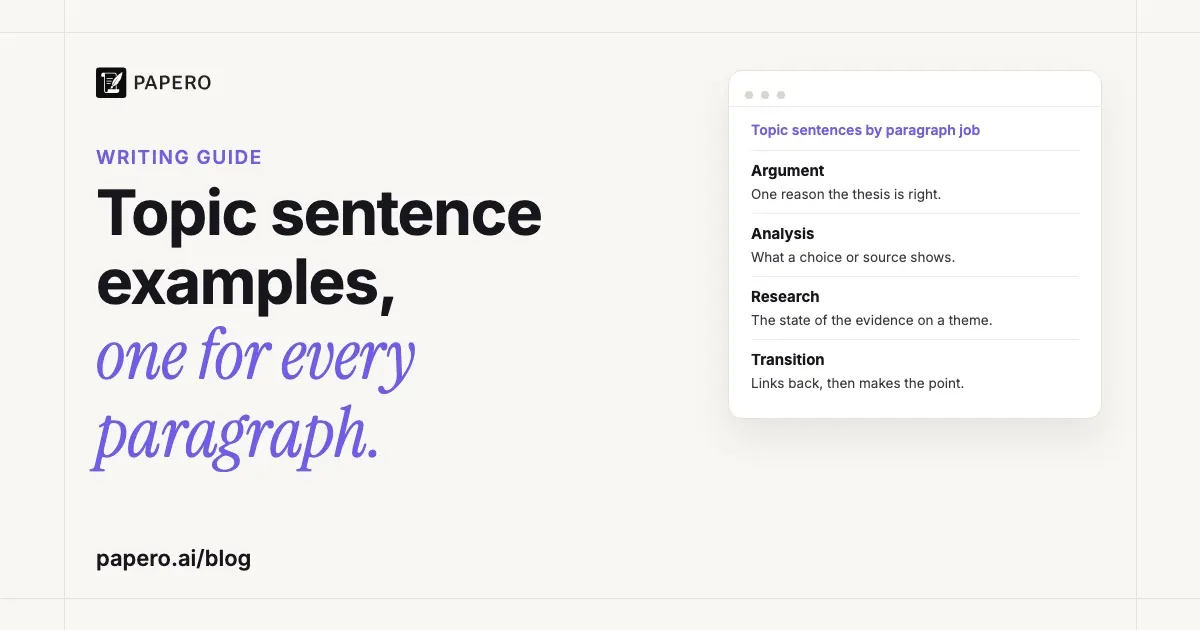
The table sums up the pattern each kind of paragraph tends to use; the sections below give examples of each.
| Paragraph job | What the topic sentence says | A pattern you can adapt |
|---|---|---|
| Argument | One reason the thesis is right | [Claim], because [reason]. |
| Evidence and analysis | What a source or a choice shows | [Author]‘s [choice] does [effect]. |
| Compare and contrast | Where two things meet and part | [A] and [B] share [X], but differ in [Y]. |
| Cause and effect | Why something happened, or what followed | [Cause] led to [effect], mainly through [mechanism]. |
| Narrative | What happens in this stage of the story | [Time or place], [the event that moves the story]. |
| Research paper | The state of the evidence on one theme | [Theme] is [settled, contested, untested]. |
The glossary entry on the topic sentence has the definition and its parts. Every example here is either quoted from a source named beside it or labelled as written for this article; the written ones model the form, and their claims are what a paragraph would then have to prove.
Topic sentence examples for argumentative essays
In an argumentative essay, each body paragraph’s topic sentence states one reason the thesis is right, in a form someone could dispute. The counterargument paragraph opens by stating the objection fairly. A reader who sees only these sentences should be able to reconstruct the argument, which is why outlines write them in full.
From our argumentative essay outline, whose thesis is that universities should make lectures laptop-free by default:
- “Off-task laptop use is linked to lower learning, for users and for the people sitting near them.”
- “Allowing computers caused lower exam scores in a controlled trial.”
Written for this article, as models:
- “Critics of a laptop-free default make one fair point: the original finding that longhand notes beat laptop notes has not held up in replications.” (for the same outline’s counterargument paragraph)
- “A later school start time is the cheapest change a district can make to students’ sleep.”
- “Grade inflation hurts the strongest students most, because it removes the signal that sets them apart.”
- “Public libraries are worth their budgets for the services that have nothing to do with books.”
Each one could be argued with, and each limits the paragraph to one reason. The first two also match their evidence: “linked to” claims only an association, “caused” needs experimental evidence. A topic sentence that overstates its evidence sets up a paragraph that cannot deliver. For complete essays built from debatable claims like these, see our three argumentative essay examples.
Topic sentence examples for evidence and analysis paragraphs
An analysis paragraph’s topic sentence names what the evidence shows or what a writer chose to do, and says why it matters. It should not report the evidence itself. In a rhetorical analysis, the sentence names one choice the author makes; in an expository essay, it names one part of the explanation.
From our rhetorical analysis essay example on the Gettysburg Address:
- “Lincoln’s first move is to set the war inside a longer story.”
- “The second move is a change in who does the dedicating.”
- “Lincoln builds his authority by playing it down.”
- “The final sentence gathers these choices into one demand.”
From our expository essay example on spaced study:
- “The spacing effect is the finding that the same amount of study produces better retention when it is divided into separate sessions.”
- “The length of the gap matters as much as the decision to space.”
Here is example 7 in its full paragraph, to show what the topic sentence lets in and what it keeps out:
Lincoln’s first move is to set the war inside a longer story. “Four score and seven years ago” counts back 87 years to 1776, and the phrase “dedicated to the proposition that all men are created equal” echoes the Declaration of Independence, which holds it “self-evident, that all men are created equal” (“Declaration of Independence”). By opening with the Declaration instead of the battle, Lincoln defines the nation by a principle. The language of birth supports that reading: the nation was “brought forth” and “conceived in Liberty,” and the speech’s last sentence asks for “a new birth of freedom.” Framed this way, the war is a test of whether something born in 1776 can survive, which is the question his second sentence asks outright: whether “that nation, or any nation so conceived and so dedicated, can long endure.”
How the topic sentence controls it: “a longer story” is the controlling idea, and every sentence after it adds a piece of that story: 1776, the Declaration, the language of birth, the question of whether the nation will last. The battle and the crowd go unmentioned, because the topic sentence did not promise them. The same shape is taught in science classes as claim, evidence, reasoning: the topic sentence is the claim, the quotations are the evidence, and the sentences that interpret them are the reasoning.
Compare and contrast topic sentence examples
A compare and contrast topic sentence names both subjects and the specific point on which they meet or part. “A and B are similar and different” says nothing, while “A and B agree on X but differ on Y” gives the paragraph its plan. In a point-by-point essay, each paragraph takes one such point.
Written for this article, as models:
- “Online and in-person tutoring cover the same material, but they reach different students.”
- “Both poems describe the same storm, yet one treats it as a threat and the other as relief.”
- “Where the expository essay explains why spacing works, an argumentative essay on the same research asks schools to act on it.”
- “The UNC Writing Center and Purdue OWL agree about where a topic sentence can go, but they differ on what can stand in for one.”
Example 16 in a full paragraph, written for this article from the two handouts in the sources:
The UNC Writing Center and Purdue OWL agree about where a topic sentence can go, but they differ on what can stand in for one. Both let it move. UNC says it “can actually go at the beginning, middle, or end of a paragraph”, and Purdue OWL says topic sentences “can occur anywhere in the paragraph”. Both also start students at the top: UNC’s model paragraph is a sandwich whose first slice is “the first sentence of the paragraph”, and Purdue OWL calls an early topic sentence “a good general rule for less experienced writers”. The difference is what can replace a single topic sentence. UNC allows that “in some cases, you may need more than one sentence to express a paragraph’s controlling idea”; Purdue OWL accepts that “not all paragraphs have clear-cut topic sentences”, provided you can still “easily summarize what the paragraph is about”. For a marked essay, the single early topic sentence both handouts recommend to beginners is the safer choice.
How the topic sentence controls it: it names both subjects, the point they share and the point that divides them, so the paragraph has a built-in order: agreement, difference, judgment. Each source gets a quotation on each point.
Cause and effect topic sentence examples
A cause and effect topic sentence names the cause, the effect and, ideally, the link between them, then the paragraph supplies the evidence for that link. Write the sentence so it commits to a direction. “Smartphones affect sleep” could open any paragraph; “Late-night phone use cuts sleep mostly by delaying bedtime” tells the reader what the paragraph will prove.
From our expository essay example, a topic sentence that arrives second, after a transition that poses a question:
- “If spacing works this well, the puzzle is why students cram. Part of the answer is that cramming feels like learning.”
Written for this article, as models:
- “Late-night phone use cuts sleep mostly by delaying bedtime, not by waking people later in the night.”
- “One reason the attendance policy failed is that it rewarded showing up rather than learning.”
- “The new bus route changed more than commuting times: it changed which students could stay for after-school clubs.”
Example 17 in its full paragraph:
If spacing works this well, the puzzle is why students cram. Part of the answer is that cramming feels like learning. Kornell and Bjork (2008) had participants study paintings by different artists, either one artist’s paintings in a row or mixed with other artists’, and then identify the artists of new paintings. Spacing helped, yet participants “rated massing as more effective than spacing, even after their own test performance had demonstrated the opposite” (p. 585). Dunlosky et al. (2013) likewise noted that students report relying heavily on rereading and highlighting, two techniques the review rated low in utility. A session of massed review leaves material feeling familiar, and familiarity is easy to mistake for memory.
How the topic sentence controls it: the first sentence is a transition that poses the question; the second is the topic sentence, and it names the cause. Everything after it supports “feels like learning”: a study in which people misjudged their own results, students’ reported habits, and a closing line on the mechanism.
Narrative paragraph topic sentence examples
A narrative paragraph’s topic sentence usually names the stage of the story, the time, place or decision the paragraph is about, rather than a claim. The point of the story often waits for the reflection, whose topic sentence states it.
From our narrative essay example about a science fair project that failed:
- “I had picked the project because it seemed safe.”
- “Standing at the table, I worked out my options.”
- “At the fair, my board was the only one with a zero on it.”
- “I used to think an experiment that did not work was a waste of three weeks.”
Example 21 opens the background paragraph, and every detail after it shows what “safe” meant to the narrator: copying a winning formula, choosing the answer before planting. Example 24 does a different job. It opens the reflection, so it is the sentence closest to a thesis in the whole essay.
Topic sentence examples for research paper sections
In a literature review or the introduction of a research paper, a topic sentence names a theme or the state of the evidence across several studies, not one study’s result. The citations come after it. In methods, results and discussion paragraphs, the topic sentence says what the paragraph reports, so a reader scanning first sentences finds the design, the main finding and the limits.
From our literature review example on retrieval practice:
- “The modern evidence base rests on two laboratory studies.”
- “Meta-analyses confirm that the effect is general.”
- “Classroom research points the same way.”
- “The effect’s limits are less settled.”
Written for this article, as models for later sections (fill example 30’s brackets from your own study):
- Methods: “Sections, not individual students, were assigned to conditions, so every comparison in this study is between whole classes.”
- Results: “[Group A] scored higher than [group B] on the delayed test, and the difference held after adjusting for [control variable].”
- Discussion: “The main limitation follows from the design: with one section per condition, a difference between sections cannot be attributed to the intervention alone.”
Example 28 in its full paragraph:
The effect’s limits are less settled. Introducing a special issue on the question, van Gog and Sweller (2015) argued that the testing effect decreases and may even disappear as learning materials become more complex, that is, when many elements must be processed together. Karpicke and Aue (2015) replied that the effect is alive and well with complex materials: in their reading, the experiments that found no benefit failed because of how retrieval was practised, and complexity itself was never defined in a measurable way. Part of the disagreement therefore turns on what counts as complex material, a term the two sides use differently.
How the topic sentence controls it: “less settled” promises a disagreement, so the paragraph gives one side, then the other, then what the dispute turns on. The topic sentence cites no one: in a review the theme comes first and the studies serve it, which is what separates a review from a list of summaries.
Weak vs strong topic sentences
Most weak topic sentences fail in one of six ways: they announce the topic instead of making a point, state a bare fact, cover too much, carry two ideas, open with someone else’s words, or ask a question without answering it. The fix is the same each time: decide the one point the paragraph proves, and say it in your own words.
| Problem | Weak | Stronger |
|---|---|---|
| Announces the topic | “In this paragraph I will discuss the Gettysburg Address.” | “Lincoln’s first move is to set the war inside a longer story.” |
| States a bare fact | “Cepeda et al. (2008) taught a set of facts to more than 1,350 people.” | “The length of the gap matters as much as the decision to space.” |
| Too broad | “Laptops have changed education.” | “Off-task laptop use is linked to lower learning, for users and for the people sitting near them.” |
| Two ideas at once | “Retrieval practice works in classrooms, and its limits are disputed.” | Two paragraphs: “Classroom research points the same way.” and “The effect’s limits are less settled.” |
| Opens with a quotation | “‘The world will little note, nor long remember what we say here.’” | “Lincoln builds his authority by playing it down.” (the quotation follows as evidence) |
| A question left hanging | “Why do students cram?” | “Students cram partly because cramming feels like learning.” |
The weak versions were written for this article, except the fact in the second row, which the expository essay uses as evidence midway through a paragraph. The stronger versions are the example essays’ own topic sentences, except the last, which merges example 17 into one sentence. The two-ideas row shows that a fix is sometimes a split: Purdue OWL’s basic rule is to “keep one idea to one paragraph”.
How do you write a topic sentence that links to the previous paragraph?
A linking topic sentence names the point of the paragraph before it, or a key word from it, and then states the new point in relation to it: adding to it, narrowing it, contrasting with it or following from it. The link and the new claim share one sentence, or a short transition sentence comes first.
Examples 27 and 28 do this. Four more, written for this article:
- Adding: “The cost argument is stronger still when transport is included.”
- Narrowing: “That pattern holds for first-year students, but it is clearest in large lecture courses.”
- Contrasting: “The interviews tell a less tidy story than the survey.”
- Following from: “If the policy works this way in theory, its first year should show it in attendance figures.”
UNC’s handout shows the two-sentence version, assuming the previous paragraph was about feared animals such as sharks, snakes and spiders:
Like sharks, snakes, and spiders, piranhas are widely feared. Although most people consider piranhas to be quite dangerous, they are, for the most part, entirely harmless. Piranhas rarely feed on large animals; they eat smaller fish and aquatic plants. When confronted with humans, piranhas’ first instinct is to flee, not attack. Their fear of humans makes sense. Far more piranhas are eaten by people than people are eaten by piranhas. If the fish are well-fed, they won’t bite humans.
The first sentence links back; the second is the topic sentence, and its “entirely harmless” is what each later sentence supports. Example 17 makes the same move with a question.
How do you know if a topic sentence works?
Run two checks. First, read only the topic sentences, in order: they should read as a summary of the essay’s argument. Second, take each paragraph and ask whether every sentence supports its topic sentence. A sentence that does not either belongs in another paragraph or tells you the topic sentence needs rewriting.
The first check, on the expository essay’s body paragraphs:
- The spacing effect is the finding that the same amount of study produces better retention when it is divided into separate sessions.
- The length of the gap matters as much as the decision to space.
- Part of the answer is that cramming feels like learning.
Together they give what spacing is, what it depends on and why people ignore it: the essay’s thesis, in order. The third reads fully only with the transition sentence before it. For the second check, UNC’s handout points to reverse outlining.
Where Papero fits
Papero is an AI writing workspace for students and researchers. Describe your essay and it builds a two-level outline with a prompt under every heading, and the suggestions it offers in each section follow that section’s prompt. One way to use that for topic sentences: write the point each body paragraph must make into its heading’s prompt before you draft, so the plan is a list of topic sentences you can check against the thesis.
As you write, the Rewrite menu can shorten or make a sentence more academic, and Review’s peer-review check returns an AI reviewer’s report with strengths, weaknesses and questions. Papero drafts only from your outline and prompts, so the points and the evidence stay yours. The essay outline page shows the planning step.
Frequently Asked Questions
Where does the topic sentence go in a paragraph?
Usually first. The UNC Writing Center and Purdue OWL both allow it at the beginning, middle or end, but both treat the start as the default for student writers. A common variation puts one transition sentence ahead of it, so the topic sentence comes second.
Can a topic sentence be a question?
A question can open a paragraph, but it is rarely the topic sentence by itself, because a question does not make a point. If you open with one, answer it in the next sentence, and that answer becomes the topic sentence. “If spacing works this well, the puzzle is why students cram” is followed at once by “Part of the answer is that cramming feels like learning.”
Does every paragraph need a topic sentence?
Not always. Purdue OWL notes that not all paragraphs have clear-cut topic sentences, and says that with or without one you should be able to summarize what the paragraph is about. Narrative paragraphs often lean on time and place instead. In an argumentative or analytical essay, an explicit topic sentence is the safer choice, because it tells the marker what the paragraph proves.
What is the difference between a topic sentence and a thesis statement?
A thesis statement gives the main claim of the whole essay, usually at the end of the introduction. A topic sentence gives the main point of one paragraph, and that point supports the thesis. Reading an essay’s topic sentences in order should produce a summary of the argument the thesis promised.
How long should a topic sentence be?
Long enough to name the subject and the specific point, and usually one sentence. Short ones work: “Classroom research points the same way” is six words. The UNC Writing Center notes that a controlling idea sometimes needs more than one sentence; in practice that is often a transition followed by the point.
Sources
- The Writing Center, University of North Carolina at Chapel Hill, “Paragraphs” (writingcenter.unc.edu, accessed October 2026): https://writingcenter.unc.edu/tips-and-tools/paragraphs/
- Purdue Online Writing Lab, “On Paragraphs” (owl.purdue.edu, accessed October 2026): https://owl.purdue.edu/owl/general_writing/academic_writing/paragraphs_and_paragraphing/index.html