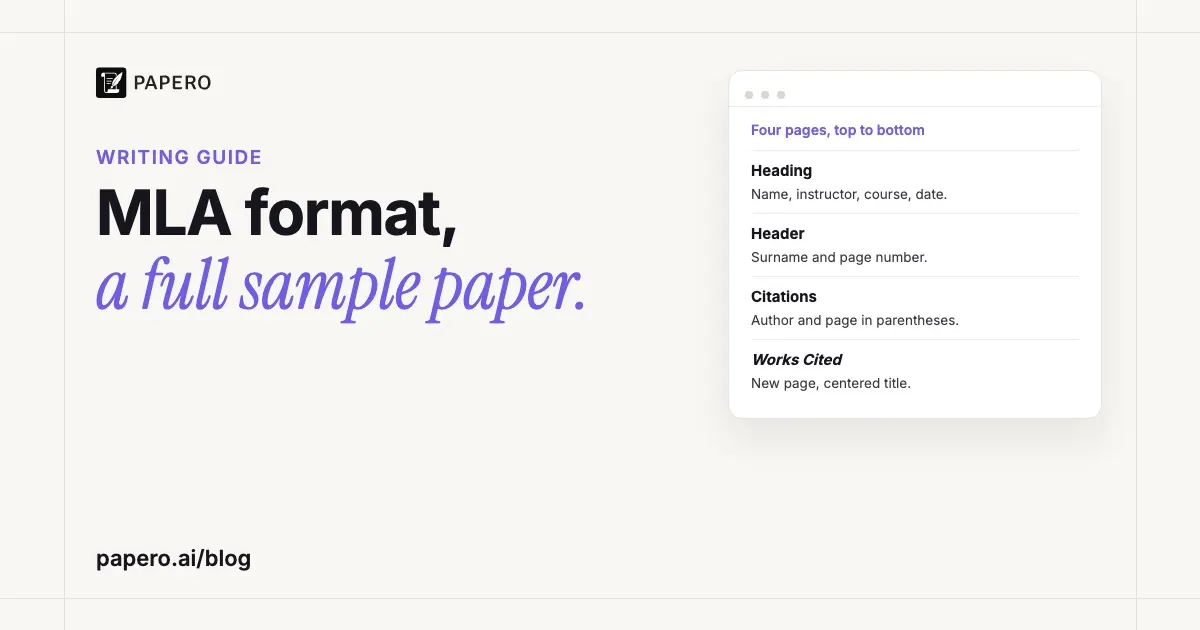
An MLA format example shows a paper laid out the way the MLA Handbook (9th edition) asks: one-inch margins, double spacing throughout, a four-line heading at the top left of page 1, a centered title, your surname and the page number at the top right of every page, and a Works Cited list on its own page. Below is a complete four-page sample paper, annotated page by page.
Key Takeaways
- Every page: one-inch margins, an easily readable font at 11 to 13 points, double spacing, and a half-inch indent at the start of each paragraph.
- Page 1 opens with your name, your instructor, the course and the date, flush left, then the title, centered in plain type. No title page unless your instructor asks or it is a group project.
- The header on every page is your surname and the page number, flush right: “Reyes 1”, never “Reyes p. 1”.
- Prose quotations longer than four lines (verse: more than three) become block quotations: indented half an inch, no quotation marks, citation after the final period.
- Works Cited starts on a new page under a centered heading in plain type, with entries in alphabetical order and a half-inch hanging indent.
What are the MLA format rules for a paper?
MLA format comes down to about a dozen settings, nearly all set out in the first chapter of the MLA Handbook: margins, type, spacing, indents, the heading, the title, the page header and the Works Cited page. The Handbook itself says acceptable variations exist, so an instructor’s format sheet wins where it differs. The table maps each setting to the Handbook section that sets it.
| Setting | MLA 9 rule | Handbook section |
|---|---|---|
| Margins | One inch at the top, bottom and both sides | 1.1 |
| Font | An easily readable typeface (Times New Roman is one example) at 11 to 13 points | 1.2 |
| Line spacing | Double-space everything, including quotations, notes and Works Cited | 1.2 |
| Alignment | Flush left; do not justify the right margin or turn on automatic hyphenation | 1.2 |
| Paragraphs | First line indented half an inch | 1.2 |
| Block quotations | The whole quotation indented half an inch | 1.2 |
| Heading | Your name, instructor, course and date on separate double-spaced lines, flush left, one inch from the top of page 1 | 1.3 |
| Title | Centered, in title case; no bold, italics, underlining, quotation marks, all capitals or final period | 1.3 (title case: MLA’s rule for all titles) |
| Title page | Not normally needed; for a group project, or when your instructor asks | 1.3 |
| Page header | Surname, a space and the page number, half an inch from the top, flush right, on every page | 1.4 |
| Works Cited | At the end, after any endnotes; heading centered an inch from the top; entries double-spaced with a half-inch hanging indent | 1.6 |
The 11-to-13-point range is new in the ninth edition; MLA’s eighth-edition formatting sheet asked for “a standard size, such as 12 points”.
MLA format example: a complete sample paper
The sample is a short literary analysis of Kate Chopin’s 1893 story “Désirée’s Baby”, laid out as four MLA pages: a first page, a body page with in-text citations, a page with a block quotation, and the Works Cited page. The student, instructor, course and essay were written for this guide. The story and the two journal articles it cites are real, and every quotation was checked against them.
A web page cannot show margins or true double spacing, and here each page ends at a paragraph break for easy comparison. The story is quoted from the Project Gutenberg edition (eBook #160), which has no page numbers, and that shapes how the essay cites it. For the APA version, see our APA format example.
Page 1: heading, title and introduction
Reyes 1
Ana Reyes
Professor Hale
English 210
27 October 2026
Seeing and Believing in Kate Chopin’s “Désirée’s Baby”
Kate Chopin’s “Désirée’s Baby” is a story about looking. Madame Valmondé looks at a baby and is startled; Désirée looks from her son to a servant’s child and goes cold; Armand Aubigny looks at his wife and tells her she is not white. Every turn of the plot follows a glance, and every person who looks treats what they see as proof. Yet the one fact that settles the question was never visible at all: it was written down, in Armand’s own house. Chopin uses this gap between what her characters see and what is true to show that race, in the world of the story, is a verdict passed by people with power rather than a fact anyone can read off a face.
The first look in the story is Armand’s, and Chopin presents it as closer to an accident than a judgment. He sees Désirée by the stone pillar at Valmondé and falls in love “as if struck by a pistol shot,” which, the narrator remarks, was “the way all the Aubignys fell in love.” Monsieur Valmondé raises “the girl’s obscure origin,” but Armand brushes it aside: “What did it matter about a name when he could give her one of the oldest and proudest in Louisiana?” A name, in his view, is something a powerful man hands out, and the woman who receives it becomes whatever his family is. The same confidence that lets him wave away her past will later let him rewrite it.
What page 1 shows:
- The header. Surname, a space and the page number, half an inch from the top, flush right (Handbook 1.4). Set it in the header area so it repeats; the glossary’s running head entry has the short definition.
- The heading. Name, instructor, course and date on separate double-spaced lines, flush left, from the one-inch top margin (1.3). The date runs day, month, year, as in MLA’s own sample papers (Caroline Anderson’s 2023 sample is dated “5 November 2022”), and the course title takes no italics or quotation marks (2.110).
- The title. Centered, with no bold, italics, underlining or final period (1.3), and capitalized in title case like any title in MLA. The story’s title inside it keeps its quotation marks, styled as it would be in a sentence; Purdue OWL’s example is Human Weariness in “After Apple Picking”.
- The first paragraph. It follows the title on the next double-spaced line, first line indented half an inch (1.2, 1.3), and its last sentence states the thesis.
- No parentheses yet. The story has no page numbers in this edition and the first sentence names Chopin, so the quotations in paragraph two need none (see page 2).
Our guide to the MLA heading and header covers page 1 in more detail.
Page 2: quotations and in-text citations
Reyes 2
When the baby is about three months old, the looking turns against Désirée. Madame Valmondé has already sensed it: on her visit she exclaims, “This is not the baby!” and scans the child “narrowly,” then looks “as searchingly” at the nurse, Zandrine. Désirée later sees it for herself, looking “from her child to the boy who stood beside him, and back again; over and over.” Armand puts the result into words: “It means,” he tells her, “that the child is not white; it means that you are not white.” Désirée answers with the only evidence the world of the story accepts, her own appearance: “Look at my hair, it is brown; and my eyes are gray, Armand, you know they are gray.” Seizing his wrist, she adds, “Look at my hand; whiter than yours, Armand.” By Armand’s own logic that should settle the matter in her favor, yet he dismisses it in one reply: “As white as La Blanche’s.” Sight counts for him only when it confirms what he has already decided.
Ellen Peel calls Désirée “a catalyst . . . for the subversion of meaning” (223), and this exchange shows why. By insisting on what her hair, eyes and skin show, Désirée exposes how little appearance decides. Peel argues that Désirée casts doubt on what race, sex and class mean in the story (223), and the scene bears her out: the categories that rule the plantation rest on nothing firmer than one man’s reading of a child’s face.
What page 2 shows:
- Quotations from the story have no parentheses. MLA gives no number when a source has no page or part numbers, and when the sentence already names the author, the citation needs no parentheses at all. Once a source is identified, it need not be named again in later paragraphs while no other source intervenes. (Both rules are from MLA Style Center answers written for the eighth edition.)
- The journal article gets a page. Peel’s article is paginated, and her name is in the sentence, so the parentheses hold only the page: (223). “Ellen Peel calls … (Peel 223)” would name her twice, which MLA’s in-text citation overview marks as incorrect.
- An ellipsis marks a cut. Three spaced periods show where “however,” was left out of Peel’s sentence. No brackets are needed; MLA 9 uses brackets, or a note, to tell your ellipses apart from ones already in the source (6.62).
- Punctuation. Closing quotation mark, then citation, then period (Purdue OWL’s MLA quotation guide).
For the other in-text cases (two authors, no author, websites, “qtd. in”), see our guide to MLA in-text citation.
Page 3: a block quotation
Reyes 3
After Désirée disappears into the bayou with her child, Armand burns the cradle, her gowns and her letters, and the story saves the answer to its question for the last lines:
The last thing to go was a tiny bundle of letters; innocent little scribblings that Désirée had sent to him during the days of their espousal. There was the remnant of one back in the drawer from which he took them. But it was not Désirée’s; it was part of an old letter from his mother to his father. He read it. . . .
“But above all,” she wrote, “night and day, I thank the good God for having so arranged our lives that our dear Armand will never know that his mother, who adores him, belongs to the race that is cursed with the brand of slavery.” (Chopin)
The proof of Armand’s own Black ancestry was in his house the whole time, in his mother’s hand, and could never have been read in a face. The story never tells us where Désirée came from; the ending exposes only the emptiness of the method Armand used to judge her.
Not every reader finds the story so critical of its world. Dan Shen argues that when all of the implied author’s choices are weighed together, “Désirée’s Baby” reads as a racist text rather than an indictment of racism, pointing among other things to its contrast between the easygoing slavery of the old master, Armand’s white father, and the harsh slavery of Armand, who turns out to be of Black descent. The point deserves weight, since the enslaved people on the plantation stay at the story’s edges. Yet the story never explains Armand’s cruelty by an ancestry he does not know about. It grows from his certainty that he can read people at a glance and rank them by what he sees, and the ending leaves that certainty in ashes, on the same bonfire as the cradle and the letters.
What page 3 shows:
- When a quotation becomes a block. The passage would run to well over four lines in the essay’s text, and Purdue OWL’s MLA guide blocks prose quotations of more than four lines. The block starts on a new line, the whole passage is indented half an inch, and it stays double-spaced (1.2). It takes no quotation marks of its own; the ones inside are Chopin’s, around the letter.
- The citation. It comes after the final punctuation, with no period after it. “(Chopin)” appears now because Peel came between this quotation and the last one from the story, so the essay names its source again; there is still no page to add.
- The cut sentence. “She was thanking God for the blessing of her husband’s love” is left out: the four periods after “He read it” are that sentence’s period plus an ellipsis. The letter begins a new paragraph in the story, so its first line takes an extra indent inside the block.
- A source cited for its whole argument. Shen is paraphrased for the article’s overall reading, not a passage, so the sentence names the author and gives no page. MLA’s in-text overview asks for a page only when a specific part of a paginated work is quoted or paraphrased.
Our guide to block quotes in APA, MLA and Chicago sets one passage out in all three styles.
Page 4: Works Cited
Reyes 4
Works Cited
Chopin, Kate. “Désirée’s Baby.” The Awakening, and Selected Short Stories, Project Gutenberg, 11 Mar. 2006, www.gutenberg.org/ebooks/160.
Peel, Ellen. “Semiotic Subversion in ‘Desiree’s Baby.’” American Literature, vol. 62, no. 2, 1990, pp. 223–37, https://doi.org/10.2307/2926914.
Shen, Dan. “Implied Author, Overall Consideration, and Subtext of ‘Désirée’s Baby.’” Poetics Today, vol. 31, no. 2, 2010, pp. 285–311, https://doi.org/10.1215/03335372-2009-021.
What page 4 shows:
- A new page, same header. The numbering carries on, “Reyes 4”; MLA’s eighth-edition “Formatting a Research Paper” sheet and Purdue OWL both start the list on a new page.
- The heading and layout. Works Cited is centered an inch from the top, in plain type with no period. Entries are double-spaced with no extra line between them, each with a half-inch hanging indent (1.3, 1.6). A one-entry list is headed Work Cited.
- Order. Alphabetical by the first word of each entry, here the surnames: Chopin, Peel, Shen.
- The story. A story in its author’s own collection puts the story’s title in quotation marks and the collection’s in italics. The Gutenberg details follow the MLA Style Center’s own Project Gutenberg example: site name, date (here the release date), URL without “https://”. Months longer than four letters are abbreviated, so March is “Mar.”
- The articles. Each DOI starts with
https://doi.org/(5.93). Page ranges drop a repeated hundreds digit (223 to 237 is “pp. 223–37”), and a title inside an article title takes single quotation marks, with the period inside both marks. Peel’s title has no accents in its DOI record, so “Desiree” stays as in its Crossref record.
Our guide to the MLA Works Cited page builds entries for journals, books and web pages from MLA’s nine core elements.
Does an MLA paper need a title page?
Usually not. The MLA Handbook (section 1.3) says a research paper does not normally need a title page: the four-line heading on page 1 replaces it. Make one only for a group project, where it lists every author, or when your instructor asks for one, in which case follow their instructions for what goes on it.
An instructor may want the title page “in lieu of or in addition to the header”, the Handbook’s word here for the four-line block, so ask which. The running header still goes on every page; for a group whose surnames do not fit, use the page number alone (1.4).
How do you format quotations in an MLA paper?
Quote short passages inside your sentence, in double quotation marks, with the citation after the closing quotation mark and before the period. Set off prose quotations longer than four lines, or verse longer than three, as a block, indented half an inch, double-spaced and without quotation marks, with the citation after the final period. Mark any words you leave out with three spaced periods, and follow every block quotation with your own analysis.
How do you order the Works Cited page in MLA?
Alphabetically by the first word of each entry, which is usually the author’s surname. A work with no author is filed by its title, skipping an opening A, An or The. Each entry starts flush left, later lines are indented half an inch, and the whole list is double-spaced with no extra space between entries.
Set the hanging indent as paragraph formatting, not with tabs, or the entries break when you edit them; our walkthrough of the hanging indent in Google Docs and Word shows where the setting lives. List only sources you cite, as the glossary’s works cited entry explains: the sample’s citations name Chopin, Peel and Shen, and those three are the whole list.
Common mistakes in an MLA format paper
Most lost marks in an MLA paper come from settings carried over from another style, such as APA, or from another assignment. Each one is easy to spot on a printout, so check the five below before you submit, then check your instructor’s own sheet, which takes priority.
- Bold or underlined title. The title and the Works Cited heading are plain text, centered.
- “p.” in citations or the header. MLA writes (Peel 223) and “Reyes 2”: no comma, no “p.”, no year.
- Extra blank lines between the heading and the title or between Works Cited entries. Double spacing does the work.
- Invented page numbers. An ebook or web page without page numbers gets none; do not count pages from a print preview.
- A Works Cited list that does not match. Every source on the list needs a citation in the essay, and every citation needs an entry.
Where Papero fits
Papero is an AI writing workspace for students and researchers. It helps you outline, draft and rewrite a paper, finds real papers to cite as you write, and formats the references in nine styles, including MLA 9. The argument stays yours: in the sample, the reading of Chopin and the answer to Shen are the student’s work.
When a document set to MLA 9 is exported to Word in the manuscript layout, the file uses 12-point Times New Roman, double spacing, one-inch margins and a half-inch first-line indent; page setup lets you change the font, size and margins. With page numbers on (the default), your surname and the page number sit at the top right of every page. The heading block sits flush left above a centered, plain title: your name, instructor and course (only the lines you fill in), then the date you enter, or today’s date in day-month-year order if you leave the date blank. Works Cited starts a new page under a centered, plain heading, with a half-inch hanging indent. Because the export writes the heading, leave it out of your document so it does not appear twice.
Citations come from a search of scholarly works, a pasted DOI, PMID, arXiv ID or ISBN, or your source library. On the free plan, in-text citations work in full and the reference list shows your real entries blurred; Plus makes it readable and exportable. Page numbers for quotations are still yours to add. Our essay writing page shows the workflow, and you can sign up free.
Frequently Asked Questions
Is an MLA paper double-spaced?
Yes. The MLA Handbook (9th edition, section 1.2) asks you to double-space the entire paper, including quotations, notes and the Works Cited list, and section 1.3 double-spaces the heading lines too. Do not add extra blank lines around the title or between Works Cited entries.
How do you cite a story with no page numbers in MLA?
Give no page number. Cite the author’s surname in parentheses, (Chopin), or nothing at all if your sentence already names the author. The Works Cited entry still lists the edition you used, such as a Project Gutenberg ebook with its date and URL. Do not count pages from your browser’s print preview.
Where does the page number go in MLA format?
At the top right of every page, half an inch from the top and flush with the right margin, after your surname and a space (for a student named Reyes: Reyes 1, Reyes 2 and so on). The MLA Handbook (section 1.4) says to number all pages consecutively and not to add “p.”, a period, a hyphen or any other mark.
Sources
- Modern Language Association, MLA Handbook, 9th edition, sections 1.0, 1.1–1.2, 1.3, 1.4 and 1.6, as published on MLA Handbook Plus (read from Internet Archive copies of 2021, October 2026): https://mlahandbookplus.org/books/book/5/chapter/56255/Title
- Susan Doose, “A Closer Look at MLA Style” (ninth-edition rules with MLA Handbook section numbers, including 2.110, 5.93 and 6.62) (style.mla.org, accessed October 2026): https://style.mla.org/closer-look-at-mla-style/
- Modern Language Association, “In-Text Citations: An Overview” (style.mla.org, accessed October 2026): https://style.mla.org/in-text-citations-overview/
- MLA Style Center, “How do I cite the prologue of a play?” (Project Gutenberg works-cited example, 2023) (style.mla.org, accessed October 2026): https://style.mla.org/citing-play-prologue/
- MLA Style Center, “What should I include in parentheses if the author’s name is provided in a signal phrase and the source has no page numbers or other kind of part number?” (eighth-edition answer) (style.mla.org, accessed October 2026): https://style.mla.org/citing-unpaginated-works/
- MLA Style Center, “When you cite from the same source in more than one paragraph and no other source intervenes, do you need to repeat the author’s name each time you start a new paragraph?” (eighth-edition answer) (style.mla.org, accessed October 2026): https://style.mla.org/same-source-multiple-paragraphs/
- Modern Language Association, “Formatting a Research Paper” (eighth-edition guide) (style.mla.org, accessed October 2026): https://style.mla.org/app/uploads/sites/3/2020/12/Formatting-a-Research-Paper_v3_-The-MLA-Style-Center.pdf
- Modern Language Association, “Sample Essays: Writing with MLA Style”, including Caroline Anderson, “L’Appel du Vide: Making Spaces for Sinful Exploration in The Strange Case of Dr. Jekyll and Mr. Hyde” (2023 edition) (style.mla.org, accessed October 2026): https://style.mla.org/sample-papers/
- Purdue OWL, “MLA Formatting Quotations” (owl.purdue.edu, read from an Internet Archive copy, October 2026): https://owl.purdue.edu/owl/research_and_citation/mla_style/mla_formatting_and_style_guide/mla_formatting_quotations.html
- Purdue OWL, “MLA General Format” (owl.purdue.edu, read from an Internet Archive copy, October 2026): https://owl.purdue.edu/owl/research_and_citation/mla_style/mla_formatting_and_style_guide/mla_general_format.html
- Purdue OWL, “MLA Works Cited Page: Basic Format” (owl.purdue.edu, read from an Internet Archive copy, October 2026): https://owl.purdue.edu/owl/research_and_citation/mla_style/mla_formatting_and_style_guide/mla_works_cited_page_basic_format.html
- Purdue OWL, “MLA Works Cited Page: Books” (owl.purdue.edu, read from an Internet Archive copy, October 2026): https://owl.purdue.edu/owl/research_and_citation/mla_style/mla_formatting_and_style_guide/mla_works_cited_page_books.html
- Chopin, Kate. “Désirée’s Baby.” The Awakening, and Selected Short Stories, Project Gutenberg eBook #160 (released 11 March 2006): https://www.gutenberg.org/ebooks/160
- Peel, E. (1990). Semiotic subversion in “Desiree’s Baby.” American Literature, 62(2), 223–237. https://doi.org/10.2307/2926914
- Shen, D. (2010). Implied author, overall consideration, and subtext of “Désirée’s Baby.” Poetics Today, 31(2), 285–311. https://doi.org/10.1215/03335372-2009-021