A research paper abstract is usually a single paragraph of 100 to 250 words that answers four questions: why the study was done, what was done, what was found, and what it means. Below are three annotated abstract examples: two published ones, an empirical study in one paragraph and a structured randomized-trial abstract with headings, and a short review abstract we wrote for this blog.
Key Takeaways
- Write the abstract last, from the finished paper, and give each part one or two sentences: background, aim, method, results, conclusion.
- Put findings, with numbers where you have them, in the results. “children showed robust retrieval practice effects” and “There was no significant difference” with its p-values both say what was found; “results are discussed” says nothing.
- APA 7 limits an abstract to 250 words, as one double-spaced paragraph with no indent under a bold, centered “Abstract” label. Student papers usually do not need one unless the instructor asks.
- An abstract must stand alone: usually no citations, as few abbreviations as possible, and nothing that is not in the paper.
What goes in an abstract?
Almost every research abstract follows the same order, whether or not it has headings. The University of Toronto’s writing advice frames it as four questions, and APA’s Abstract and Keywords Guide asks for one or two sentences on each topic. Here is that order mapped onto the first example below.
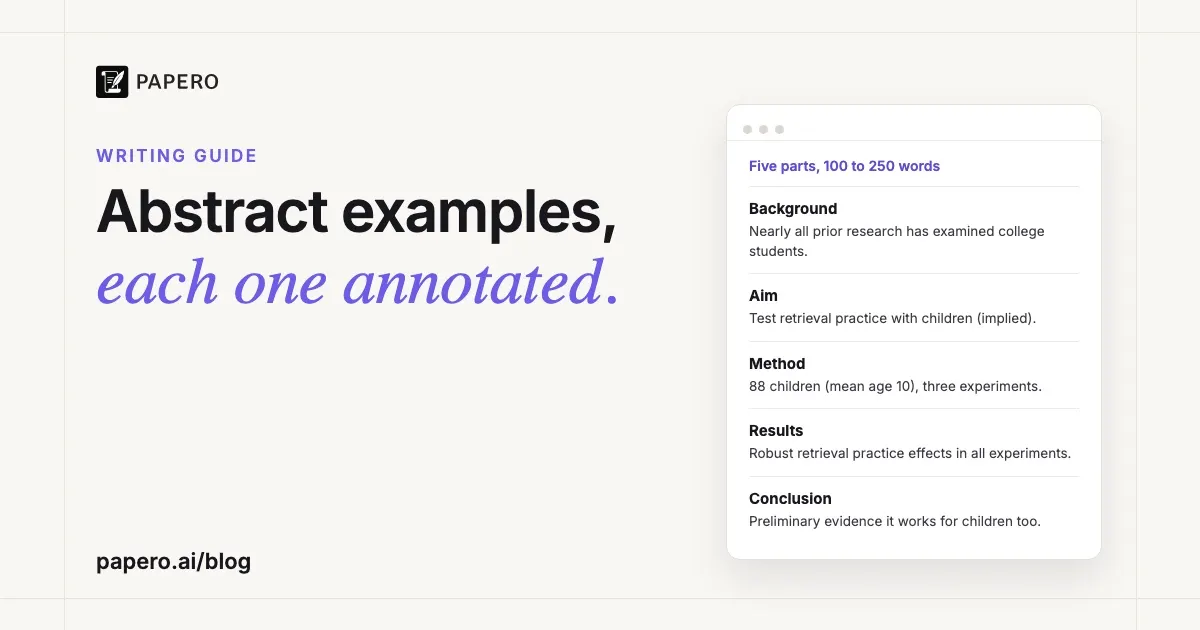
| Part | Question it answers | Sentences | In Example 1 |
|---|---|---|---|
| Background and gap | Why does this matter, and what is missing? | 1–2 (Example 1 uses 3) | Retrieval practice works, but almost all studies used college students |
| Aim or question | What did this paper set out to do? | 0–1 | Implied: test retrieval practice in children |
| Method | Who, what and how? | 1–2 | 88 children, mean age 10, three experiments, restudy vs retrieval |
| Results | What was found, with numbers? | 1–2 | Retrieval practice effects in all experiments, independent of reading and speed |
| Conclusion | So what? | 1 | May work for children with varied reading and processing levels |
The proportions matter more than the labels. Toronto’s guide advises giving each point space in proportion to its weight in the paper, so a study with a short method and complex results should spend its words on the results.
Abstract example 1: an empirical study (unstructured)
This abstract is from a 2016 paper in Frontiers in Psychology by Karpicke, Blunt and Smith, published under a Creative Commons Attribution (CC BY) licence and reproduced in full. It is 164 words, a single paragraph, with no headings.
A wealth of research has demonstrated that practicing retrieval is a powerful way to enhance learning. However, nearly all prior research has examined retrieval practice with college students. Little is known about retrieval practice in children, and even less is known about possible individual differences in retrieval practice. In three experiments, 88 children (mean age 10 years) studied a list of words and either restudied the items or practiced retrieving them. They then took a final free recall test (Experiments 1 and 2) or recognition test (Experiment 3). In all experiments, children showed robust retrieval practice effects. Although a range of individual differences in reading comprehension and processing speed were observed among these children, the benefits of retrieval practice were independent of these factors. The results contribute to the growing body of research supporting the mnemonic benefits of retrieval practice and provide preliminary evidence that practicing retrieval may be an effective learning strategy for children with varying levels of reading comprehension and processing speed.
What makes it work:
- Three sentences of background build to a gap. The first states what is known, the second what is missing (studies with children), the third narrows it further (individual differences). By the fourth sentence the reader knows exactly why the study exists.
- The method sentence carries the numbers. Sample size, age and design fit in one sentence, and the next names the outcome measures.
- The results answer both questions from the background. Children showed the effect, and it did not depend on reading comprehension or processing speed.
- The conclusion is hedged to match the evidence. “Preliminary evidence” and “may be” are honest for 88 children and word lists. An abstract that claimed more than the study shows would be the weakest part of the paper.
Abstract example 2: a structured abstract
Many medical and health journals require a structured abstract, with a labelled heading for each part. The US National Library of Medicine describes these as abstracts with distinct, labelled sections such as Introduction, Methods, Results and Discussion, and notes that the medical journal editors’ recommendations (ICMJE) require them for original research, systematic reviews and meta-analyses. This example is from a 2024 randomized controlled trial in BMC Medical Education by Raksakietisak and colleagues, published under CC BY and reproduced word for word (the bold labels are ours).
Background: Test enhancing learning (TEL) had shown a significant effect in promoting the learning of many learning contents. However, its effect on the postgraduate medical level was unclear. This study aimed to investigate the effect of TEL in 1st year anesthesiology residents learning neuroanesthesia.
Method: The residents were randomized to either group A, which was assigned to do the intervention exam (exam A) for two times during learning in neuroanesthesia, or group B, which studied in the same environment without doing the exam. All participants were assigned to do the assessment exam (exam B) at one month after the end of the rotation. All of the exams were ten multiple choice questions (MCQ). Since the anesthesia residents rotated to neuroanesthesia for two weeks twice during the first year, we conducted the experiments twice, using exams that covered both basic science (BS) and clinical science (CS) topics.
Results: There was no significant difference in mean ± SD of the scores for assessment exams asking about the basic science topic (BS_B) [group A (5.25 ± 2.05) VS group B (4.90 ± 1.80); p = 0.570] and the clinical science topic (CS_B) [group A (6.30 ± 1.26) VS group B (5.95 ± 1.61); p = 0.448].
Conclusion: This study showed null findings on the effect of TEL on learning in residents of the first year of anesthesiology. More studies on TEL were required to confirm the effect of TEL and find the appropriate test format that could enhance learning for post-graduate medical trainees.
What to learn from it:
- It reports a null result plainly. The conclusion says the study found no effect, with both p-values in the results. Many students hide a non-significant result behind “results are discussed”; this abstract does the opposite, and it is more useful for it.
- The results section is all numbers. Means, standard deviations and p-values for both comparisons, with nothing interpretive. Interpretation waits for the conclusion.
- Most abbreviations are defined at first use. TEL, MCQ, BS and CS are each spelled out before they are used; SD and VS are not, which a strict editor would flag. Toronto’s guide suggests avoiding abbreviations where you can, because each one costs words to explain.
- The method takes the most space. In a trial, the design is what readers judge first, so it earns the longest section.
Note also what the abstract leaves out: it does not give the number of residents in each group. That is the first thing a reader would look for in the full text, and a sentence worth adding if you write a trial abstract of your own.
Abstract example 3: a review abstract
Not every paper has a method and results. A literature review, essay or theoretical paper still needs an abstract, but the “what did you find” part becomes “what does the literature show”. We wrote this 136-word example for the literature review example on this blog, which reviews ten sources on retrieval practice.
Students spend much of their study time rereading and highlighting, techniques that research rates as low in utility. This review examines the evidence for retrieval practice, the act of recalling information from memory, and asks whether its benefits hold outside the laboratory and with complex material. Ten sources are reviewed: a review of study techniques, two foundational experiments, three meta-analyses, a systematic review of classroom studies, a classroom survey on test anxiety, and a two-paper exchange on the limits of the effect. Three meta-analyses with different inclusion rules estimate an advantage near half a standard deviation over restudying, and a review of 50 classroom experiments found medium or large benefits in 57% of effects. The evidence is weaker for highly complex material, and the field lacks an agreed definition of complexity that would settle the question.
The review abstract keeps the same order: a problem, a question, what was examined (in place of a method), what it shows (with the two key numbers), and what remains open. Without numbers, the fourth sentence would read “studies show that retrieval practice is effective”, which a reader could have guessed from the title.
How do you write an abstract?
Write it last, after the paper is finished, by pulling one or two sentences from each section in order, then cut until it fits the word limit. An abstract drafted first describes the paper you planned, not the one you wrote.
- List one line per part. Background, aim, method, key results, conclusion. Copy the most important number from your results section.
- Write the draft in full sentences, in that order. Do not try to make it short yet.
- Cut what a reader does not need to decide whether to read on. Cut anything that repeats the title first, as Toronto’s guide advises, then citations, long background and secondary results.
- Check that every claim is in the paper. Toronto’s guide warns against referring in the abstract to anything that is not in the document.
- Add three to five keywords if your style or journal asks for them. APA’s guide suggests covering the topic, population, method and application.
A weak abstract, rewritten
Here is a weak abstract for the same review, of the kind students often write first:
This paper is about retrieval practice. Retrieval practice is a very important topic in education today. Many studies have been done on it. In this review I will look at some of these studies and discuss what they say. The results will be discussed and some conclusions will be drawn.
It has five sentences and no information: no question, no sources described, no finding, no conclusion. The 136-word version in Example 3 replaces each sentence with something a reader can use. The test is simple: if a sentence would fit any review on any topic, cut it or replace it with a fact from your paper.
APA abstract format
APA’s Abstract and Keywords Guide (7th edition) sets out the format. The abstract goes on page 2, after the title page. The label “Abstract” is bold and centered on the first line. The text starts on the next line, is not indented, and is a single double-spaced paragraph of no more than 250 words unless your instructor or journal sets another limit.
Keywords go one line below the abstract. The label Keywords: is italic and indented like a new paragraph, followed by three to five lowercase keywords separated by commas, with no full stop at the end. The guide also notes that abstracts and keywords are not typically required for student papers, so check your assignment before writing one. The glossary entry on the abstract gives the short definition, and our annotated bibliography example explains why an annotation is not an abstract.
Where Papero fits
Papero is an AI writing workspace for students and researchers, and you can sign up free. According to the Papero homepage, it builds a two-level outline for your paper, including standard IMRaD sections, each with its own writing prompt, and exports the finished document to Word with a title page and page numbers.
That structure helps with the abstract, because a paper written section by section gives you one clear source for each sentence of the abstract. The abstract itself should be written last, from your own results, and checked against the paper line by line. If the paper reports research, the glossary entry on the research paper covers the usual sections.
Frequently Asked Questions
How long should an abstract be?
Usually 100 to 250 words. APA 7 sets a limit of 250 words unless your instructor or journal says otherwise, and the University of Toronto’s writing advice gives 100 to 250 words for a typical informative abstract. Conference and journal limits vary, often below 250, so always check the call for papers or author guidelines.
What are the five parts of an abstract?
Background, aim, method, results and conclusion. Some guides merge background and aim, giving four parts, which is how the University of Toronto frames it: why you did the study, what you did, what you found, and what it means. Structured abstracts label each part with a heading; unstructured abstracts keep the same order in one paragraph.
What is a structured abstract?
An abstract divided into labelled sections, such as Background, Methods, Results and Conclusions. The National Library of Medicine notes that medical journal editors require structured abstracts for original research articles, systematic reviews and meta-analyses, and that the exact headings differ from journal to journal. Example 2 above is a structured abstract.
Should an abstract include citations?
Generally no. An abstract is read on its own, in databases and search results, where a citation to a reference list the reader cannot see is no help. If your paper responds to one specific work, name the author in the text of the abstract instead, and check your journal’s author guidelines. In the body of the paper, cite as usual; our guide to APA in-text citation covers the formats.
Is an abstract the same as an introduction?
No. An introduction sets up the problem and leads into your paper; an abstract summarizes the whole paper, including the results and conclusion. A common mistake is to paste the first paragraph of the introduction as the abstract, which leaves out everything the reader most wants to know.
Sources
- American Psychological Association, Abstract and Keywords Guide, 7th edition (apastyle.apa.org, accessed October 2026): https://apastyle.apa.org/instructional-aids/abstract-keywords-guide.pdf
- University of Toronto, Writing Advice, “The Abstract” (advice.writing.utoronto.ca, accessed October 2026): https://advice.writing.utoronto.ca/types-of-writing/abstract/
- US National Library of Medicine, “Structured Abstracts” (nlm.nih.gov, accessed October 2026): https://www.nlm.nih.gov/bsd/policy/structured_abstracts.html
- Purdue OWL, “General Format” (APA abstract page) (owl.purdue.edu, accessed October 2026): https://owl.purdue.edu/owl/research_and_citation/apa_style/apa_formatting_and_style_guide/general_format.html
- Karpicke, J. D., Blunt, J. R., & Smith, M. A. (2016). Retrieval-based learning: Positive effects of retrieval practice in elementary school children. Frontiers in Psychology, 7, Article 350. Licence: CC BY. https://doi.org/10.3389/fpsyg.2016.00350
- Raksakietisak, M., Lertsiripatarajit, V., Aroonpruksakul, N., Plailaharn, N., & Raksamani, K. (2024). Test-enhanced learning in neuroanesthesia for the first year anesthetic residents: A randomized controlled trial. BMC Medical Education, 24, Article 905. Licence: CC BY. https://doi.org/10.1186/s12909-024-05887-0