An MLA works cited page starts on a new page at the end of your paper, with the title Works Cited centered at the top in plain type. Every entry is double-spaced, alphabetized by its first word, usually the author’s last name, and formatted with a half-inch hanging indent. Each entry follows the same template of core elements, ending with a period.
Key Takeaways
- Page: new page, same header and margins as the paper, “Works Cited” centered with no bold, italics or quotation marks. A list with one entry is titled “Work Cited”.
- Entries: double-spaced throughout, no extra space between them, first line flush left and the rest indented 0.5 inch.
- Order: alphabetical by the first word of each entry, skipping a leading A, An or The. A work with no author is alphabetized by its title.
- Every entry is built from the same nine core elements, in order, and you skip the ones a source does not have.
- DOIs get
https://doi.org/in front; plain URLs can drop “https://”.
MLA works cited page format
Start the list on a new page after the text, keep the running header with your last name and page number, and center the title Works Cited one inch from the top in plain type. Double-space everything and give each entry a half-inch hanging indent. These rules come from the MLA’s own “Formatting a Research Paper” guide and the Purdue OWL page on the basic format, and they have not changed in the ninth edition of the MLA Handbook (2021).
| Element | Rule |
|---|---|
| Placement | A new page after the text and any endnotes; page numbers continue |
| Header | Your last name and the page number, top right, as on every page |
| Title | Works Cited, centered, one inch from the top, no bold, italics or quotation marks |
| Spacing | Double-spaced, including between the title and the first entry, with no extra lines between entries |
| Indent | Hanging indent: first line at the left margin, later lines indented 0.5 inch |
| Order | Alphabetical by the first word of the entry (ignoring A, An or The), usually the author’s last name |
| Ending | Every entry ends with a period |
The running header is the one carried over from page 1, where it sits above the four-line MLA heading with your name, instructor, course and date. The hanging indent is the rule that trips people up, because pressing Tab on each line breaks the moment you edit the entry. Our guide to the hanging indent in Google Docs and Word sets it up properly in either program.
What are the MLA core elements?
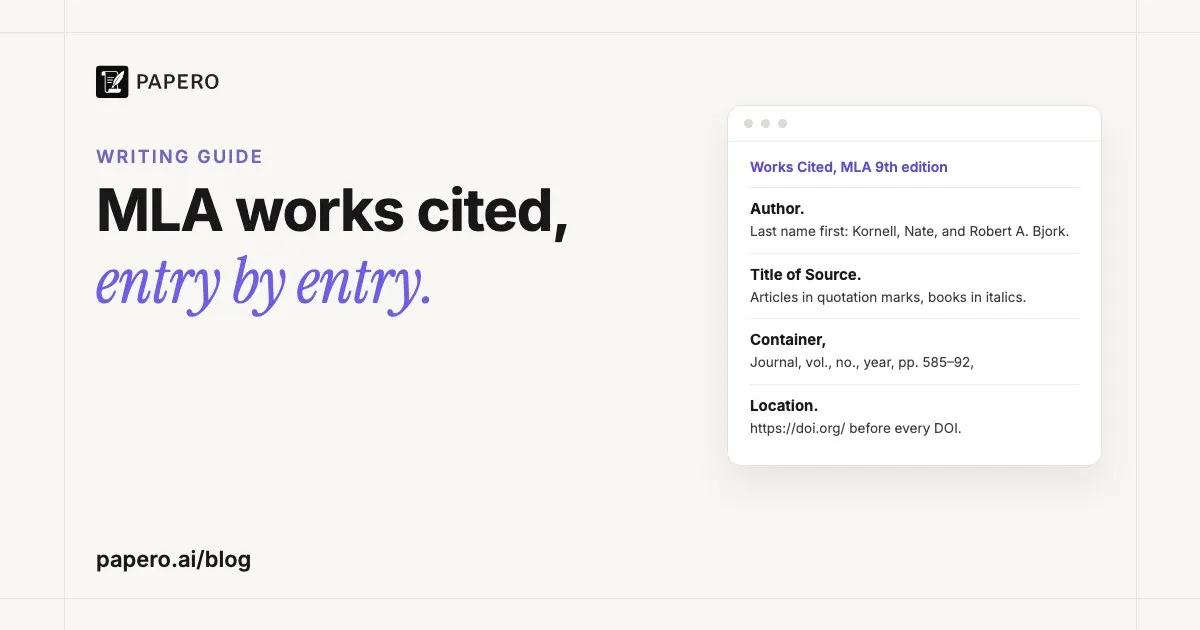
Every MLA entry follows one template of nine core elements, in a fixed order: author, title of source, title of container, other contributors, version, number, publisher, publication date and location. Include the elements your source has and skip the rest. Each element is followed by the punctuation shown below.
Author. Title of Source. Title of Container, Other Contributors, Version,
     Number, Publisher, Publication Date, Location.
A container is whatever holds the source: a journal holds an article, an edited collection holds a chapter, a website holds a page. A book you cite as a whole is its own container, so its entry has no container title. Purdue OWL’s MLA pages add that a source can sit in a second container, such as a journal article you read in a database: the second container’s elements follow the first, starting with its title in italics.
Titles of whole works, such as books, journals and websites, go in italics. Titles of parts, such as articles, chapters and web pages, go in quotation marks. MLA capitalizes titles in title case: the main words, plus the first word of the title and subtitle, but not articles, prepositions or coordinating conjunctions such as and, but and or in the middle.
MLA works cited examples by source type
The first three rows use real sources, which you will meet again in the sample list below; the last two show the pattern.
| Source | Entry |
|---|---|
| Journal article, two authors, DOI | Kornell, Nate, and Robert A. Bjork. “Learning Concepts and Categories: Is Spacing the ‘Enemy of Induction’?” Psychological Science, vol. 19, no. 6, 2008, pp. 585–92, https://doi.org/10.1111/j.1467-9280.2008.02127.x. |
| Book, translated | Ebbinghaus, Hermann. Memory: A Contribution to Experimental Psychology. Translated by Henry A. Ruger and Clara E. Bussenius, Teachers College, Columbia University, 1913. |
| Document by an organization that also published it | Student Paper Setup Guide. American Psychological Association, 8 Oct. 2025, apastyle.apa.org/instructional-aids/student-paper-setup-guide.pdf. |
| Web page (pattern) | Surname, First Name. “Title of Page.” Name of Website, Publisher if different from the website, Day Month Year, URL. |
| Chapter in an edited book (pattern) | Surname, First Name. “Title of Chapter.” Title of Book, edited by First Name Surname, Publisher, Year, pp. 00–00. |
Notice what changes between rows. The article and the chapter have a title in quotation marks and a container in italics; the book has only an italic title. The translators sit in the “other contributors” slot, after the title. For editions, translations and edited collections, our guide on how to cite a book sets the MLA entry beside APA and Chicago. Two sources students often ask about follow the same template. A painting or photo found online takes the year the work was made after its title, as our image citation guide shows. A YouTube video takes YouTube as the container, usually with the channel after “uploaded by”, as our guide to citing a YouTube video shows with a TED talk. The setup guide has no author line at all, which brings us to the rule behind it.
How do you list authors in MLA?
Give the first author last name first, then the first name: Ebbinghaus, Hermann. A second author is written first name first, joined with “and”: Kornell, Nate, and Robert A. Bjork. For three or more authors, give the first author followed by “et al.”: Dunlosky, John, et al. Leave out titles and degrees such as Dr. or PhD, but keep suffixes like Jr. or III.
Two more rules from the ninth edition, as listed on the MLA Style Center. When a nongovernment organization is both the author and the publisher, skip the author and start the entry with the title (section 5.19), which is why the APA setup guide above begins with its title. When you cite two or more works by the same author, give the name in the first entry only and use three hyphens or em dashes in its place in the others, ordered by title (section 5.126).
A work with no author is alphabetized by its title. If the title starts with “A”, “An” or “The”, skip that word when alphabetizing, but keep it in the entry: The Art of War is filed under A.
How do you format DOIs, URLs and page numbers?
Put https://doi.org/ in front of a DOI, as the MLA Style Center’s ninth-edition summary requires (section 5.93). For a web address without a DOI, Purdue OWL notes that you can drop “http://” or “https://”. A DOI or URL usually comes last in the entry, followed by a period.
For an online source, the MLA Handbook puts the options in order of preference: DOI, permalink, URL. An MLA Style Center answer on paginated articles adds that you may give the page range as well as the DOI, separated by a comma, as in the Kornell entry above. Page ranges take “pp.” and a single page takes “p.”. Purdue OWL notes that MLA shortens the second number of a range when the leading digits repeat, so pages 585 to 592 become “pp. 585–92”.
An access date is optional. Purdue OWL recommends one for web pages that have no publication date or that are likely to change: add “Accessed 21 Oct. 2026.” at the end. MLA abbreviates months longer than four letters in works cited entries, so October is “Oct.” and June stays “June”.
MLA works cited example: a sample list
Here is a complete works cited list of five real sources, in the order they would appear at the end of a paper. Each entry was checked against its DOI record or title page in October 2026.
Works Cited
Dunlosky, John, et al. “Improving Students’ Learning with Effective Learning Techniques: Promising Directions from Cognitive and Educational Psychology.” Psychological Science in the Public Interest, vol. 14, no. 1, 2013, pp. 4–58, https://doi.org/10.1177/1529100612453266.
Ebbinghaus, Hermann. Memory: A Contribution to Experimental Psychology. Translated by Henry A. Ruger and Clara E. Bussenius, Teachers College, Columbia University, 1913.
Kornell, Nate, and Robert A. Bjork. “Learning Concepts and Categories: Is Spacing the ‘Enemy of Induction’?” Psychological Science, vol. 19, no. 6, 2008, pp. 585–92, https://doi.org/10.1111/j.1467-9280.2008.02127.x.
Roediger, Henry L., III, and Jeffrey D. Karpicke. “Test-Enhanced Learning: Taking Memory Tests Improves Long-Term Retention.” Psychological Science, vol. 17, no. 3, 2006, pp. 249–55, https://doi.org/10.1111/j.1467-9280.2006.01693.x.
Student Paper Setup Guide. American Psychological Association, 8 Oct. 2025, apastyle.apa.org/instructional-aids/student-paper-setup-guide.pdf.
In a paper, the title would be centered in plain type, not bold, and every entry would have a hanging indent, which this page cannot show. The last entry is filed under S because it starts with its title. The Kornell title ends in a question mark, so no period follows it before the journal name. Our MLA sample paper shows a Works Cited page like this one at the end of a complete essay, with the in-text citations that point to it.
Works cited vs bibliography vs references
A works cited list includes only the sources you cite in your paper. A bibliography can also list works you consulted but did not cite. MLA uses Works Cited, APA calls its list References, and Chicago’s notes-and-bibliography style uses a Bibliography.
The Chicago style footnotes guide shows how Chicago’s entries differ, and the APA references page guide shows APA’s. In MLA, every entry on the list needs at least one in-text citation in your paper, and every in-text citation needs an entry. The in-text citation is the author’s last name and the page, with no comma: (Kornell and Bjork 585); our guide to MLA in-text citation covers the other cases. If your teacher wants a summary under each source, that is an annotated works cited list; our annotated bibliography example shows an MLA one. A side-by-side table of how APA and MLA differ covers the rest of the paper too.
Where Papero fits
Papero is an AI writing workspace for students and researchers. It finds real papers to cite for the sentence you are writing, looks sources up by DOI, PMID, arXiv ID or ISBN, and formats in-text citations and the reference list in MLA 9 or eight other styles.
On the free plan, in-text citations work in full and the reference list shows your real entries blurred; Plus makes the list readable, copyable and exportable (papero.ai/pricing). Check every generated entry against the rules above, especially title capitalization and page ranges. The find sources page shows the workflow, and you can sign up free. The glossary entries on the works cited page and MLA style have the short definitions.
Frequently Asked Questions
Is the Works Cited title bold in MLA?
No. The title Works Cited is centered at the top of a new page in the same plain type as the rest of the paper: no bold, no italics, no underlining and no quotation marks. If the list has only one entry, MLA changes the title to Work Cited.
Do you double-space a works cited page?
Yes. Double-space the whole list, including the space between the title and the first entry, and do not add extra blank lines between entries. The hanging indent, not extra spacing, shows the reader where each new entry starts.
How do you cite a source with three authors in MLA?
In the works cited entry, give the first author’s name, last name first, followed by a comma and “et al.”: Dunlosky, John, et al. In a parenthetical citation, use the last name and “et al.” before the page: (Dunlosky et al. 4). The same applies to any source with three or more authors. In your own sentences, an MLA Style Center answer (written for the eighth edition, and still the usual practice) advises writing the first author’s name and “and others” rather than “et al.”, which it reserves for parenthetical citations and the list.
Do you need an access date in MLA 9?
Usually not. An access date is optional in the ninth edition. Purdue OWL recommends adding one, as “Accessed 21 Oct. 2026.”, for web pages without a publication date or for pages likely to change. Sources with a DOI or a fixed publication date do not need one.
What goes first in a works cited entry with no author?
The title. Start the entry with the title of the source and alphabetize it by the first word that is not “A”, “An” or “The”. This also applies when a nongovernment organization is both the author and the publisher of a work: MLA 9 skips the author element and begins with the title.
Sources
- Modern Language Association, “Formatting a Research Paper” (style.mla.org, accessed October 2026): https://style.mla.org/app/uploads/sites/3/2020/12/Formatting-a-Research-Paper_v3_-The-MLA-Style-Center.pdf
- Susan Doose, “A Closer Look at MLA Style” (ninth-edition rules with MLA Handbook section numbers) (style.mla.org, accessed October 2026): https://style.mla.org/closer-look-at-mla-style/
- MLA Style Center, “When a work by three or more authors is mentioned in the text of a research paper…should the names of all the authors be included?” (eighth-edition answer) (style.mla.org, accessed October 2026): https://style.mla.org/when-a-work-by-three-or-more-authors-is-mentioned-in-the-text-of-a-research-paper-rather-than-in-a-parenthetical-citation-should-the-names-of-all-the-authors-be-included-or-only-the-first-one-foll/
- MLA Style Center, “I am citing a paginated journal article that appears online. Should I include the page range, the URL, or the DOI?” (style.mla.org, accessed October 2026): https://style.mla.org/page-range-and-doi/
- Purdue OWL, “MLA Works Cited Page: Basic Format” (owl.purdue.edu, accessed October 2026): https://owl.purdue.edu/owl/research_and_citation/mla_style/mla_formatting_and_style_guide/mla_works_cited_page_basic_format.html
- Purdue OWL, “MLA Works Cited: Electronic Sources” (owl.purdue.edu, accessed October 2026): https://owl.purdue.edu/owl/research_and_citation/mla_style/mla_formatting_and_style_guide/mla_works_cited_electronic_sources.html
- Purdue OWL, “MLA Works Cited Page: Books” (owl.purdue.edu, accessed October 2026): https://owl.purdue.edu/owl/research_and_citation/mla_style/mla_formatting_and_style_guide/mla_works_cited_page_books.html
- Ebbinghaus, H. (1913). Memory: A contribution to experimental psychology (H. A. Ruger & C. E. Bussenius, Trans.). Teachers College, Columbia University. (Original work published 1885); scan of the 1913 edition on the Internet Archive: https://archive.org/details/memorycontributi00ebbiuoft
- Dunlosky, J., Rawson, K. A., Marsh, E. J., Nathan, M. J., & Willingham, D. T. (2013). Improving students’ learning with effective learning techniques: Promising directions from cognitive and educational psychology. Psychological Science in the Public Interest, 14(1), 4–58. https://doi.org/10.1177/1529100612453266
- Kornell, N., & Bjork, R. A. (2008). Learning concepts and categories: Is spacing the “enemy of induction”? Psychological Science, 19(6), 585–592. https://doi.org/10.1111/j.1467-9280.2008.02127.x
- Roediger, H. L., III, & Karpicke, J. D. (2006). Test-enhanced learning: Taking memory tests improves long-term retention. Psychological Science, 17(3), 249–255. https://doi.org/10.1111/j.1467-9280.2006.01693.x