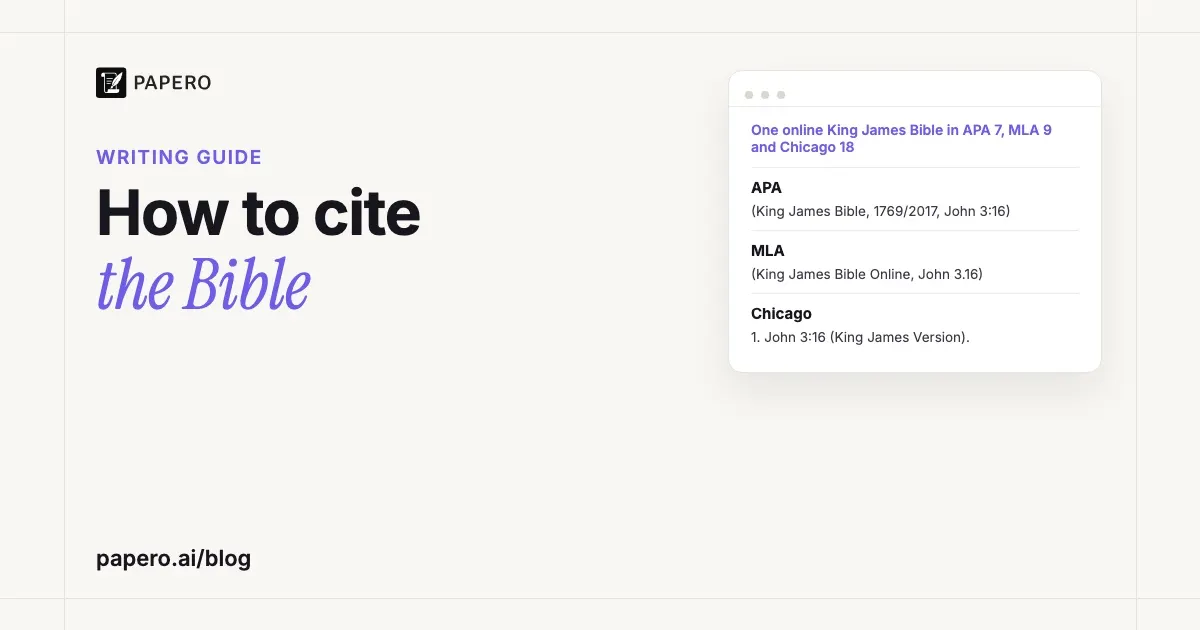
To cite the Bible, name the version you read and give the book, chapter and verse instead of a page number. APA 7 lists the version in the reference list and cites (King James Bible, 1769/2017, John 3:16). MLA 9 lists it in works cited: (King James Bible Online, John 3.16). Chicago leaves it out of the bibliography and names the version in the first note: John 3:16 (King James Version).
Key Takeaways
- Every style replaces the page number with book, chapter and verse. APA and Chicago put a colon between chapter and verse (John 3:16); MLA’s examples use a period (John 3.16).
- APA 7 gives the Bible a reference list entry with no author. This is new to the seventh edition: APA 6 said reference entries were “not required for major classical works”, religious ones included.
- MLA puts the title of the edition you used first in the works cited entry and names that title once, at your first citation (in your sentence or in parentheses).
- Chicago usually leaves the Bible out of the bibliography. Name the version once, in the first note or parenthetical reference, as a full name or an accepted abbreviation such as NRSV.
- Spell out book names in your sentences. Abbreviations such as Gen. and Ps. belong only inside parentheses and notes, and APA’s examples spell names out even there.
How to cite the Bible in APA, MLA and Chicago
A Bible citation needs the version you read, the book, the chapter and the verse. The table cites one source four ways: the King James Bible on the King James Bible Online website, the one example that both APA and the MLA use on their own pages, with John 3:16 as the passage. Chicago has no list entry for it.
| Style | Reference list or works cited entry | In-text citation or note |
|---|---|---|
| APA 7 | King James Bible. (2017). King James Bible Online. https://www.kingjamesbibleonline.org/ (Original work published 1769) | (King James Bible, 1769/2017, John 3:16) |
| MLA 9 | King James Bible Online, www.kingjamesbibleonline.org/. | First citation: (King James Bible Online, John 3.16). Later: (John 3.16) |
| Chicago 18, notes-bibliography | None: the Bible usually stays out of the bibliography | 1. John 3:16 (King James Version). |
| Chicago 18, author-date | None | (John 3:16, King James Version) |
The APA and MLA entries are the associations’ own examples. We built the two Chicago forms from the 18th-edition rules quoted by university library guides, because the manual’s text is behind a paywall.
The verse itself, as Project Gutenberg’s King James text prints it: “For God so loved the world, that he gave his only begotten Son, that whosoever believeth in him should not perish, but have everlasting life.”
How do you cite the Bible in APA?
APA 7 treats a Bible as a book or a web page with no author, depending on the copy you read. The version’s title goes in italics in the author position, followed by the year of that version, the publisher or website and, for a web page, the URL. In the text, give the title, the year and the book, chapter and verse: (King James Bible, 1769/2017, John 3:16).
APA’s page on religious works says they “are usually treated as having no author” and to “Use the year of publication of the version that you used”. When a version reprints an older one, both dates appear: the online King James Bible “was published in 2017 and is based on the version of the King James Bible published in 1769”. The reference ends with (Original work published 1769), and the in-text citation gives both years, earlier first, with a slash.
For the passage, APA says to “Cite a chapter or verse in the text using canonical numbering rather than page numbers”. Its example: The person vowed to “set me as a seal upon thine heart” (King James Bible, 1769/2017, Song of Solomon 8:6). In a narrative citation the version and year move into your sentence and the verse stays in parentheses, as in APA’s blog example: Jesus says to his disciples in the New American Bible (2002), “…” (John 13:34).
A print Bible follows APA’s book format: title, year, publisher. If the edition has an editor’s introduction and notes, APA’s rule for annotated works puts the editors first. An Oxford World’s Classics King James Bible, from the same publisher and year as the MLA’s model below, was “edited with an introduction and notes by Robert Carroll and Stephen Prickett” (its library record), so we would write: Carroll, R. P., & Prickett, S. (Eds.). (1998). The Bible: Authorized King James Version. Oxford University Press. Our guide to the APA reference page covers where each entry sits; one with no author is alphabetized by its title.
How do you cite the Bible in MLA?
MLA 9 starts the works cited entry with the title of the edition you used, in italics, then the version if the source names one, the publisher and the year. Your first in-text citation gives that title, a comma and the book, chapter and verse, with a period between chapter and verse. Later citations give only the book, chapter and verse.
MLA’s model for a print Bible, from an eighth-edition answer: The Bible. Authorized King James Version, Oxford UP, 1998. The title is italic “because you are referring to a published edition”; the version that follows is not.
For a website that holds one version, the MLA’s example lists the site by its title: King James Bible Online, www.kingjamesbibleonline.org/. The same answer then quotes three verses in a row:
Many passages from the Bible encourage human reproduction, from “Be fruitful, and multiply” (King James Bible Online, Gen. 1.22) and “And God Almighty bless thee, and make thee fruitful” (28.3) to “Thy wife shall be as a fruitful vine by the sides of thine house” (Ps. 128.3).
The first citation names the edition because you “indicate at first instance, in either your prose or a parenthetical citation, the first element of the works-cited-list entry”. The second quotation is also from Genesis, so it gives only “28.3”; the third moves to Psalms, so the book returns. The same eighth-edition answer says one entry covers the whole site, with no “separate works-cited-list entry for each hymn, chapter, or surah”.
A 2025 MLA answer, written for the ninth edition, adds a rule for single verses: once the book and chapter are clear, “you can spell out the word verse the first time and treat it as implied for the citations that follow”: (verse 6), then (21). Our guide to the MLA works cited page explains the containers and punctuation these entries use.
How do you cite the Bible in Chicago style?
Chicago cites the Bible in notes or parenthetical references and usually leaves it out of the bibliography. Give the book, chapter and verse, never a page number, with a colon between chapter and verse, and name the version in your first reference: 1. John 3:16 (King James Version). Later notes can drop the version.
Section 14.139 of The Chicago Manual of Style, 18th edition, quoted by the University of Notre Dame Australia’s library, says: “Parenthetical or note references to the Bible should include book (in roman and usually abbreviated), chapter, and verse”, never a page number, and “A colon is used between chapter and verse.” For the version (section 14.140), the same library’s guide says to use “either the complete name or an accepted abbreviation”: 2 Kgs 11:8 (New Revised Standard Version) or 2 Kgs 11:8 (NRSV). Marist College’s 18th-edition answer adds that later notes need not repeat the version.
Marist’s answer says scripture references “usually appear only in footnotes rather than in bibliographies.” The exception, in Australian Catholic University’s 18th-edition guide, is a study Bible with commentary, which goes in the bibliography as an edited book.
In author-date, the reference moves into parentheses in your sentence, as in (John 14:17, NRSV), the form Australian Catholic University’s notes-bibliography guide also allows in place of a footnote. Our guide to Chicago style footnotes covers note numbering and shortened notes for your other sources.
How do you cite a verse in the Bible in the text?
Write the book, the chapter and the verse where a page number would go. Spell the book’s name out in your sentence (Genesis, not Gen.), and abbreviate it inside parentheses or notes where the style allows. Separate chapter and verse with a colon in APA and Chicago and with a period in MLA. Use an en dash for a range of verses.
Genesis 1:1 and a later verse, from the King James Version, in each style:
| Style | First citation | A later verse from the same version |
|---|---|---|
| APA 7 | “In the beginning God created the heaven and the earth” (King James Bible, 1769/2017, Genesis 1:1). | “The LORD is my shepherd; I shall not want” (King James Bible, 1769/2017, Psalm 23:1). |
| MLA 9 | “In the beginning God created the heaven and the earth” (King James Bible Online, Gen. 1.1). | “The LORD is my shepherd; I shall not want” (Ps. 23.1). |
| Chicago 18, author-date | “In the beginning God created the heaven and the earth” (Gen 1:1, King James Version). | “For God so loved the world” (John 3:16). |
- Book names. The MLA’s examples abbreviate in parentheses (Gen. 1.22) and spell the book out in prose (“Matthew 7.7 tells us”), and Chicago’s library guides do the same. APA’s examples spell the name out even in parentheses (Song of Solomon 8:6).
- Chicago’s two sets of abbreviations. Chicago lists traditional abbreviations, which end in a period (1 Cor. 6:1–10), and shorter ones without the period (1 Cor 10:17). Pick one set and keep to it; your department may name one.
- Several passages. Separate references with semicolons, as in Notre Dame Australia’s Chicago example (Is 55:2; 1 Cor 10:17; 2 Cor 9:10).
If a passage runs to several lines of verse or prose, set it as a block quotation and put the citation after the final punctuation. Our guide to block quotes in APA, MLA and Chicago shows the length thresholds and indentation for each style.
Which version of the Bible should you name?
Name the version you actually read, in the words your copy uses: King James Version, New International Version, New Revised Standard Version Updated Edition. Translations differ in wording, and the books and numbering are not identical across versions, so the name tells your reader which text you quoted. Keep to one version unless you are comparing translations.
Each style handles the name a little differently:
- APA makes the version the title of the reference, in italics, with the year of that version. Mentioning a Bible in general takes no italics: APA’s examples are “the King James Version of the Bible, the New Revised Standard Version, Holy Bible, the Septuagint.” If you quote two translations, “create a separate reference list entry for each version.”
- MLA italicizes the title of the published edition, puts the version after it in roman type, and keeps general references plain: “the Old Testament”, but “The 1985 New Jerusalem Bible”. To compare translations from one app, name each translation in your sentence and cite the app once.
- Chicago sets the Bible and its books in roman type and names the version in the first reference. A Chicago Q&A suggests the roman type probably comes from the word itself: “bible” comes from the Greek biblia, “books”, so it works as the name of a collection rather than a publication title.
How do you cite an online Bible such as Bible Gateway?
Cite the version you read on the site, not the site alone. In APA the version is the title, followed by the year, the site’s name and the URL. In MLA, for a site that holds many translations, the title is The Bible, the translation is the version, and the website is a second container. Chicago still uses a note or parenthetical reference with the version and no bibliography entry.
The rows cite two translations on Bible Gateway. The APA rows use the latest copyright year each version page prints (NIV 2011, NRSVue 2021); the MLA rows give no year and name the operator the site’s footer names, HarperCollins Christian Publishing. We built them from APA’s web page pattern and the MLA’s Bible app answer.
| Version | APA 7 reference | MLA 9 works cited | Chicago note |
|---|---|---|---|
| NIV | New International Version. (2011). Bible Gateway. https://www.biblegateway.com/versions/New-International-Version-NIV-Bible/ | The Bible. New International Version. Bible Gateway, HarperCollins Christian Publishing, www.biblegateway.com/versions/New-International-Version-NIV-Bible/. | 1. John 3:16 (NIV). |
| NRSVue | New Revised Standard Version Updated Edition. (2021). Bible Gateway. https://www.biblegateway.com/versions/New-Revised-Standard-Version-Updated-Edition-NRSVue-Bible/ | The Bible. New Revised Standard Version Updated Edition. Bible Gateway, HarperCollins Christian Publishing, www.biblegateway.com/versions/New-Revised-Standard-Version-Updated-Edition-NRSVue-Bible/. | 1. John 3:16 (New Revised Standard Version Updated Edition). |
The MLA’s own answer, written for the eighth edition, cites the Bible Gateway app: The Bible. King James Version. Bible Gateway, version 42, Bible Gateway / Zondervan, 2016. In the text, the MLA names the verse in the sentence: Matthew 7.7 tells us, “…” (Bible).
How do you cite a study Bible or its notes?
Treat a study Bible as an edited book. APA puts the editors in the author position, MLA names the editor after the title, and Chicago lists a study Bible in the bibliography, unlike a plain Bible. The editors’ own notes take a page number.
APA’s example is a study Bible edited by Walter C. Kaiser Jr. and Duane Garrett. It cites the scripture as (Kaiser & Garrett, 2006, Genesis 1:20) and the editors’ note as (Kaiser & Garrett, 2006, footnote to Genesis 1:12, p. 4).
MLA’s example of an edited Bible: The New Jerusalem Bible. General editor, Henry Wansbrough, Doubleday, 1985. Australian Catholic University’s Chicago guide cites study Bibles “as chapters in edited books or edited books”. Our guide on how to cite a book shows the edited-book and chapter patterns in all three styles.
What about the Quran and other sacred texts?
The same rules carry over. APA cites an online Quran as a web page, the MLA cites Quran chapter and verse as (Qur’an 56.17–18), and Chicago treats other sacred works like the Bible: cited in the text or notes, as in Koran 19:17–21, and not in the bibliography. Name the translation you used.
APA’s blog says “an online version of the Qur’an would be cited using the webpage reference format.” An eighth-edition MLA answer skips the works cited entry for the Arabic original but adds: “If you provide a translation other than your own, include a works-cited-list entry for it.” Chicago covers other sacred works in section 14.141.
For detailed work in biblical or theological studies, Chicago points writers to The SBL Handbook of Style (section 14.138). Ask your department which guide it expects.
Where Papero fits
Papero is an AI writing workspace for students and researchers. It formats references in nine styles, including APA 7, MLA 9 and Chicago author-date, from sources you find in OpenAlex, look up by DOI, PMID, arXiv ID or ISBN, or enter by hand. It does not produce Chicago footnotes, so write Bible notes yourself with the pattern above.
A Bible fits the manual entry form as a book or a web page, and only the title is required, so the author can stay empty. Entered as a web page (title King James Bible, website King James Bible Online, 2017, the URL), Papero’s APA entry matches APA’s example except that the form has no field for an original publication date: add “(Original work published 1769)” and 1769/2017 yourself.
Type the verse in the “Text after” box with a leading comma (“, John 3:16”) to get (King James Bible, 2017, John 3:16), then italicize the title by hand, since Papero prints it in roman. The “Page or location” box prints as a page, which in APA gives “p. John 3:16”. Papero’s MLA entry for a web page puts the page title in quotation marks, unlike the MLA’s example above, so edit it to match that example. For Chicago author-date, type the reference into your sentence instead of citing a source, since the Bible stays out of the reference list.
The essay writing page shows how citing works while you draft, and the glossary defines the in-text citation and the reference list. You can start on the free plan.
Frequently Asked Questions
Do you italicize the Bible?
Not when you mean the Bible in general, or a version in general such as the King James Version. Italicize the title of the specific edition you cite: King James Bible in APA, The Bible or The New Jerusalem Bible in MLA. Chicago sets the Bible in roman type, and book names such as Genesis stay roman in all three styles’ examples.
Does the Bible go in the reference list, works cited or bibliography?
In APA 7 and MLA 9, yes: list the version you used, with no author. APA added this in its seventh edition. In Chicago, usually not: the Bible is cited in notes or parenthetical references and kept out of the bibliography, although a study Bible with commentary is listed as an edited book.
Do you use a colon or a period between chapter and verse?
APA and Chicago use a colon, as in John 3:16. The MLA’s examples use a period, as in Matthew 7.7 and Gen. 1.22, and a range of verses takes an en dash, as in the MLA’s Qur’an example (Qur’an 56.17–18). Whichever style you follow, give the verse instead of a page number: APA calls for “canonically numbered parts common across editions”, and Chicago’s rule says “never a page number”.
How do you cite two different Bible translations in one paper?
In APA, create a separate reference list entry for each version and put the right version in each in-text citation. In MLA, list each edition you quote, or name the translations in your sentences and cite the app or website that holds them once. In Chicago, name the version in the first note for each translation you quote.
Do you have to name the Bible version every time you cite a verse?
In APA, yes: each in-text citation gives the version’s title and year, unless your sentence already names them. In MLA, only the first citation names the edition; later ones give the book, chapter and verse. In Chicago, name the version in the first note or parenthetical reference, then give only the book, chapter and verse unless you switch versions.
Sources
- American Psychological Association, “Religious work references” (apastyle.apa.org, date created 2020, read November 2026 through the Internet Archive, capture of August 25, 2026): https://apastyle.apa.org/style-grammar-guidelines/references/examples/religious-work-references
- David Becker, “Citing classical and religious works”, APA Style blog (April 5, 2021, read November 2026 through the Internet Archive, capture of June 1, 2025): https://apastyle.apa.org/blog/citing-classical-religious-works
- MLA Style Center, “How do I cite verse numbers in scripture?” (January 29, 2025, ninth edition): https://style.mla.org/cite-verse-numbers-in-scripture/
- MLA Style Center, “If I am citing an online version of a sacred text and each chapter is on a separate web page, must each web page be listed in the works-cited list?” (eighth edition, November 28, 2018): https://style.mla.org/citing-web-pages-sacred-text/
- MLA Style Center, “How do I cite scriptural writings? And when do I use italics in referring to them?” (eighth edition, June 16, 2016): https://style.mla.org/scriptural-writings/
- MLA Style Center, “How do I cite a Bible app with more than one translation?” (eighth edition, March 23, 2018): https://style.mla.org/bible-app-multiple-translations/
- MLA Style Center, “How do you cite Qur’an chapters and verses?” (eighth edition, May 21, 2018): https://style.mla.org/citing-quran-chapters-and-verses/
- The Chicago Manual of Style Online, 18th edition, chapter 14 contents (sections 14.138–14.141 on biblical references, versions and other sacred works) and chapter 10 contents (sections 10.50–10.54 on biblical abbreviations), accessed November 2026: https://www.chicagomanualofstyle.org/book/ed18/part3/ch14/toc.html, https://www.chicagomanualofstyle.org/book/ed18/part2/ch10/toc.html
- The Chicago Manual of Style Online, Q&A on italics for the Bible and its books (Headlines and Titles of Works, read November 2026 through the Internet Archive, capture of February 14, 2024): https://www.chicagomanualofstyle.org/qanda/data/faq/topics/CapitalizationTitles/faq0097.html
- University of Notre Dame Australia Library, “How do I reference religious or classical works?” (AskUs answer quoting CMOS 18, section 14.139; accessed November 2026): https://askus.library.nd.edu.au/faq/212985
- University of Notre Dame Australia Library, “Religious & classical works”, Chicago Notes & Bibliography guide (accessed November 2026): https://library.nd.edu.au/instruction/referencing/chicago/religious
- Australian Catholic University Library, “Religious documents & texts”, Chicago A: 18th edition (accessed November 2026): https://libguides.acu.edu.au/chicago/religious_texts
- Marist College Library, “How do I cite the Bible in Chicago Style?” (updated to the 18th edition, last updated July 21, 2025): https://marist.libanswers.com/faq/409365
- Thompson Rivers University Library, “Scriptural References”, Chicago Manual of Style guide (17th-edition section numbers; accessed November 2026): https://libguides.tru.ca/chicago/scrip
- Australian Catholic University Library, “Religious scripture”, MLA guide (accessed November 2026): https://libguides.acu.edu.au/mla/religious-documents
- Project Gutenberg, The King James Version of the Bible, eBook #10 (most recently updated October 29, 2024): https://www.gutenberg.org/ebooks/10
- Bible Gateway, version information pages for the New International Version and the New Revised Standard Version Updated Edition (copyright notices; accessed November 2026): https://www.biblegateway.com/versions/New-International-Version-NIV-Bible/, https://www.biblegateway.com/versions/New-Revised-Standard-Version-Updated-Edition-NRSVue-Bible/
- The Bible: Authorized King James Version, Oxford University Press, 1998, Open Library record (ISBN 0192835254): https://openlibrary.org/books/OL18389656M
- The New Jerusalem Bible, Doubleday, 1985, Open Library record (ISBN 0385142641): https://openlibrary.org/books/OL2535288M