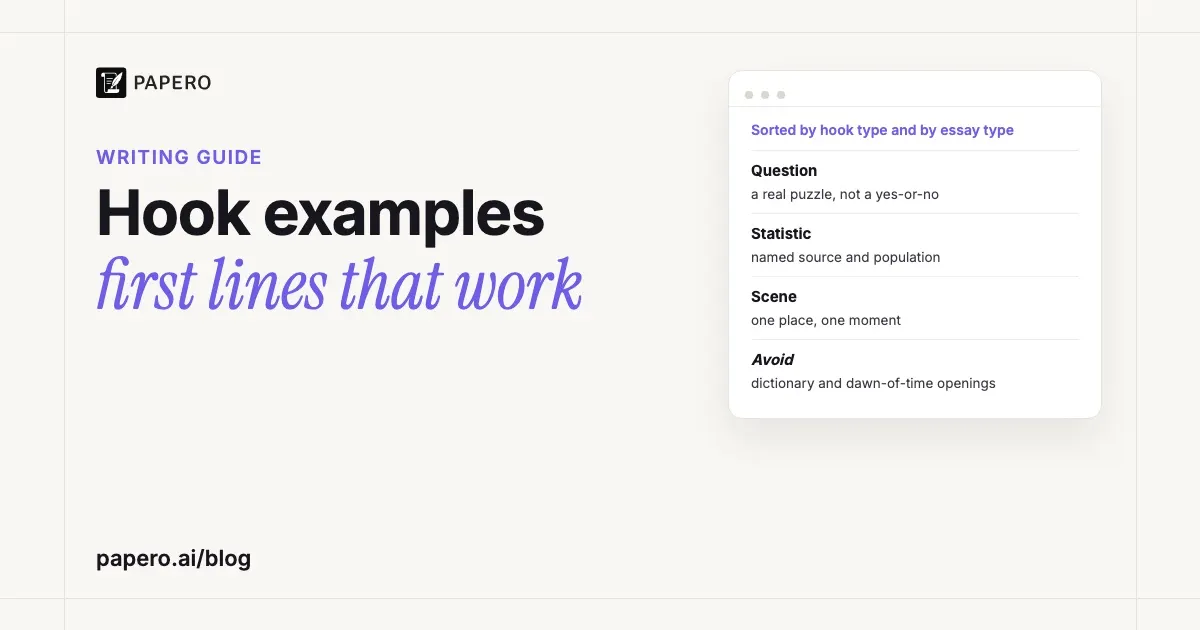
A hook is the first sentence or two of an essay: it makes the reader want the next sentence and points toward the thesis. For an essay on Frederick Douglass, one could be “Why does Douglass, denied almost every freedom, write most urgently about learning to read?” The hook examples below are sorted by hook type and by essay type.
Key Takeaways
- A good academic hook is specific, true and short, and leads to the question your thesis answers. It does not have to be dramatic.
- Pick the hook by essay type: a sourced fact or claim for an argument, a scene for a narrative, a puzzle in the text for a literary analysis, the problem itself for a research paper.
- A statistic needs a named source and the exact population it describes.
- UNC and Harvard both warn against dictionary definitions and “since the dawn of time” sweeps; they differ on how broad a first sentence may be.
- Write the hook last, once you know what the essay argues.
What makes a good hook for an essay?
A good hook is specific to your topic, true, and short, and it leads straight to the question your thesis answers. In academic writing it does not need to be dramatic. A sourced fact, a real puzzle in the text, or a precise scene does the job, because each one shows the reader why the question is worth an essay.
Harvard College Writing Center goes further: “You don’t have to ‘hook’ your readers with a dramatic promise (every other discussion of the topic you’re writing about is completely wrong!) or an exciting fact (the moon can reach 127 degrees Celsius!).” Its test is whether the introduction can “explain to your readers why your essay is going to be interesting to read”. The glossary entry on the hook has the short definition.
| Hook type | What it does | Suits | Watch out for |
|---|---|---|---|
| Question | Poses the puzzle the essay answers | Expository, literary analysis | Questions with an obvious answer |
| Fact or statistic | Shows the problem is bigger or stranger than expected | Argumentative, persuasive, research | A number with no named source |
| Anecdote | Tells a short story that carries the point | Narrative, personal, persuasive | A story that never reaches the thesis |
| Scene | Puts the reader in one place and moment | Narrative, college essays | Description with nothing at stake |
| Quotation | Lets a source say the key thing | Literary and rhetorical analysis | Famous inspirational quotes |
| Bold claim | States a position someone could dispute | Argumentative, persuasive | A claim the essay cannot prove |
| Misconception | Names a common belief, then corrects it | Expository, argumentative | A belief nobody actually holds |
| Problem or gap | Says what is unknown or unresolved | Research papers, reports | Claiming “no one has studied this” |
Hook examples by type
Each hook type below gets one to three examples and a note on why each works. Swap in your own topic, but keep what makes each one work: a specific detail, a source for every fact, and a clear line to a thesis.
Examples quoted from a source name it. Every other example was written for this guide: its people and scenes are invented, and its facts come from the sources named beside it or listed at the end.
Question hooks
- “Given all of the freedoms that were denied enslaved individuals in the American South, why does Frederick Douglass focus his attentions so squarely on education and literacy?” Source: UNC Writing Center, “Introductions”. Why it works: only this book raises it, and the thesis is the answer.
- “If a bachelor’s degree takes four years, why do federal graduation rates give students six?” Why it works: the answer, a 1990 law that set the 150 percent window (NCES), opens a real question about what the rate should measure.
Fact and statistic hooks
- “Of first-time, full-time students who began a bachelor’s degree at a four-year institution in fall 2014, 64 percent had finished it at that same institution six years later (National Center for Education Statistics, 2022).” Why it works: a precise number, a named source and the exact group.
- “In a Pew Research Center survey of 1,458 U.S. teenagers in autumn 2025, four in ten said they are online almost constantly.” Why it works: it says who was asked and when, so the reader can judge the number.
- “In 2014, a widely shared study reported that students who took notes on laptops did worse on conceptual questions than students who wrote by hand (Mueller & Oppenheimer, 2014).” Source: our argumentative essay outline. Why it works: a famous finding the essay goes on to complicate.
Anecdote and scene hooks
- “Learning about slavery in the American history course at Frederick Douglass High School, students studied the work slaves did, the impact of slavery on their families, and the rules that governed their lives. We didn’t discuss education, however, until one student, Mary, raised her hand and asked, ‘But when did they go to school?’” Source: UNC Writing Center’s sample anecdote about a high school history class. Why it works: one small moment shows the gap the essay will explore.
- “The first time I cited a source I had not read, my teacher asked me one question about it, and I had no answer.” Why it works: the lesson is implied, not stated.
- “At 2 a.m. in the week before finals, the only light on the library’s third floor came from laptop screens.” Why it works: time, place and topic in one image.
Quotation, claim and misconception hooks
- Douglass writes that “education and slavery were incompatible with each other.” Source: UNC Writing Center, quoting Douglass’s Narrative. Why it works: it quotes the author under study, not a famous person from outside the topic.
- “The five-paragraph essay teaches students to fill a shape, not to answer a question.” Why it works: many teachers would dispute it, so the essay must defend it.
- “A 64 percent graduation rate sounds like a 36 percent dropout rate. It is not: a student who transfers and graduates elsewhere counts as a noncompleter.” Why it works: it corrects a misreading with the source’s own definition.
Problem and gap hooks
- “Two well-designed studies of [topic] reached opposite conclusions, and this paper asks why.” Why it works: it follows Harvard’s advice to frame the question and say why it is worth answering. Fill the brackets only with a disagreement your reading has shown you.
Hook examples for each type of essay
The right hook depends on the essay type. Argumentative essays open with a sourced fact or a claim, persuasive essays with a fact or a scene the reader can picture, narrative and personal essays open inside a moment, expository essays open with something the reader recognizes, and research papers and literary analyses open with the problem they address.
Argumentative essay hooks
- “The widely shared 2014 study on laptop notes has not held up well in replications, and that is where an honest case for a ban has to start.” What it does: it opens with the other side’s best point, promising an answer. The replications are Morehead et al. (2019) and Urry et al. (2021), summarized in our argumentative essay outline.
- “Public libraries charge overdue fines to get books back, and the same fines keep away some of the readers who most need the books.” What it does: it states the tension the thesis will resolve. The second half is a claim the essay must then source.
Persuasive essay hooks
- “Imagine a sixteen-year-old whose alarm goes off in the dark.” Source: our persuasive essay example on school start times. What it does: “Imagine” marks the person as hypothetical, so nothing is invented.
- “About three in ten U.S. teenagers say they use an AI chatbot every day (Pew Research Center, 2025). A school policy that pretends otherwise is a policy students will ignore.” What it does: a fact, then the stakes for a school board.
Narrative essay hooks
- “At 11:40 on the night before the county science fair, I lifted the plastic wrap off forty paper cups and found forty cups of wet soil.” Source: our narrative essay example. What it does: it starts mid-problem, at an exact time.
- “I failed my driving test before I had left the parking lot.” What it does: the failure first; the reader reads on to learn how.
Expository essay hooks
- “Most students prepare for an exam the same way: one long session the night before.” Source: our expository essay example on spaced study. What it does: a habit the reader recognizes, which the essay explains.
- “A citation does two jobs at once: it credits another writer, and it lets the reader check the claim.” What it does: it names a familiar habit and promises to explain its purpose.
Research paper hooks
- “Federal graduation rates count a student who transfers and finishes elsewhere as a noncompleter, so they cannot say how many students eventually earn a degree.” What it does: a gap in how something is measured.
- Darwin’s On the Origin of Species (first edition) begins: “When on board H.M.S. ‘Beagle,’ as naturalist, I was much struck with certain facts in the distribution of the inhabitants of South America”. What it does: a scientific argument that opens with the observation behind it.
College application and personal essay hooks
Purdue OWL’s advice on personal statements: “The lead or opening paragraph is generally the most important. It is here that you grab the reader’s attention or lose it.”
- “My grandmother kept every receipt she was ever handed, and the summer I turned fifteen, sorting them became my job.” What it does: a specific job in a specific summer, ready to become a lesson.
- “I learned to cook because my brother refused to eat anything green.” What it does: character through action.
Literary analysis hooks
- “Pride and Prejudice opens with a ‘truth universally acknowledged’, that a rich single man must want a wife, and its next sentence shows that the people who believe it are the neighbors with daughters.” What it does: it notices a gap between what the text says and what it shows.
- “Douglass clearly asserts that slave owners went to great lengths to destroy the mental capacities of slaves, yet his own life story proves that these efforts could be unsuccessful.” Source: UNC Writing Center’s “puzzling scenario” example. What it does: a contradiction the thesis will explain.
Famous opening lines and what they teach
Famous first lines show each hook type at its best, but they come from novels, pamphlets and public essays, not class essays, so borrow the move rather than the sentence. Each line below is copied from the Project Gutenberg edition listed in the sources.
| Opening | Work | Hook type | What to borrow |
|---|---|---|---|
| “It is a truth universally acknowledged, that a single man in possession of a good fortune must be in want of a wife.” | Jane Austen, Pride and Prejudice | Bold claim, meant ironically | A claim the rest of the work tests |
| “Call me Ishmael.” | Herman Melville, Moby Dick | Voice | A short first sentence before longer ones |
| “It was the best of times, it was the worst of times” | Charles Dickens, A Tale of Two Cities | Paradox | Two opposites held together |
| “Happy families are all alike; every unhappy family is unhappy in its own way.” | Leo Tolstoy, Anna Karenina, tr. Constance Garnett | Generalization | A general claim narrow enough to argue with |
| “It is a melancholy object to those, who walk through this great town, or travel in the country, when they see the streets, the roads, and cabbin-doors crowded with beggars of the female sex” | Jonathan Swift, A Modest Proposal (1729), a satire | Scene | A persuasive essay that starts with what the reader has seen |
| “These are the times that try men’s souls.” | Thomas Paine, The American Crisis | Bold claim | Urgency in eight words |
| “That government is best which governs least”, quoted, then pushed to “That government is best which governs not at all” | Henry David Thoreau, On the Duty of Civil Disobedience | Quotation, then a turn | Quote a view in order to go past it |
Weak hooks rewritten: before and after
Most weak hooks fail because they could open any essay: a dictionary definition, a sweep across all of history, a statistic with no source, a question with an obvious answer, a famous quotation or an announcement. The fix is the same each time: replace the general sentence with one that only your essay could use, and give any number its source.
| Problem | Weak | Stronger |
|---|---|---|
| Dictionary definition | “Education is defined as the process of receiving instruction.” | “In this essay, ‘remote learning’ means a course with no in-person meetings at all; hybrid courses are left out.” |
| Since the dawn of time | “Since the dawn of time, people have valued a college degree.” | “Of first-time, full-time students who began a bachelor’s degree at a four-year institution in fall 2014, 64 percent finished at the same institution within six years (National Center for Education Statistics, 2022).” |
| Unsourced statistic | “Studies show that 90 percent of teens are addicted to their phones.” | “Four in ten U.S. teens say they are online almost constantly (Pew Research Center, 2025).” |
| Obvious question | “Have you ever wondered what freedom means?” | “Why does Douglass, denied almost every freedom, write most urgently about learning to read?” |
| Inspirational quote | “As the saying goes, knowledge is power.” | “In his Narrative, Douglass says the mistress who stopped teaching him to read had come to see that ‘education and slavery were incompatible with each other.’” |
| Announcement | “This essay will discuss teenagers and AI.” | “About three in ten U.S. teens say they use an AI chatbot every day (Pew Research Center, 2025), so the question for schools is how students use them, not whether.” |
The weak versions were written for this guide; the “90 percent” is invented on purpose.
Which hooks do professors dislike?
The openings writing centers warn against are the ones that could start any essay: dictionary definitions, “since the dawn of time” sweeps, broad funnel openings, famous inspirational quotes, a restated assignment question, and statistics with no source. Instructors read many essays on the same prompt, so these openings are the ones they see most and value least.
- Dictionary definitions. UNC: “Anyone can look a word up in the dictionary and copy down what Webster says.” Harvard: “Avoid beginning with a dictionary definition of a term or concept you will be writing about.” UNC suggests your own definition instead, as in the table’s first row.
- “Since the dawn of time”. Of the “dawn of man” introduction, UNC says: “Instructors often find them extremely annoying.” Harvard’s example of a too-general first sentence is “Since the dawn of time, people have been telling love stories.”
- Famous quotations. UNC warns that “quotes from famous people” and “inspirational quotes” “may not work well for an academic paper”; its own example quotes the author under study.
- Unsourced statistics. Middle Tennessee State University’s writing center builds the condition into the advice: “Use (and cite) a surprising statistic or fact.”
- The restated question. The instructor who wrote it does not need it repeated back, UNC notes.
UNC offers, as one strategy, to “start off with a big picture sentence or two and then focus in”, while Harvard says to “avoid writing a ‘funnel’ introduction in which you begin with a very broad statement about a topic and move to a narrow statement”. The two meet on scale: UNC adds that “even a ‘big picture’ opening needs to be clearly related to your topic.” Our reading: start no wider than the question needs. An essay on Douglass can open on education in 19th-century America; it should not open on human history.
How do you write a hook?
Write your thesis first, then choose the hook type that suits the essay and the reader, draft two or three options, and keep the one that is most specific and that you can source. UNC suggests writing the introduction last, once the body shows what you actually argue.
- Know the answer first. A hook points at a thesis; our thesis statement examples show the claims a hook leads up to.
- Choose by essay type and reader: a statistic for a board that respects data, a scene for readers who have lived the problem.
- Draft three, keep one. Write a question, a fact and a scene, and keep whichever only your essay could use.
- Check that it is true. Every number gets a source and its population; every anecdote you present as real happened.
- Write the bridge. The next sentence says why the hook matters to the question, so the thesis does not arrive out of nowhere.
A full introduction written for this guide:
Of first-time, full-time students who began a bachelor’s degree at a four-year institution in fall 2014, 64 percent finished it at that same institution within six years (National Center for Education Statistics [NCES], 2022). The figure looks like a count of how many students earn degrees, but it measures something narrower: under the federal definition, a student who transfers and graduates somewhere else is a noncompleter (NCES, 2022). Colleges should report a second rate alongside the federal one, the share of their starting students who earn a degree anywhere, because the current number cannot tell a student who left from a student who moved on.
What it does: the hook is a sourced number, the bridge shows what the number hides, and the thesis proposes a fix. Each body paragraph then opens with one reason, as in our topic sentence examples, and the ending can come back to the 64 percent, the “return to the opening image” option in our guide on how to write a conclusion. For whole introductions in other disciplines, see our essay introduction examples.
Where Papero fits
Papero is an AI writing workspace for students and researchers. Describe your essay and it builds a two-level outline with a prompt under every heading, so the introduction’s prompt can hold your thesis and the hook you plan to use before you draft the paragraph.
When a hook cites research, one click finds scholarly papers for the sentence you are writing, and Review’s Claims check finds sentences that need a citation and offers papers to cite. Figures from agencies such as NCES or Pew come from their own sites; Papero’s search covers scholarly papers. The Rewrite menu can shorten a long opening or make it more academic. Papero drafts only from your outline and prompts, so the hook and the argument stay yours. The essay writing page shows the whole process.
Frequently Asked Questions
What is a good hook sentence for an essay?
One that is specific to your topic, true, and leads to your thesis. For an essay on graduation rates, “Of first-time, full-time students who began a bachelor’s degree at a four-year institution in fall 2014, 64 percent finished at the same institution within six years” works: it is precise, sourced to the National Center for Education Statistics, and raises the essay’s question.
How long should a hook be?
Usually one or two sentences. The hook only has to make the reader want the next sentence; the context and the thesis do the rest. In a narrative or personal essay an anecdote can run a few sentences, as long as it reaches the point quickly.
Can you start an essay with a question?
Yes, if the question is a real puzzle and the essay answers it. The UNC Writing Center lists “a thought-provoking question” as an opening strategy. Avoid questions with an obvious answer, such as “Have you ever wondered why education matters?”
Do research papers need a hook?
Not in the popular sense. A research paper opens with the problem, why it matters and what is not yet known. Harvard College Writing Center says you do not need a dramatic promise or an exciting fact to hook readers; explain why the question is worth answering. A precise, sourced fact about the problem is as close to a hook as most papers need.
Can you use a quote as a hook?
Yes, if it comes from a source you are analyzing and bears on your argument. The UNC Writing Center recommends “a provocative quotation that is closely related to your argument” and says quotes from famous people and inspirational quotes may not work well in an academic paper. Cite it as you would in the body.
Sources
- The Writing Center, University of North Carolina at Chapel Hill, “Introductions” (writingcenter.unc.edu, accessed November 2026): https://writingcenter.unc.edu/tips-and-tools/introductions/
- Harvard College Writing Center, “Introductions” (writingcenter.fas.harvard.edu, read via the Internet Archive capture of 23 September 2026, accessed November 2026): https://writingcenter.fas.harvard.edu/introductions
- Middle Tennessee State University Writing Center, “The Art of the Introduction” (handout, accessed November 2026): https://w1.mtsu.edu/writing-center/handouts/printable_handouts/16.The_Art_of_the_Introduction.pdf
- Purdue Online Writing Lab, “Writing the Personal Statement” (owl.purdue.edu, accessed November 2026): https://owl.purdue.edu/owl/job_search_writing/preparing_an_application/writing_the_personal_statement/index.html
- National Center for Education Statistics, “Undergraduate Retention and Graduation Rates”, Condition of Education (U.S. Department of Education, last updated May 2022, accessed November 2026): https://nces.ed.gov/programs/coe/indicator/ctr
- Pew Research Center, “Teens, Social Media and AI Chatbots 2025” (9 December 2025, accessed November 2026): https://www.pewresearch.org/internet/2025/12/09/teens-social-media-and-ai-chatbots-2025/
- Project Gutenberg editions quoted (accessed November 2026): Jane Austen, Pride and Prejudice; Herman Melville, Moby Dick; Or, The Whale; Charles Dickens, A Tale of Two Cities; Leo Tolstoy, Anna Karenina, translated by Constance Garnett; Jonathan Swift, A Modest Proposal; Thomas Paine, The American Crisis; Henry David Thoreau, On the Duty of Civil Disobedience; Charles Darwin, On the Origin of Species, first edition; Frederick Douglass, Narrative of the Life of Frederick Douglass, an American Slave