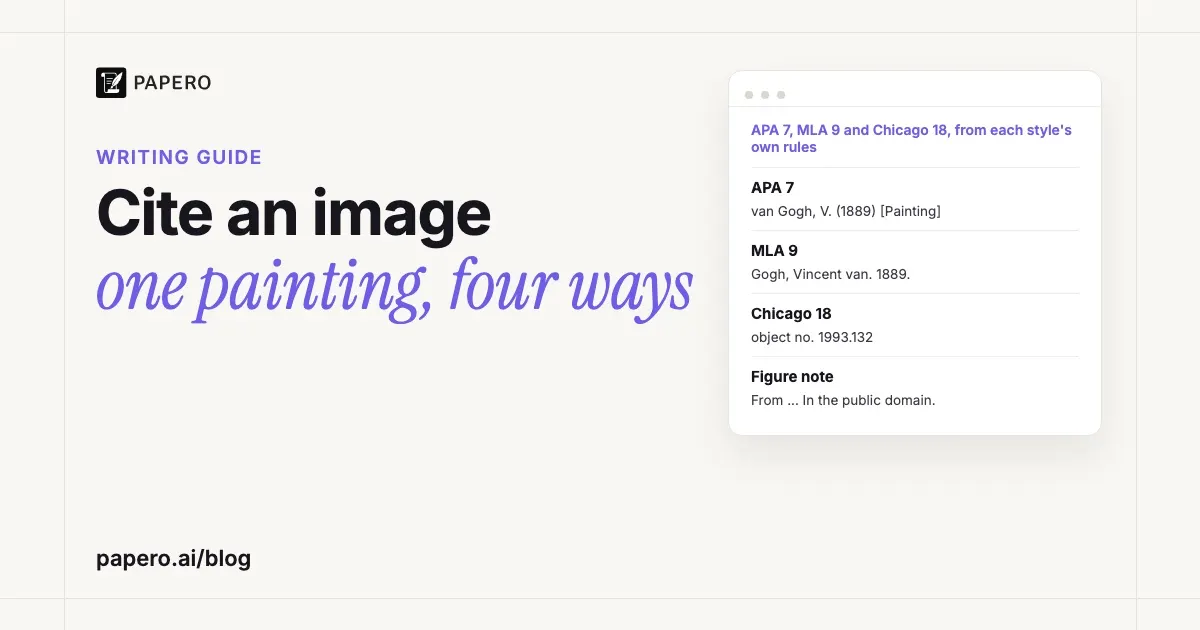
To cite an image, give its creator, its title (or a description if it has none), the year it was made and where you saw it. In APA 7: van Gogh, V. (1889). Wheat field with cypresses [Painting]. The Metropolitan Museum of Art, New York, NY, United States, then the page’s URL. In the text: (van Gogh, 1889). A reproduced image needs a credit in its caption or figure note.
Key Takeaways
- Every style needs the creator, a title or description, the date of the work and the place you found it. Cite the website that hosts the image, never Google Images.
- APA 7 adds the medium in square brackets after the title, such as [Painting] or [Photograph], and names the museum and its city as the source.
- MLA 9 and Chicago notes put the year the work was made after the title. Chicago 18 says an artwork can usually be identified in your text alone, with no note at all.
- A reproduced image needs a credit beside it, in APA a figure note starting “From” or “Adapted from”. A citation is not permission to reuse the image.
- A photo you took needs only a caption. An AI-generated image is credited to the tool and the company that made it.
How to cite an image in APA, MLA and Chicago
The table cites one real image four ways: Vincent van Gogh’s Wheat Field with Cypresses (1889), seen in the online collection of the Metropolitan Museum of Art, object number 1993.132. The patterns come from APA’s artwork page, the MLA Style Center and Chicago 18th-edition library guides.
| Style | List entry | In the text or note |
|---|---|---|
| APA 7 | van Gogh, V. (1889). Wheat field with cypresses [Painting]. The Metropolitan Museum of Art, New York, NY, United States. https://www.metmuseum.org/art/collection/search/436535 | (van Gogh, 1889) or van Gogh (1889) |
| MLA 9 | Gogh, Vincent van. Wheat Field with Cypresses. 1889. The Met, Metropolitan Museum of Art, www.metmuseum.org/art/collection/search/436535. | (Gogh) |
| Chicago 18, notes-bibliography | van Gogh, Vincent. Wheat Field with Cypresses. 1889. Oil on canvas, 73.2 × 93.4 cm. Metropolitan Museum of Art, New York. Object no. 1993.132. https://www.metmuseum.org/art/collection/search/436535. | 1. Vincent van Gogh, Wheat Field with Cypresses, 1889, oil on canvas, 73.2 × 93.4 cm, Metropolitan Museum of Art, New York, object no. 1993.132, https://www.metmuseum.org/art/collection/search/436535. |
| Chicago 18, author-date | van Gogh, Vincent. 1889. Wheat Field with Cypresses. Oil on canvas, 73.2 × 93.4 cm. Metropolitan Museum of Art, New York. Object no. 1993.132. https://www.metmuseum.org/art/collection/search/436535. | (van Gogh 1889) |
APA writes the title in sentence case in the reference, Wheat field with cypresses, but in title case in a figure note, where “With” takes a capital, as in APA’s own sample note: “Perspective Change With Noncoplanar Points”. MLA and Chicago keep “with” in lowercase. APA and Chicago start with “van Gogh”, while MLA alphabetizes a Dutch name by its main part, “Gogh, Vincent van”, and keys the in-text citation to that form, so (Gogh). The MLA Style Center gave that rule for the 8th edition; in your own sentences (not in citations), you still write “Van Gogh” when the surname stands alone.
How do you cite an image in APA?
APA 7 cites an image like any other reference: the creator, the year, the title in italics, a description of the medium in square brackets, then the source. For artwork in a museum, the source is the museum’s name and location plus a link to the work’s page. For a photo on a website, it is the site’s name and URL. The in-text citation is the creator and the year.
APA’s artwork page applies one format to “paintings, sculptures, photographs, prints, drawings, digital art, crafts, and installations.” The bracketed description is flexible: [Painting], [Oil painting] and [Oil on canvas] are all correct. APA’s own example is a Flickr photo of a sled dog:
Denali National Park and Preserve. (2013). Lava [Photograph]. Flickr.
https://www.flickr.com/photos/denalinps/8639280606/
The in-text citation is (Denali National Park and Preserve, 2013). For a stock photo or clip art, APA lets the licence decide: if it says “no attribution required”, you give no reference, citation or attribution at all.
How do you cite an image in MLA?
MLA 9 builds the entry from its core elements: the creator, the title in italics or a description if the image has no title, the year the work was made, then the website or database that holds it and the URL. For a work you saw in a gallery, name the museum and its city instead. In the text, cite the first element of the entry, usually the creator’s surname.
The punctuation after the year matters. The MLA Style Center cites a painting seen in person as Bearden, Romare. The Train. 1975, Museum of Modern Art, New York, with a comma, because 1975 fills the publication-date slot. Online it reads Bearden, Romare. The Train. 1975. MOMA, then the URL: the period marks 1975 as the year the work was made, not the page’s date.
For an image you found through Google Images, click through to the site that posted it and cite that site. The MLA says the thumbnail in the search results “is not sufficient.” The MLA treats Wikimedia Commons as such a site, a container like a museum website. Its March 2025 example:
Bruegel, Pieter, the Elder. Children’s Games. 1560. Wikimedia,
commons.wikimedia.org/wiki/File:Pieter_Bruegel_the_Elder_-_Children%E2%80%99s_Games_-_Google_Art_Project.jpg.
Link the file’s commons.wikimedia.org page, not the upload.wikimedia.org image file. Our guide to the MLA works cited page covers the core elements for every other kind of source.
How do you cite an image in Chicago?
The Chicago Manual of Style, 18th edition, says information about paintings, photographs and sculptures can usually go in your text rather than in a note or bibliography. When you need a formal citation, give the artist, the title in italics and the date, then the medium, the size and the place that holds the work, adding a URL for a work you saw online (section 14.133).
In practice, “Van Gogh painted Wheat Field with Cypresses in 1889, and it is in the Metropolitan Museum of Art” may be all a Chicago paper needs. Later notes shorten to the artist’s surname and the title: 2. van Gogh, Wheat Field with Cypresses. Our guide to Chicago footnotes and short notes covers numbering and placement.
Author-date moves the year straight after the name, as in CSU Channel Islands’ model entry, Monet, Claude. 1906. Water Lilies.
How do you cite an image you put in your paper?
When you reproduce an image, the credit sits next to it. APA gives the figure a bold number and an italic title above it, and a note below, opening with Note., whose credit starts “From” for an image reproduced as it is, or “Adapted from” for one you changed, and ends with its copyright or licence. MLA labels the image “Fig. 1.” (its own examples also spell out “Figure 1.”) with a caption below. Chicago captions usually start “Figure 1.”
This is the note under a graph in APA’s sample figures, reprinted from a journal article:
Note. [Explanation of the graph.] From “Large Continuous Perspective Change With Noncoplanar Points Enables Accurate Slant Perception,” by X. M. Wang, M. Lind, and G. P. Bingham, 2018, Journal of Experimental Psychology: Human Perception and Performance, 44(10), p. 1513 (
https://doi.org/10.1037/xhp0000553). Copyright 2018 by the American Psychological Association.
For a public-domain work, the copyright line becomes “In the public domain”, as in APA’s sample map, which is “Adapted from” a U.S. Census Bureau map. Reproduced in an APA paper, our van Gogh painting looks like this (the figure title is ours to choose):
Figure 1
Wheat Field With Cypresses, Painted in 1889
[the image]
Note. From Wheat Field With Cypresses [Painting], by V. van Gogh, 1889, The Metropolitan Museum of Art (
https://www.metmuseum.org/art/collection/search/436535). In the public domain.
APA says the copyright attribution replaces the in-text citation, and the image still gets a reference list entry. Add “Reprinted with permission” or “Adapted with permission” only if you asked for and received permission. For the layout of the number, title and notes, see our guide to APA tables and figures.
In MLA, the caption reads: Fig. 1. Vincent van Gogh, Wheat Field with Cypresses, 1889, The Met, Metropolitan Museum of Art, www.metmuseum.org/art/collection/search/436535. MLA’s 2025 guidance, citing section 1.7 of the MLA Handbook, lets you give the full citation in the caption or in a works-cited entry instead. For Chicago, Red Deer Polytechnic’s 18th-edition guide notes there is no set caption format and suggests writing the caption like a footnote, starting “Figure 1.” The glossary entry on the figure caption compares where each style places it.
How do you cite a photo you took yourself?
Usually you do not cite it. APA’s Publication Manual says that for your own unpublished photos, “no citation or copyright attribution is required in the figure note.” The MLA says that, unless told otherwise, readers assume you made the images in your paper. Give your photo a figure number and caption as usual. If you published it online, cite that version like any other image.
The MLA’s example is a photo you took of the Oculus in New York, captioned only “Figure 1. Oculus. New York City.” with no works-cited entry, because the caption says enough.
How do you cite an image with no author, title or date?
Fill each gap in a fixed way and never invent the missing detail. APA moves the title into the author position when there is no creator, writes (n.d.) when there is no date, and describes an untitled image in square brackets. MLA starts with a description in place of a missing title and adds the date you viewed a page that shows no date of its own.
APA’s missing-information page gives these patterns, adapted here for images:
| Missing | APA reference pattern | In-text citation |
|---|---|---|
| Creator | Title [Photograph]. (Date). Source. | (Title, year) |
| Date | Creator. (n.d.). Title [Photograph]. Source. | (Creator, n.d.) |
| Title | Creator. (Date). [Description of image]. Source. | (Creator, year) |
| Creator, date and title | [Description of image]. (n.d.). Source. | ([Description of image], n.d.) |
The MLA’s example of an undated image is a jigsaw-puzzle picture of the Mona Lisa: Jigsaw puzzle image of Leonardo da Vinci’s Mona Lisa. Liberty Puzzles, www.libertypuzzles.com/wooden-jigsaw-puzzles/mona-lisa. Accessed 25 Sept. 2018. For an image from a database, the MLA says you do not need to hunt for an artist the database leaves out: give only the information you are given. Our guide to the APA reference list gives the same missing-information table for every kind of source.
How do you cite images in PowerPoint or Google Slides?
Cite an image on a slide as you would in a paper. APA makes the figure number and title optional on a slide, but requires a note with the copyright attribution when the licence asks for credit. MLA, in an 8th-edition answer, gives full details in the caption of an image you only show, or a short caption keyed to a works-cited list on your last slide.
APA’s clip-art page says images and clip art that come with Microsoft Word and PowerPoint can be used without attribution, because buying the program buys a licence to use them. Pictures found through PowerPoint’s online image search, like stock images from sites such as Pixabay or Flickr, follow their own licences; APA notes that “many (but not all)” Creative Commons images require attribution, and the rules apply “regardless of whether the image costs money.” Nothing in the rules depends on the program, so the same caption and reference work in Google Slides.
How do you cite an AI-generated image?
Credit the tool and its maker, and say what you asked for. APA’s September 2025 guidance says to state in the figure note that you used AI to make a figure, and to cite the tool in the reference list, with the company as author. MLA’s 2025 example puts the prompt, the tool, its version, the company, the date and the share link in the figure caption.
The MLA’s caption reads:
Fig. 1. “Create an expressionist-style image of two people standing on a beach looking at the ocean” prompt, DALL-E, version 3, OpenAI, 23 Sept. 2024, chatgpt.com/share/66f1c3a3-3f90-8000-9750-82c57c4a6592.
APA keeps the prompt out of the reference and describes it in your text: “I provided the following prompt to Gemini (Google, 2025): “Please create an image of students in a classroom studying grammar concepts.”” In APA’s example that sentence cites a shared chat. For an AI-made figure, APA cites the tool in general, because “AI itself cannot be an author”: Google. (2025). Gemini 2.5 Flash [Large language model]. https://gemini.google.com Chicago 18 covers the subject in section 14.112, “Citing AI-generated content”, and the Red Deer Polytechnic guide suggests a caption that follows the figure number with “Image generated by”, then the tool, its version, the date and the prompt. Our guide to citing ChatGPT and other AI tools covers AI chats in each style.
Does citing an image give you permission to use it?
No. A citation tells readers where an image came from; permission depends on the image’s copyright or licence. The MLA says reproducing someone else’s copyrighted image needs permission from the rights holder. Public-domain works, like the Met painting above, still get a credit but need no permission.
A Creative Commons image comes with its terms attached, which is why APA’s Flickr note ends by naming the licence, CC BY 2.0. Auckland University of Technology’s APA guide draws one firm line: in a thesis or other published work, you must get the copyright holder’s permission for a figure you did not create, unless it is in the public domain or openly licensed.
Where Papero fits
Papero is an AI writing workspace for students and researchers. In a Papero document, Insert image on the toolbar, the Image item in the “/” menu, or dropping or pasting a picture turns it into a numbered figure with a caption. The label follows the document’s citation style: “Figure 1” above the image in APA, “Fig. 1.” below it in MLA, and “Figure 1.” below it in the other styles. Each image has an alt-text field and an Add note button for the figure note where an APA credit goes. Adding images needs a confirmed email address.
Papero’s manual source types are article, book, book chapter, web page and report, with none for an artwork or a photograph, so type the reference and the credit under the figure yourself, from the patterns above. Papero formats Chicago author-date, not footnotes, and eight other styles, including APA 7 and MLA 9. The research paper writing page shows the workflow, and you can sign up free.
Frequently Asked Questions
Do you need to cite images from Google Images?
Yes, but you cite the website where the image was posted, not Google. Click through to the page that hosts the image and cite that site with its URL. The MLA says a thumbnail in the search results is not enough to cite, and APA and Chicago likewise name the site or museum that holds the image as its source.
Do you italicize the title of an image?
Yes, in APA, MLA and Chicago the title of a painting, photograph or other standalone image is set in italics. APA writes it in sentence case in the reference list and in title case in a figure note. An untitled image gets a plain description instead: in square brackets in APA, and without italics or quotation marks in MLA.
Do you need to cite a public domain image?
Yes. Public domain removes the need for permission, but readers still need to know where the image came from. APA ends the figure note of a public-domain image with the words “In the public domain”, and MLA and Chicago give the usual caption or entry.
Do you cite clip art from PowerPoint?
Not in APA. The APA says images and clip art that come with Microsoft Word and PowerPoint can be used without attribution, because the program’s licence covers them. MLA’s older guidance gives a works-cited form with PowerPoint as the container if you discuss the clip art itself.
Sources
- American Psychological Association, “Artwork references” (apastyle.apa.org, created 2020, read November 2026 through the Internet Archive): https://apastyle.apa.org/style-grammar-guidelines/references/examples/artwork-references
- American Psychological Association, “Clip art or stock image references” (apastyle.apa.org, created 2020, read November 2026 through the Internet Archive): https://apastyle.apa.org/style-grammar-guidelines/references/examples/clip-art-references
- American Psychological Association, “Sample figures” (apastyle.apa.org, Internet Archive capture of October 14, 2026): https://apastyle.apa.org/style-grammar-guidelines/tables-figures/sample-figures
- American Psychological Association, “Figure setup” (apastyle.apa.org, last updated December 2021): https://apastyle.apa.org/style-grammar-guidelines/tables-figures/figures
- American Psychological Association, “Missing reference information” (apastyle.apa.org, read November 2026 through the Internet Archive): https://apastyle.apa.org/style-grammar-guidelines/references/missing-information
- Timothy McAdoo, Samantha Denneny and Chelsea Lee, “Citing generative AI in APA Style: Part 1 - Reference formats” (APA Style blog, September 9, 2025): https://apastyle.apa.org/blog/cite-generative-ai-references
- MLA Style Center, “How do I cite a museum image that I viewed in person or online?” (8th-edition guidance, September 2016): https://style.mla.org/citing-images-viewed-firsthand-or-online/
- MLA Style Center, “How do I cite an image found through an online search engine like Google Images?” (January 2017, updated September 2024): https://style.mla.org/citing-online-images/
- MLA Style Center, “How do I cite a Wikimedia picture of an artwork?” (March 2025): https://style.mla.org/cite-artwork-wikimedia/
- MLA Style Center, “How do I credit myself as the author of a photograph?” (June 2022): https://style.mla.org/crediting-your-own-photos/
- MLA Style Center, “How do I cite a photo or other image reproduced in a website article?” (8th-edition guidance, March 2019): https://style.mla.org/citing-images-from-web-sites/
- MLA Style Center, “How do I cite photographs or other images that I use in a PowerPoint presentation or web project?” (8th-edition guidance, May 2019): https://style.mla.org/image-citations-slides-web-project/
- MLA Style Center, “How do I cite clip art from a computer program like PowerPoint?” (8th-edition guidance, October 2017): https://style.mla.org/citing-clip-art/
- MLA Style Center, “How should I format captions for figures that I include in my paper?” (June 2017, updated November 2023): https://style.mla.org/formatting-figure-captions/
- MLA Style Center, “If I am citing an image from a database, and no information is provided about the artist, do I need to seek out the information for my citation?” (8th-edition guidance, July 2018): https://style.mla.org/info-missing-from-database-image/
- MLA Style Center, “How do I cite a work by an author with a Dutch name that includes the word van?” (8th-edition guidance, April 2019): https://style.mla.org/citing-dutch-names/
- MLA Style Center, “How do I cite generative AI in MLA style? (Updated and Revised)” (August 13, 2025, updated October 2025): https://style.mla.org/citing-generative-ai-updated-revised/
- The Chicago Manual of Style, 18th edition, chapter 14 contents (sections 14.112, “Citing AI-generated content”, and 14.133, “Citing paintings, photographs, and sculpture”): https://www.chicagomanualofstyle.org/book/ed18/part3/ch14/toc.html
- University of Queensland Library, “Artwork”, Chicago 18th edition notes and bibliography guide (last updated October 15, 2026): https://guides.library.uq.edu.au/referencing/chicago-18th-edition-notes-and-bibliography/artwork
- Australian Catholic University Library, “Images & figures”, Chicago A: 18th edition guide (last updated September 18, 2026): https://libguides.acu.edu.au/chicago/images
- Red Deer Polytechnic Library, “Image or Work of Art”, Chicago Citation Style 18th Edition guide (last updated August 25, 2026): https://guides.rdpolytech.ca/chicago18/citation/image
- California State University Channel Islands Writing & Multiliteracy Center, “Chicago Style: Author/Date” handout (updated February 2026): https://www.csuci.edu/wmc/pdf/citations/wmc-chicago-authdate-18threv2026.pdf
- Royal Roads University Writing Centre, “How should I reference personal photographs in APA Style?” (quoting the Publication Manual, 7th ed., p. 230; last updated July 16, 2026): https://writeanswers.royalroads.ca/faq/199066
- Auckland University of Technology Library, “Figures”, APA 7th referencing guide (last updated August 7, 2026): https://aut.ac.nz.libguides.com/APA7th/figures
- The Metropolitan Museum of Art, Wheat Field with Cypresses, Vincent van Gogh, 1889, object number 1993.132 (collection record and Open Access API, read November 1, 2026): https://www.metmuseum.org/art/collection/search/436535
- Wang, X. M., Lind, M., & Bingham, G. P. (2018). Large continuous perspective change with noncoplanar points enables accurate slant perception. Journal of Experimental Psychology: Human Perception and Performance, 44(10), 1508–1522. https://doi.org/10.1037/xhp0000553