A compare and contrast essay sets two subjects side by side, shows how they are alike and different, and argues why that matters. The compare and contrast essay example below compares Shakespeare’s Sonnet 18 with Sonnet 130 in five paragraphs, with a note after each one. Both poems are printed in full, and the same material is outlined two ways, block and point-by-point, so you can see the difference.
Key Takeaways
- A compare and contrast essay needs a thesis that says what the comparison shows, not only that two things are “similar in some ways and different in others”.
- There are two main ways to organize one: block (subject-by-subject), which covers one subject and then the other, and point-by-point, which takes one point of comparison at a time.
- Point-by-point keeps the two subjects in direct contact. Block is fine for short essays and “lens” comparisons, but it needs a paragraph that ties the two halves together.
What is a compare and contrast essay?
A compare and contrast essay examines two subjects, usually two texts, ideas, events or people, and explains their similarities (the comparison) and differences (the contrast). Its purpose is analysis: the thesis says what you learn by putting the two together that you would miss by looking at each alone.
The University of North Carolina’s Writing Center, in its handout on comparing and contrasting, describes the goal as going “beyond mere description or summary to generate interesting analysis”.
Purdue OWL lists “comparison and contrast” first among the ways an expository essay can develop its idea, beside definition, example and cause and effect. Our expository essay example shows the cause-and-effect version of that genre.
The two texts: Sonnets 18 and 130
Shakespeare’s 154 sonnets were first printed in 1609, in a quarto published by Thomas Thorpe (Folger Shakespeare Library). Both poems below are English sonnets: in the Folger editors’ words, the form “sets three four-line quatrains in parallel, followed by the two-line rhyming couplet”. The text below is Project Gutenberg’s public-domain edition (eBook #1041), which numbers the sonnets in Roman numerals and keeps older spellings such as “dimm’d” and “damask’d”. The essay quotes it exactly, so you can check every quotation.
| Line | Sonnet 18 (XVIII) | Sonnet 130 (CXXX) |
|---|---|---|
| 1 | Shall I compare thee to a summer’s day? | My mistress’ eyes are nothing like the sun; |
| 2 | Thou art more lovely and more temperate: | Coral is far more red, than her lips red: |
| 3 | Rough winds do shake the darling buds of May, | If snow be white, why then her breasts are dun; |
| 4 | And summer’s lease hath all too short a date: | If hairs be wires, black wires grow on her head. |
| 5 | Sometime too hot the eye of heaven shines, | I have seen roses damask’d, red and white, |
| 6 | And often is his gold complexion dimm’d, | But no such roses see I in her cheeks; |
| 7 | And every fair from fair sometime declines, | And in some perfumes is there more delight |
| 8 | By chance, or nature’s changing course untrimm’d: | Than in the breath that from my mistress reeks. |
| 9 | But thy eternal summer shall not fade, | I love to hear her speak, yet well I know |
| 10 | Nor lose possession of that fair thou ow’st, | That music hath a far more pleasing sound: |
| 11 | Nor shall death brag thou wander’st in his shade, | I grant I never saw a goddess go; |
| 12 | When in eternal lines to time thou grow’st, | My mistress, when she walks, treads on the ground: |
| 13 | So long as men can breathe, or eyes can see, | And yet by heaven, I think my love as rare, |
| 14 | So long lives this, and this gives life to thee. | As any she belied with false compare. |
The pair is a natural choice because both poems are built out of comparisons, and both bring in the sun. The Folger’s own summary of Sonnet 130 says it “plays with poetic conventions in which, for example, the mistress’s eyes are compared with the sun, her lips with coral, and her cheeks with roses.” Sonnet 18 uses exactly that kind of comparison.
Compare and contrast essay outline example: block vs point-by-point
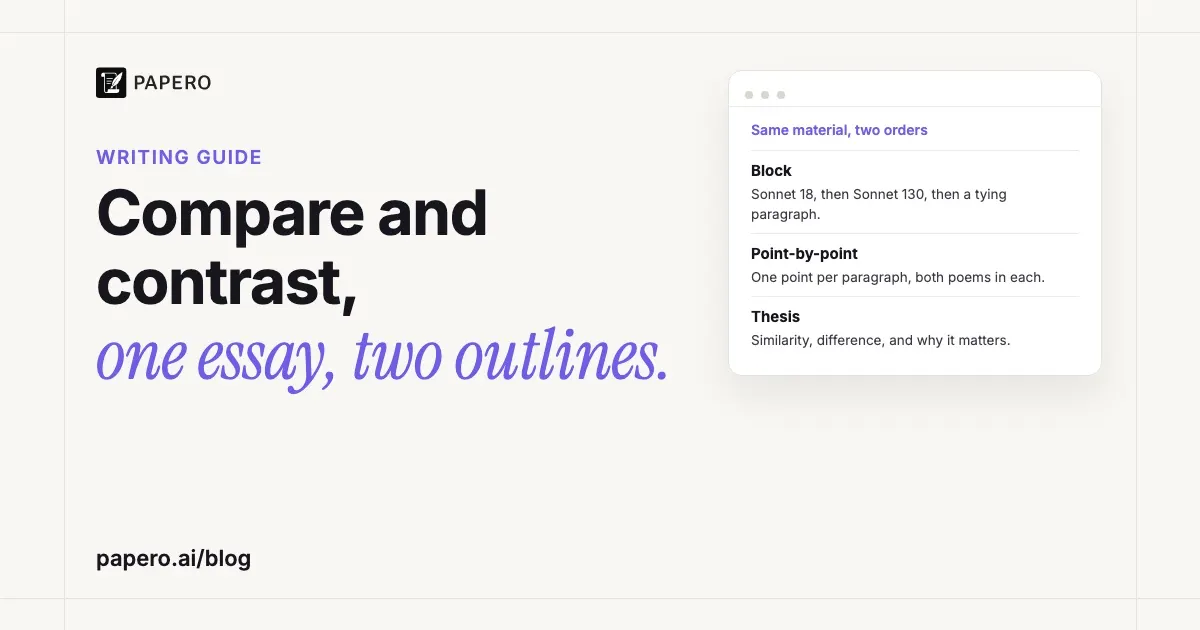
A compare and contrast essay can be outlined in two main ways. Block (subject-by-subject) order says everything about the first subject, then everything about the second. Point-by-point order takes one point of comparison at a time and discusses both subjects under it. The same research fits either; only the paragraph order changes.
Here is the material for the essay below, outlined both ways, with the same three points in each column.
| Paragraph | Block (subject-by-subject) | Point-by-point |
|---|---|---|
| 1 | Introduction and thesis | Introduction and thesis |
| 2 | Sonnet 18: the sun, the quatrains, the couplet | Point 1: how each poem uses the sun (18, then 130) |
| 3 | Sonnet 130: the sun, the quatrains, the couplet | Point 2: who loses the comparisons in the quatrains (18, then 130) |
| 4 | Tying paragraph: what the two routes have in common and why they differ | Point 3: what each couplet rests its praise on (18, then 130) |
| 5 | Conclusion | Conclusion |
The block outline needs that fourth paragraph. UNC’s handout warns that with subject-by-subject order “your paper will simply be a list of points”, and advises that if you use it, “you will probably want to have a very strong, analytical thesis and at least one body paragraph that ties all of your different points together.” In the point-by-point column, every body paragraph already does that tying.
Compare and contrast essay example: two ways to praise
This compare and contrast essay example is about 700 words, in five paragraphs, organized point-by-point. We wrote it for this guide; it is a model to study, not a paper to submit. Citations follow MLA style: the text makes clear which sonnet each quotation comes from, the first citation from each poem says “line” and later ones give the number alone, and a slash marks a line break inside a quotation.
Purdue OWL’s MLA guide cites a poem by “line” or “lines” instead of a page, and the MLA Style Center (in advice written for the 8th edition of the Handbook) says to use the word only in the first citation of each poem; our guide to MLA in-text citation covers the other locators. Our guide on how to cite a poem shows the works-cited entry for a poem in an anthology and how APA and Chicago cite it.
Paragraph 1: introduction
Shakespeare’s Sonnets 18 and 130 are both love poems, and both are built out of comparisons. Sonnet 18 opens by asking whether to compare its subject to a summer’s day; Sonnet 130 opens by declaring that the speaker’s mistress has eyes “nothing like the sun” (line 1). Side by side, they can look like opposites, one flattering and one teasing. Their endings suggest otherwise. Both sonnets claim that the person they describe is beyond ordinary comparison, but Sonnet 18 reaches that claim by finding fault with summer, while Sonnet 130 reaches it by finding fault with the comparisons poets use, so the first poem rests its praise on the power of poetry and the second on the speaker’s honesty.
What it does: the first sentence names both subjects and the ground they share. The next three set up the expected reading (opposites) so the thesis can complicate it. The thesis is the last sentence, and it has the three parts a comparison thesis needs: the similarity (both claim their subject is beyond comparison), the difference (the route each takes) and what the difference shows (where each poem places its praise).
Paragraph 2: body, point 1, the sun
Both poems bring in the sun, and what each does with it sets the pattern for the rest. Sonnet 18 begins with a question, “Shall I compare thee to a summer’s day?” (line 1), and answers it at once: “Thou art more lovely and more temperate” (2). The comparison is accepted, then improved on. When the sun itself appears, as “the eye of heaven,” it is “Sometime too hot” (5), and “often is his gold complexion dimm’d” (6). The sun is the standard, and the poem’s subject beats it. Sonnet 130 raises the same comparison only to refuse it: “My mistress’ eyes are nothing like the sun” (1). Where Sonnet 18 measures its subject against the sun and declares a win, Sonnet 130 declines to take the measurement at all.
What it does: the topic sentence names the point and both poems at once, the signature move of point-by-point order. Sonnet 18 comes first, as in the thesis, and the last sentence states the contrast outright instead of leaving the reader to infer it.
Paragraph 3: body, point 2, who loses the comparisons
The quatrains of each poem run a series of comparisons, and the two poems differ in who loses them. In Sonnet 18 the loser is summer. Its winds are “Rough” and “shake the darling buds of May” (3), its “lease hath all too short a date” (4), and “every fair from fair sometime declines” (7). Each line lowers summer so that the person addressed can rise above it. Sonnet 130 runs the same kind of list against the mistress: coral “is far more red, than her lips red” (2), there are no roses “in her cheeks” (6), and “music hath a far more pleasing sound” (10) than her voice. The mistress loses every comparison, yet the list keeps undercutting itself. The line before the one about music begins “I love to hear her speak” (9), and the quatrain ends by placing her where real people walk: she “treads on the ground” (12). In Sonnet 18 summer loses; in Sonnet 130 the losers are the stock images themselves, coral, snow, roses and a goddess, which turn out to describe no one real.
What it does: it carries the most evidence, quotations from three lines of Sonnet 18 and five of Sonnet 130, in parallel sentences that let the reader line the two up. The closing sentence answers the paragraph’s question, who loses, for both poems at once.
Paragraph 4: body, point 3, the couplets
The two couplets make the same kind of claim and rest it on different grounds. Sonnet 18 promises that its subject’s “eternal summer shall not fade” (9), and the couplet names what will keep that promise: “So long as men can breathe, or eyes can see, / So long lives this, and this gives life to thee” (13–14). The “this” that lives on is the poem, so the praise is guaranteed by poetry’s power to outlast its subject. Sonnet 130’s couplet turns on “And yet”: “And yet by heaven, I think my love as rare, / As any she belied with false compare” (13–14). The mistress is as “rare” as any woman whom poets have misrepresented with “false compare.” Here the guarantee is honesty. Having refused every flattering comparison for twelve lines, the speaker has earned the right to be believed when the praise finally comes.
What it does: it moves from the similarity (both couplets praise) to the difference (what backs the praise), mirroring the thesis. The two-line quotations use a slash for the line break, as MLA asks. Ending the body on the couplets is deliberate, because the essay’s last word on the pair should be the contrast it cares about most.
Paragraph 5: conclusion
Sonnets 18 and 130 share a form, a subject and even an image, the sun, and both end by declaring someone beyond comparison. What separates them is the route. Sonnet 18 makes comparison work for its subject, faulting summer so that the beloved outshines it, and trusts the poem to keep that praise alive. Sonnet 130 makes comparison fail, faulting the stock images rather than the woman, and asks to be believed because it has refused to flatter. Read together, the two poems show two ways a love poem can make its praise believable: by claiming that poetry lasts, or by showing that the speaker does not lie.
What it does: it restates the similarity and the difference with what the body established, and adds no new quotation. The last sentence answers the question UNC says an instructor will ask of a comparison thesis, “So what?”, by naming what the reader gains from reading the two poems together. Our conclusion examples set five kinds of ending side by side.
Works Cited
Shakespeare, William. “Sonnet 18.” Shakespeare’s Sonnets, Project Gutenberg, 1 Sept. 1997, www.gutenberg.org/ebooks/1041. Accessed 25 Oct. 2026.
---. “Sonnet 130.” Shakespeare’s Sonnets, Project Gutenberg, 1 Sept. 1997, www.gutenberg.org/ebooks/1041. Accessed 25 Oct. 2026.
The three hyphens replace the author’s name for a second work by the same author, as Purdue OWL’s MLA guide shows. In a paper, the list starts on a new page with a centered heading, and each entry has a hanging indent.
Block or point-by-point: which should you use?
Use point-by-point for most college essays, because it compares the subjects directly in every body paragraph. Use block order for a short essay, or for a “lens” comparison, where one subject mainly helps explain the other. If you choose block order, add a paragraph that ties the two halves together, or the essay reads as two separate summaries.
In the block version of the same material, the Sonnet 18 and Sonnet 130 paragraphs never mention each other, so all the comparison happens in the tying paragraph, which might read like this (written for this guide):
Set beside each other, the two poems run the same race by opposite routes. Each brings in the sun, each fills its quatrains with comparisons, and each ends with a couplet claiming its subject is beyond compare. But where Sonnet 18 makes summer lose so that its subject can win, Sonnet 130 makes the conventional comparisons lose so that its speaker can be trusted. The first poem’s praise depends on the poem lasting; the second’s depends on the poem telling the truth.
Compare and contrast thesis examples
A compare and contrast thesis names both subjects, the main similarity or difference, and why it matters. A strong thesis could be disputed by a reader who knows both subjects, and the body has to prove it. It usually closes the introduction, as the last sentence of Paragraph 1 above does.
UNC’s handout makes the same point with two pizza places. It suggests replacing vague statements with “something more detailed and specific”, such as: “Pepper’s and Amante have similar prices and ingredients, but their atmospheres and willingness to deliver set them apart.” Then it asks the next question: the obvious one is “So what?” A thesis statement for a comparison has to answer it.
| Weak | Why it is weak | Stronger |
|---|---|---|
| Sonnets 18 and 130 are similar in some ways and different in others. | True of any two poems | Both sonnets call their subject beyond comparison, but 18 gets there by faulting summer and 130 by faulting the comparisons. |
| This essay will compare and contrast two Shakespeare sonnets. | An announcement, not a claim | Sonnet 130’s refusal to flatter is what makes its final compliment more believable than Sonnet 18’s. |
| Sonnet 18 is romantic and Sonnet 130 is funny. | A description with no “so what” | Sonnet 130’s jokes target the conventions of praise, not the woman, which is why its couplet can still praise her. |
Four templates that work for most topics, with the blanks filled by your own subjects:
- Although ___ and ___ both ___, ___ does ___ while ___ does ___, which shows ___.
- ___ and ___ seem opposite in ___, but they share ___, and that shared ___ explains ___.
- Compared with ___, ___ is ___, because ___.
- Both ___ and ___ try to ___; ___ succeeds better because ___.
Compare and contrast transition words
Transition words tell the reader whether the next point is a similarity or a difference. Use “likewise” or “similarly” for comparison, “in contrast” or “unlike” for contrast, and “although” or “yet” when one point qualifies another. Put them at the start of topic sentences, where the reader needs the signal most.
The words below are UNC’s cue-word list, grouped by job:
| Job | Words | Example |
|---|---|---|
| Similarity | like, similar to, also, similarly, in the same way, likewise, again, in like manner | Like Sonnet 18, Sonnet 130 ends with a couplet that praises. |
| Difference | unlike, in contrast, compared to, contrasted with, conversely, on the contrary, however, but | Unlike Sonnet 18, Sonnet 130 refuses the comparison with the sun. |
| Concession | although, yet, even though, still, nevertheless, regardless, despite, while | Although the mistress loses every comparison, the speaker still calls her rare. |
| Balance | on the one hand … on the other hand, at the same time | At the same time, both poems end by claiming their subject is beyond compare. |
How do you write a compare and contrast essay?
Check whether the assignment wants comparison, contrast or both, chart the similarities and differences, keep the few points that matter, and write a thesis that says what the comparison shows. Then choose block or point-by-point order, draft with clear transitions, and end on the point you most want remembered.
- Read the prompt for its verb. Some prompts want only similarities, some only differences, and some use the comparison as a step toward an evaluation.
- Make a chart or a Venn diagram. UNC suggests criteria down the left side and the subjects across the top. For two poems, try imagery, form, tone and ending.
- Choose the points that matter. UNC’s example is Wordsworth’s “Tintern Abbey” and Coleridge’s “Frost at Midnight”: that both are about nature is relevant “but not terribly interesting”. How each one depicts nature is the better point.
- Write the thesis before the body. It should name the similarity or difference and say why it matters. If you could cut the last clause of your thesis without losing anything, it is not yet saying what the comparison shows.
- Choose block or point-by-point, and keep the subjects in the same order in every paragraph. In point-by-point order, open each body paragraph with both.
- Place the last point deliberately. UNC notes that “the last point you make is the one you are leaving your reader with”, so end the body on the contrast your thesis cares about most.
A comparison of two speeches’ techniques overlaps with rhetorical analysis; our rhetorical analysis essay example analyzes one speech in the same annotated format.
Where Papero fits
Papero is an AI writing workspace for students and researchers. For a compare and contrast essay the useful part is planning: describe the assignment, pick a citation style and a structure, and Papero builds a two-level outline with a prompt for every section, while a hint says what your description still needs. You can also choose no headings and set out the block or point-by-point plan yourself.
As you write, select a sentence to paraphrase, simplify, shorten or make more academic, and add the texts you compare as manual entries to cite them in MLA 9. In-text citations work on every plan; the full Works Cited is readable and exportable on Plus. Papero drafts only from your outline and prompts, so the reading of the two texts and the comparison stay yours. The essay outline page shows the planning step, and you can sign up free.
Frequently Asked Questions
What are the two ways to organize a compare and contrast essay?
Block (subject-by-subject) and point-by-point. Block order covers everything about the first subject, then everything about the second, and usually needs a paragraph that ties them together. Point-by-point order takes one point of comparison per paragraph and discusses both subjects in it. Point-by-point compares more directly, so most college essays use it.
How many paragraphs is a compare and contrast essay?
A short one is usually five: an introduction, three body paragraphs and a conclusion. In point-by-point order, the three body paragraphs are three points of comparison. A longer essay can give each subject its own paragraph per point, so three points become six body paragraphs.
Does a compare and contrast essay need both similarities and differences?
Only if the assignment asks for both. Some prompts ask only for similarities, some only for differences, and many for both. When both are required, the thesis decides which matters more, and that side gets more space and the final position.
Can a compare and contrast essay have an argument?
Yes, and it should. A thesis that only says two things are alike and different gives the reader nothing to test. A strong comparison thesis makes a claim about what the similarities and differences show, such as why one approach works better or what the pair reveals together, and the body proves it.
Can you compare more than two things in a compare and contrast essay?
Yes. Block order extends to a third subject by adding another block, and point-by-point order discusses all the subjects under each point. With three or more subjects, point-by-point paragraphs get long, so keep the number of points small and the subjects in the same order every time.
Sources
- The Writing Center, University of North Carolina at Chapel Hill, “Comparing and Contrasting” (writingcenter.unc.edu, accessed October 2026; CC BY-NC-ND 4.0): https://writingcenter.unc.edu/tips-and-tools/comparing-and-contrasting/
- Purdue OWL, “Expository Essays” (owl.purdue.edu, accessed October 2026): https://owl.purdue.edu/owl/general_writing/academic_writing/essay_writing/expository_essays.html
- Purdue OWL, “MLA In-Text Citations: The Basics” (poems cited by line): https://owl.purdue.edu/owl/research_and_citation/mla_style/mla_formatting_and_style_guide/mla_in_text_citations_the_basics.html
- Purdue OWL, “MLA Formatting Quotations” (slashes for line breaks in short verse quotations): https://owl.purdue.edu/owl/research_and_citation/mla_style/mla_formatting_and_style_guide/mla_formatting_quotations.html
- Purdue OWL, “MLA Works Cited Page: Basic Format” (more than one work by the same author): https://owl.purdue.edu/owl/research_and_citation/mla_style/mla_formatting_and_style_guide/mla_works_cited_page_basic_format.html
- MLA Style Center, “When citing poems by different poets, should I use the word line or lines the first time I quote from each poet’s work?” (8th-edition guidance; style.mla.org, accessed October 2026): https://style.mla.org/citing-poems-by-different-poets/
- William Shakespeare, Shakespeare’s Sonnets, Project Gutenberg eBook #1041 (released September 1, 1997, updated October 29, 2024; public domain; the text of both sonnets): https://www.gutenberg.org/ebooks/1041
- Folger Shakespeare Library, Sonnet 130 page (its synopsis, quoted above; folger.edu, accessed October 2026): https://www.folger.edu/explore/shakespeares-works/shakespeares-sonnets/read/130/
- Folger Shakespeare Library, “Shakespeare’s Sonnets” (first printing in 1609): https://www.folger.edu/explore/shakespeares-works/shakespeares-sonnets/
- Folger Shakespeare Library, “Reading Shakespeare’s Language: The Sonnets” (the English sonnet form): https://www.folger.edu/explore/shakespeares-works/shakespeares-sonnets/reading-shakespeares-language-sonnets/