A literature review outline plans the review in three parts: an introduction that sets out the topic, scope and organising pattern; a body divided into sections by theme, period, method or theory; and a conclusion that states what the research shows and leaves open. Below are a template for each pattern, two filled-in examples with real sources, and a way to build the outline from your notes.
Key Takeaways
- Every outline has an introduction, a body and a conclusion. Reviews differ in how the body is divided: by theme, period, method or theory.
- Each body line should state a claim about the research and name the studies behind it. A heading with no studies under it is a gap in your reading, found early.
- Close every body section with a “so what” line: your interpretation of what the studies show together.
- If you kept a synthesis matrix, the outline is already in it: sort the matrix by the column that matches your pattern.
What goes in a literature review outline?
A literature review outline lists the introduction, the body sections and the conclusion, with one line for each point the review will make and the sources behind it. The introduction lines define the topic, scope and organising pattern. Each body section covers one theme, period, method or theory. The conclusion lines summarise the evidence, name the gap and connect it to your question.
The UNC Writing Center, Purdue OWL and Brown University Library all describe these three parts.
| Part | What the outline lines say | Notes |
|---|---|---|
| Introduction | The topic and key terms; the scope (years, kinds of study, fields); why it matters; the organising statement | Standalone reviews may add how sources were found and chosen |
| Body | One section per theme, period, method or theory, each with a claim, the studies that support or complicate it, and a closing interpretation | The bulk of the review |
| Conclusion | What the research shows together; what is unresolved; how that connects to your question or study | In a thesis chapter, this bridges to your method |
The organising statement is the line students most often leave out. UNC notes that a literature review “may not have a traditional thesis statement (one that makes an argument), but you do need to tell readers what to expect.” Write it as the last line of the introduction: one sentence that names the pattern and the sections, such as “This review traces the research in three periods.”
Purdue OWL adds that when the review is part of a larger paper, the introduction and conclusion “may be just a few sentences”.
Which structure should a literature review follow?
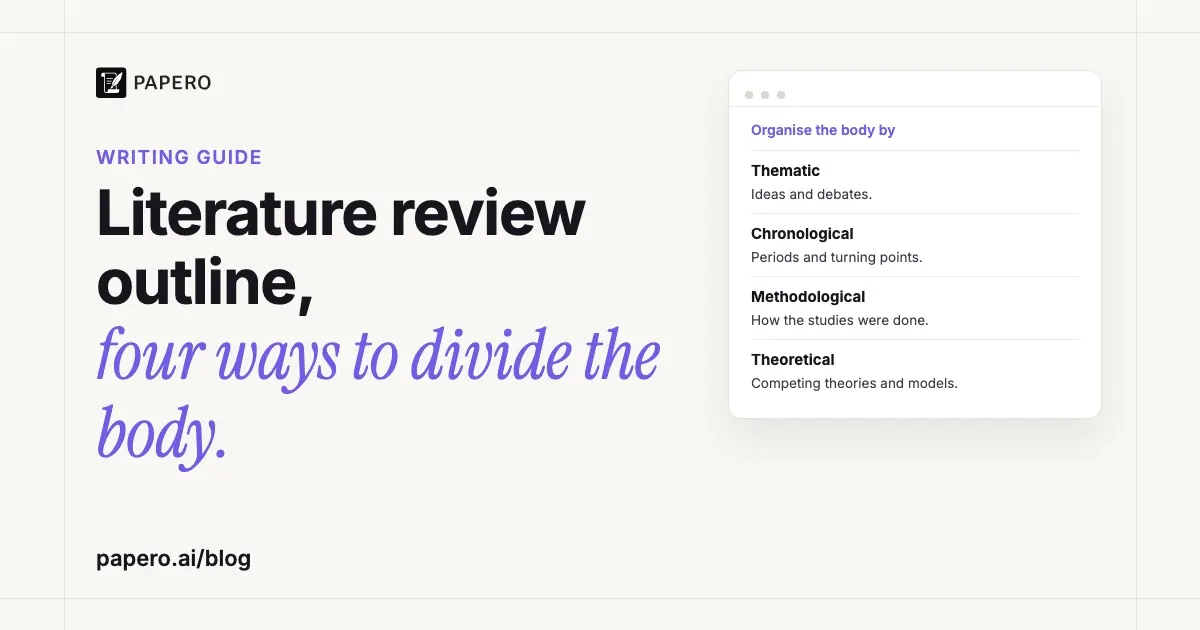
Use thematic order unless your question is about change over time, about methods or about theories. Thematic groups studies by idea or debate. Chronological traces how a field developed through its turning points. Methodological groups studies by how they were done and compares what each method found. Theoretical sets competing theories or models side by side. Pick one for the body; another can work inside a section.
| Pattern | Divide the body by | Use it when | Watch for |
|---|---|---|---|
| Thematic | Ideas, debates or sub-questions | Most reviews; the default for coursework | Themes that are really one source each |
| Chronological | Periods defined by turning points | The history of the research is part of the answer | Listing studies by year with no trend |
| Methodological | Research methods or kinds of evidence | Different methods produced different answers | Describing methods without comparing findings |
| Theoretical | Theories, models or definitions | You need a theoretical framework for your own study | Summarising theories without testing them against evidence |
Take UNC’s warning about chronological order seriously: it recommends ordering by publication date “only if the order demonstrates a more important trend”, and Purdue OWL asks writers to analyse “the patterns, turning points, and key debates” instead. Purdue also adds the theoretical review, noting that “In many humanities articles, the literature review is the foundation for the theoretical framework.”
Literature review outline templates
Each template follows the same three-part frame and differs only in how the body is divided. Copy the one that matches your pattern, replace every bracket, and keep each line to one sentence. A body section gets a claim, the studies behind it and a closing interpretation. Add or remove body sections to fit your sources; a section with no study under it is a gap in your reading, found early.
Thematic template
- I. Introduction
- A. Topic: [what the review covers, with any key term defined]
- B. Scope: [years, kinds of study, populations or fields included]
- C. Why it matters: [the problem or decision the research informs]
- D. Organising statement: this review groups the research into [theme 1], [theme 2] and [theme 3]
- II. Theme 1: [claim about the research, as a full sentence]
- A. Agreement: [author, year] and [author, year]: [what they show together]
- B. Complication: [author, year]: [what qualifies or limits it]
- C. So what: [your interpretation of what the theme establishes]
- III. Theme 2: same pattern as theme 1
- IV. Theme 3, often the disagreement: [position A, with studies] against [position B, with studies]; [why they disagree]; so what: [what the disagreement leaves open]
- V. Conclusion
- A. What the themes show together
- B. The gap: [what is unknown or unsettled]
- C. How the gap connects to [your research question or study]
Chronological template
- I. Introduction: [key term defined]; [start and end dates, and why]; the research falls into [number] periods, each opened by a turning point
- II. Period 1 ([years]): [what the field believed]
- A. Founding work: [author, year]: [finding]
- B. Consolidation: [author, year]: [finding]
- C. So what: [the consensus at the end of the period]
- III. Period 2 ([years]): [the turning point]
- A. What changed: [author, year]: [new finding, method or critique]
- B. Why it changed: [new data, a new method, or a problem with earlier work]
- C. So what: [how the consensus shifted]
- IV. Period 3 ([years] to now): same pattern, ending on the current state of the question
- V. Conclusion: where the field stands; the open question the history leaves; how it connects to [your study]
Name each period by its turning point, not by a decade. “2014 to 2015: the bias reanalyses” tells the reader what changed; “2010s” does not.
Methodological template
- I. Introduction: [the question the studies try to answer]; [why method matters here]; this review compares [method A], [method B] and [method C]
- II. Studies using [method A]: [what they found], [author, year]; [what the method can and cannot show]; so what: [what these studies establish]
- III. Studies using [method B]: same pattern
- IV. Comparison: where the methods agree, where they conflict, and which explanation fits best
- V. Conclusion: what the evidence supports across methods; the study design that is missing
Purdue OWL’s examples of methodological divisions include qualitative versus quantitative research. Line IV carries the weight: without it, the review is three summaries in a row.
Theoretical template
- I. Introduction: [the concept, defined]; [what your own study needs from a theory]; this review compares [theory A] and [theory B] and argues for [framework]
- II. Theory A: [core claim]; key works [author, year]; what it explains well; what it struggles with; so what: [what your study can use from it]
- III. Theory B: same pattern
- IV. Synthesis: where the theories conflict, and the framework you adopt or combine
- V. Conclusion: the framework stated plainly, and what it lets your study test
In the ego depletion research used in the second example below, a theoretical outline would set the original strength model against the process model proposed by Inzlicht and Schmeichel (2012).
Literature review outline example: retrieval practice (thematic)
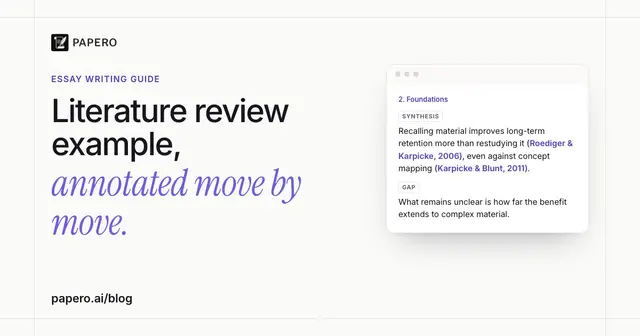
This is the outline behind our annotated literature review example on retrieval practice. We derived it from that review’s published text, so you can compare each line with the paragraph it became. It is a thematic outline in which the fourth theme is the disagreement, and the conclusion grows out of it.
Working title: Retrieval Practice and Long-Term Learning: A Short Review
- I. Introduction
- A. Problem: students spend study time rereading and highlighting; Dunlosky et al. (2013) rated practice testing and distributed practice as high utility, rereading and highlighting as low.
- B. Organising statement: this review examines the evidence for retrieval practice, focusing on whether its benefits hold outside the laboratory and with complex material.
- II. Foundations: the benefit comes from retrieval itself
- A. Roediger and Karpicke (2006): restudying won on a test five minutes later; testing won after two days and one week.
- B. Karpicke and Blunt (2011): retrieval beat concept mapping a week later, including on inference questions.
- C. So what: the benefit comes from the act of retrieval, not from extra time with the material.
- III. Consolidation: meta-analyses show the effect is general
- A. Rowland (2014), g = 0.50; Adesope et al. (2017), g = 0.51; Yang et al. (2021), classroom studies only, g = 0.499.
- B. So what: three reviews with different inclusion rules land near half a standard deviation.
- IV. Application: the benefit holds in classrooms
- A. Agarwal et al. (2021): 57% of effect sizes from 50 classroom experiments were medium or large.
- B. Objection, test anxiety: Agarwal et al. (2014): 72% of students whose classes used retrieval practice said it made them less nervous for tests.
- C. So what: the laboratory benefit holds in real classrooms, and testing need not raise anxiety.
- V. Disagreement: complex material
- A. van Gog and Sweller (2015): the effect decreases and may disappear as complexity rises.
- B. Karpicke and Aue (2015): the effect holds; failed studies practised retrieval poorly, and complexity was never defined in a measurable way.
- C. So what: part of the dispute is about what counts as complex.
- VI. Conclusion
- A. Supported: retrieval practice for remembering facts and applying them, in laboratories and classrooms.
- B. Gap: how far the benefit extends to highly complex material, and the lack of an agreed, measurable definition of complexity.
Read the outline against the literature review example, which lists the full references with DOIs. Each body section became one paragraph, and every “so what” line except IV.C survived as that paragraph’s closing sentence (IV.C is ours: that paragraph of the review ends on its evidence). The organising statement, kept from the review, names the focus rather than the four themes; in your own outline, name them. The gap in VI.B was already visible in V.C: the outline decided the ending before the review was written.
Literature review outline example: ego depletion, 1998 to 2021 (chronological)
We wrote this second outline for this article, on a different topic and in a different pattern. The seven studies are real; each finding comes from the paper’s abstract unless the line says otherwise, and the references are in the sources below. Ego depletion suits a chronological outline because the research changed direction twice, and those turning points, not the publication dates, divide the body.
Working title: Ego Depletion, 1998 to 2021: From Established Effect to Open Question
- I. Introduction
- A. Key term: ego depletion, the idea that self-control draws on a limited resource, so one act of self-control weakens the next.
- B. Scope: laboratory experiments, meta-analyses and multi-lab replications, 1998 to 2021.
- C. Organising statement: the research falls into three periods, the second and third each opened by a change in how the effect was tested.
- II. 1998 to 2012: the effect is established, and its mechanism questioned
- A. Baumeister et al. (1998): in the first of four experiments, people who had to resist chocolates (eating radishes instead) then gave up sooner on unsolvable puzzles than people who had not.
- B. Hagger et al. (2010): a meta-analysis of 83 studies found a significant effect, later cited as medium in size (d = 0.62), and support for motivation and fatigue as alternative explanations.
- C. Inzlicht and Schmeichel (2012): citing over 100 supporting experiments, proposed that depletion reflects shifts in motivation and attention rather than a used-up resource.
- D. So what: by 2012 the effect looked settled, and the debate was about why it happens.
- III. 2014 to 2015: the bias reanalyses
- A. Carter and McCullough (2014): correcting the 2010 meta-analysis’s data for small-study effects found “very strong signals of publication bias” and an indication that the effect is no different from zero.
- B. Carter et al. (2015): a series of meta-analytic tests found very little evidence that the effect is real, at least with the laboratory methods used most often.
- C. So what: the question moved from why the effect happens to whether it exists.
- IV. 2016 to 2021: preregistered multi-lab replications
- A. Hagger et al. (2016): 23 laboratories, 2,141 participants, d = 0.04, with a confidence interval that includes zero.
- B. Vohs et al. (2021): 36 laboratories, 3,531 participants, d = 0.06 and nonsignificant; in exploratory analyses the effect was larger for participants who reported more fatigue.
- C. So what: two large tests with procedures fixed in advance found effects close to zero.
- V. Conclusion
- A. The medium-sized effect of the first period has not survived preregistered testing.
- B. Gap: whether a small effect exists under particular conditions, such as fatigue, a possibility that so far rests on exploratory analysis.
The “so what” lines carry the argument. Read only II.D, III.C and IV.C and you have the review’s story in three sentences, which is what UNC’s test for ordering by date asks: each period exists because something changed, not because a decade ended.
How do you turn a synthesis matrix into an outline?
Sort the matrix by the column that matches your pattern. A synthesis matrix has one row per source and one column per thing you compare. Sort by a theme column for a thematic outline, by year and turning point for a chronological one, or by method for a methodological one. The groups become body sections, and the rows become the lines under them.
Brown University Library’s guide describes the same move: “Review the Summary Table you created for themes and connecting ideas.” The glossary entry on research synthesis explains how to build the matrix. Here is the one behind the ego depletion outline.
| Source | Year | Method | Main finding | Turning point |
|---|---|---|---|---|
| Baumeister et al. | 1998 | Laboratory experiments | Self-control on one task reduced persistence on the next | Establishes the effect |
| Hagger et al. | 2010 | Meta-analysis, 83 studies | Significant effect (d = 0.62) | Consolidates it |
| Inzlicht & Schmeichel | 2012 | Theoretical review | Motivation and attention, not a used-up resource | Questions the mechanism |
| Carter & McCullough | 2014 | Bias-corrected reanalysis | Strong signs of publication bias; effect possibly zero | Questions the effect |
| Carter et al. | 2015 | Meta-analytic tests | Very little evidence the effect is real | Questions the effect |
| Hagger et al. | 2016 | Preregistered, 23 labs | d = 0.04, interval includes zero | Tests it directly |
| Vohs et al. | 2021 | Preregistered, 36 labs | d = 0.06, nonsignificant | Tests it directly |
Read in year order, the last column marks where each period begins: the first three rows form period II, the two reanalyses period III and the two replications period IV. Sort the same seven rows by “Method” instead and a methodological body appears:
- II. Single-laboratory experiments: Baumeister et al. (1998)
- III. Meta-analyses of published studies: Hagger et al. (2010) against the bias-corrected tests of Carter and McCullough (2014) and Carter et al. (2015)
- IV. Preregistered multi-lab replications: Hagger et al. (2016); Vohs et al. (2021)
- V. Theory: Inzlicht and Schmeichel (2012), set apart because it reinterprets the evidence rather than adding to it
That version argues something different from the same sources: the estimated effect shrinks as the method guards more strongly against publication bias. Neither outline is wrong; choose the one whose argument answers your question. If you kept an annotated bibliography instead of a matrix, turn each annotation into a row first.
Where does your own interpretation go in the outline?
Put it in the closing line of every body section and in the conclusion. The studies supply the evidence; the “so what” line says what they show together. How much depends on the field: Purdue OWL notes that humanities reviews tend to include more overt argumentation, while science reviews report study designs and results.
The guides disagree on this point. Brown’s guide says of the body: “Focus on ways to have the body of literature tell its own story. Do not add your own interpretations at this point.” Purdue OWL lists “Analyze and interpret” among the body’s jobs and says to “add your own interpretations where possible”. UNC’s sample paragraph keeps the writers’ voice “by starting and ending the paragraph with their own ideas and their own words”.
We side with Purdue and UNC for most coursework, with one condition taken from Brown: a “so what” line may only claim what the lines above it support. In the ego depletion outline, “self-control is not a limited resource” would overreach; “two large preregistered tests found effects close to zero” does not.
How much space should each section get?
Give the introduction and conclusion a short share and the body the rest, then check that the sections add up to the length of the review, not of the whole paper. Our literature review example plans the opening at about 10 to 15%, the theme paragraphs at 65 to 75% and the gap and conclusion at 10 to 20%, a planning guide rather than a rule.
The adding-up check catches real mistakes. The University of Kent’s AI prompt bank shows an AI-suggested structure for the literature review of an 8,000-word Economics dissertation whose section ranges (500 to 600, 6,400 to 6,600, 400 to 500 and 300 to 400 words) total 7,600 to 8,100 words: the whole dissertation, with nothing left for the method or results. Kent’s page tells students to “bring this to your supervisor for review and guidance”, good advice for any outline. Write a word budget next to each heading and total them before you draft.
Where Papero fits
Papero is an AI writing workspace for students and researchers. Its outline builder turns a description of your paper into a two-level outline of four to eight main headings, each with up to four subheadings and a short prompt saying what to write there. The headings are generated from your description, so name your pattern and your themes, periods or methods in it.
The outline names no studies, by design; attaching sources to each line, as in the templates above, stays your job. For a review you have already started, Suggest headings proposes only the sections the document still lacks.
When you draft, citation search finds papers for the sentence you are writing, and one citation can hold several sources, which is what a synthesis sentence needs. The literature review page shows the process from search to cited draft. Deciding what the studies add up to stays with you.
Frequently Asked Questions
How do you start a literature review outline?
Start with the question the review answers and a list of your sources, ideally in a synthesis matrix. Group the sources by theme, period, method or theory, choose the grouping that answers your question best, and make each group a body section. Write the introduction’s organising statement and the conclusion’s gap last, once the body shows what the research adds up to.
Does a literature review need a thesis statement?
It needs an organising statement, which plays a similar role. The UNC Writing Center notes that a literature review may not have a traditional thesis that makes an argument, but it must tell readers what to expect. Write one sentence at the end of the introduction that names the organising pattern and the main sections.
Should a literature review outline use APA headings?
Use outline numbering while you plan and APA heading levels in the paper. In APA style the body sections usually become Level 1 or Level 2 headings, depending on whether the review stands alone or sits inside a larger paper, and the headings carry no numbers or letters. Our APA headings guide shows how an outline’s main points become Level 1 headings.
How is a literature review outline different from a research paper outline?
A research paper outline plans a paper that makes its own argument or reports its own study, usually with a thesis-driven or IMRaD structure. An outline for a review plans a synthesis of other people’s research, so its body is divided by theme, period, method or theory, and it ends on the gap rather than on new findings. Our research paper outline guide covers the IMRaD and thesis-driven shapes.
Sources
- The Writing Center, University of North Carolina at Chapel Hill, “Literature Reviews” (writingcenter.unc.edu, accessed October 2026): https://writingcenter.unc.edu/tips-and-tools/literature-reviews/
- Purdue Online Writing Lab, “Writing a Literature Review” (owl.purdue.edu; read from the Internet Archive copy, October 2026): https://owl.purdue.edu/owl/research_and_citation/conducting_research/writing_a_literature_review.html
- Brown University Library, “Organizing and Creating Information: Literature Reviews” (libguides.brown.edu, last updated July 24, 2026, accessed October 2026): https://libguides.brown.edu/organize/litreview
- University of Kent, “Draft an outline for a literature review” (Kent AI Prompt Bank, student.kent.ac.uk, accessed October 2026): https://student.kent.ac.uk/studies/using-generative-ai-in-your-studies/prompt-bank/draft-an-outline-for-a-literature-review
- The retrieval practice studies in the first example are listed with their DOIs in our literature review example’s reference list.
- Baumeister, R. F., Bratslavsky, E., Muraven, M., & Tice, D. M. (1998). Ego depletion: Is the active self a limited resource? Journal of Personality and Social Psychology, 74(5), 1252–1265. https://doi.org/10.1037/0022-3514.74.5.1252
- Carter, E. C., Kofler, L. M., Forster, D. E., & McCullough, M. E. (2015). A series of meta-analytic tests of the depletion effect: Self-control does not seem to rely on a limited resource. Journal of Experimental Psychology: General, 144(4), 796–815. https://doi.org/10.1037/xge0000083
- Carter, E. C., & McCullough, M. E. (2014). Publication bias and the limited strength model of self-control: Has the evidence for ego depletion been overestimated? Frontiers in Psychology, 5, Article 823. https://doi.org/10.3389/fpsyg.2014.00823
- Hagger, M. S., Chatzisarantis, N. L. D., Alberts, H., Anggono, C. O., Batailler, C., Birt, A. R., Brand, R., Brandt, M. J., Brewer, G., Bruyneel, S., Calvillo, D. P., Campbell, W. K., Cannon, P. R., Carlucci, M., Carruth, N. P., Cheung, T., Crowell, A., De Ridder, D. T. D., Dewitte, S., . . . Zwienenberg, M. (2016). A multilab preregistered replication of the ego-depletion effect. Perspectives on Psychological Science, 11(4), 546–573. https://doi.org/10.1177/1745691616652873
- Hagger, M. S., Wood, C., Stiff, C., & Chatzisarantis, N. L. D. (2010). Ego depletion and the strength model of self-control: A meta-analysis. Psychological Bulletin, 136(4), 495–525. https://doi.org/10.1037/a0019486
- Inzlicht, M., & Schmeichel, B. J. (2012). What is ego depletion? Toward a mechanistic revision of the resource model of self-control. Perspectives on Psychological Science, 7(5), 450–463. https://doi.org/10.1177/1745691612454134
- Vohs, K. D., Schmeichel, B. J., Lohmann, S., Gronau, Q. F., Finley, A. J., Ainsworth, S. E., Alquist, J. L., Baker, M. D., Brizi, A., Bunyi, A., Butschek, G. J., Campbell, C., Capaldi, J., Cau, C., Chambers, H., Chatzisarantis, N. L. D., Christensen, W. J., Clay, S. L., Curtis, J., . . . Albarracín, D. (2021). A multisite preregistered paradigmatic test of the ego-depletion effect. Psychological Science, 32(10), 1566–1581. https://doi.org/10.1177/0956797621989733