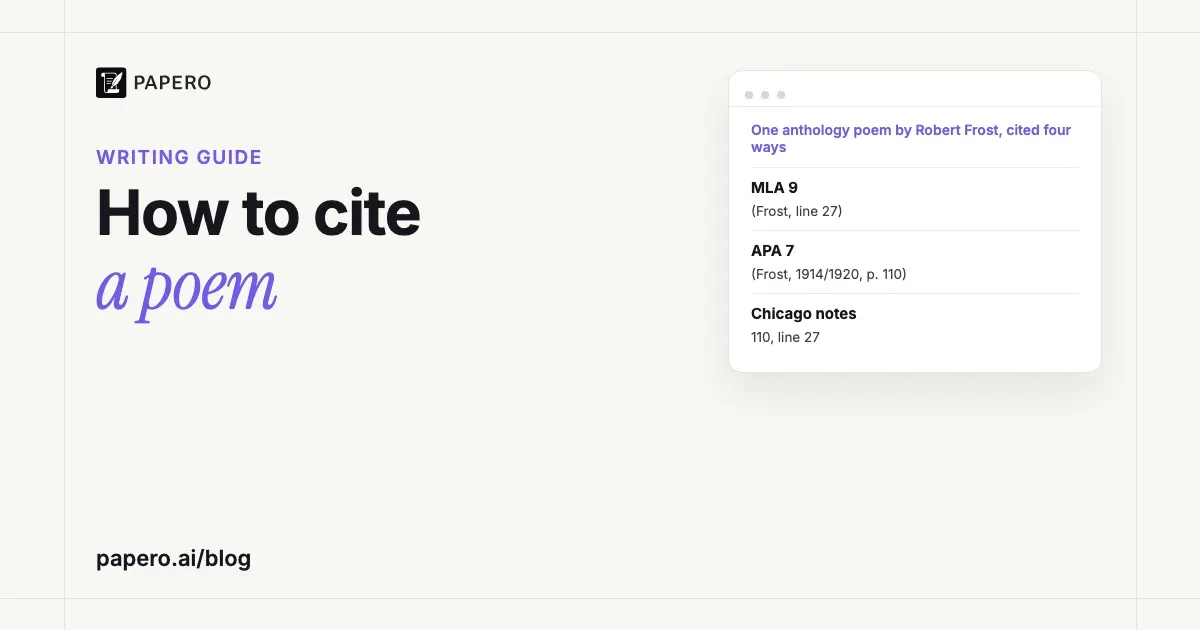
Here is how to cite a poem: name the book or website that holds it and, in MLA and Chicago, put the poem’s title in quotation marks. MLA 9: Frost, Robert. “Mending Wall.” The New Poetry: An Anthology, edited by Harriet Monroe and Alice Corbin Henderson, Macmillan, 1920, pp. 110–11. In the text, most classes want line numbers, with “line” or “lines” the first time: (Frost, line 27).
Key Takeaways
- A poem’s title goes in quotation marks; the anthology, collection or website that holds it goes in italics. A book-length poem is italicized.
- MLA in-text citations usually give line numbers: “line” or “lines” the first time for each poem, then the numbers alone.
- Run one to three lines into your sentence with slashes (a double slash at a stanza break); block-quote four or more.
- APA cites a poem in an anthology like a chapter in an edited book, with the page in the text.
- Chicago notes give the page, then the lines: 110, line 27. Author-date gives the year and page: (Frost 1920, 110).
How to cite a poem in MLA, APA and Chicago
Each style needs the poet, the poem’s title, the book or website it appeared in, the editors of an anthology, the publisher and the year. MLA and Chicago put the poem’s title in quotation marks; APA writes an anthology poem’s title in plain sentence case. The table cites one real poem, Robert Frost’s “Mending Wall” as printed in a 1920 anthology, with a quotation from line 27.
| Style | List entry | In-text citation or note |
|---|---|---|
| MLA 9 | Frost, Robert. “Mending Wall.” The New Poetry: An Anthology, edited by Harriet Monroe and Alice Corbin Henderson, Macmillan, 1920, pp. 110–11. | (Frost, line 27) the first time; after that, the number alone: (45). The MLA’s own advice cites this printing, which has no line numbers, by page: (Frost 110) |
| APA 7 | Frost, R. (1920). Mending wall. In H. Monroe & A. C. Henderson (Eds.), The new poetry: An anthology (pp. 110–111). Macmillan. (Reprinted from North of Boston, pp. 11–13, by R. Frost, 1914, David Nutt) | (Frost, 1914/1920, p. 110) |
| Chicago 18, notes-bibliography | Frost, Robert. “Mending Wall.” In The New Poetry: An Anthology, edited by Harriet Monroe and Alice Corbin Henderson. Macmillan, 1920. | 1. Robert Frost, “Mending Wall,” in The New Poetry: An Anthology, ed. Harriet Monroe and Alice Corbin Henderson (Macmillan, 1920), 110, line 27. Later: 2. Frost, “Mending Wall,” 111, line 45. |
| Chicago 18, author-date | Frost, Robert. 1920. “Mending Wall.” In The New Poetry: An Anthology, edited by Harriet Monroe and Alice Corbin Henderson. Macmillan. | (Frost 1920, 110) |
The details come from the Project Gutenberg copy of The New Poetry (eBook #65807), which reproduces Macmillan’s 1920 printing of the anthology first published in 1917; “Mending Wall” runs from page 110 to page 111. The poem first appeared in Frost’s North of Boston (London: David Nutt, 1914), hence APA’s 1914. Line 27 reads: He only says, “Good fences make good neighbors.”
How do you cite a poem in MLA?
An MLA works-cited entry for a poem starts with the poet, inverted, then the poem’s title in quotation marks. The container follows in italics: the anthology, the poet’s own collection or the website. Add the editors after the container title with “edited by”, then the publisher, the year and the poem’s page or page range. A web entry ends with the URL.
- In an anthology: Frost, Robert. “Mending Wall.” The New Poetry: An Anthology, edited by Harriet Monroe and Alice Corbin Henderson, Macmillan, 1920, pp. 110–11.
- In a collection by one poet: Frost, Robert. “The Road Not Taken.” Mountain Interval, Henry Holt, 1916, p. 9.
- On a website: Frost, Robert. “The Road Not Taken.” Poetry Foundation,
www.poetryfoundation.org/poems/44272/the-road-not-taken. Accessed 2 Nov. 2026.
The 1916 first edition of Mountain Interval prints “The Road Not Taken” on page 9 alone (we checked a scan on the Internet Archive). If you quote several poems from one collection, the MLA says one entry for the whole book is generally the most efficient choice.
A book-length poem is italicized like a book, as in the MLA’s Beowulf entry. An untitled poem is listed under its first line, styled “the way it is shown in the source”. A poem known by its number, such as a Shakespeare sonnet, takes the number in the title slot with no quotation marks. The MLA’s own example: Shakespeare, William. Sonnet 30. The Norton Anthology of English Literature, M. H. Abrams, general editor, 6th ed., vol. 1, W. W. Norton, 1993, p. 812. Our guide to the MLA works cited page explains containers and the order of the elements.
How do you cite a poem in text in MLA?
Give the line numbers in parentheses after the quotation. In the first citation of each poem, write “line” or “lines” before the numbers; after that, give the numbers alone. If your sentence does not name the poet, put the surname first, followed by a comma: (Frost, lines 19–20). Use an en dash in ranges.
The MLA Style Center states the rule with a quotation from the eighth edition of the MLA Handbook: “in your first citation” of a poem, “use the word line or lines and then, having established that the numbers designate lines, give the numbers alone.” A second answer applies it to every new poem, “even if you have previously cited a poem by the same author.” Both answers were written for the eighth edition; ninth-edition guides such as Memorial University Libraries’ teach the same: “Afterwards, it’s not necessary to include ‘line/s’ in every citation.”
In an essay on “The Road Not Taken”:
Frost’s speaker ends by claiming his choice mattered: “I took the one less traveled by, / And that has made all the difference” (lines 19–20). Yet he has already admitted that the passing there “Had worn them really about the same” (10).
Our guide to MLA in-text citation covers the author-page pattern, and our compare and contrast essay example applies the line rule to two Shakespeare sonnets.
Do you cite line numbers or page numbers for a poem?
Usually lines. The MLA’s own answer is narrower: a short poem of a page or less needs no number at all, a longer poem printed with line numbers gets line numbers, and a longer poem printed without them gets page numbers. A poem on a website with no line numbers gets no number, since MLA says not to count unnumbered parts yourself.
That 2016 answer, written for the eighth edition, is stricter than most classes. By its logic “The Road Not Taken”, which fits on page 9, takes no number, and “Mending Wall”, which runs across two pages with no printed line numbers, is cited by page: (Frost 110). Memorial University’s ninth-edition guide tells students to “cite LINE numbers not page numbers”, and adds that “some Professors may prefer page numbers instead of line numbers.” Our advice: follow your assignment sheet, and if it is silent, cite line numbers, which work in any edition.
How do you quote lines from a poem with slashes?
Quote one to three lines inside your sentence, in quotation marks, with a slash and a space on each side to mark each line break. Mark a stanza break with a double slash. Keep the poem’s own capitals and punctuation at the start of each line. Four lines or more go in a block quotation instead.
From the Project Gutenberg text of Mountain Interval (eBook #29345):
- Two lines: “I took the one less traveled by, / And that has made all the difference” (lines 19–20).
- Across a stanza break: “I doubted if I should ever come back. // I shall be telling this with a sigh” (lines 15–16).
- A line left out: “Two roads diverged in a yellow wood, / … / And be one traveler, long I stood” (lines 1–3).
The double slash comes from an eighth-edition MLA answer on stanza breaks. The third pattern comes from a 2021 MLA answer: “substitute an ellipsis for the omitted line, using forward slashes to indicate line breaks in the poem.” The period moves to after the parenthesis, as with any run-in quotation. APA’s own example of a quotation from a play also marks the line break with a slash. Song lyrics are quoted the same way; our guide on how to cite a song applies the rule to a hymn from 1779 and shows how to cite a 1970 recording of it.
How do you block quote four or more lines of a poem?
In MLA, set off a quotation of four or more lines of verse as a block. Start it on a new line, indent every line half an inch from the left margin, drop the quotation marks and keep the line breaks and spacing of the original, with one blank line between stanzas. The citation goes after the punctuation that ends the last line.
Two roads diverged in a yellow wood,
And sorry I could not travel both
And be one traveler, long I stood
And looked down one as far as I could
To where it bent in the undergrowth; (lines 1–5)
The threshold comes from the MLA’s 2021 answer, the single line space between quoted stanzas from an eighth-edition answer, and the indentation from Memorial University’s ninth-edition guide. APA counts words instead and blocks quotations of 40 words or more. Our guide to block quotes in APA, MLA and Chicago compares the three thresholds.
How do you cite a poem in APA?
We found no APA page written for poems, so a poem is cited like the source that holds it. A poem in an anthology follows the format for a chapter in an edited book: poet, year of the anthology, poem title in sentence case, then “In”, the editors, the italic book title, the page range and the publisher. When the poem first appeared in another book, add a “Reprinted from” note with that book’s title, pages, author, year and publisher.
Frost, R. (1920). Mending wall. In H. Monroe & A. C. Henderson (Eds.), The new poetry: An anthology (pp. 110–111). Macmillan. (Reprinted from North of Boston, pp. 11–13, by R. Frost, 1914, David Nutt)
In the text, give both years, earlier first, and the page of a quotation: the neighbor says again, “Good fences make good neighbors” (Frost, 1914/1920, p. 111). APA’s chapter page says to “provide both years in the in-text citation, separated with a slash, with the earlier year first”, and APA asks for “the author, year, and page number” with every direct quotation.
A poem from a collection by one poet is different: “Do not create references for chapters of authored books,” says APA’s chapter page. The entry is Frost, R. (1916). Mountain interval. Henry Holt. The citation is (Frost, 1916, p. 9).
Line numbers enter APA only for works with “canonically numbered sections (e.g., religious or classical works)”, such as APA’s blog example for Rumi’s Masnavi: (Rumi, 2008, Line 140).
How do you cite a poem in Chicago style?
In Chicago notes-bibliography, a poem in an anthology follows the pattern for a chapter in an edited book: the poet, the poem title in quotation marks, “in” and the italic anthology title, “ed.” and the editors, then the publisher and year in parentheses. After the page, add the lines you quote. The bibliography entry repeats the details without a page range.
The 18th edition’s sample citations show the chapter pattern; the University of York’s 18th-edition guide adds the lines after the page for a poem. For “Mending Wall”:
- First note: 1. Robert Frost, “Mending Wall,” in The New Poetry: An Anthology, ed. Harriet Monroe and Alice Corbin Henderson (Macmillan, 1920), 110, line 27.
- Shortened note: 2. Frost, “Mending Wall,” 111, line 45.
- Bibliography: Frost, Robert. “Mending Wall.” In The New Poetry: An Anthology, edited by Harriet Monroe and Alice Corbin Henderson. Macmillan, 1920.
In author-date style the year moves up after the name, and the text citation is (Frost 1920, 110). For a book of poems with no page numbers, a Chicago Q&A answer (17th edition) names the poem instead: (Grimes 1999, “Something Will Happen”). Our guide to Chicago style footnotes covers where note numbers go.
How do you cite a poem from a website?
Cite the website as the container. MLA puts the site’s name in italics after the poem title and ends with the URL, plus an access date when the page shows no date. APA treats the poem as a webpage, with an italic title and “n.d.” for no date. Chicago gives the site name, an access date and the URL. With no line numbers on the page, MLA cites none.
For “The Road Not Taken” on the Poetry Foundation’s site, which shows no date and no line numbers:
| Style | Entry | In the text |
|---|---|---|
| MLA 9 | Frost, Robert. “The Road Not Taken.” Poetry Foundation, www.poetryfoundation.org/poems/44272/the-road-not-taken. Accessed 2 Nov. 2026. | (Frost), or no parenthesis when your sentence names Frost |
| APA 7 | Frost, R. (n.d.). The road not taken. Poetry Foundation. https://www.poetryfoundation.org/poems/44272/the-road-not-taken | (Frost, n.d.) |
| Chicago 18 | Frost, Robert. “The Road Not Taken.” Poetry Foundation. Accessed November 2, 2026. https://www.poetryfoundation.org/poems/44272/the-road-not-taken. | Note: 1. Robert Frost, “The Road Not Taken,” Poetry Foundation, accessed November 2, 2026, https://www.poetryfoundation.org/poems/44272/the-road-not-taken. |
The MLA’s answer on online poems: if the poem “does not contain line numbers, do not include line numbers in your citation.” APA says to “italicize the title of the webpage”. The Chicago pattern follows Columbia College’s 18th-edition guide. We found no APA example that pairs “n.d.” with an original publication year, one more reason to cite a print edition when you have one.
How do you cite a poem quoted in another source or in translation?
If you read a poem only as a quotation inside another work, cite the work you read. MLA adds “qtd. in” to the parenthesis, APA writes “as cited in”, and Chicago notes say “quoted in”. For a translated poem, name the translator after the title in MLA (“Translated by”) and in APA (“Trans.” in parentheses).
The MLA’s own example quotes Wordsworth from a journal article: In his Immortality Ode, Wordsworth lamented the loss of “splendor in the grass,” a feeling linked to childhood (qtd. in Kantor 508). Only Kantor’s article goes in the works-cited list. APA’s pattern is (Rabbitt, 1982, as cited in Lyon et al., 2014), and APA asks writers to cite secondary sources sparingly, so find the poem itself when you can.
A translated poem in MLA, from the Gutenberg text of Longfellow’s translation (published in Boston by Ticknor and Fields, 1867): Alighieri, Dante. Inferno. Translated by Henry Wadsworth Longfellow. Project Gutenberg, 1 Aug. 1997, www.gutenberg.org/ebooks/1001. If the source names no translator, the MLA says to leave that element out.
Where Papero fits
Papero is an AI writing workspace for students and researchers. It formats references in nine styles, including MLA 9, APA 7 and Chicago author-date; it does not produce Chicago footnotes, so write notes-bibliography citations by hand. Papero has no poem source type. The closest fit is Book chapter: the poem’s title, the poet, the book title, the page range, the publisher and the year.
We ran “Mending Wall” entered that way through Papero’s formatter. The MLA entry comes out as Frost, Robert. “Mending Wall.” The New Poetry: An Anthology, Macmillan, 1920, pp. 110–11. The manual entry form has no editor field, so “edited by” is missing, and no field for an earlier publication, so APA’s “Reprinted from” note and 1914/1920 must be added by hand after you export. Papero prints titles as you type them, so for APA type the poem and book titles in sentence case. The citation’s “Page or location” box is formatted as a page: an MLA line number typed there prints as (Frost 27), with no “line” before it, so add the word by hand in your first citation, while APA turns it into “p. 27”.
Papero is more useful for the critics a poetry essay cites alongside the poem. The essay writing page shows how an essay is written and cited in Papero, and the glossary defines the works cited list and the in-text citation.
Frequently Asked Questions
Do you put a poem title in quotation marks or italics?
In MLA and Chicago, use quotation marks for a poem inside a larger work, such as an anthology, a collection or a website: “The Road Not Taken”. Use italics for a poem published as a book of its own, such as Beowulf. In an APA reference list, a poem from an anthology is in plain sentence case, like a book chapter.
How many lines of a poem can you quote without a block quote?
In MLA, up to three lines, run into your sentence in quotation marks with a slash between lines and a double slash at a stanza break. Set four or more lines off as a block quotation, indented half an inch, without quotation marks, with the citation after the last line’s punctuation. APA blocks quotations of 40 words or more.
Do you need to write “line” or “lines” in every MLA citation?
No. MLA guidance says to write “line” or “lines” in the first citation of each poem, so readers know the numbers are lines and not pages, and to give the numbers alone after that, such as (lines 19–20) and then (10). Repeat the word the first time you cite each new poem, even one by a poet you have already cited.
How do you cite a poem in APA in text?
Give the poet’s surname, the year and the page of the quotation: (Frost, 1916, p. 9). If the poem was first published earlier than the book you used, give both years with a slash, earlier first: (Frost, 1914/1920, p. 110). APA uses line numbers instead of pages for classical works with numbered lines, as in (Rumi, 2008, Line 140).
How do you cite two poems by the same poet?
In MLA, if both poems come from one collection, one works-cited entry for the whole book is generally enough, and your sentences name each poem; give each poem its own entry when they come from different books or sites. Write “line” or “lines” in the first citation of each poem. APA cites a collection by one poet as the whole book.
Sources
- MLA Style Center, “If I am citing two poems, each by a different poet, should I use the word line or lines the first time I quote from each poet’s work?” (eighth edition, July 7, 2020, accessed November 2026): https://style.mla.org/citing-poems-by-different-poets/
- MLA Style Center, “How should I style my parenthetical citation the first time I quote lines from a poem if I have not mentioned the author’s name in my prose?” (eighth edition, June 12, 2019): https://style.mla.org/line-numbers-in-text-citation/
- MLA Style Center, “What kind of number do I put in the parenthetical citation for a poem” (title shortened; eighth edition, February 29, 2016): https://style.mla.org/number-parenthetical-poem/
- MLA Style Center, “How do I cite an online poem with no line numbers?” (eighth edition, December 15, 2020): https://style.mla.org/web-site-poem-no-line-numbers/
- MLA Style Center, “How do I indicate that a line has been omitted from a run-in poetry quotation?” (October 27, 2021): https://style.mla.org/eliding-lines-in-poetry-quotations/
- MLA Style Center, “How do I show the blank space between stanzas when quoting from a poem?” (eighth edition, January 31, 2019): https://style.mla.org/space-between-stanzas/
- MLA Style Center, “How do I cite numbered poems from an anthology?” (September 10, 2025): https://style.mla.org/cite-numbered-poems-from-anthology/
- MLA Style Center, “Can I create a works-cited-list entry for an essay, poem, or story in a collection by one author?” (June 14, 2018): https://style.mla.org/essay-poem-collection-one-author/
- MLA Style Center, “If an untitled poem is known by its first line, how do I style that line in my works-cited-list entry?” (eighth edition, January 19, 2018): https://style.mla.org/poem-titles-in-entries/
- MLA Style Center, “How do I cite a poem quoted in a journal article?” (eighth edition, November 22, 2019): https://style.mla.org/poem-quoted-in-an-article/
- MLA Style Center, “How do I cite an anonymously translated poem?” (April 10, 2024): https://style.mla.org/anonymously-translated-poem/
- MLA Style Center, “Citations by Format” (the Beowulf entry; accessed November 2026): https://style.mla.org/works-cited/citations-by-format/
- Memorial University Libraries, “MLA: Poetry, Songs and Plays” (9th edition handout, September 2021; PDF, accessed November 2026): https://lib-vee.library.mun.ca/media/MUNLibrary/pdf/MLA_Poetry_Songs_Plays_9th_ed.pdf
- American Psychological Association, “Chapter in an edited book/ebook references” (apastyle.apa.org, last updated December 2020, read November 2026 through the Internet Archive): https://apastyle.apa.org/style-grammar-guidelines/references/examples/edited-book-chapter-references
- American Psychological Association, “Direct quotation of material with page numbers” (apastyle.apa.org, last updated August 2022, read through the Internet Archive): https://apastyle.apa.org/style-grammar-guidelines/citations/quotations/page-numbers
- American Psychological Association, “Direct quotation of material without page numbers” (apastyle.apa.org, read through the Internet Archive, capture of June 2025): https://apastyle.apa.org/style-grammar-guidelines/citations/quotations/no-page-numbers
- D. Becker, “Citing classical and religious works,” APA Style blog (April 5, 2021, read through the Internet Archive): https://apastyle.apa.org/blog/citing-classical-religious-works
- American Psychological Association, “Webpage on a website references” (apastyle.apa.org, last updated June 2026, read through the Internet Archive): https://apastyle.apa.org/style-grammar-guidelines/references/examples/webpage-website-references
- American Psychological Association, “Secondary sources” (apastyle.apa.org, last updated July 2022, read through the Internet Archive): https://apastyle.apa.org/style-grammar-guidelines/citations/secondary-sources
- The Chicago Manual of Style Online, “Notes and Bibliography: Sample Citations” and “Author-Date: Sample Citations”, 18th edition (read November 2026 through the Internet Archive): https://www.chicagomanualofstyle.org/tools_citationguide/citation-guide-1.html, https://www.chicagomanualofstyle.org/tools_citationguide/citation-guide-2.html
- The Chicago Manual of Style Online, Chicago Style Q&A, “Citation, Documentation of Sources” (poem with no page numbers; 17th edition answer, read through the Internet Archive): https://www.chicagomanualofstyle.org/qanda/data/faq/topics/Documentation/faq0049.html
- University of York Library, “Chicago referencing style” (based on the 18th edition; accessed November 2026): https://subjectguides.york.ac.uk/referencing-style-guides/chicago
- Columbia College (BC), “Poetry”, Chicago Citation Guide (18th Edition) (last updated May 14, 2026): https://columbiacollege-ca.libguides.com/chicago/poetry
- Harriet Monroe and Alice Corbin Henderson, eds., The New Poetry: An Anthology (Macmillan, 1920 printing), Project Gutenberg eBook #65807 (public domain; “Mending Wall”, pp. 110–11): https://www.gutenberg.org/ebooks/65807
- Robert Frost, Mountain Interval, Project Gutenberg eBook #29345 (public domain; the text of “The Road Not Taken” quoted above): https://www.gutenberg.org/ebooks/29345
- Robert Frost, Mountain Interval (Henry Holt, 1916), first edition scanned by the Internet Archive (page 9): https://archive.org/details/mountaininterv00frosrich
- Robert Frost, North of Boston (London: D. Nutt, 1914), scanned by the Internet Archive: https://archive.org/details/northofboston00fros
- Dante Alighieri, Divine Comedy, Longfellow’s Translation, Hell, Project Gutenberg eBook #1001 (public domain): https://www.gutenberg.org/ebooks/1001
- Robert Frost, “The Road Not Taken,” Poetry Foundation (read November 2026 through the Internet Archive): https://www.poetryfoundation.org/poems/44272/the-road-not-taken