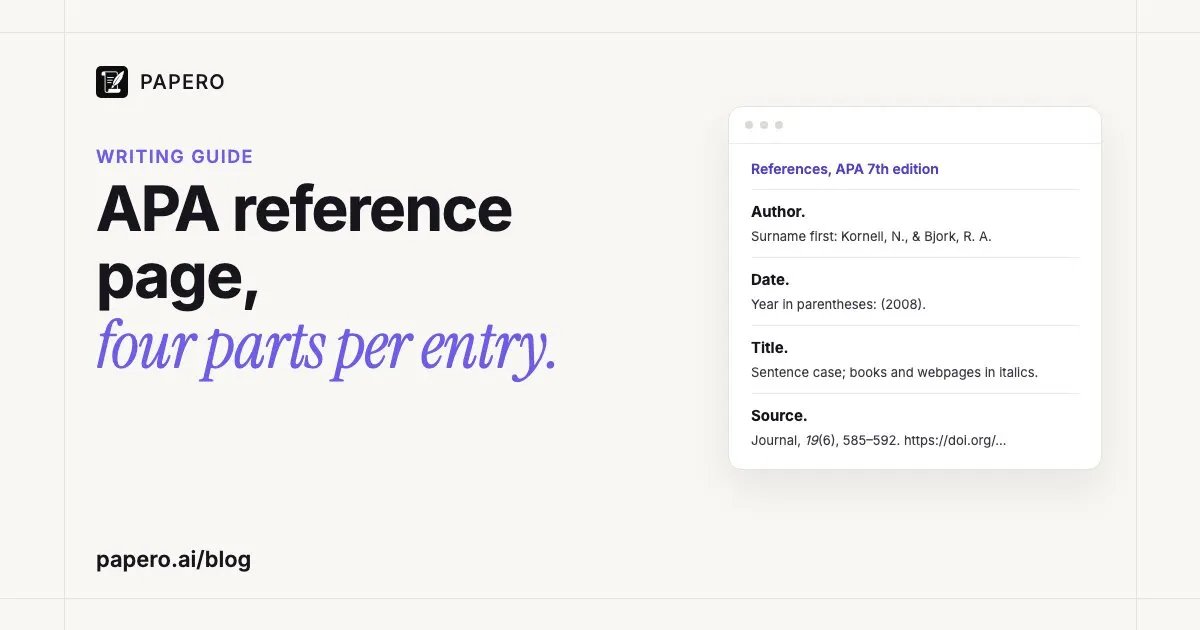
An APA reference page starts on a new page after the text of your paper, with the label References centered and bold at the top. Every entry is double-spaced, has a 0.5-inch hanging indent and is listed alphabetically by its first word, usually the first author’s surname. Each entry gives four things in order: the author, the date, the title and the source.
Key Takeaways
- Page: a new page after the text, labeled “References” in bold and centered. Not “Works Cited”, “Bibliography” or “Reference List”.
- Entries: double-spaced with no extra lines between them, first line flush left and later lines indented 0.5 inch.
- Every entry answers four questions: who wrote it, when, what it is called and where to find it.
- DOIs go at the end as
https://doi.org/...links, with no period after them. - Order: alphabetical by the first word of each entry. A work with no author is filed under its title.
APA reference page format
Start the reference list on a new page after the text, write the label References in bold at the top center of the page, and type each reference as its own paragraph. Double-space the whole list without extra space between entries, apply a 0.5-inch hanging indent and list the entries alphabetically. These are the American Psychological Association’s own setup rules for APA 7.
| Element | Rule |
|---|---|
| Placement | A new page after the text of the paper |
| Label | References, bold and centered at the top; “Reference” if you cite only one work |
| Spacing | Double-spaced throughout, with no extra space between entries |
| Indent | 0.5-inch hanging indent: first line flush left, later lines indented |
| Order | Alphabetical by the first word of the entry, usually the first author’s surname |
| Links | DOIs and URLs blue and underlined, or plain text with no underline; either is fine |
| Page numbers | Top right on every page, including the reference pages |
APA’s reference list setup page also says to let your word processor break a reference across two pages rather than forcing it onto one. The hanging indent is easy to get wrong, because an indent made with Enter and Tab breaks as soon as you edit the entry. Our guide to the hanging indent in Google Docs and Word sets it as a paragraph format instead. The label looks like a Level 1 heading, which our guide to APA headings covers.
What are the 4 parts of an APA reference?
Every APA reference is built from four elements, each followed by a period except a closing DOI or URL: the author, the date, the title and the source. APA frames them as four questions. Who is responsible for this work? When was it published? What is it called? Where can I retrieve it? Answer those four and you can build an entry for any source, even one with no example in the manual.
Author, A. A., & Author, B. B. (Year). Title of the work. Source.
The title and the source change with the kind of work. A work that stands alone, such as a book, a report or a webpage, has an italic title, and its source is the publisher or website. A work that is part of a greater whole, such as a journal article or a chapter in an edited book, has a plain title, and the greater whole (the journal or the edited book) goes in the source element in italics.
APA writes every title in sentence case: capitalize the first word, the first word after a colon or a dash, and proper nouns, and leave the rest lowercase. Journal names are the exception: they keep all major words capitalized, as in Psychological Science. For a journal article, the volume number is italic and the issue number follows it in parentheses, in plain type and with no space: 19(6).
APA reference page examples by source type
Most papers cite the same handful of source types: journal articles, books, chapters in edited books, webpages and reports. Every type keeps the author, date, title and source order, but each formats the title and the source a little differently. These entries come from the APA Style website’s reference example pages, checked in October 2026.
| Source | Reference entry |
|---|---|
| Journal article | Rybaczewska, M., & Sparks, L. (2022). Ageing consumers and e-commerce activities. Ageing and Society, 42(8), 1879–1898. https://doi.org/10.1017/S0144686X20001932 |
| Article with an article number | Schlesselmann, A. J., McNally, R. J., & Held, P. (2025). Using network analysis to characterize clinical improvement during cognitive processing therapy. Behaviour Research and Therapy, 185, Article 104678. https://doi.org/10.1016/j.brat.2024.104678 |
| Authored book | Sapolsky, R. M. (2017). Behave: The biology of humans at our best and worst. Penguin Books. |
| Chapter in an edited book | Dillard, J. P. (2020). Currents in the study of persuasion. In M. B. Oliver, A. A. Raney, & J. Bryant (Eds.), Media effects: Advances in theory and research (4th ed., pp. 115–129). Routledge. |
| Webpage with an individual author | Mantel, B. (2025, April 24). How to be a caregiver for someone with multiple sclerosis. AARP. https://www.aarp.org/caregiving/health/info-2025/multiple-sclerosis-care-plan/ |
| Webpage by an organization | World Health Organization. (2018, May 24). The top 10 causes of death. https://www.who.int/news-room/fact-sheets/detail/the-top-10-causes-of-death |
| Government report | National Cancer Institute. (2019). Taking time: Support for people with cancer (NIH Publication No. 18-2059). U.S. Department of Health and Human Services, National Institutes of Health. https://www.cancer.gov/publications/patient-education/takingtime.pdf |
Compare the rows. The two articles and the chapter have plain titles because they sit inside something bigger; the book, the webpages and the report have italic titles because they stand alone. The Sapolsky entry ends with the publisher because it gives no DOI or URL, and APA leaves out the publisher’s location. The World Health Organization page has no site name after the title, because when the author and the website are the same, APA drops the repeat. The Schlesselmann entry has a volume but no issue number, as in APA’s own example, and an article number in place of a page range; when a journal does not use issue numbers, APA leaves that part out. Our guide to citing a book in APA, MLA and Chicago covers the book cases this table leaves out, from translations to group authors. A chat with an AI tool has had its own APA format since September 2025: see how to cite ChatGPT. A YouTube video takes the uploading channel as author and [Video] after its italic title, as our guide on how to cite a YouTube video shows.
How do you write author names in an APA reference?
Invert every author’s name: surname, a comma, then initials with a space between them, as in Sapolsky, R. M. Separate authors with commas, even when there are only two, and put an ampersand (&) before the last one. List up to 20 authors this way. For 21 or more, give the first 19, an ellipsis, then the final author, with no ampersand.
Write each name the way it appears on the work, including hyphenated and two-part surnames (Santos-García, Velasco Rodríguez) and the author’s own capitalization (hooks, b.).
A group author, such as a government agency or an organization, is written out in full, followed by a period: National Institute of Mental Health. Never abbreviate it in the reference list, even if you use an abbreviation like NIMH in your text. When several layers of government are listed, APA uses the most specific agency as the author and moves the parent agencies to the source element, as the National Cancer Institute row above shows.
How do you order an APA reference list?
Alphabetize the entries by the first word of each reference, which is usually the first author’s surname. A work with no author is alphabetized by its title, because the title moves into the author’s place. Works by the same author are listed by year, oldest first, and works with the same author and the same year get the letters a, b and so on after the year.
Purdue OWL’s APA pages spell out the tie-breaks that follow from these rules:
- Same author, different years: oldest first, with a no-date entry (n.d.) before the dated ones.
- One author alone and the same author with co-authors: the single-author entry comes first.
- Same first author, different co-authors: alphabetize by the second author’s surname, then the third.
- Same author or authors, same year: entries with only a year come before those with a more specific date, and works with the same date are ordered by title.
The letters assigned in the list carry into your in-text citations, so a paper might cite (Blondaux & O’Hanrahan, 2018a) and (Blondaux & O’Hanrahan, 2018b). Our guide to APA in-text citation covers the citations that point to each entry, including et al. and page numbers.
How do you format DOIs and URLs in APA 7?
Write a DOI as a link that starts with https://doi.org/, even if the article prints an older form such as “doi:” or “dx.doi.org”. Put it last in the reference with no period after it, and do not add “Retrieved from” in front. If a work has both a DOI and a URL, give only the DOI. ISBNs and ISSNs never go in an APA reference.
When there is no DOI, the rule depends on where the work lives. For a work on an ordinary website, give a URL that will work for readers. For a work without a DOI from an academic research database, such as an article you read through your library, end the reference after the page range, or after the publisher for a book, exactly as you would for the print version, with no URL and no database name. Database names appear only in two cases: original content published in one database, such as UpToDate, and works of limited circulation, such as dissertations and theses in ProQuest’s dissertation databases or monographs in ERIC.
Most references have no retrieval date. Add one only for a page that is designed to change and is not archived, such as a live population counter: Retrieved January 9, 2020, from https://www.census.gov/popclock/. APA also allows shortDOIs from the International DOI Foundation’s service, and shortened URLs as long as you check that the link goes to the right place.
What if a source is missing the author, date or title?
Keep the four elements in order and fill the gap: with no author, move the title into the author’s place, then the date. With no date, write (n.d.). With no title, describe the work in square brackets in place of the title. If you cannot say where readers could find the work, it does not go in the reference list.
APA’s missing-information page pairs each case with its citation:
| Missing | Reference entry pattern | In-text citation |
|---|---|---|
| Author | Title. (Date). Source. | (Title, year) |
| Date | Author. (n.d.). Title. Source. | (Author, n.d.) |
| Title | Author. (Date). [Description of work]. Source. | (Author, year) |
| Author and date | Title. (n.d.). Source. | (Title, n.d.) |
| Source | No reference list entry | Personal communication, or find another work |
Use “Anonymous” as the author only when the work is actually signed that way. A webpage with no visible date takes n.d., but do not use a “last reviewed” date: APA points out that reviewed content has not necessarily changed. A “last updated” date for the content you cite is fine. As in the table’s Title row, an untitled photo or artwork takes a description in square brackets; our guide on citing an image in APA, MLA and Chicago gives the patterns.
APA reference page example: a sample list
Here is a complete reference list of four real sources, as it would appear at the end of a paper: an organization’s handout, a book, a journal article with an article number and a journal article with a page range. Each entry was checked against its DOI record, publisher page or the handout itself in October 2026.
References
American Psychological Association. (2022). Creating an APA Style reference list guide. https://apastyle.apa.org/instructional-aids/creating-reference-list.pdf
Brown, P. C., Roediger, H. L., III, & McDaniel, M. A. (2014). Make it stick: The science of successful learning. Belknap Press. https://doi.org/10.4159/9780674419377
Karpicke, J. D., Blunt, J. R., & Smith, M. A. (2016). Retrieval-based learning: Positive effects of retrieval practice in elementary school children. Frontiers in Psychology, 7, Article 350. https://doi.org/10.3389/fpsyg.2016.00350
Kornell, N., & Bjork, R. A. (2008). Learning concepts and categories: Is spacing the “enemy of induction”? Psychological Science, 19(6), 585–592. https://doi.org/10.1111/j.1467-9280.2008.02127.x
A few things to notice. The handout comes first because “American” sorts before “Brown”, and it has no publisher in the source element because the author published it. Karpicke comes before Kornell because “Ka” sorts before “Ko”. The Kornell title ends with a question mark, which replaces the period. In a real paper the References label would be centered, the list double-spaced and every entry given a hanging indent, which this page cannot show. Our full APA student paper shows a References page in that layout, after the pages that cite it.
Check your reference page before you hand it in
APA’s checklist for the list comes down to a two-way match. Every work you cite in the text needs an entry, and every entry needs at least one citation in the text. Personal communications are the main exception: they are cited in the text only, because readers cannot retrieve them. If you read a work during your research but did not cite it, leave it off.
That rule sets an APA reference list apart from a bibliography, which can include works you consulted but never cited. An MLA works cited page follows the same one-to-one rule but uses title case, full first names and a different label. An annotated bibliography adds a short summary under each entry; it is a separate assignment, not a reference page. Before you submit, read the list once against the text, checking names, years and spelling: (Kornell & Bjork, 2008) in the text and a 2009 entry in the list do not match, and a reader cannot tell which one is right. If any entry came from an AI chat tool, also check that the work exists: our guide to fake AI references shows how.
Where Papero fits
Papero is an AI writing workspace for students and researchers. It finds real papers to cite for the sentence you are writing, looks sources up by DOI, PMID, arXiv ID or ISBN, and builds the in-text citations and the reference list in APA 7 or eight other styles.
On the free plan, in-text citations work in full and the reference list shows your real entries blurred; Plus makes it readable, copyable and exportable (papero.ai/pricing). In the double-spaced manuscript layout of the Word export on Plus, an APA 7 document’s list starts on a new page under a centered, bold References heading, with a 0.5-inch hanging indent on every entry, and page numbers, when they are on, sit at the top right; check each entry against the rules above. If you only need a few entries, the free DOI to citation generator turns up to 10 DOIs into an APA reference list with no account. The find sources page shows the full workflow, the glossary has a short definition of a reference list, and you can sign up free.
Frequently Asked Questions
Is the References label bold in APA 7?
Yes. In APA 7 the label References is bold and centered at the top of the first reference page. Use the singular “Reference” only if your paper cites a single work, and never label the page “Works Cited” or “Bibliography”.
Is an APA reference page double-spaced?
Yes. Double-space the whole reference list, both within and between entries, and do not add blank lines between references. The 0.5-inch hanging indent, not extra space, shows where each new entry begins.
Do you include sources you read but did not cite?
No. An APA reference list contains only the works you cite in the text of your paper. A source you read during your research but did not end up citing is left off. The main exception runs the other way: personal communications such as interviews and emails are cited in the text but not listed, because readers cannot retrieve them.
How do you alphabetize references with the same author?
List works by the same author by year, oldest first, with any n.d. work before the dated ones. A single-author work comes before works where that person is first author with co-authors. If the same author has two works in the same year, order them alphabetically by title (a work with only a year goes before one with a more specific date) and add a, b and so on after the year, in both the list and the citations.
Do you need the database name in an APA reference?
Almost never. If you found a journal article or book through a library database and it has no DOI, end the reference after the page range or publisher, the same as for the print version. The database name appears only for original content published in one database, such as UpToDate, and for works of limited circulation, such as dissertations and theses in ProQuest and monographs in ERIC.
Sources
- American Psychological Association, “Reference list setup” (apastyle.apa.org, created October 2024, accessed October 2026 through the Internet Archive): https://apastyle.apa.org/style-grammar-guidelines/paper-format/reference-list
- American Psychological Association, “Basic principles of reference list entries” (apastyle.apa.org, updated July 2022): https://apastyle.apa.org/style-grammar-guidelines/references/basic-principles
- American Psychological Association, “Elements of reference list entries” (apastyle.apa.org, updated October 2025): https://apastyle.apa.org/style-grammar-guidelines/references/elements-list-entry
- American Psychological Association, “DOIs and URLs” (apastyle.apa.org, updated July 2022): https://apastyle.apa.org/style-grammar-guidelines/references/dois-urls
- American Psychological Association, “Missing reference information” (apastyle.apa.org, updated July 2022): https://apastyle.apa.org/style-grammar-guidelines/references/missing-information
- American Psychological Association, “Citing works with the same author and date” (apastyle.apa.org): https://apastyle.apa.org/style-grammar-guidelines/citations/basic-principles/same-year-author
- American Psychological Association, reference examples for journal articles, books, edited book chapters, webpages and government reports (apastyle.apa.org, accessed October 2026): https://apastyle.apa.org/style-grammar-guidelines/references/examples
- American Psychological Association. (2022). Creating an APA Style reference list guide. https://apastyle.apa.org/instructional-aids/creating-reference-list.pdf
- Purdue OWL, “Reference List: Basic Rules” (owl.purdue.edu, accessed October 2026): https://owl.purdue.edu/owl/research_and_citation/apa_style/apa_formatting_and_style_guide/reference_list_basic_rules.html
- Purdue OWL, “Reference List: Author/Authors” (owl.purdue.edu, accessed October 2026): https://owl.purdue.edu/owl/research_and_citation/apa_style/apa_formatting_and_style_guide/reference_list_author_authors.html
- Brown, P. C., Roediger, H. L., III, & McDaniel, M. A. (2014). Make it stick: The science of successful learning. Belknap Press. https://doi.org/10.4159/9780674419377
- Karpicke, J. D., Blunt, J. R., & Smith, M. A. (2016). Retrieval-based learning: Positive effects of retrieval practice in elementary school children. Frontiers in Psychology, 7, Article 350. https://doi.org/10.3389/fpsyg.2016.00350
- Kornell, N., & Bjork, R. A. (2008). Learning concepts and categories: Is spacing the “enemy of induction”? Psychological Science, 19(6), 585–592. https://doi.org/10.1111/j.1467-9280.2008.02127.x