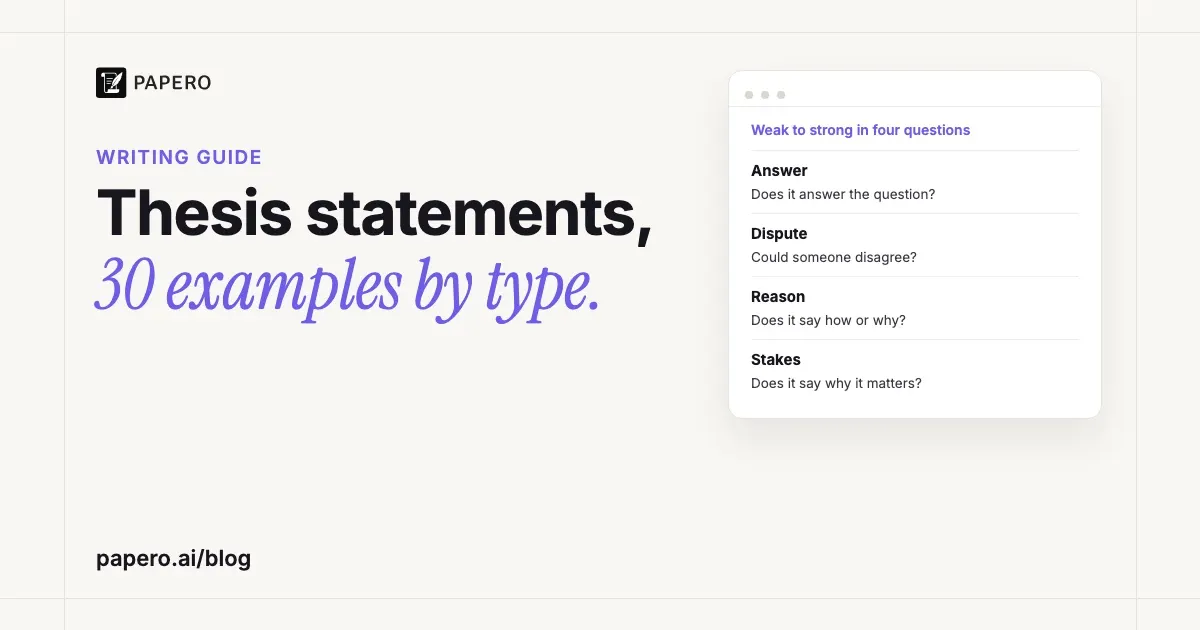
A good thesis statement answers the essay’s question in one sentence, with a claim specific enough that a reader could disagree and the body could prove it. Below are 30 thesis statement examples sorted by essay type, each with a note on why it works, a fill-in template for every type, and a four-question method for turning a weak thesis into a strong one.
Key Takeaways
- A thesis is an answer, not a topic. “Social media” is a topic; a sentence about what social media does, to whom and why, is a thesis.
- What a strong thesis has to do changes with the essay type. An argumentative thesis takes a side, an expository thesis explains, a narrative thesis states what the story taught.
- Most weak theses fail one of four checks: they do not answer the question, nobody could disagree, they skip the “how or why”, or they never say why it matters.
- Write a working thesis early and rewrite it last, once the body shows what you can actually prove.
- Use the examples to learn the patterns. Your own thesis has to come from your own reading and evidence.
What makes a good thesis statement?
A good thesis statement makes one claim that answers the assignment’s question, is narrow enough to prove in the space you have, and, in an argument, is open to dispute. It names the reasons or parts the body will cover, so it doubles as a plan. In most essays it is the last sentence of the introduction.
The UNC Writing Center’s core test is that a thesis “makes a claim that others might dispute”, and it flags vague words such as “good” or “successful” as a sign the claim needs sharpening. Purdue OWL adds that a thesis should “cover only what you will discuss in your paper”. For the definition and how a thesis differs from a topic sentence, see the glossary entry on the thesis statement; this guide is about examples you can model.
Thesis statement templates by essay type
A thesis template is a sentence frame for one kind of essay: fill in the brackets with your topic, your claim and your reasons. Templates help with a first draft because they force the parts a thesis needs, a claim plus its reasons or meaning. Revise the result until it no longer sounds like a frame.
| Essay type | What the thesis has to do | Fill-in template |
|---|---|---|
| Argumentative | Take a side someone could oppose, with reasons | [Who] should [do what], because [reason 1] and [reason 2]. |
| Persuasive | Ask a specific audience to act or believe | [Audience] should [act], because [what it gives them]. |
| Expository | Explain how or why something happens | [Thing] happens because [cause 1], [cause 2] and [cause 3]. |
| Analytical | Break a subject into parts and say what they show | An analysis of [subject] shows [finding], which suggests [meaning]. |
| Compare and contrast | Say what the comparison reveals | Although [A] and [B] both [share X], [A] [does Y] while [B] [does Z], which shows [point]. |
| Narrative | State what the experience taught or changed | [Event] taught me [lesson], because [what changed]. |
| Rhetorical analysis | Name the author’s choices and their purpose | Through [choice 1] and [choice 2], [author] [achieves purpose] with [audience]. |
| Research paper | Make a claim about what the evidence shows | [Claim about the evidence], because [main reason], although [limit or rival view]. |
| Literary analysis | Interpret how a work makes its meaning | In [work], [author] uses [element] to show [interpretation]. |
Examples below with a source line are quoted word for word from that source. Every other example was written for this guide.
Argumentative thesis statement examples
An argumentative thesis takes a position that a reasonable reader could reject and gives the reasons the essay will defend. It names who should do what, or what is true, and why. The strongest versions also show they know the other side, often with an “although” clause, because the essay will have to answer that objection.
-
“Universities should make lectures laptop-free by default, with exceptions for students who need a device, because off-task laptop use is linked to lower learning for users and the students around them, and a randomized trial found that allowing computers in class lowered exam scores.”
Source: our argumentative essay outline. Why it works: a limited policy (“by default”, “exceptions”) and two reasons, each of which becomes a body paragraph.
-
“High school graduates should be required to take a year off to pursue community service projects before entering college in order to increase their maturity and global awareness.”
Source: Purdue OWL. Why it works: a clear policy with two stated benefits. It leaves open who would require the year off, which the essay would have to settle.
-
“Cities should replace minimum parking requirements near transit stops with parking caps, because required spaces raise the cost of new housing and encourage the car trips the transit line was built to replace.”
Written for this guide. Why it works: it narrows the policy to one place and ties both reasons to one goal.
-
“Public libraries should stop charging overdue fines, because fines keep away the borrowers who most need the library while bringing in little money.”
Written for this guide. Why it works: one action and a two-part reason, cost to users and small gain for the library, that evidence can test.
-
“Although a four-day school week saves districts money, it should be a last resort, because the savings are small next to the lost teaching time for students whose families cannot cover the fifth day.”
Written for this guide. Why it works: the “although” clause concedes the other side’s best point, so the reader expects the counterargument paragraph.
Persuasive essay thesis statement examples
A persuasive thesis asks a specific audience to believe or do something and gives them a reason that matters to them. Many teachers use “persuasive” and “argumentative” interchangeably. Where they differ, a persuasive thesis speaks more directly to its reader and leans on what that reader values, while an argumentative thesis leans on evidence and answers the other side.
-
“Our school should start classes at 8:30 instead of 7:45, because students who get more sleep learn more in their first lessons, and the main cost of the change is a new bus timetable.”
Written for this guide. Why it works: a precise change, a benefit the school community cares about, and an answer to the first objection, cost.
-
“Every student who drives to campus should try the bus for one week, because the commute they think they cannot change costs them more than the fare.”
Written for this guide. Why it works: it names its audience and asks for a small, concrete action, which is easier to win than a lifelong change.
-
“Parents should keep phones out of children’s bedrooms at night, because it is the one screen rule that is easy to enforce, and it protects the sleep that other screen rules are meant to protect.”
Written for this guide. Why it works: its reasons answer the parent’s real question, “will this work in my house?”
Expository and analytical thesis statement examples
An expository thesis explains how or why something happens, without taking a side. An analytical thesis breaks a subject into parts and says what they reveal. Both still make a claim: the expository claim is one a reader would accept on the evidence, not one they would dispute on values. The thesis usually lists its points in the order the body explains them.
-
“Spaced study produces better long-term memory than cramming, the best gap between sessions depends on how long the material needs to be remembered, and students keep cramming mainly because it feels more effective than it is.”
Source: our expository essay example. Why it works: three points in body order (what, how, why), so the thesis is also the plan.
-
“The life of the typical college student is characterized by time spent studying, attending class, and socializing with peers.”
Source: Purdue OWL. Why it works: it maps the essay’s three parts. Unlike example 9, it does not say how or why they connect, which is enough for a short essay and too little for a long one.
-
“An analysis of the college admission process reveals one challenge facing counselors: accepting students with high test scores or students with strong extracurricular backgrounds.”
Source: Purdue OWL. Why it works: it breaks a process down and names the one tension the analysis found.
-
“Hurricanes weaken over land because they lose the warm ocean water that feeds them and because friction with the ground slows their winds.”
Written for this guide. Why it works: a cause-and-effect thesis with two causes and no opinion in it.
-
“The cafeteria’s food-waste logs show that most of what students throw away is fruit, not the main dish, which suggests the problem lies in how lunch is served rather than in what is served.”
Written for this guide. Why it works: it moves from a finding to its meaning, which separates analysis from a report of numbers.
Compare and contrast thesis statement examples
A compare and contrast thesis names both subjects, the basis of the comparison and what the comparison shows. Listing similarities and differences is not enough; the thesis has to say why the comparison matters. A useful pattern is “although A and B share X, they differ in Y, which shows Z”.
-
“Both the Roman Republic and the early United States feared concentrated power, but Rome divided it between two consuls who served one-year terms, while the US Constitution split it among three branches, so Rome’s checks relied on time limits and America’s on rival institutions.”
Written for this guide. Why it works: a shared starting point, one clear difference, and a conclusion the reader can test against each system.
-
“Printed textbooks suit courses built on annotation and moving between chapters, while e-books suit courses built on searching and carrying many titles, so the right format depends on the course rather than the price.”
Written for this guide. Why it works: it compares on one basis (how the course uses the book) and turns the comparison into advice.
-
“Online and in-person study groups cover the same material, but in-person groups make it harder to stay silent, which makes them the better choice for students who need accountability more than flexibility.”
Written for this guide. Why it works: it grants the similarity, then names the one difference that decides the question.
Narrative essay thesis examples
A narrative thesis states what the experience taught, changed or revealed. A narrative often holds that point back until the closing reflection, though Purdue OWL notes that even here “a thesis statement somewhere in the first paragraph could still be helpful to your reader”. Either placement works, as long as the point is clear by the end.
-
“A result I did not want was still a result, and it told me something real about the garage that no graph about rainwater could have.”
Source: the reflection in our narrative essay example, after a science fair project (beans watered with tap water and rainwater, kept in a cold garage) failed to grow. Why it works: the point of the whole story in one sentence, arriving after the events that earn it.
-
“Losing the class election taught me more about listening than winning would have, because the campaign I lost was the first time I asked people what they wanted instead of telling them.”
Written for this guide. Why it works: it names the event, the lesson and the reason, so the reader knows what to watch for.
-
“Teaching my grandmother to make video calls during the winter she lived alone showed me that patience is less about waiting than about explaining the same thing a different way each time.”
Written for this guide. Why it works: it redefines a familiar word, which gives the story a point beyond “it was hard but worth it”.
Rhetorical analysis thesis statement examples
A rhetorical analysis thesis names the author, the specific choices the essay will analyze and the purpose those choices serve. It does not say whether the author is right. A thesis that only lists ethos, pathos and logos names categories every text has, so the strong versions name choices only this text makes.
-
“Through a timeline that runs from the nation’s birth to its possible death, a repeated word that shifts the work of dedication from the speakers to the listeners, and a modesty that makes his own words seem small beside the soldiers’ deeds, [Lincoln] turns a cemetery dedication into a charge to finish the war for a principle first stated in 1776.”
Source: our rhetorical analysis essay example on the Gettysburg Address. Why it works: three choices in the order the body takes them, then the purpose they serve.
-
“By claiming his words will be forgotten, Lincoln makes the soldiers’ sacrifice, not his speech, the source of the duty he asks for.”
Source: the same post’s weak vs strong table. Why it works: one choice, analyzed for its effect, at a length that suits a timed essay.
-
“In ‘Letter from Birmingham Jail’, King answers the clergymen who had criticized his protests by matching their calm, reasoned tone, so that his demand for immediate action reads as the conclusion of a careful argument rather than as impatience.”
Written for this guide. Why it works: it links a choice (tone) to the audience it was chosen for and to its effect.
Research paper thesis statement examples
A research paper thesis makes a claim about what the evidence, taken together, shows. It is narrower than the topic and often more qualified than an essay thesis, because the paper has to account for studies that point the other way. Some fields accept “This paper argues that”, as long as the claim follows in the same sentence.
-
“This essay argues that carbon taxation remains the most effective policy tool for reducing industrial emissions.”
Source: our guide to essay introduction examples. Why it works: “most effective” is a comparison the paper must defend against every other tool. The opening words are acceptable because the claim follows them; “This essay will look at carbon taxes” would not be.
-
“Research on microplastics in drinking water has moved faster than its methods: because studies still sample and count particles in different ways, their estimates of human exposure cannot yet be compared.”
Written for this guide. Why it works: it makes a claim about the state of the research itself, which is what many source-based papers argue.
-
“The decline of managed honeybee colonies is better explained by several pressures acting together, including pesticides, parasites and poor nutrition, than by any single cause.”
Written for this guide. Why it works: it takes a side in a debate (one cause or many) and names the three factors the body will weigh.
Thesis statement examples for literary analysis essays
A literary analysis thesis interprets how a work makes its meaning: which element, such as a contrast, a symbol or a voice, the essay follows and what it shows. A plot summary or “the novel is about love” is not a thesis, because everyone already agrees with it. The interpretation has to be one a reader could argue with.
-
“Through its contrasting river and shore scenes, Twain’s Huckleberry Finn suggests that to find the true expression of American democratic ideals, one must leave ‘civilized’ society and go back to nature.”
Source: the UNC Writing Center. Why it works: UNC reaches it in three drafts. “Mark Twain’s Huckleberry Finn is a great American novel” is appreciation, not analysis. “In Huckleberry Finn, Mark Twain develops a contrast between life on the river and life on the shore” picks an element, but the handout notes the contrast is “well-known and accepted”. The final version says what the contrast means.
-
“In Frankenstein, the creature turns violent only after the people he approaches reject him again and again, which suggests that Mary Shelley blames Victor’s abandonment, not the creature’s nature, for the murders.”
Written for this guide. Why it works: it uses the order of events as evidence for an interpretation a reader could dispute.
-
“Fitzgerald lets the green light lose its meaning once Gatsby is close to Daisy, which suggests that Gatsby’s dream depended on distance more than on Daisy herself.”
Written for this guide. Why it works: it follows one symbol through a change and says what the change reveals.
-
“In ‘Ozymandias’, Percy Shelley makes the king’s own boast the only words that survive, so the ruined statue lets his words mock his power.”
Written for this guide. Why it works: a short poem gets a narrow thesis about one choice, the right scale for a two-page essay.
-
“West Side Story follows the plot of Romeo and Juliet closely but replaces the family feud with a rivalry between gangs divided by ethnicity, which turns a private quarrel into a comment on prejudice in 1950s New York.”
Written for this guide. Why it works: it names what stays, what changes and what the change does.
How do you turn a weak thesis into a strong one?
Ask four questions of the draft, in this order: does it answer the question, could someone disagree, does it say how or why, and does it say why it matters? Rewrite after each answer. The questions are condensed from the UNC Writing Center’s thesis checklist; asking them in order means each rewrite builds on the last instead of starting over.
Here is the method on one draft, written for this guide, for an assignment that asks whether the school should introduce uniforms.
- Does it answer the question? “School uniforms are an interesting topic” does not. “Our school should require uniforms” does.
- Could someone disagree? Yes, many students would, but the draft gives them nothing to weigh.
- Does it say how or why? Add the reason: “Our school should require uniforms, because they lower what families spend on school clothes.”
- Does it say why it matters? Add the stakes and face the objection: “Our school should adopt a simple uniform, because it lowers what families spend on school clothes and removes one visible sign of income, even though it limits how students express themselves.”
UNC runs the same process on a social media assignment. Its working thesis, “Social media impacts public awareness in both positive and negative ways”, fails because almost nobody could disagree with it. The revision commits to one effect: “Because not every voice on social media is reliable, people have become much more critical consumers of information, and thus, more informed voters.”
More weak to strong rewrites, written for this guide:
| Weak thesis | What is wrong | Strong thesis |
|---|---|---|
| “Should college athletes be paid?” | A question, not an answer | “College athletes in sports that earn revenue should share in it, because their scholarships are worth far less than the income their games bring in.” |
| “This essay will compare online and in-person classes.” | An announcement with no claim | “Online classes match in-person ones for lecture courses but fall short in lab courses, where hands-on practice is the content.” |
| “The Industrial Revolution changed the world.” | A fact far too broad to prove | “Britain industrialized before its neighbors partly because its coal lay close to its growing cities and ports, which made steam power cheap where it was needed.” |
| “Hamlet uses a lot of literary devices.” | A list of nothing in particular | “The play-within-a-play gives Hamlet proof of Claudius’s guilt but also delays his revenge, so the scene meant to end his doubt becomes one more reason to wait.” |
| “Fast fashion is bad for the environment.” | A vague value word and no reason | “Fast fashion’s largest environmental cost is the volume of clothes worn a few times and thrown away, so policies that keep garments in use would do more than cleaner factories.” |
Each strong version replaces a topic, a question or a vague word with a specific claim and its reason, and each is longer. That is fine: precision costs words. Once the thesis is fixed, each reason in it becomes a topic sentence, as our topic sentence examples show. After the draft, read the thesis again: if the body proved something narrower, rewrite the thesis to match.
Where Papero fits
Papero is an AI writing workspace for students and researchers. Describe your essay and it builds a two-level outline with a prompt under every heading; a hint says what your description still needs, which is often the claim itself, the part a thesis needs most.
That structure suits the way a thesis works: put your working thesis in the description, and each heading’s prompt can carry one of its reasons. Papero drafts only from your outline and prompts, so the claim and the argument stay yours, and the examples on this page are for studying patterns, not for copying into an assignment. Before you submit, Review’s peer-review check gives an AI reviewer’s report with strengths, weaknesses and questions, a quick way to see whether the body still supports the thesis. The essay outline page shows the planning step.
Frequently Asked Questions
What is a good example of a thesis statement?
“Public libraries should stop charging overdue fines, because fines keep away the borrowers who most need the library while bringing in little money.” It answers a clear question, takes a position someone could dispute, and names the reasons the essay will defend. What counts as good also depends on the essay type: an expository thesis explains, and a narrative thesis states a lesson.
How long should a thesis statement be?
Usually one sentence. A long or complex paper sometimes needs two sentences, one for the claim and one for the reasons. The UNC Writing Center describes the thesis as usually a single sentence near the beginning of the paper. Precision matters more than length: every word should narrow the claim.
Where does the thesis statement go in an essay?
At the end of the introduction, in most essays. Purdue OWL says the thesis usually appears at the end of the first paragraph, and the UNC Writing Center says the same. Narrative essays are the common exception: they often state their point in the final reflection, though a thesis in the first paragraph still helps the reader.
Can a thesis statement be a question?
No. A question names a topic; a thesis answers it. “Should college athletes be paid?” can open an essay as a hook, but the thesis has to be the answer, such as “College athletes in sports that earn revenue should share in it, because their scholarships are worth far less than the income their games bring in.”
What is the difference between a strong and a weak thesis statement?
A strong thesis is specific, arguable (or, in an expository essay, provable) and says how or why; a weak one states a fact, a topic or a vague opinion. “Fast fashion is bad for the environment” is weak. “Fast fashion’s largest environmental cost is the volume of clothes worn a few times and thrown away” is stronger, because it names one cause a reader could challenge.
Sources
- The Writing Center, University of North Carolina at Chapel Hill, “Thesis Statements” (writingcenter.unc.edu, accessed October 2026): https://writingcenter.unc.edu/tips-and-tools/thesis-statements/
- Purdue Online Writing Lab, “Tips and Examples for Writing Thesis Statements” (owl.purdue.edu, accessed October 2026): https://owl.purdue.edu/owl/general_writing/the_writing_process/thesis_statement_tips.html