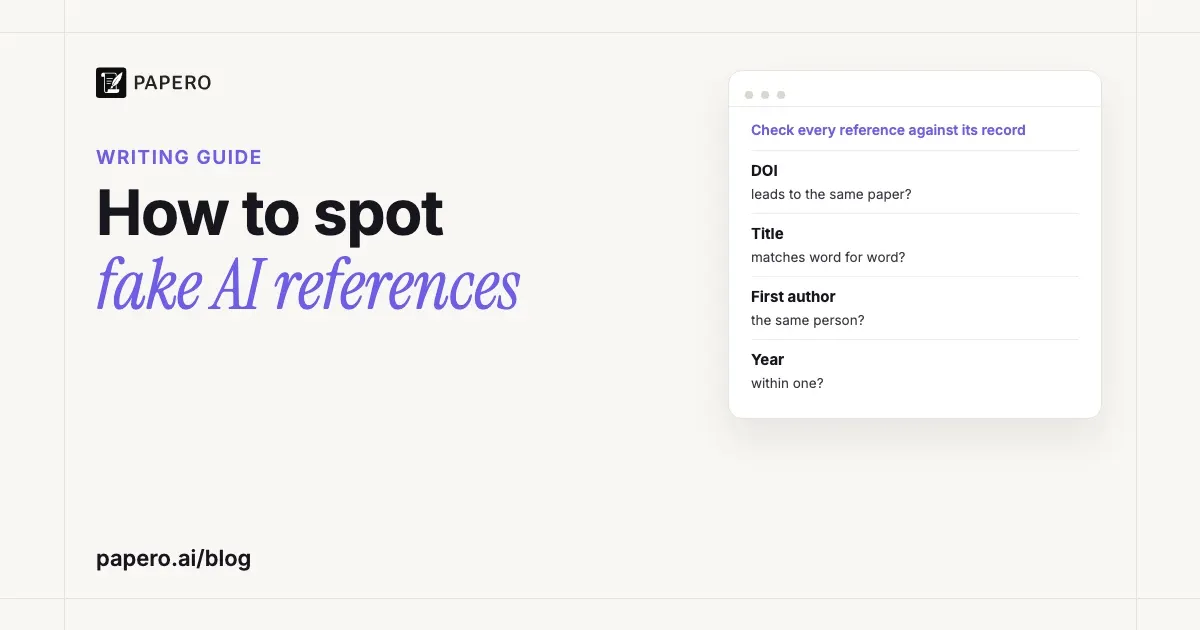
A fake AI reference, or hallucinated citation, looks like a normal entry in a reference list but describes no published work, or pins a real DOI on the wrong paper. To spot one, open the DOI and compare the record’s title, first author and year with the reference, search for the exact title when there is no DOI, and read the source before you cite it.
Key Takeaways
- A hallucinated citation is a reference an AI tool wrote that points to no real work, or to a different one than it names.
- A fake reference can carry a working DOI that leads to another paper. You only see it if you open the DOI and read the record.
- Check three things for every reference: the title, the first author and the year, against the record the DOI or a search finds.
- In a 2023 study, 55% of the references GPT-3.5 wrote and 18% of those GPT-4 wrote were fabricated.
- A reference that exists can still be wrong for your sentence. Read at least the abstract before you rely on it.
What is a hallucinated citation?
A hallucinated citation is a reference produced by an AI chat tool that does not match any real publication. Some have invented authors and an invented title on your topic, placed in a real journal with page numbers. Others mix real parts, such as a real author with an invented title, or a real title with a DOI that belongs to a different article.
The term comes from AI hallucination, a chatbot’s habit of stating false things with confidence; the glossary has a short definition of AI hallucination. References are where it is easiest to catch, because every real paper leaves a record you can look up.
The problem is common. Walters and Wilder (2023) asked ChatGPT for 84 short literature reviews and checked the 636 references in them: 55% of the GPT-3.5 references and 18% of the GPT-4 references were fabricated. In a medical version of the test, Bhattacharyya and colleagues (2023) found that 47% of 115 ChatGPT references were fabricated, 46% were real but inaccurate and only 7% were real and accurate. A 2026 preprint by Zhao and colleagues, which checked 111 million references in 2.5 million papers on arXiv, bioRxiv, SSRN and PubMed Central, conservatively estimated 146,932 hallucinated citations in those archives in 2025 alone. That last figure comes from a preprint that has not yet been peer reviewed.
Does ChatGPT make up sources?
Yes, it can, and the made-up ones look exactly like real ones. A chat tool writes a reference the same way it writes any sentence: as the words most likely to come next. It does not look the reference up unless it is connected to a search tool, and even then nothing guarantees that the entry it prints is the record it found.
The 2023 studies above tested GPT-3.5 and GPT-4. GPT-4 made fewer up than GPT-3.5 (18% against 55%), but it still made them up, and neither 2023 study tested the models people use today. Treat every reference a chatbot gives you as a lead to check, not a source you have read. The same goes for the details of real references: Walters and Wilder found substantive errors in 43% of the real GPT-3.5 references and 24% of the real GPT-4 ones, such as a wrong year, volume or page range. When you do quote or paraphrase a chatbot’s own words, cite the chat itself: our guide to citing ChatGPT in APA, MLA and Chicago shows the current formats.
6 signs a reference is fake
A fake reference rarely looks wrong at a glance. The signs show up when you compare it with a record. A fake citation usually gets the title, the first author or the year wrong, or carries a DOI, volume or page range that belongs to another paper. These six signs cover most of what you will meet:
| Sign | What it looks like | How to check |
|---|---|---|
| The DOI leads to another paper | The DOI works, but the page it opens has a different title and authors | Open the DOI and read the title, first author and year |
| The DOI leads nowhere | doi.org answers “DOI not found” | Find the paper’s own page and copy its DOI from there; if no such page exists, the reference is suspect |
| A real author, a title you cannot find | The author exists and works on the topic, but no record has that title | Search the exact title in quotation marks |
| A real title, the wrong authors | The paper exists, written by other people | Compare the first author with the record |
| A real title with an extra subtitle | The main title is right, the part after the colon is new | Compare the whole title, subtitle included |
| Details that do not fit | A volume from one year, an issue that never had those pages, a year years off | Look up the journal issue’s table of contents |
The first sign is easy to miss, because the reference looks checked. In Walters and Wilder’s data, 18% of the fabricated GPT-3.5 references carried a link, against 5% of the real ones; for GPT-4 it was 8% of each. Most fabricated references had no link at all, but a link or DOI makes one look checked when nobody has opened it.
A seventh, softer sign is a reference that fits your sentence too well: a title that restates your claim almost word for word, in a top journal, from exactly the year you would expect. Real papers rarely line up that neatly with someone else’s argument.
How to check if a citation is real
Checking a citation means finding the record it describes and comparing the two. It takes a minute per reference by hand, less with a checker. A real reference agrees with its record on the title, the first author and the year. These five steps work for any style, APA, MLA or another:
- Open the DOI. Paste it after
https://doi.org/in your browser. Compare the title, the first author and the year on the page that opens with your reference. All three should agree; a year one off is often the online date against the print date. - No DOI? Search the exact title. Put the title in quotation marks in Google Scholar, your library catalogue or Crossref’s search at search.crossref.org. A real article turns up with the same authors and year.
- Check the journal details. Open the journal’s page for that volume and issue and look for the article on the listed pages. A fabricated reference often borrows a real volume and issue from another paper.
- For a book, check a catalogue. Your library catalogue, WorldCat or Open Library should list the same title, author and publisher, with the year of the edition you cite.
- Read the source. Open the paper, or at least its abstract, and confirm that it says what your sentence claims. A real reference can still be the wrong one for your point.
Step 5 is the one no tool does in full. A checker can tell you a paper exists, and a check against the abstract can flag a poor fit, but neither reads the whole paper to confirm it supports your point. When a real reference turns out to be a review or a textbook rather than the study you meant, our guide to primary and secondary sources explains when to go back to the original. If you are building the list from scratch, our guides to the APA reference page and the MLA Works Cited page cover the format once you know every entry is real.
Fake references, checked: 6 worked examples
These examples show the most common faults on real records. Reference 1 is correct. References 2 to 5 were made up for this guide from two real papers, LeCun, Bengio and Hinton (2015) in Nature and Roediger and Karpicke (2006) in Psychological Science, the way a chat tool might make them up, and reference 6 is invented outright. Do not cite 2 to 6.
- LeCun, Y., Bengio, Y., & Hinton, G. (2015). Deep learning. Nature, 521(7553), 436–444. https://doi.org/10.1038/nature14539
- Novak, P., & Lindqvist, A. (2015). Neural networks for protein structure prediction. Nature, 521(7553), 436–444. https://doi.org/10.1038/nature14539
- Roediger, H. L., & Karpicke, J. D. (2006). Retrieval practice improves exam scores in undergraduate biology courses. Psychological Science, 17(3), 249–255. https://doi.org/10.1111/j.1467-9280.2006.01693.x
- Roediger, H. L., & Karpicke, J. D. (2006). Test-enhanced learning: A systematic review of retrieval practice. Psychological Science, 17(3), 249–255. https://doi.org/10.1111/j.1467-9280.2006.01693.x
- LeCun, Y., Bengio, Y., & Hinton, G. (2012). Deep learning. Nature, 521(7553), 436–444. https://doi.org/10.1038/nature14539
- Smith, J., & Patel, R. (2021). Retrieval practice and long-term memory in undergraduate science courses. Journal of Educational Psychology, 113(4), 512–528.
Here is what is wrong with each one, and what Papero’s free reference checker answered when we ran them through it in October 2026:
| # | What is wrong | Checker result |
|---|---|---|
| 1 | Nothing | Matches a record |
| 2 | Invented authors and title on the DOI of the 2015 deep learning review | This DOI belongs to a different paper |
| 3 | Real authors and DOI, invented title | This DOI belongs to a different paper |
| 4 | Real title with an invented subtitle | Close match, details differ |
| 5 | Year three years before the paper appeared | Close match, details differ |
| 6 | Invented article, no DOI | No matching record found |
Reference 4 is the hardest to see by eye: the main title, authors, journal, volume, pages and DOI are all right, and only the subtitle is new. The real paper is called “Test-enhanced learning: Taking memory tests improves long-term retention.” A close match is a prompt to compare the reference with the record word by word, not a pass.
Reference 6 shows the limit of any search. “No matching record found” fits a made-up article, but it also fits a real report, a thesis or a very new paper, which often have no record in the scholarly databases a checker searches. Check those by hand with the steps above.
What a reference checker can and cannot tell you
A reference checker looks up the record a reference describes and compares its title, first author and year with what you wrote. It can show that a DOI leads to another paper, that a DOI or a title matches nothing, or that a record exists and agrees. It cannot read the paper for you, and a match does not prove the paper supports your claim.
Checkers also miss things. Papero’s checker, for example, does not compare volume or page numbers, and a journal that differs is noted on the result but does not change it. In our own test in October 2026, it matched all 36 references to published papers with a DOI in a set we held back, and none of the 31 made-up ones. Without a DOI, it matched or closely matched 134 of 150 published works and matched none of 170 made-up ones, though 26 of those came back as close matches. The published references in that test were formatted from the same records they were checked against, so references typed by hand will match less often. Read every result next to its record.
Some references need a human check whatever tool you use: web pages, reports from organisations, theses, conference talks and anything brand new. And a paper can exist and still be unusable: a retracted paper should not support a claim. Retraction Watch keeps a public database of retractions, and the glossary explains what a retraction is.
Is a citation mistake the same as a fake citation?
No. A citation mistake is a real work cited with a wrong detail: a misspelt author, the online year instead of the print year, a DOI copied from the next entry in your list. A fake citation describes a work that does not exist, or attaches a real work’s details to one that does not. Both need fixing, but only the second means the source was never read.
The line can blur. Bhattacharyya and colleagues counted a reference as authentic but inaccurate when the paper existed but details such as the PubMed ID, volume, pages or year were wrong; nearly half of the ChatGPT references they checked fell in that group. When you find a wrong detail, find the paper itself and copy every detail from its own page. If you keep an annotated bibliography or a literature review matrix as you read, each entry is already tied to a paper you opened. In a numbered medical style, also check the abbreviated journal name against the NLM Catalog; our guide to AMA citation format shows how.
Where Papero fits
Papero is an AI writing workspace for students and researchers. Its citations come from scholarly records rather than a model’s memory: you search OpenAlex, look a paper up by DOI, PMID, arXiv ID or ISBN, or cite from your own source library. On Plus, suggestions and section drafts can carry citations, each one a paper from your own sources or one Papero found and checked before it is shown.
Papero’s Review runs a source check on your document that flags cited papers that are retracted, are preprints, are rarely cited or could not be checked, with 3 reviews a month on the free plan. For a list you already have, the free reference checker takes up to 10 references at a time, 5 checks a day, with no account. The find sources page shows the whole workflow, and you can sign up free.
Frequently Asked Questions
Does ChatGPT make up references?
Yes. In a 2023 study, 55% of the references GPT-3.5 produced and 18% of those GPT-4 produced did not exist, and many of the real ones had wrong details. GPT-4 made fewer up than GPT-3.5 but still made them up, so check every reference a chatbot gives you before you use it.
Can a fake reference have a real DOI?
Yes. The DOI belongs to a real paper, so the link works, but that paper has a different title and different authors from the reference. Open the DOI and compare the record’s title, first author and year with what the reference says.
How do I check if a citation is real?
Open its DOI and compare the title, first author and year with the record. If there is no DOI, search the exact title in quotation marks in Google Scholar or your library catalogue. Then read at least the abstract to confirm the paper says what you cite it for.
Can a reference checker catch every fake citation?
No. A checker compares a reference with the record it finds, so it catches a DOI that leads to another paper and a title that matches nothing. It can still rate a made-up reference as a close match, it cannot check reports or web pages that have no record, and it cannot tell whether a real paper supports your sentence.
What should I do if I find a fake reference in my paper?
Remove it, then look for a real source for the claim it was supporting. Search for papers on the claim itself, read one, and cite that. If you cannot find a source, the claim may not be supported, and it is better to cut or soften it than to keep it without a citation.
Sources
- Walters, W. H., & Wilder, E. I. (2023). Fabrication and errors in the bibliographic citations generated by ChatGPT. Scientific Reports, 13, Article 14045. https://doi.org/10.1038/s41598-023-41032-5
- Bhattacharyya, M., Miller, V. M., Bhattacharyya, D., & Miller, L. E. (2023). High rates of fabricated and inaccurate references in ChatGPT-generated medical content. Cureus, 15(5), e39238. https://doi.org/10.7759/cureus.39238
- Zhao, Z., Wang, Y., Stuart, T., De Vaan, M., Ginsparg, P., & Yin, Y. (2026). LLM hallucinations in the wild: Large-scale evidence from non-existent citations [Preprint]. arXiv. https://arxiv.org/abs/2605.07723
- LeCun, Y., Bengio, Y., & Hinton, G. (2015). Deep learning. Nature, 521(7553), 436–444. https://doi.org/10.1038/nature14539
- Roediger, H. L., & Karpicke, J. D. (2006). Test-enhanced learning: Taking memory tests improves long-term retention. Psychological Science, 17(3), 249–255. https://doi.org/10.1111/j.1467-9280.2006.01693.x
- Papero, “Reference checker and citation checker” (papero.ai, accessed October 2026): https://papero.ai/tools/reference-checker