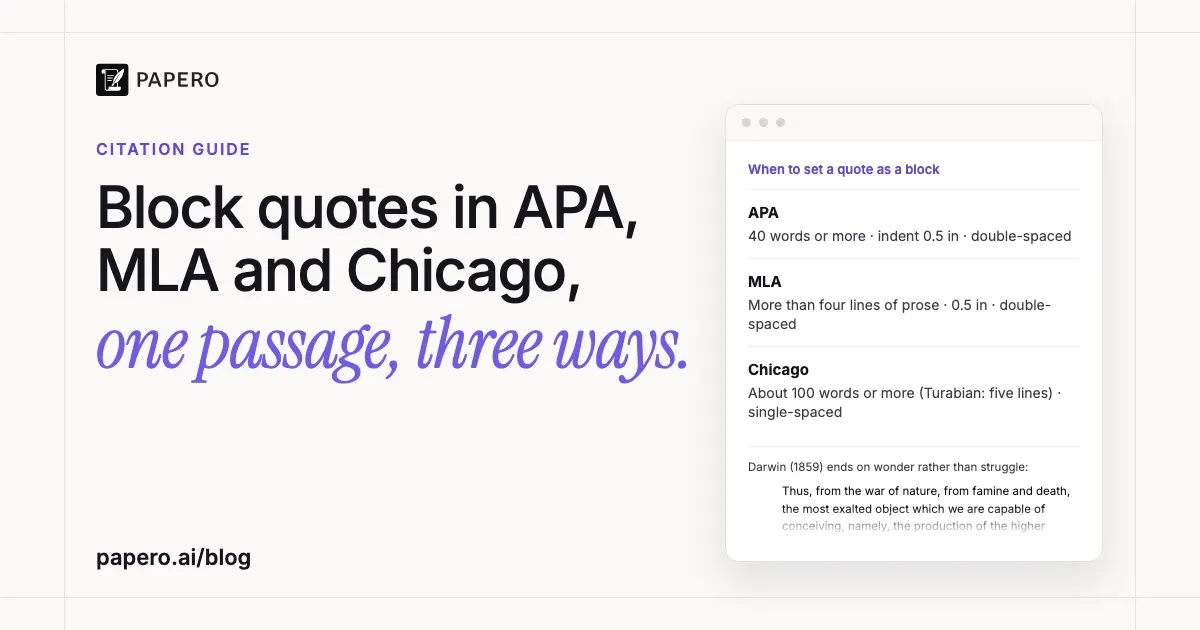
A block quote is a long quotation set off from your text as its own indented paragraph, with no quotation marks. APA uses one for quotations of 40 words or more, MLA for prose that would run to more than four lines, and Chicago for quotations of about 100 words or more. All three indent the block half an inch from the left margin.
Key Takeaways
- The threshold is the only big difference between the styles: 40 words (APA), more than four lines of prose or three of verse (MLA), and roughly 100 words in The Chicago Manual of Style, which its student guide (Turabian) states as five or more lines.
- In every style, the block starts on a new line, is indented 0.5 inch as a whole, and drops the quotation marks. The parenthetical citation goes after the final punctuation mark.
- Spacing is where students lose marks: APA and MLA keep the block double-spaced like the rest of the paper; Turabian single-spaces it, with a blank line before and after.
- A block quote is evidence, not a paragraph. Introduce it with a full sentence and follow it with your own analysis.
Block quote rules by style
The table below puts the rules side by side, read from each style’s own guidance in October 2026: the APA Style student checklists, the MLA Style Center, The Chicago Manual of Style Q&A (18th edition) and Chicago’s Turabian tip sheet, with Purdue OWL for two details (MLA’s verse limit and APA’s extra paragraph indent) that the official pages we could read do not spell out. Where none of them covers a rule, the row says so rather than borrowing one from another style.
| Rule | APA (7th edition) | MLA (9th edition) | Chicago (CMOS 18 / Turabian) |
|---|---|---|---|
| When to block | 40 words or more | More than four lines of prose, or more than three lines of verse | CMOS: a hundred words or more “can generally” be blocked. Turabian: five or more lines |
| Indent | Whole block 0.5 in from the left margin | Whole block 0.5 in from the left margin | Whole block 0.5 in from the left margin (Turabian) |
| Line spacing | Double-spaced, no extra blank line before or after | Double-spaced, like the rest of the paper | Single-spaced, with a blank line before and after (Turabian) |
| Quotation marks | None around the block | None around the block | None around the block |
| Citation | After the final punctuation, with no period after the parenthesis | After the final punctuation | Author-date: after the final punctuation. Notes: the note number follows the block’s final punctuation |
| More than one paragraph | Indent the first line of each later paragraph a further 0.5 in | Indent the first line of each paragraph after the first | Not covered by the CMOS Q&A or the Turabian tip sheet |
Two of these rules surprise people. MLA counts lines as they would look run into your text, at a standard size such as 12 point, so the same quotation can change category if you change the font. And Chicago’s 100-word figure is guidance, not a hard cut-off: the manual says length is “usually the deciding factor”, which leaves the call to you or your instructor.
One passage, formatted three ways
To see the rules work, here is the closing passage of Charles Darwin’s On the Origin of Species. It is 86 words long and sits on page 490 of the first edition (John Murray, 1859), which is in the public domain. We checked the wording and the page against the scanned first edition on Wikisource in October 2026.
At 86 words it passes APA’s 40-word line easily. In 12-point type it runs to six or seven lines, so MLA blocks it too. Under the Chicago Manual’s 100-word guidance it could run in as an ordinary quotation; under Turabian’s five-line rule it would be blocked. That gap is a real one, and it is why an instructor’s brief beats any general rule.
APA block quote example
In APA, introduce the quotation, start it on a new line, indent the whole block 0.5 inch and keep it double-spaced. The citation sits after the final period, with no period after it.
Darwin (1859) ended the book by turning the struggle for existence into a source of wonder:
Thus, from the war of nature, from famine and death, the most exalted object which we are capable of conceiving, namely, the production of the higher animals, directly follows. There is grandeur in this view of life, with its several powers, having been originally breathed into a few forms or into one; and that, whilst this planet has gone cycling on according to the fixed law of gravity, from so simple a beginning endless forms most beautiful and most wonderful have been, and are being, evolved. (p. 490)
Because the author and year are already in the signal phrase, the parenthesis carries only the page. If the sentence before the block did not name Darwin, the parenthesis would read (Darwin, 1859, p. 490).
MLA block quote example
MLA looks almost the same: 0.5-inch indent, double spacing, no quotation marks, citation after the final punctuation. The citation itself is shorter, author and page with no comma.
Darwin closes by turning the struggle for existence into a source of wonder:
Thus, from the war of nature, from famine and death, the most exalted object which we are capable of conceiving . . . directly follows. There is grandeur in this view of life, with its several powers, having been originally breathed into a few forms or into one; and that, whilst this planet has gone cycling on according to the fixed law of gravity, from so simple a beginning endless forms most beautiful and most wonderful have been, and are being, evolved. (Darwin 490)
This version also shows an omission. The three spaced periods mark where we cut “namely, the production of the higher animals,” from the first sentence. MLA’s ninth edition does not put square brackets around an ellipsis unless they add clarity. The cut still leaves more than four lines, so the quotation stays a block.
Chicago block quote example
In the notes-and-bibliography system, the block is single-spaced (Turabian), indented 0.5 inch, and followed by a footnote number after the final punctuation. In the author-date system, the parenthesis goes after the final punctuation instead, as (Darwin 1859, 490).
Darwin ends the Origin on a note of wonder rather than struggle:
Thus, from the war of nature, from famine and death, the most exalted object which we are capable of conceiving, namely, the production of the higher animals, directly follows. There is grandeur in this view of life, with its several powers, having been originally breathed into a few forms or into one; and that, whilst this planet has gone cycling on according to the fixed law of gravity, from so simple a beginning endless forms most beautiful and most wonderful have been, and are being, evolved.¹
- Charles Darwin, On the Origin of Species by Means of Natural Selection, or the Preservation of Favoured Races in the Struggle for Life (John Murray, 1859), 490.
The blog shows a quotation with a line down its left side rather than a half-inch indent, so read the examples for wording, order and punctuation, then set the indent and spacing in your word processor.
How do you format a block quote in Word or Google Docs?
Put the quotation in its own paragraph, select it, and increase the left indent by 0.5 inch for the whole paragraph, not only the first line. In Word, use the Paragraph settings and set Left indentation to 0.5”. In Google Docs, use Format, then Align and indent, then Indentation options, and set the left indent. Do not press Tab at the start of each line.
A Tab-and-Enter block looks right until you edit a word, then every line breaks in the wrong place. A paragraph indent survives edits, font changes and export. The same principle applies to reference lists, which use a hanging indent instead: one paragraph per entry, with the indent applied as formatting.
If your quotation has more than one paragraph, keep each source paragraph as its own paragraph in the block. APA indents the first line of each later paragraph a further 0.5 inch, and MLA indents the first line of each paragraph after the first, but not the first line of the first one, even if it began a paragraph in the source.
How do you introduce and follow a block quote?
Introduce a block quote with a complete sentence that tells the reader what to look for, usually ending in a colon. After the block, return to your own voice and explain what the passage shows. A block quote dropped between two paragraphs with no lead-in and no follow-up reads as filler, and markers treat it that way.
The follow-up is where the marks are. In an essay on Darwin’s rhetoric, the paragraph after the APA example above might point out that the passage moves from “war”, “famine” and “death” to “grandeur” and “beautiful” within two sentences, and argue that the reversal is deliberate. The quotation supplies the evidence; the analysis is yours.
This is also the best test of whether you need the block at all. If your analysis only uses one phrase from the passage, quote that phrase in your sentence or paraphrase the rest. The same discipline drives a good literature review, where paraphrase and synthesis do almost all the work and direct quotation is rare.
When should you avoid a block quote?
Avoid a block quote when a paraphrase would make the point, when you would only analyse a few words of it, or when it would take up a large share of a short essay. Long quotations are most at home in literary analysis, history and law, where the exact wording is the evidence. In most social science and STEM writing, paraphrase with a citation is the norm.
A useful rule of thumb in coursework: one block quote in a 1,500-word essay can be strong; three usually mean the essay is leaning on the source instead of arguing with it. The argumentative essay outline guide shows how to plan each body paragraph around a claim, so that quotations serve the claim rather than replace it. And an essay introduction is almost never the place for a block quote.
Common block quote mistakes
Most block quote errors are mechanical, and each one is easy to check before you submit.
- Quotation marks around the block. The indent already marks it as a quotation. Keep only the quotation marks that appear inside the source passage itself.
- Citation before the final period. In a run-in quotation the citation comes before the period. In a block it comes after, with no period after the parenthesis.
- Indenting only the first line. That is a paragraph indent, not a block quote. The whole passage moves in.
- Wrong spacing. Single-spacing a block in an APA or MLA paper, or adding extra blank lines around it, are both common and both visible at a glance.
- No page number. A direct quotation needs a page or an alternative locator (a paragraph number, section heading or time stamp) in every style.
Where Papero fits
Papero is an AI writing workspace for students and researchers, and you can sign up free. According to the Papero homepage, it formats references in APA 7, MLA 9, Chicago author-date, Harvard and IEEE, and its citations come from real scholarly records you choose, found by searching or by DOI.
The page number is still yours to note: every direct quote needs one, and finding it again in a 300-page book is where time goes, so write it down when you copy the passage. Papero does not decide whether a passage deserves a block quote, or what it proves. The glossary entry on the block quote gives the short definition, and the one on in-text citations covers the run-in format. For the common APA author and page cases, see our guide to APA in-text citation.
Frequently Asked Questions
How many words is a block quote?
It depends on the style. APA blocks quotations of 40 words or more. MLA counts lines instead: more than four lines of prose or three lines of verse, as they would appear in your paper. The Chicago Manual of Style says a hundred words or more can generally be blocked, and Turabian, Chicago’s student guide, uses five or more lines.
Do block quotes need quotation marks?
No. In APA, MLA and Chicago the indentation shows that the text is quoted, so the block takes no opening or closing quotation marks. If the source passage itself contains a quotation, keep those inner quotation marks as they appear in the source.
Where does the period go in a block quote?
The period stays at the end of the quoted text, and the citation follows it: “…are being, evolved. (Darwin 490)”. Do not add a second period after the parenthesis. This is the reverse of a short run-in quotation, where the citation sits before the sentence’s final period.
Are block quotes single- or double-spaced?
In APA and MLA papers, double-spaced like the rest of the text, with no extra blank line before or after. Chicago’s Turabian guidelines single-space block quotations and leave a blank line before and after. When a brief specifies its own spacing, follow the brief.
Can I start a paragraph with a block quote?
You can, but it is rarely a good idea. A paragraph should open with your claim, and the block quote should arrive as evidence for it, introduced by a sentence of your own. A paragraph that opens with a block quote makes the reader work out why it is there.
Sources
- APA Style, Student Paper Checklist, 7th edition (apastyle.apa.org, accessed October 2026): https://apastyle.apa.org/instructional-aids/publication-manual-formatting-checklist.pdf
- APA Style, In-Text Citation Checklist, 7th edition (apastyle.apa.org, accessed October 2026): https://apastyle.apa.org/instructional-aids/in-text-citation-checklist.pdf
- MLA Style Center, “Formatting a Research Paper” (style.mla.org, accessed October 2026): https://style.mla.org/app/uploads/sites/3/2020/12/Formatting-a-Research-Paper_v3_-The-MLA-Style-Center.pdf
- MLA Style Center, “How does the font and type size I choose affect the formatting of block quotations in my paper?” (style.mla.org, accessed October 2026): https://style.mla.org/font-type-size-block-quotations/
- MLA Style Center, “How should I style paragraphs in a block quotation?” (style.mla.org, accessed October 2026): https://style.mla.org/paragraphs-block-quotations/
- The Chicago Manual of Style Online, Q&A on block quotation length, citing CMOS 12.10, 18th edition (chicagomanualofstyle.org, accessed October 2026): https://www.chicagomanualofstyle.org/qanda/data/faq/topics/Quotations/faq0061.html
- The Chicago Manual of Style Online, Q&A on note number placement, citing CMOS 13.29, 18th edition (chicagomanualofstyle.org, accessed October 2026): https://www.chicagomanualofstyle.org/qanda/data/faq/topics/Punctuation/faq0020.html
- Turabian Tip Sheet 6, sample text page with block quotation (chicagomanualofstyle.org, accessed October 2026): https://www.chicagomanualofstyle.org/dam/jcr:08a960b0-c75f-42f2-bb22-dea381b2101c/Turabian-Tip-Sheet-6.pdf
- CMOS Shop Talk, “Announcing The Chicago Manual of Style, 18th Edition” (place of publication no longer required for books) (cmosshoptalk.com, accessed October 2026): https://cmosshoptalk.com/2024/04/16/announcing-the-chicago-manual-of-style-18th-edition/
- Purdue OWL, MLA Formatting Quotations (owl.purdue.edu, accessed October 2026): https://owl.purdue.edu/owl/research_and_citation/mla_style/mla_formatting_and_style_guide/mla_formatting_quotations.html
- Purdue OWL, In-Text Citations: The Basics (APA) (owl.purdue.edu, accessed October 2026): https://owl.purdue.edu/owl/research_and_citation/apa_style/apa_formatting_and_style_guide/in_text_citations_the_basics.html
- Darwin, C. (1859). On the origin of species by means of natural selection, or the preservation of favoured races in the struggle for life. John Murray. Page 490 checked against the first-edition facsimile on Wikisource: https://en.wikisource.org/wiki/On_the_Origin_of_Species_(1859)/Chapter_XIV