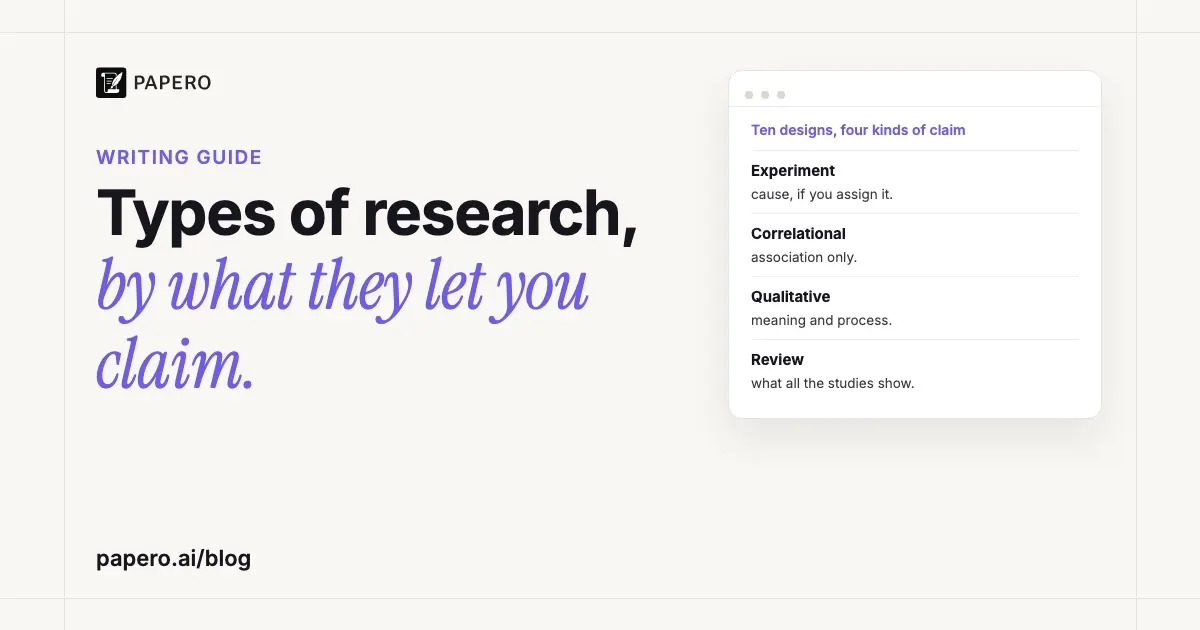
The main types of research methodology are experimental, quasi-experimental, correlational, descriptive, case study, ethnography, phenomenology, grounded theory, action research, and systematic review with meta-analysis; mixed methods combines two of them. What separates them is the claim each one supports: a cause, an association, a description, or an account of meaning. Below, all ten in one table, what each lets you claim, and how to choose.
Key Takeaways
- “Types of research methodology” lists usually mix three layers: the approach (qualitative, quantitative, mixed), the design (experiment, ethnography) and the technique (questionnaire, interview). Most of the types students need to choose between are designs.
- Choose by the claim your question needs. An experiment, where you assign people to conditions at random, is the design built for “X caused Y”. A correlational study supports “X went with Y”. A qualitative design supports an account of what something means to the people involved.
- “Quasi-experimental” has two meanings, and they allow different claims.
- Feasibility narrows the choice: time, access to people or records, ethics approval and your own skills.
- In your methods section, name the design, give the reason it fits your question, and say which stronger design you could not use and why.
What do people mean by “types of research methodology”?
Searchers use “methodology” for three different things. The approach is qualitative, quantitative or mixed. The design is the plan that connects your question to your evidence: an experiment, a correlational study, an ethnography. The method is the technique for collecting data: a questionnaire, an interview, an observation. Methodology, strictly, is the reasoning that justifies the other three. Lists that put “qualitative”, “experimental” and “interviews” side by side mix these layers.
That is where this guide parts company with most list-style pages. A survey is a technique that serves several designs: a descriptive study, a correlational study, even an experiment that measures its outcome by questionnaire. “Qualitative” is an approach that contains several designs. USC Libraries’ guide to research designs makes the same point about mixed methods, which it says “represents more of an approach to examining a research problem than a methodology.”
| Layer | What it answers | Examples |
|---|---|---|
| Approach | Will the data be numbers, words, or both? | Qualitative, quantitative, mixed methods |
| Design | What plan connects the question to the evidence? | Experiment, correlational study, case study, ethnography |
| Method (technique) | How will each piece of data be collected? | Questionnaire, interview, observation, existing records |
| Methodology (the reasoning behind the other three) | Why do these choices suit the question? | The argument in your methods chapter |
MIT’s Teaching + Learning Lab describes the same order of decisions: “Your choice of specific research methods may be guided by an overarching research methodology.” The Papero glossary entry on research design gives a one-line definition of most of these designs; this guide compares them by what they let you conclude.
What are the main types of research methodology?
Ten designs cover most student and published research. Four are quantitative (experimental, quasi-experimental, correlational, descriptive), four are qualitative (ethnography, phenomenology, grounded theory, and most action research), and two sit across the line: a case study uses whatever data the case offers, and a systematic review studies other studies. Mixed methods combines two designs in one project.
| Type | Question it answers | What you can claim | Typical data | Example |
|---|---|---|---|---|
| Experimental | Does changing X change Y? | Cause, under the conditions tested | Outcomes measured after random assignment to conditions | Roediger and Karpicke (2006): testing vs restudying |
| Quasi-experimental | Did X change Y, where you could not randomise? | A weaker causal claim, with rival explanations left open | Existing groups, ideally measured before and after | Ours: two seminar groups, only one given weekly quizzes |
| Correlational | Do X and Y vary together? | Association, not cause | Several variables measured in one sample | Okano et al. (2019): sleep and grades |
| Descriptive | What is there, how much, how often? | A description of a group or setting | Questionnaires, counts, records, observation | Ours: hours of paid work per week among students in one department |
| Case study | What happened in this case, and how? | A detailed account of one or a few cases | Documents, interviews, observation and records together | Ours: one school’s move to a four-day week |
| Ethnography | How does this group see and do things? | Meanings and practices within a culture | Field notes, observation, informal conversations | Korstjens and Moser (2017): caring relationships within three ethnic groups |
| Phenomenology | What is it like to live through X? | A detailed account of lived experience | In-depth interviews | Korstjens and Moser (2017): being a family caregiver for someone with COPD near the end of life |
| Grounded theory | How does a social process unfold? | A theory built from the data | Interviews, sometimes with observation | Korstjens and Moser (2017): how trust develops between doctors and caregivers |
| Action research | How do we improve our own practice? | What changed here, and what was learned | Repeated cycles of planning, acting and observing | Ours: a tutor revising written feedback over three terms |
| Systematic review and meta-analysis | What do all the studies on X show together? | A synthesis, or a pooled estimate across studies | Published and unpublished studies | Yang et al. (2021): 222 classroom studies of quizzing |
| Mixed methods (a combination) | A question with a “how much” and a “why” part | Each strand’s claim, plus what integration adds | Both numbers and words | See our qualitative vs quantitative guide |
Rows marked “Ours” are invented examples. The three Korstjens and Moser rows are example questions from a published methods paper, all on one topic, which shows how the same subject leads to three different qualitative designs; the other rows are published studies.
One common type is missing from most lists: the generic qualitative interview study. Edvardsen Tonheim and colleagues (2025) describe their own design in six words, “We conducted a qualitative interview study”, and analysed the transcripts with reflexive thematic analysis, without claiming ethnography, phenomenology or grounded theory. Korstjens and Moser note that some researchers “do not mention a specific qualitative approach or research tradition”, using a generic descriptive design or reporting only their thematic or content analysis. For a student project, that is often the honest label. Which approach suits your question in the first place is the subject of our guide to qualitative vs quantitative research, which also walks through a published mixed methods study.
What can each type of research let you claim?
Each design licenses a different verb in your results and discussion. An experiment can say a condition improved, reduced or caused an outcome. A correlational study can say variables were associated or that one predicted another. A descriptive study reports how many and how much. A qualitative study reports what participants described and the themes the researchers developed. Using a stronger verb than your design allows is a common overclaim.
| Design | Verbs that fit | Verbs that overreach |
|---|---|---|
| Experiment | caused, improved, reduced, produced | “always works”, “in every setting” |
| Quasi-experiment | the groups differed after; was followed by | “caused”, with no rival explanations ruled out |
| Correlational | was associated with, predicted, varied with | led to, improved, affects |
| Descriptive | reported, the average was, the most common was | because, explains |
| Qualitative (any design) | participants described, the themes were | “most students”, generalises to |
| Meta-analysis | across k studies, the pooled effect was | “applies everywhere”, when results vary widely |
The table is ours; the published examples below show four of these designs’ verbs in use.
Experiment. Roediger and Karpicke (2006) had students study prose passages and then either take recall tests or restudy the material, and gave a final test 5 minutes, 2 days or 1 week later. Because the researchers, not the students, decided which passage was tested and which restudied, their abstract states that on the delayed tests “prior testing produced substantially greater retention than studying.” The causal verb “produced” is earned. OpenStax’s Psychology 2e puts the rule plainly: “the only way to establish that there is a cause-and-effect relationship between two variables is to conduct a scientific experiment”.
Correlational. Okano and colleagues (2019) gave activity trackers to 100 students in an introductory chemistry class (88 completed the study) and found that three sleep measures accounted for 24.44% of the variance in grades. Their title uses the right verb: sleep quality, duration and consistency “are associated with better academic performance”. The authors explain why they stopped there: “Establishing a causal relation between sleep and academic performance will require experimental manipulations in randomized controlled trials, but these will be challenging to conduct in the context of real education in which students care about their grades.” That sentence is the decision this guide describes, made in print.
Qualitative. Edvardsen Tonheim and colleagues interviewed 14 health science master’s students about online group work and developed three themes. They are explicit about the claim: “we did not seek to generalise our results, but to gain in-depth knowledge of the master’s students’ perspectives”. A qualitative study claims depth and meaning, and its findings are judged on whether they are credible and well grounded in the data.
Meta-analysis. The question Roediger and Karpicke tested in a lab was later pooled across classrooms. Yang and colleagues (2021) “integrated 48,478 students’ data, extracted from 222 independent studies”, and report that quizzing raised achievement “to a medium extent (g = 0.499)”. Their abstract lists experimental design among the factors that changed the size of the effect, a reminder that a pooled answer is only as good as the studies it pools. The glossary entry on meta-analysis explains effect sizes and forest plots, and our literature review example is built on the same retrieval-practice research.
Quasi-experiment, two meanings. In OpenStax’s psychology textbook the term covers a study whose independent variable cannot be assigned at all, such as a participant’s sex, and OpenStax says that in such cases “we cannot make cause-and-effect claims”. In education and policy research it more often means an intervention given to groups you did not form at random, such as two existing classes. There the intervention was still yours, so a cautious causal reading is defensible if you measure both groups beforehand and rule out pre-existing differences. Say which meaning you are using. Our guide to independent and dependent variables shows how the variables are named when the independent variable cannot be assigned. When groups cannot be assigned at random, those pre-existing differences can act as confounding variables, and restriction, matching or statistical adjustment has to stand in for random assignment.
Which qualitative research designs are there?
Ethnography, phenomenology and grounded theory are the three best-known qualitative designs, and each asks a different question. Ethnography studies the culture of a group, phenomenology the lived experience of individuals, and grounded theory a social process, with the aim of building a theory. Case studies, narrative research and participatory action research are further traditions, and many published studies use a generic interview design instead.
Korstjens and Moser (2017), writing for master’s students and new researchers, note that ethnography, phenomenology and grounded theory “are considered the ‘big three’ qualitative approaches” (citation numbers removed). Their worked example keeps one topic, family caregivers of people with COPD in palliative care, and changes the question:
- Ethnography. “What constitutes the caring relationship between GPs and family caregivers in the palliative care for people with COPD among family caregivers of Moroccan, Syrian, and Iranian ethnicity?” Data come “mostly through observations, informal (ethnographic) conversations, interviews and/or artefacts.”
- Phenomenology. “What is the lived experience of being a family caregiver for a family member with COPD whose end is near?” Data come from in-depth interviews, and findings are “detailed descriptions of participants’ experiences, grouped in themes.”
- Grounded theory. “How does a relationship of trust between GPs and family caregivers evolve in end-of-life care for people with COPD?” The finding is a theory, “including a basic social process and relevant concepts and categories.”
Two further designs come up often in theses. A case study is an in-depth look at one or a few cases, and USC’s guide is blunt about its reach: “Design does not facilitate assessment of cause and effect relationships.” Action research follows cycles in which practitioners plan a change, carry it out, observe what happens and repeat; USC lists among its drawbacks that the cycle “is time-consuming and complex to conduct”, which matters if you have one term.
How else are types of research classified?
Research is also sorted by purpose, by depth, by time, by data source and by the researcher’s role. These labels cut across the ten designs, so one study carries several: a correlational study can be applied, cross-sectional and based on secondary data all at once. In a methods chapter they appear as adjectives on the design.
| Classified by | Types | What the label tells a reader |
|---|---|---|
| Purpose | Basic vs applied | Knowledge for its own sake, or a defined practical problem |
| Depth | Exploratory, descriptive, explanatory | Mapping a new area, describing it, or testing why |
| Time | Cross-sectional vs longitudinal | Measured once, or the same people measured repeatedly |
| Data source | Primary vs secondary | Data you collected, or data that already existed |
| Researcher’s role | Observational vs interventional | You recorded what happened, or you made something happen |
Basic and applied. OpenStax’s Biology 2e defines basic science as research that “seeks to expand knowledge regardless of the short-term application of that knowledge”, while applied science “aims to use science to solve real-world problems”.
Exploratory, descriptive, explanatory. USC’s guide describes exploratory research as work done when “there are few or no earlier studies to refer to”, producing “insight but not definitive conclusions”, and says a descriptive study “cannot conclusively ascertain answers to why.” Explanatory work tests causes, which brings you back to the experiment.
Cross-sectional and longitudinal. A longitudinal study tests “the same group of individuals repeatedly over an extended period of time”, in OpenStax’s definition, while a cross-sectional study compares different groups at one moment. OpenStax warns that cross-sectional comparisons of age groups can reflect generational differences that “have nothing to do with age per se”. Our annotated research proposal plans a cross-sectional survey of undergraduates, from sample size to limitations. For the repeated-measures side, see what a longitudinal design can show that a one-time survey cannot.
Primary and secondary data. Archival research, which uses existing records, is cheap, OpenStax notes, although “researchers using this approach have no control on how or what kind of data was collected.”
How do you choose a research methodology?
Start from the claim your research question needs, then check which design can deliver it with the time, access, ethics approval and skills you have. If the question needs a cause and you can assign the cause yourself, run an experiment, or a quasi-experiment if you cannot randomise. If you cannot assign it at all, claim an association. If the question is about meaning or process, choose the qualitative design that matches it, and if the question is about existing evidence, review it.
USC’s guide is direct about the order: “the research problem determines the type of design you choose, not the other way around!” Ranganathan and Aggarwal (2018) cite a three-question test from the Centre for Evidence-Based Medicine, meant for identifying the design of a published study from its methods section. Asked of your own plan, it works as a decision path:
- Does the study describe a group, or analyse a relationship between variables? Describing makes it descriptive; analysing makes it analytical.
- If analytical, did the investigator determine the exposure? If yes, it is experimental; if no, observational (correlational, cohort or case-control).
- If observational, when was the outcome measured? At the start (case-control), after follow-up (cohort), or at the same time as the exposure (cross-sectional).
The test covers quantitative designs. For qualitative ones, add a fourth question: is the interest a culture (ethnography), an experience (phenomenology), a process (grounded theory), one bounded case (case study), or your own practice (action research)? If none of these fits, a generic interview study with thematic analysis is a legitimate answer.
Then test feasibility. MIT’s Teaching + Learning Lab notes that “Researchers never have unlimited time and resources, so practicality is an important factor to consider”, and adds: “However, practicality should never supersede ethical considerations.” Korstjens and Moser list skills, “the resources and time available and your access to the study settings and participants” as the factors that shape a qualitative design. The worked examples below are ours.
| Research question (ours) | Claim needed | Constraint | Type chosen |
|---|---|---|---|
| Do weekly low-stakes quizzes raise exam marks in a first-year statistics module? | Cause | You teach two seminar groups and cannot move students between them | Quasi-experiment: quizzes in one group, a pre-test in both groups as the baseline |
| Is paid work during term linked to lower grades among second-year students? | Association | Assigning students to jobs is impossible and unethical | Correlational: a questionnaire on working hours, linked to grades with consent |
| How do first-generation students experience their first term at university? | Meaning | Ten students you can reach, one term to finish | Phenomenology, or a generic interview study with thematic analysis |
| What do published studies show about peer tutoring and exam results? | A synthesis | Working alone, one semester | A systematic review with a narrow question; a meta-analysis only if the studies report comparable outcomes |
The last row deserves a warning. USC’s guide notes that systematic reviews take so much work that “these types of reviews are often conducted as a group project”, so narrow the question (one outcome, one level of education, a date range) before you commit. The wording of each question above also matters; our research question examples show how published studies phrase each kind. If you are still choosing the topic itself, our guide on how to choose a research topic comes first.
How do you name and justify your research type in a methods section?
Name the design with its classification labels in the first sentence of your methods, then give the reason it fits the question and the alternative you rejected. A full label reads like “a cross-sectional correlational survey using primary data” or “a qualitative interview study using reflexive thematic analysis”. The justification states the claim you need and the constraint that ruled out a stronger design, which also prepares your limitations paragraph.
A sentence pattern that works, ours to adapt: This study used a [design] because the research question asks [what claim]; an experiment was not possible because [constraint], so the findings are reported as [associations, descriptions or themes]. A thesis methodology chapter expands that sentence into an argument; our guide to writing a methodology section covers the parts, the reporting checklists and the difference between methods and methodology.
Where Papero fits
Papero is an AI writing workspace for students and researchers. When you describe a research paper, its outline builder can start from a standard IMRaD template, and the Methods heading comes with three prompts: “Design, participants or materials”, “Procedure and measures” and “How the data were analysed”. The first prompt is where the named design and its justification go.
Find papers searches more than 250 million papers through OpenAlex, which helps you find published studies that used your design on your topic, such as a meta-analysis to check before you plan a review of your own. Chat answers questions only from the PDFs in your library and the document you have open, so you can ask how the studies you uploaded describe their designs and get answers that cite the passages. The thesis writing page shows how chapter outlines and one source library fit together across a long project. Choosing the design, and defending it, stays your job.
Frequently Asked Questions
What are the 4 types of research methods?
The four types most often listed are descriptive, correlational, quasi-experimental and experimental research. All four are quantitative designs, ordered from describing a group to testing a cause. Lists that name qualitative, quantitative, mixed methods and a fourth item are sorting by approach instead, which is a different layer from the design.
Which research methodology is best for a thesis?
No research methodology is best for every thesis. The best one is the design that can support the claim your research question needs, using the time, participants, data and ethics approval you actually have. A question about cause needs an experiment or a quasi-experiment, a question about relationships needs a correlational design, and a question about experiences needs a qualitative design.
Is a survey a research methodology or a research method?
A survey is a research method, meaning a technique for collecting data, usually through a questionnaire. The same survey serves different designs: it describes a group in a descriptive study, measures variables that are then related in a correlational study, and records outcomes in an experiment. The methodology is the reasoning for choosing a survey at all.
What is the difference between research design and research methodology?
Research design is the plan for a study: the type of study, who takes part, what data are collected and how they are analysed. Research methodology is the reasoning that justifies that plan and the methods inside it, including why the design suits the research question. A thesis methodology chapter usually presents both together.
What is correlational research?
Correlational research measures two or more variables in the same sample, without changing any of them, to see whether they vary together. It answers questions such as whether more sleep goes with higher grades. It supports a claim of association, not of cause, because a third variable could explain the pattern and the researcher did not assign either variable.
Sources
- Clark, M. A., Douglas, M., & Choi, J. (2018). Biology 2e, Section 1.1, The science of biology. OpenStax. https://openstax.org/books/biology-2e/pages/1-1-the-science-of-biology
- Edvardsen Tonheim, L., Molin, M., Brevik, A., & Garnweidner-Holme, L. (2025). Experiences with online group work among master’s students in health sciences: A qualitative study. BMC Medical Education, 25, Article 1262. Licence: CC BY. https://doi.org/10.1186/s12909-025-07845-w
- Korstjens, I., & Moser, A. (2017). Series: Practical guidance to qualitative research. Part 2: Context, research questions and designs. European Journal of General Practice, 23(1), 274–279. Licence: CC BY. https://doi.org/10.1080/13814788.2017.1375090
- MIT Teaching + Learning Lab. (n.d.). Selecting research methods. https://tll.mit.edu/research-evaluation/selecting-research-methods/
- Okano, K., Kaczmarzyk, J. R., Dave, N., Gabrieli, J. D. E., & Grossman, J. C. (2019). Sleep quality, duration, and consistency are associated with better academic performance in college students. npj Science of Learning, 4, Article 16. Licence: CC BY. https://doi.org/10.1038/s41539-019-0055-z
- Ranganathan, P., & Aggarwal, R. (2018). Study designs: Part 1 – An overview and classification. Perspectives in Clinical Research, 9(4), 184–186. https://doi.org/10.4103/picr.PICR_124_18
- Roediger, H. L., III, & Karpicke, J. D. (2006). Test-enhanced learning: Taking memory tests improves long-term retention. Psychological Science, 17(3), 249–255. https://doi.org/10.1111/j.1467-9280.2006.01693.x
- Spielman, R. M., Jenkins, W. J., & Lovett, M. D. (2020). Psychology 2e, Sections 2.2, Approaches to research, and 2.3, Analyzing findings. OpenStax. https://openstax.org/books/psychology-2e/pages/2-2-approaches-to-research and https://openstax.org/books/psychology-2e/pages/2-3-analyzing-findings
- University of Southern California Libraries. (n.d.). Types of research designs. In Organizing your social sciences research paper. https://libguides.usc.edu/writingguide/researchdesigns
- Yang, C., Luo, L., Vadillo, M. A., Yu, R., & Shanks, D. R. (2021). Testing (quizzing) boosts classroom learning: A systematic and meta-analytic review. Psychological Bulletin, 147(4), 399–435. https://doi.org/10.1037/bul0000309