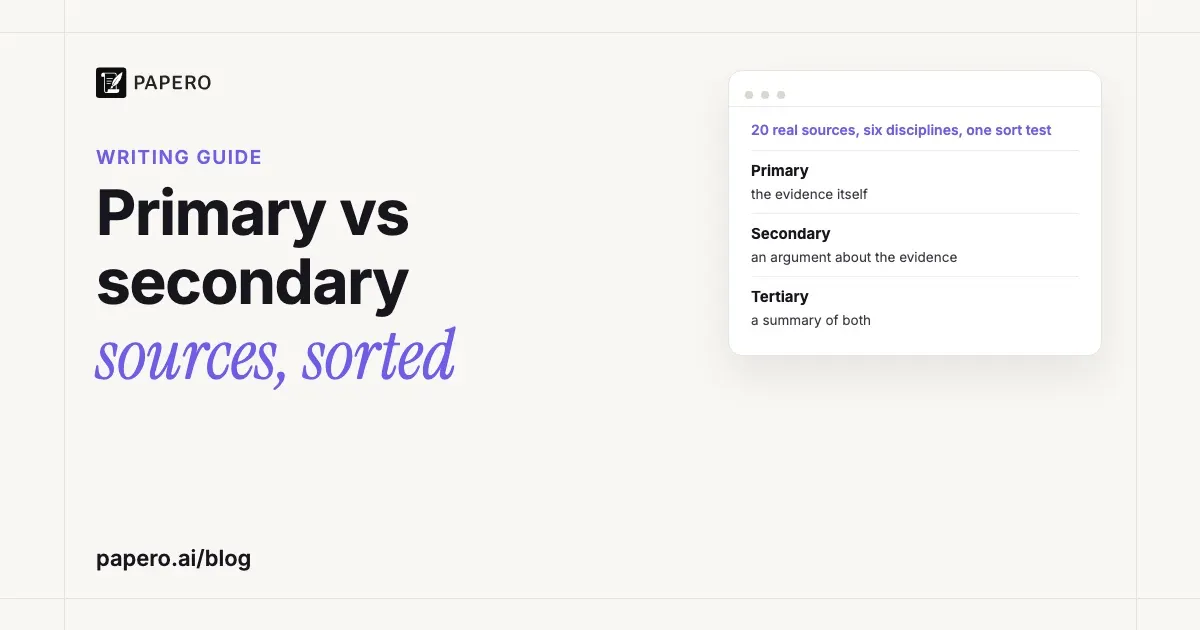
Primary vs secondary sources is a question of distance. A primary source is first-hand evidence: a letter, a photograph, a dataset, a court decision, or a research article reporting its own experiment. A secondary source interprets primary sources, as a biography, a review article or a history book does. Tertiary sources, such as encyclopedias, summarize both. The same document can change class depending on the question you ask of it.
Key Takeaways
- Primary sources are the evidence itself. Secondary sources are someone’s interpretation of that evidence. Tertiary sources condense both for quick reference.
- What counts as primary changes by field: a novel in literature, a research article in the sciences, a court decision in law, survey responses in the social sciences.
- The label depends on use. A newspaper report on a memory study is secondary for the science and primary for an essay on press coverage.
- Textbooks are the classic disagreement: some library guides call them secondary, others tertiary.
- Cite what you actually read. If you only saw a source quoted in another one, APA writes “as cited in” and MLA writes “qtd. in”.
What is the difference between primary and secondary sources?
A primary source was created at the time or by someone directly involved, or it reports original research for the first time. A secondary source was written later or by someone outside the events, and it describes, analyses or interprets primary sources. The difference is distance: a primary source is the evidence, a secondary source is an argument about the evidence. Tertiary sources sit one step further away.
The Library of Congress calls primary sources “the raw materials of history”, meaning “original documents and objects that were created at the time under study”. Secondary sources, in its words, are “accounts that retell, analyze, or interpret events, usually at a distance of time or place.” The University of Kentucky Libraries’ guide adds the third tier: a tertiary source “presents summaries or condensed versions of materials, usually with references back to the primary and/or secondary sources.”
| Primary | Secondary | Tertiary | |
|---|---|---|---|
| What it is | The evidence or the first report of it | Interpretation or analysis of primary sources | A summary of primary and secondary sources |
| Who made it | A participant, a witness, or the researchers who did the work | Someone writing later, or from outside the events | An editor or reference writer compiling what is known |
| Examples | Letters, diaries, photographs, datasets, court decisions, research articles | Biographies, review articles, history books, critical essays | Encyclopedias, dictionaries, handbooks, many introductory textbooks |
| What you use it for | Evidence for your own analysis | Other scholars’ readings to agree or argue with | Background, terms, and leads to the sources worth citing |
Papero’s glossary entries define each term in a sentence: a primary source is the raw material you analyse, and a secondary source sits one step removed from it.
Primary vs secondary sources by discipline
Each field has its own idea of what counts as the evidence. Historians mean documents and objects from the period; literary scholars mean the text under study; scientists mean the article in which researchers first report their own study; lawyers mean the law itself. Secondary sources follow from that: whatever interprets the field’s evidence. The table below sets the three tiers side by side for six disciplines.
| Discipline | Primary | Secondary | Tertiary |
|---|---|---|---|
| History | Letters, diaries, speeches, photographs, official records, newspapers from the time | Biographies, history books, journal articles about the period, documentaries | Encyclopedia entries, chronologies, lists of battle sites |
| Literature | The novel, poem or play you are analysing; the author’s letters and drafts | Critical essays and books about the work | Dictionaries of literary terms, author encyclopedias |
| Sciences | Research articles, preprints, conference papers, lab notebooks, patents, datasets | Review articles, meta-analyses, monographs; textbooks in some guides | Encyclopedias, handbooks, compiled data tables; textbooks in other guides |
| Social sciences | Survey responses, interview transcripts, census tables, opinion polls | Articles and books that interpret other researchers’ findings | Handbooks, subject encyclopedias, dictionaries of terms |
| Law and policy | Constitutions, statutes, court decisions, regulations, treaties | Law review articles, treatises, restatements, legal encyclopedias and dictionaries | Rarely a separate tier: law libraries count encyclopedias as secondary |
| Arts | The painting, building, score, recording or performance itself | A critical review of the work, a monograph on the artist | An encyclopedia entry on the artist |
Two rows break the usual pattern. In the sciences, the Kentucky guide defines primary sources as “documents that provide full description of the original research”, so a peer-reviewed article reporting an experiment is primary even though it was written after the experiment ended.
Law libraries usually work with two tiers, primary and secondary authority. Boston College Law Library puts it plainly: “Primary authority is the law itself. It can take the form of constitutions, statutes, cases, and regulations.” Secondary sources “explain, analyze, or comment on the law” and include “treatises, restatements, law review articles, legal dictionaries, and legal news.” A legal dictionary that a history guide would call tertiary is a secondary source to a law librarian.
Primary, secondary or tertiary? A sort test of 20 real sources
Each source below is real and listed under Sources, with a link where one exists. The verdict assumes you are using the source for its own subject: the letter for 1776, the study for memory research, the decision for school segregation law. Cover the last two columns and try to sort them yourself first; rows 2, 3, 10, 11 and 12 come back in the next section, and row 13 in the one after it.
| # | Source | Verdict | Why |
|---|---|---|---|
| 1 | John Adams, letter to Abigail Adams, 3 July 1776 (Massachusetts Historical Society) | Primary | Written in Philadelphia the day after the date it calls “the most memorable Epocha, in the History of America” |
| 2 | David McCullough, John Adams (Simon & Schuster, 2001) | Secondary | A biography written more than two centuries later |
| 3 | Ken Burns, The Civil War (PBS, 1990) | Secondary | A documentary made 125 years after the war ended; the archival photographs in it are primary |
| 4 | Dorothea Lange, “Migrant Mother”, Nipomo, California, March 1936 (Library of Congress) | Primary | A photograph taken at the place and time it shows |
| 5 | Frederick Douglass, Narrative of the Life of Frederick Douglass (1845) | Primary | A first-hand account of his own enslavement, though written after his escape |
| 6 | Charles Darwin, On the Origin of Species, 1st ed. (1859) | Primary | Darwin’s own statement of his theory, in the edition he first published |
| 7 | Watson and Crick, “Molecular Structure of Nucleic Acids”, Nature (1953) | Primary | The authors’ own report of their proposed structure for DNA |
| 8 | Roediger and Karpicke, “Test-Enhanced Learning”, Psychological Science (2006) | Primary | Reports two experiments the authors ran themselves |
| 9 | Karpicke and Blunt, “Retrieval Practice Produces More Learning than Elaborative Studying with Concept Mapping”, Science (2011) | Primary | Reports the authors’ own experiments comparing retrieval practice with concept mapping |
| 10 | Pam Belluck, “To Really Learn, Quit Studying and Take a Test”, The New York Times, 20 January 2011 | Secondary | A journalist’s account of study 9, published the day the study appeared online |
| 11 | Dunlosky et al., “Improving Students’ Learning With Effective Learning Techniques” (2013) | Secondary | A review that evaluates published research on 10 learning techniques |
| 12 | Adesope et al., “Rethinking the Use of Tests: A Meta-Analysis of Practice Testing” (2017) | Secondary | Pools results from earlier studies; the combined estimate is new, the data are not |
| 13 | Spielman et al., Psychology 2e (OpenStax, 2020) | Tertiary or secondary | Guides disagree on textbooks; see below |
| 14 | Wikipedia, “Testing effect” | Tertiary | An encyclopedia article that summarizes studies and cites them, Roediger and Karpicke (2006) among them |
| 15 | U.S. Census Bureau, 2020 Census Apportionment Results (April 2021) | Primary | The official counts produced by the census itself |
| 16 | OECD, PISA 2022 Database | Primary | Individual responses from students, principals, teachers and parents, released for others to analyse |
| 17 | Brown v. Board of Education, 347 U.S. 483 (1954) | Primary | A Supreme Court decision is the law itself |
| 18 | Derrick A. Bell Jr., “Brown v. Board of Education and the Interest-Convergence Dilemma”, Harvard Law Review (1980) | Secondary | A law review comment interpreting the decision 26 years later |
| 19 | Jane Austen, Pride and Prejudice (1813) | Primary | In a literature essay, the novel is the text under analysis |
| 20 | Vaswani et al., “Attention Is All You Need”, arXiv (2017) | Primary | Original research posted as a preprint; peer review does not decide the class |
Rows 8 to 12 and row 14 follow one topic, retrieval practice, up the chain: two experiments, a news report on one of them, a review, a meta-analysis and an encyclopedia article. Our literature review example on retrieval practice draws on four of these studies, which makes it a secondary source of its own.
Row 1 holds a smaller lesson. The Massachusetts Historical Society’s online letter shows the manuscript pages beside a transcription taken from a printed edition, Adams Family Correspondence (volume 2, 1963). A transcription or a digitised copy is still treated as the primary source, but cite the copy you actually read, because editors make choices.
When does the answer depend on your research question?
Whenever you use a source for something other than its own subject. A source is primary when you use it as direct evidence, and secondary when you use it for someone’s interpretation of other evidence. The Kentucky guide states it as a rule: “the research application of a source will determine its source type.” Wikipedia’s own sourcing policy says the same: “A source may be considered primary for one statement but secondary for a different one.”
A newspaper article. Belluck’s 2011 report is secondary for the science of memory: she describes a study someone else ran. For an essay on how newspapers explain learning research, the same article is primary, because press coverage is now the thing you are studying. A newspaper report written as an event happened, such as one on election night, is primary for the event itself.
A review article. Dunlosky et al. (2013) is secondary for the question “does practice testing work?”. It becomes primary if your topic is study advice: their abstract states that practice testing and distributed practice “received high utility assessments”, and a paper on how that verdict spread into teacher training would treat the review as its evidence.
A meta-analysis. Adesope et al. (2017) produce a new pooled number, which tempts students to call it primary research. For most assignments it counts as secondary, because every data point comes from a study someone else published. If your instructor or field treats systematic reviews as research in their own right, follow that.
A biography. McCullough’s John Adams is secondary for Adams’s life. For a study of how popular history portrayed the founders around 2001, it is primary.
A documentary. Burns’s The Civil War is secondary for the war, and the 1860s photographs it shows are primary sources inside it. For a film studies essay on documentary technique, the film itself is primary.
A thesis. Its literature review chapter (often Chapter 2) is secondary writing: it synthesizes published studies. The same thesis’s results chapter is primary research, because it reports data the author collected. If another thesis’s review leads you to a study, read and cite the study itself.
Datasets add one more distinction. The PISA 2022 Database holds raw responses and is primary; a paper you write from it is your analysis of data someone else collected, and your methods section should say so. The methods section is also where you report the published reliability and validity evidence for any questionnaire you borrow, and our guide to reliability vs validity gives a sample paragraph for the Satisfaction With Life Scale.
What is a tertiary source?
A tertiary source condenses primary and secondary sources into a reference work: encyclopedias, dictionaries, handbooks, chronologies and, by many accounts, introductory textbooks. You use it to learn a topic’s outline, its vocabulary and its key studies. You rarely cite it in an academic paper, because it adds no new evidence and no new argument of its own.
Wikipedia describes itself this way. Its “No original research” policy defines tertiary sources as “publications such as encyclopedias and other compendia that summarize, and often quote, primary and secondary sources”, and adds: “Wikipedia is considered to be a tertiary source.” The same policy states that “Many introductory undergraduate-level textbooks are regarded as tertiary sources because they sum up multiple secondary sources.” The Kentucky guide, by contrast, lists textbooks among secondary sources in the sciences. That disagreement is why row 13 carries two labels.
The practical rule does not depend on the label. APA’s guidance on secondary sources asks you, “rather than citing an instructor’s lecture or a textbook or encyclopedia that in turn cites original research, find, read, and cite the original research directly (unless an instructor has directed you to do otherwise).” Use the Wikipedia article on the testing effect to find Roediger and Karpicke (2006), then cite the 2006 article.
Answers from an AI chatbot do not fit any of the three tiers: the same prompt can give the next reader a different answer, and the references they produce can be invented. Our guide to spotting fake AI references shows how to check whether a reference names a real paper before you go looking for it.
How do primary and secondary sources change the way you cite?
Cite the source you actually read. If you read a primary source in full, cite it directly. If you only met it quoted or summarized inside another work, name the original author, in your sentence or in the citation, and cite the work you read: APA adds “as cited in”, MLA adds “qtd. in”. Only the work you read goes in your reference list or works cited list.
APA uses the terms in a narrower sense than a library guide does: “In scholarly work, a primary source reports original content; a secondary source refers to content first reported in another source.” It asks you to cite secondary sources “sparingly”, for instance “when the original work is out of print, unavailable, or available only in a language that you do not understand.”
Here is a real case. Dunlosky et al.’s 2013 review lists in its references a 1917 work by A. I. Gates in Archives of Psychology. If you cannot get hold of Gates’s work and rely on the review’s account of it, the APA citation is:
(Gates, 1917, as cited in Dunlosky et al., 2013)
Only Dunlosky et al. (2013) goes in your reference list. When the year of the original is unknown, APA leaves it out, as in its own example: Allport’s diary (as cited in Nicholson, 2003). The full set of in-text cases is in our guide to APA in-text citation.
Citing the review for its own conclusion is different. “Practice testing received a high utility rating (Dunlosky et al., 2013)” needs no “as cited in”, because the rating is the review’s own content.
MLA puts “qtd. in” before the source you read. Here is the MLA Style Center’s example, from a 2023 post on indirect sources written after the ninth edition of the MLA Handbook:
According to Alexander Pope, “A little learning is a dang’rous thing” (qtd. in Damrosch 239).
The works cited list holds only Damrosch’s book, The Imaginative World of Alexander Pope. Our MLA in-text citation guide covers the remaining cases, from two authors to sources without page numbers.
Where Papero fits
Papero is an AI writing workspace for students and researchers, and its sourcing tools help you get from a summary back to the original. Find papers searches more than 250 million papers through OpenAlex, citation search results mark retracted papers and preprints, and you can look a work up by its DOI, PMID, arXiv ID or ISBN. When a review or a textbook points you to a study, you can find that study, read it and cite it directly.
Chat answers questions only from the PDFs in your library and the document you are writing, and cites the passages it used, with the page when it is certain, so you can check what a source says before you cite it. The find sources page shows how searching and citing fit together. Deciding whether a source is primary or secondary for your question stays with you.
Frequently Asked Questions
Is a newspaper article a primary or secondary source?
It depends on how you use it. A report written as an event happened is a primary source for that event. An article describing someone else’s research is a secondary source for the research. Any newspaper article becomes primary when your topic is the press itself, such as how papers covered an election or a scientific finding.
Is a peer-reviewed journal article a primary source?
A research article that reports the authors’ own study, with methods and results, is a primary source in the sciences and social sciences. In history and literature, a journal article about a period or a text is a secondary source. A review article or meta-analysis in the same journal is a secondary source, because it summarizes or pools studies others published. Peer review does not decide the category; the content does.
Is a textbook a primary, secondary or tertiary source?
Guides disagree. Wikipedia’s sourcing policy regards many introductory undergraduate textbooks as tertiary because they sum up secondary sources, while the University of Kentucky Libraries list textbooks among secondary sources in the sciences. Either way, a textbook is rarely what you should cite in a research paper: use it to find the original studies.
Is Wikipedia a primary or secondary source?
Wikipedia is a tertiary source, and its own policy says so. Like other encyclopedias, it summarizes primary and secondary sources. Use an article for background and follow its references to the original studies or books, then cite those.
Can a source be both primary and secondary?
Yes. A documentary is secondary for the history it tells, but the archival photographs inside it are primary. A review article is secondary for the research it covers and primary for a study of how advice in that field changed. Classify the source by the job it does in your argument.
Are interviews primary sources?
Yes. An interview you conduct, an oral history recording and a published interview transcript are primary sources, because they record the speaker’s own words. An article that summarizes or analyses interviews someone else conducted is a secondary source.
Sources
- Library of Congress, “Getting Started with Primary Sources” (loc.gov, accessed November 2026 through the Internet Archive, capture of 6 October 2026): https://www.loc.gov/programs/teachers/getting-started-with-primary-sources/
- University of Kentucky Libraries, “Primary, Secondary, & Tertiary Sources: Examples by Discipline” (libguides.uky.edu, last updated 4 September 2026): https://libguides.uky.edu/sourcetypes/examples
- Boston College Law Library, “Basic Legal Research Process: The Research Process” (lawguides.bc.edu, last updated 12 December 2025): https://lawguides.bc.edu/tips/TheResearchProcess
- Austin Peay State University Woodward Library, “Types of Sources” (library.apsu.edu, accessed November 2026): https://library.apsu.edu/services/howto/types_of_sources.html
- Wikipedia, “Wikipedia:No original research”, section “Primary, secondary and tertiary sources” (en.wikipedia.org, accessed November 2026): https://en.wikipedia.org/wiki/Wikipedia:No_original_research
- American Psychological Association, “Secondary sources” (apastyle.apa.org, created 2019, updated July 2022, Publication Manual 7th ed., section 8.6; accessed November 2026 through the Internet Archive): https://apastyle.apa.org/style-grammar-guidelines/citations/secondary-sources
- MLA Style Center, “Where should the original author’s name appear when citing indirect sources?” (style.mla.org, 20 September 2023): https://style.mla.org/citing-indirect-sources/
- Adams, J. (1776, July 3). Letter from John Adams to Abigail Adams, 3 July 1776, “Had a Declaration…”. Adams Family Papers: An Electronic Archive, Massachusetts Historical Society. https://www.masshist.org/digitaladams/archive/doc?id=L17760703jasecond
- McCullough, D. (2001). John Adams. Simon & Schuster.
- Burns, K. (Director). (1990). The Civil War [TV series]. PBS; WETA. https://www.pbs.org/kenburns/civil-war/
- Lange, D. (1936). Destitute pea pickers in California. Mother of seven children. Age thirty-two. Nipomo, California [“Migrant Mother”; photograph]. Library of Congress Prints and Photographs Division. https://www.loc.gov/pictures/item/2017762891/
- Douglass, F. (1845). Narrative of the life of Frederick Douglass, an American slave. Project Gutenberg, eBook #23. https://www.gutenberg.org/ebooks/23
- Darwin, C. (1859). On the origin of species by means of natural selection (1st ed.). Project Gutenberg, eBook #1228. https://www.gutenberg.org/ebooks/1228
- Watson, J. D., & Crick, F. H. C. (1953). Molecular structure of nucleic acids: A structure for deoxyribose nucleic acid. Nature, 171(4356), 737–738. https://doi.org/10.1038/171737a0
- Roediger, H. L., III, & Karpicke, J. D. (2006). Test-enhanced learning: Taking memory tests improves long-term retention. Psychological Science, 17(3), 249–255. https://doi.org/10.1111/j.1467-9280.2006.01693.x
- Karpicke, J. D., & Blunt, J. R. (2011). Retrieval practice produces more learning than elaborative studying with concept mapping. Science, 331(6018), 772–775. https://doi.org/10.1126/science.1199327
- Belluck, P. (2011, January 20). To really learn, quit studying and take a test. The New York Times. https://www.nytimes.com/2011/01/21/science/21memory.html
- Dunlosky, J., Rawson, K. A., Marsh, E. J., Nathan, M. J., & Willingham, D. T. (2013). Improving students’ learning with effective learning techniques: Promising directions from cognitive and educational psychology. Psychological Science in the Public Interest, 14(1), 4–58. https://doi.org/10.1177/1529100612453266
- Adesope, O. O., Trevisan, D. A., & Sundararajan, N. (2017). Rethinking the use of tests: A meta-analysis of practice testing. Review of Educational Research, 87(3), 659–701. https://doi.org/10.3102/0034654316689306
- Spielman, R. M., Jenkins, W. J., & Lovett, M. D. (2020). Psychology 2e. OpenStax. https://openstax.org/details/books/psychology-2e
- Wikipedia, “Testing effect” (en.wikipedia.org, accessed November 2026): https://en.wikipedia.org/wiki/Testing_effect
- U.S. Census Bureau. (2021). 2020 Census apportionment results. https://www.census.gov/data/tables/2020/dec/2020-apportionment-data.html
- OECD. (n.d.). PISA 2022 database. https://www.oecd.org/en/data/datasets/pisa-2022-database.html
- Brown v. Board of Education, 347 U.S. 483 (1954). U.S. Reports, Library of Congress. https://www.loc.gov/item/usrep347483/
- Bell, D. A., Jr. (1980). Brown v. Board of Education and the interest-convergence dilemma. Harvard Law Review, 93(3), 518–533. https://doi.org/10.2307/1340546
- Austen, J. (1813). Pride and prejudice. Project Gutenberg, eBook #1342. https://www.gutenberg.org/ebooks/1342
- Vaswani, A., Shazeer, N., Parmar, N., Uszkoreit, J., Jones, L., Gomez, A. N., Kaiser, L., & Polosukhin, I. (2017). Attention is all you need (arXiv:1706.03762). arXiv. https://arxiv.org/abs/1706.03762