IEEE citation format numbers your sources in the order you first cite them. In the text, each number sits in square brackets on the line, inside the punctuation, as in [1]. The reference list, titled References, gives the sources in that same numbered order, not alphabetically. IEEE is the standard style in electrical engineering, electronics and computer science, and these rules come from IEEE’s Reference Guide, version 3.28.2025.
Key Takeaways
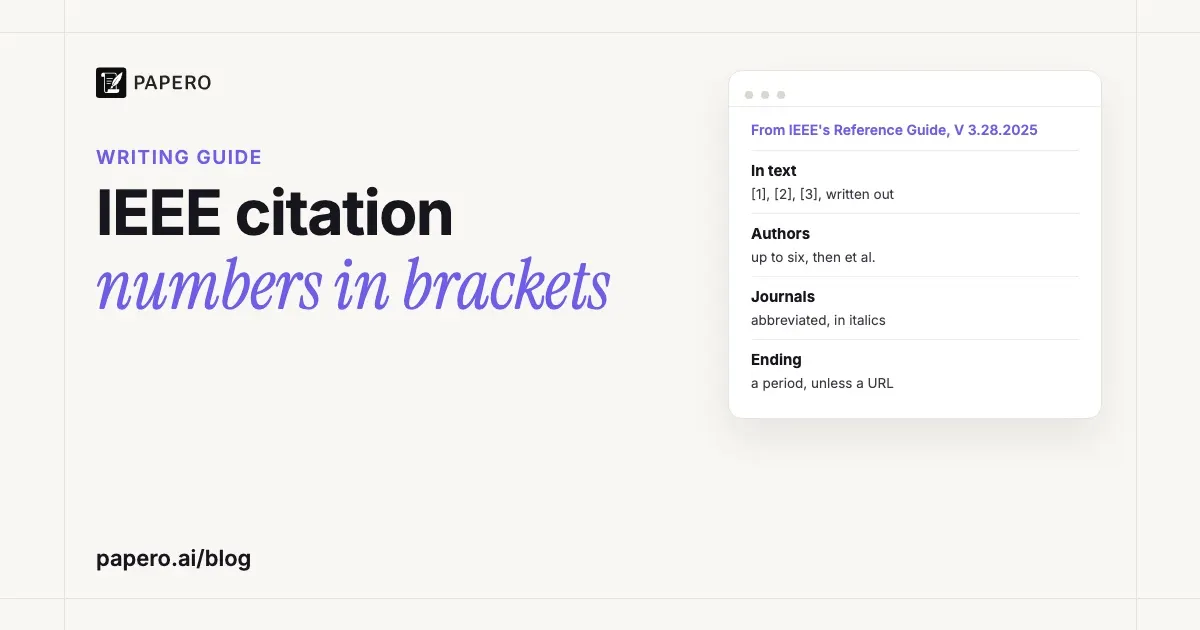
- In the text: a number in square brackets, on the line and before the punctuation. A source keeps its first number every time you cite it again.
- Several sources at once: write every number out, as in [1], [2], [3]. The current IEEE guide no longer joins a run of numbers with a dash.
- Authors: list up to six; with seven or more, give the first author and et al. In the text, use et al. for three or more names.
- Article, chapter and paper titles go in quotation marks. Journal, book and conference names go in italics, and journal and conference names are abbreviated: IEEE Trans. Inf. Theory.
- Every reference ends with a period, DOIs included, unless it ends with a URL.
IEEE reference format: examples by source type
An IEEE reference starts with the authors, initials first, then the title, then the details of where the work appeared. Titles of articles, chapters, papers, theses and patents go in quotation marks; journals, books, conference proceedings and standards are in italics. A journal entry gives the volume, issue, pages, month and year in that order, then the DOI. Every example below is a real work, checked against its Crossref, DataCite or publisher record in November 2026.
| Source | IEEE reference |
|---|---|
| Journal article, up to 6 authors | Y. LeCun, Y. Bengio, and G. Hinton, “Deep learning,” Nature, vol. 521, no. 7553, pp. 436–444, May 2015, doi: 10.1038/nature14539. |
| Journal article, 7 or more authors | O. Russakovsky et al., “ImageNet large scale visual recognition challenge,” Int. J. Comput. Vis., vol. 115, no. 3, pp. 211–252, Dec. 2015, doi: 10.1007/s11263-015-0816-y. |
| Conference paper | K. He, X. Zhang, S. Ren, and J. Sun, “Deep residual learning for image recognition,” in 2016 IEEE Conf. Comput. Vis. Pattern Recognit. (CVPR), Las Vegas, NV, USA, Jun. 2016, pp. 770–778, doi: 10.1109/CVPR.2016.90. |
| Book | I. Goodfellow, Y. Bengio, and A. Courville, Deep Learning. Cambridge, MA, USA: MIT Press, 2016. |
| Chapter in an edited book | S. Schulz, R. Stegwee, and C. Chronaki, “Standards in healthcare data,” in Fundamentals of Clinical Data Science, P. Kubben, M. Dumontier, and A. Dekker, Eds., Cham, Switzerland: Springer, 2019, pp. 19–36, doi: 10.1007/978-3-319-99713-1_3. |
| Thesis | C. E. Shannon, “A symbolic analysis of relay and switching circuits,” M.S. thesis, Dept. Elect. Eng., Massachusetts Inst. Technol., Cambridge, MA, USA, 1940. [Online]. Available: https://hdl.handle.net/1721.1/11173 |
| Standard | IEEE Standard for Floating-Point Arithmetic, IEEE Standard 754-2019, 2019, doi: 10.1109/IEEESTD.2019.8766229. |
| Patent | L. Page, “Method for node ranking in a linked database,” U.S. Patent 6 285 999, Sep. 4, 2001. |
| Website | “IEEE Editorial Style Manual.” IEEE Author Center Journals. Accessed: Nov. 1, 2026. [Online]. Available: https://journals.ieeeauthorcenter.ieee.org/your-role-in-article-production/ieee-editorial-style-manual/ |
| Dataset | R. A. Fisher, 1936, “Iris,” UCI Machine Learning Repository, doi: 10.24432/C56C76. |
| Online video | 3Blue1Brown. But What Is a Neural Network? | Deep Learning Chapter 1. (Oct. 5, 2017). Accessed: Nov. 1, 2026. [Online Video]. Available: https://www.youtube.com/watch?v=aircAruvnKk |
| Preprint on arXiv | A. Vaswani et al., “Attention is all you need,” 2017, arXiv:1706.03762. |
The ImageNet paper has 12 authors, so only the first is named. Crossref dates it April 2015 online and December 2015 in print, and the guide says an article in a volume takes the volume and issue date: Dec. 2015. The book’s city comes from the guide’s own list of publishers (“MIT Press, Cambridge, MA, USA”).
The website has no named author, so it opens with the page title. The Transformer paper also appeared in Advances in Neural Information Processing Systems 30 (2017), and the guide says to cite the publisher’s version rather than arXiv once one exists, so keep the arXiv form for work that is only a preprint.
How do you write an IEEE in-text citation?
Put the reference number in square brackets at the point where you use the source, on the line and inside the punctuation, so it comes before a period or comma. Number sources in the order you first cite them and reuse a source’s number every time it comes back. The number can work as a noun or close a clause the way a footnote mark would.
Most rows below are the IEEE guide’s own examples. Purdue OWL and Victoria University’s library guide add one habit: write “in [1]”, not “in reference [1]”.
| Situation | IEEE in-text citation |
|---|---|
| One source | …trained much deeper networks [3]. |
| Number used as a noun | As shown in [3], residual networks… |
| One author named | as shown by Brown [4], [5] |
| Two authors, or two works | Smith [4] and Brown and Jones [5] |
| Three or more authors | Wood et al. [7] |
| Several sources | as mentioned earlier [2], [4], [5], [6], [7], [9] |
| A part of a source | [3, Fig. 1]; [3, pp. 5–10]; [3, Sect. 4.5]; [3, eq. (2)]; [3, Thm. 1] |
On runs of numbers, the guide now says reference ranges in text “will not include an en dash” and that “[1]–[4]” becomes “[1], [2], [3], [4]”. If a course handout or conference template asks for the dashed form, follow the handout.
The guide also rules out “ibid.” and “op. cit.”: cite the earlier number again, with the page, figure or section inside the brackets. And never combine references: each number points to exactly one source.
What does a full IEEE reference list look like?
Title the list References and give the sources in number order, which is the order they first appear in your text. Each number sits in square brackets, flush left, and the numbers form a column of their own with the reference text aligned beside them. Here is a short paragraph and the reference list it produces, using four of the works from the table.
Deep learning lets models built from many processing layers learn their own representations of data [1]. In computer vision, the ImageNet challenge, which began in 2010, gave the field a shared benchmark with hundreds of object categories and millions of images [2]. He et al. [3] trained residual networks up to 152 layers deep and took first place in the ILSVRC 2015 classification task. Convolutional networks, the architecture behind these results, get a full chapter in [4, Ch. 9], and the review in [1] places them in the wider history of the field.
References
[1] Y. LeCun, Y. Bengio, and G. Hinton, “Deep learning,” Nature, vol. 521, no. 7553, pp. 436–444, May 2015, doi: 10.1038/nature14539.
[2] O. Russakovsky et al., “ImageNet large scale visual recognition challenge,” Int. J. Comput. Vis., vol. 115, no. 3, pp. 211–252, Dec. 2015, doi: 10.1007/s11263-015-0816-y.
[3] K. He, X. Zhang, S. Ren, and J. Sun, “Deep residual learning for image recognition,” in 2016 IEEE Conf. Comput. Vis. Pattern Recognit. (CVPR), Las Vegas, NV, USA, Jun. 2016, pp. 770–778, doi: 10.1109/CVPR.2016.90.
[4] I. Goodfellow, Y. Bengio, and A. Courville, Deep Learning. Cambridge, MA, USA: MIT Press, 2016.
The LeCun review keeps number 1 when the last sentence cites it again. Chapter 9 of the Goodfellow book is “Convolutional Networks”, so the citation names the chapter inside the brackets and the reference stays the same. The hanging column of numbers is easiest to build with a hanging indent and a tab after each number; our guide to hanging indents in Google Docs and Word shows the setting.
How many authors do you list in an IEEE reference?
List every author up to six. With seven or more, give only the first author’s name followed by et al. Each name is written as initials and then the surname, as in Y. LeCun, with commas between names and “and” before the last one. With three or more names, the comma before “and” stays: I. Goodfellow, Y. Bengio, and A. Courville.
The guide puts it as a rule for IEEE’s own journals: “IEEE publications must list names of all authors, up to six names. If there are more than six names listed, use the primary author’s name followed by ‘et al.’” Purdue OWL gives the same cutoff. Vancouver, the numbered style used in medicine, also lists up to six names in NLM’s sample references, but a longer list keeps the first six before et al.; our Vancouver referencing guide shows both forms of a nine-author article.
A hyphenated given name keeps its hyphen, as in the guide’s J.-L. Dessalles, and suffixes take no commas: W. P. Pratt Jr., not W. P. Pratt, Jr. In the text the threshold is lower: et al. for three or more names, both names for two. Our guide to what et al. means compares the IEEE cut-off with eight other styles on the same 34-author paper.
How do you abbreviate journal and conference names in IEEE?
Abbreviate each word that has an entry in the guide’s list of common abbreviations, spell out the words that do not, and leave one-word titles such as Nature and Science in full. IEEE’s own journals have fixed abbreviations, in IEEE’s list of its journal and magazine titles: IEEE Transactions on Information Theory becomes IEEE Trans. Inf. Theory.
| Word | Abbreviation | Word | Abbreviation |
|---|---|---|---|
| Transactions | Trans. | Communications | Commun. |
| Journal | J. | Computer | Comput. |
| Proceedings | Proc. | Engineering | Eng. |
| Conference | Conf. | Systems | Syst. |
| International | Int. | Technology | Technol. |
| Symposium | Symp. | Letters | Lett. |
For words not on its list, the guide gives shortcuts: “-ology” stops after “-ol.” (Endocrinol.), “-graphy” after “-gr.” (Oceanogr.), and a compound takes the abbreviation of its last part (Bioeng.). Anything else is spelled out: IEEE Trans. Pattern Anal. Mach. Intell. leaves “Pattern” whole.
Conference names drop articles and most prepositions and write ordinals as numerals: the guide turns Proceedings of the 1996 Robotics and Automation Conference into Proc. 1996 Robot. Automat. Conf. Months are abbreviated too. The guide’s examples write Jan., Feb., Mar., Apr., Jun., Jul., Aug., Sep., Oct., Nov. and Dec., keep May whole, and join two months of one issue with a slash: Jul./Aug.
How do you cite DOIs, URLs and access dates in IEEE?
Give the DOI after the other details as “doi:” followed by the number, and end the reference with a period unless a URL follows. For a source read online, add “Accessed:” with the date you viewed it, then “[Online]. Available:” and the URL, with no period after the URL. A source with no date gets “(n.d.)” where the date would go, because every reference needs at least a year.
The guide’s notes on online references list the allowed endings:
| How the reference ends | Period at the end? |
|---|---|
| Accessed date. DOI. [Online]. Available: URL | No |
| Accessed date. [Online]. Available: URL | No |
| Accessed date. DOI. | Yes |
| DOI. URL | No |
| URL | No |
| DOI, with no accessed date | Yes, unless a URL follows |
The guide is not fully consistent here: its website section gives the basic format with “[Online]. Available:” but prints “[Online.] Available:”, period inside the bracket, in its three examples and the sentence that explains them. We use “[Online]. Available:”, the form in the basic format and the rest of the guide; whichever you choose, use it everywhere.
Work that is not out yet has its own wording: “to be published” once accepted, “submitted for publication” while under review, and never “to appear in”. An early access article gives the journal, “early access”, its online date and the DOI, as in the guide’s example: IEEE Commun. Lett., early access, Dec. 11, 2018, doi: 10.1109/LCOMM.2018.2886261.
Where do common IEEE guides differ from IEEE’s own guide?
On several small points, mostly because they were written against older versions of the guide. The most visible is the run of citation numbers: Purdue OWL’s IEEE pages still teach a dashed range, while IEEE has written every number out since at least its November 2023 guide. Before you copy a rule from any guide, check which version of IEEE’s guide it follows.
| Point | IEEE Reference Guide, V 3.28.2025 | Purdue OWL IEEE pages |
|---|---|---|
| A run of numbers | [1], [2], [3], [4] | [3]–[5] |
| Suffix after a name | W. P. Pratt Jr. | E. C. M. Boyle, III |
| Part of a source | [3, Sect. 4.5], [3, Thm. 1] | [6, Sec. XI], [6, Th. 13] |
| Months | Jun., Jul., Sep. | June, July, Sept. |
| End of a website entry | Accessed: date. [Online]. Available: URL | URL (accessed month day, year) |
Victoria University’s IEEE guide follows the November 2023 IEEE guide, but its in-text page gives two thresholds for et al.: “more than three authors” in one paragraph and “three or more names” a few lines later. IEEE’s guide says three or more.
Unless a lecturer or conference template sets other rules, follow the current guide and keep each rule consistent across the paper.
IEEE vs AMA and APA: what is the difference?
IEEE and AMA are both numbered styles: each source gets a number, and the reference list runs in number order, not alphabetically. IEEE writes the number in square brackets on the line, inside the punctuation. AMA, the American Medical Association’s style, uses superscript numbers placed outside periods and commas. APA is an author-date style, so its in-text citations name the author and year instead of a number.
Our guide to AMA citation style covers the medical style, the one on APA in-text citations covers the author-date system, and the IEEE style glossary entry is a one-page summary.
Where Papero fits
Papero is an AI writing workspace for students and researchers. It finds real papers to cite for the sentence you are writing, looks sources up by DOI, PMID, arXiv ID or ISBN, and formats the in-text citations and the reference list in IEEE or one of eight other styles, including APA 7 and AMA 11.
The formatting step is not a language model: Papero runs citeproc-js, an open-source citation engine, with the Citation Style Language’s IEEE style, based on IEEE’s November 2023 guide. Three sources cited together print as [1], [2], [3], and a source with seven or more authors is cut to the first author plus et al. On the free plan, in-text citations work in full and the reference list shows your entries blurred; Plus makes it readable, copyable and exportable. Every plan can export a LaTeX project and open it in Overleaf, with a references.bib file on Plus.
For a few references without an account, the free DOI to citation generator takes up to 10 DOIs at a time and 30 a day, with IEEE among its nine styles. It builds each reference from the paper’s OpenAlex and Crossref records, and the editor formats with the same engine and IEEE style file, so check what either returns against the rules above. We ran the three DOIs in our sample reference list through it on November 2, 2026. The journal came back abbreviated with IEEE’s periods (Int. J. Comput. Vis.), the dates were the issue dates (Dec. 2015 for ImageNet), and the CVPR paper came back in its proceedings with the conference’s location and its pages. Four details still needed fixing by hand: the conference name was spelled out in full instead of abbreviated, the conference paper’s DOI followed a period where IEEE puts a comma, titles kept the capitals of the record where IEEE’s own examples use sentence case, and Hinton gained a middle initial the paper’s byline does not have. Confirm that any reference you did not find yourself exists: our guide to spotting fake AI references shows how. The research paper writing page shows the whole workflow, and you can sign up free.
Frequently Asked Questions
What is the IEEE citation format?
It is the numbered citation style of the Institute of Electrical and Electronics Engineers. Sources are numbered in the order they are first cited, each citation is the number in square brackets, such as [1], and the reference list at the end gives the full sources in that numbered order. IEEE’s rules are set out in its Reference Guide; the current version is dated March 28, 2025.
Does an IEEE citation go before or after the period?
Before. IEEE places the bracketed number on the line and inside the punctuation, so it comes before a period, comma or semicolon: “…for image recognition [3].”
How do you cite multiple sources in IEEE?
Put each number in its own square brackets and separate them with commas, as in [1], [3], [7]. The current IEEE Reference Guide also writes out consecutive numbers in full, so four sources in a row are [1], [2], [3], [4] rather than a dashed range.
How do you cite a website in IEEE?
Give the author’s initials and surname if the page names one, then the page title in quotation marks, the name of the website, “Accessed:” with the date you viewed the page, and “[Online]. Available:” followed by the URL. The reference ends with the URL and no period. A page with no author starts with its title.
Does IEEE use et al.?
Yes, in two places. In the reference list, list all authors up to six; with seven or more, give the first author followed by et al. In the text, use the first author’s surname plus et al. when a source has three or more authors, followed by the bracketed number, as in “Wood et al. [7]”.
Sources
- IEEE Publication Operations, “IEEE Reference Guide,” V 3.28.2025 (© 2025 IEEE; the IEEE Author Center link now opens it as a Google Doc; read November 1, 2026): https://journals.ieeeauthorcenter.ieee.org/wp-content/uploads/sites/7/IEEE_Reference_Guide.pdf
- IEEE, “IEEE Reference Guide,” V 11.29.2023 and the version updated 12 August 2022 (read November 2026 through the Internet Archive): https://web.archive.org/web/20240522144120/http://journals.ieeeauthorcenter.ieee.org/wp-content/uploads/sites/7/IEEE_Reference_Guide.pdf, https://web.archive.org/web/20221007175502/https://journals.ieeeauthorcenter.ieee.org/wp-content/uploads/sites/7/IEEE_Reference_Guide.pdf
- IEEE Author Center Journals, “IEEE Editorial Style Manual” (journals.ieeeauthorcenter.ieee.org, accessed November 1, 2026): https://journals.ieeeauthorcenter.ieee.org/your-role-in-article-production/ieee-editorial-style-manual/
- IEEE, “IEEE journal and magazine titles and reference abbreviations” (spreadsheet linked from the IEEE Author Center, accessed November 1, 2026): https://docs.google.com/spreadsheets/d/1D4xH38098a2xpq0sO16o9gQuje1bq_-GOinRRPTYZac/edit
- Purdue OWL, IEEE Style, “In-Text Citation” and “Reference List” (owl.purdue.edu, accessed November 2026): https://owl.purdue.edu/owl/research_and_citation/ieee_style/in-text_citation.html, https://owl.purdue.edu/owl/research_and_citation/ieee_style/reference_list.html
- Victoria University Library, “IEEE Referencing: Citing sources in the text” and the guide’s home page (libraryguides.vu.edu.au, accessed November 2026): https://libraryguides.vu.edu.au/ieeereferencing/CitingSources, https://libraryguides.vu.edu.au/ieeereferencing/home
- Purdue OWL, “AMA Style” (owl.purdue.edu, accessed November 2026): https://owl.purdue.edu/owl/research_and_citation/ama_style/index.html
- American Psychological Association, “Author–date citation system” (apastyle.apa.org, read November 2026 through the Internet Archive): https://apastyle.apa.org/style-grammar-guidelines/citations/basic-principles/author-date
- Citation Style Language, IEEE style (“IEEE Reference Guide version 11.29.2023”), styles repository: https://github.com/citation-style-language/styles/blob/master/ieee.csl
- Y. LeCun, Y. Bengio, and G. Hinton, “Deep learning,” Nature, vol. 521, no. 7553, pp. 436–444, May 2015: https://doi.org/10.1038/nature14539
- O. Russakovsky et al., “ImageNet large scale visual recognition challenge,” Int. J. Comput. Vis., vol. 115, no. 3, pp. 211–252, Dec. 2015: https://doi.org/10.1007/s11263-015-0816-y; abstract of the arXiv version: https://arxiv.org/abs/1409.0575
- K. He, X. Zhang, S. Ren, and J. Sun, “Deep residual learning for image recognition,” CVPR 2016, pp. 770–778: https://doi.org/10.1109/CVPR.2016.90
- I. Goodfellow, Y. Bengio, and A. Courville, Deep Learning, MIT Press, 2016 (the authors’ site, with the table of contents): https://www.deeplearningbook.org/
- S. Schulz, R. Stegwee, and C. Chronaki, “Standards in healthcare data,” in Fundamentals of Clinical Data Science, Springer, 2019, pp. 19–36: https://doi.org/10.1007/978-3-319-99713-1_3
- C. E. Shannon, “A symbolic analysis of relay and switching circuits,” M.S. thesis, MIT, 1940 (MIT DSpace record): https://hdl.handle.net/1721.1/11173
- IEEE Standard for Floating-Point Arithmetic, IEEE Std 754-2019: https://doi.org/10.1109/IEEESTD.2019.8766229
- L. Page, “Method for node ranking in a linked database,” U.S. Patent 6 285 999, Sep. 4, 2001 (Google Patents record): https://patents.google.com/patent/US6285999B1/en
- R. A. Fisher, “Iris,” UCI Machine Learning Repository, 1936 (DataCite record): https://doi.org/10.24432/C56C76
- 3Blue1Brown, “But what is a neural network? | Deep learning chapter 1” (YouTube, October 5, 2017): https://www.youtube.com/watch?v=aircAruvnKk
- A. Vaswani et al., “Attention is all you need,” arXiv:1706.03762, 2017: https://arxiv.org/abs/1706.03762; proceedings version in Advances in Neural Information Processing Systems 30: https://papers.nips.cc/paper_files/paper/2017/hash/3f5ee243547dee91fbd053c1c4a845aa-Abstract.html