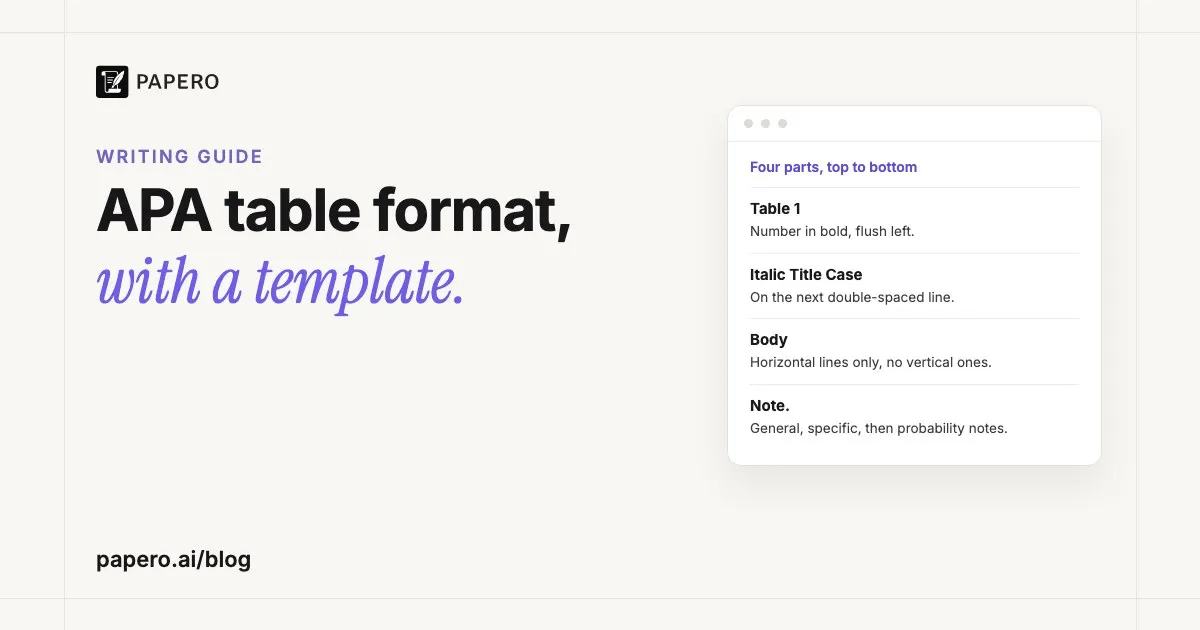
In APA table format, every table has four parts in a fixed order: the table number in bold (“Table 1”), a title on the next line in italic title case, the body with horizontal lines only, and an optional note below that starts with the word Note in italics. The number, title, table and note are left-aligned; column headings are centered, and so are short entries in the body. The number, title and note are double-spaced.
Key Takeaways
- Number tables in the order you mention them: Table 1, Table 2. No suffix letters such as 3a; combine related tables instead.
- Title: italic, title case, on its own line under the bold number. Both are left-aligned.
- Lines: horizontal only, at the top, under the column headings and at the bottom. No vertical lines and no box around each cell.
- Notes come in three types and in this order: general, specific, probability.
- Data that would fill only two rows or columns belongs in a sentence, not a table.
APA table format at a glance
An APA table has a bold number and an italic title above it, a body with horizontal rules only, and an optional note below it; the number, title and note sit flush left, and the whole table uses the same font as the paper. This summary follows APA’s Student Paper Setup Guide (last updated October 8, 2025) and the Purdue OWL page on APA tables, which reproduces the table checklist from section 7.20 of the Publication Manual, 7th edition.
| Part | Position | Format |
|---|---|---|
| Table number | Above the table, flush left | Bold: Table 1 |
| Title | One double-spaced line under the number, flush left | Italic Title Case |
| Column headings | Top row | Centered, sentence case |
| Leftmost column (stub) | Body | Left-aligned under a centered stub heading |
| Body cells | Body | Centered if short, left-aligned if long; single, 1.5 or double spacing |
| Note | Below the table, flush left | Starts with Note. in italics, double-spaced |
| Borders | Top, under headings, bottom | Horizontal only |
| Font | Whole table | The same font as your paper |
The rule people miss most often is the spacing. The number, title and note are double-spaced like the rest of the paper, but APA lets you choose single, 1.5 or double spacing inside the table body, whichever reads best.
APA table template
Copy this layout into your document. A code block cannot show bold or italics, so remember that the number is bold and the title is italic.
Table 1

Title of the Table in Italic Title Case

------------------------------------------------------
Stub heading            Column heading    Column heading
------------------------------------------------------
Row label               0.00              0.00
Row label               0.00              0.00
Row label               0.00              0.00
------------------------------------------------------
Note. General note about the table as a whole.
a Specific note about one column, row or cell.
*p < .05. **p < .01.
The three dashed rules are the only lines most tables need. Purdue OWL also allows a short rule between the parts of a decked head, where a column spanner sits over two or more columns that each have their own heading. Leave a cell blank when data do not apply, and if a reader could misread the blank, use a dash and explain it in the general note.
APA table example
Here is a complete example built from a real source. Dunlosky et al. (2013) reviewed 10 learning techniques and gave each an overall utility rating; their abstract lists the ratings, which makes them easy to check.
Table 1
Utility Ratings of 10 Learning Techniques
| Technique | Utility |
|---|---|
| Practice testing | High |
| Distributed practice | High |
| Elaborative interrogation | Moderate |
| Self-explanation | Moderate |
| Interleaved practice | Moderate |
| Summarization | Low |
| Highlighting | Low |
| Keyword mnemonic | Low |
| Imagery use for text learning | Low |
| Rereading | Low |
Note. Ratings from Dunlosky et al. (2013), who judged each technique on whether its benefits generalize across learning conditions, student characteristics, materials and criterion tasks.
This page draws the table with the blog’s own styling, so the cell borders you see are not APA’s. In your paper, keep only the line above the headings, the line under them and the line at the bottom. The word entries are in sentence case, the stub column is left-aligned, and the note explains where the ratings come from, so a reader understands the table without the surrounding text.
When should data go in a table instead of the text?
Use a table when readers need to compare many exact values. Purdue OWL’s guidance is that data needing only two or fewer columns and rows should go in the text, and simple descriptive statistics usually read better in a sentence. A table also has to stand alone: every abbreviation in it is explained in the note, except standard statistical symbols such as M and SD.
A worked case: Cepeda et al. (2008) found that the best gap between study sessions was about 20 to 40% of a 1-week test delay, but only about 5 to 10% of a 1-year delay. That is two rows and one value each. As a table it would be a box around one sentence, so it stays in the text. The 10 ratings above are different: readers scan them and compare, which is what a table is for.
Mention every table in your text by its number, as in “Table 1 shows”, before the table appears, and number tables in the order you first mention them. Purdue OWL adds that APA does not use suffix letters such as Table 3a; combine related tables instead. APA’s setup guide places a table after its first mention, at the bottom of that page, at the top of the next page or on a page of its own, and asks you to avoid the middle of a page.
How do you write an APA table note?
Start with the word Note in italics, followed by a period. APA tables use three kinds of notes, always in this order: a general note about the whole table, specific notes about particular cells, then probability notes for significance levels. A table without anything to explain needs no note at all.
| Note type | What it does | Example |
|---|---|---|
| General | Explains abbreviations, symbols and the source of the data | Note. CI = confidence interval. |
| Specific | Explains one column, row or cell, marked with a superscript lowercase letter | a n = 823. |
| Probability | Gives the p value each asterisk stands for | *p < .05. **p < .01. |
Specific notes are lettered from left to right and top to bottom, and each table starts again at “a”. Purdue OWL adds that the same number of asterisks should mean the same alpha level in every table of the paper.
If a table comes from another source, or reports data you took from one, the note is where the citation goes. Purdue OWL advises copying the original’s structure exactly when you reproduce a table, and citing it in APA style; you may also need the copyright holder’s permission to reproduce it.
How do you make an APA table in Word or Google Docs?
Build the table with the program’s table tool, then remove the lines APA does not use. In Word, select the table and choose Table Design > Borders > No Border, as Microsoft’s support page describes. Then select the heading row and add a top and a bottom border, and select the last row and add a bottom border.
Type the number and title as ordinary paragraphs above the table, never inside it: “Table 1” in bold, the title in italics on the next double-spaced line. Write the note as a paragraph below the table. Google Docs works on the same principle: set the table’s borders to zero, then select the rows that need a rule and give only those edges a border. Section headings, by contrast, are best set up once as styles; our guide to APA heading levels gives the settings for each level.
If a long table runs onto a second page, Word’s Repeat Header Rows option, on the table’s Layout tab, keeps the column headings visible at the top of the next page. A literature review often ends up with a table of its own: the synthesis matrix in our literature review example is one, and it follows the same rules once it moves into the paper. For theses that need a list of tables, the glossary entry on tables in academic writing explains how to generate one in Word.
APA table vs figure: which one?
A table shows exact values in rows and columns; a figure is any other visual, such as a chart, graph or photo. Both use the same parts: a bold number and an italic title above, and an optional note below. The numbering runs separately, so a paper can have Table 1 and Figure 1.
Pick the table when exact numbers matter and the figure when the pattern matters more. Never show the same data both ways. The one formatting difference worth remembering is in the body: a figure’s labels use a sans serif font between 8 and 14 points, while a table uses the same font as the rest of your paper. When the figure is a photo or artwork someone else made, our guide on how to cite an image shows the copyright note that goes under it.
Where Papero fits
Papero is an AI writing workspace for students and researchers. For a research paper, it starts from an IMRaD outline with a prompt for every section, formats citations in nine styles including APA 7, and exports to Word in a double-spaced manuscript layout with a title page and page numbers.
Papero does not know your data, so the numbers in your tables and what they mean are yours to report and check. What it can handle is the citation that a table note needs: look the source up by DOI and insert the APA in-text citation. Our guide to APA in-text citation covers the citation rules, and the abstract examples show how a results section is summarized in 250 words. The research paper writing page walks through the whole workflow, and you can sign up free.
Frequently Asked Questions
Is the title of an APA table italicized?
Yes. The title goes on the line below the table number, in italic title case, flush left: Utility Ratings of 10 Learning Techniques. The number above it, “Table 1”, is bold and not italic. Both lines are double-spaced, like the rest of the paper.
Does an APA table have vertical lines?
No. APA tables use horizontal lines only: one above the column headings, one below them and one at the bottom of the table, plus short rules under any column spanners. Do not put vertical lines between columns or a border around each cell; spacing and alignment separate the columns.
Where does the note go in an APA table?
Below the table, flush left and double-spaced. It starts with the word Note in italics and a period. If you have more than one kind of note, give the general note first, then specific notes marked with superscript letters, then probability notes for asterisks.
Do APA tables need to be double-spaced?
The table number, title and note are double-spaced. The body of the table can be single-spaced, 1.5-spaced or double-spaced, according to APA’s Student Paper Setup Guide; choose whichever makes the table easiest to read, and use the same choice for every table in the paper.
Can you put an APA table at the end of the paper?
Yes, if your instructor asks for it. APA’s default for student papers is to embed each table in the text after its first mention, but the Student Paper Setup Guide points to the Publication Manual and the professional sample paper for the format with tables placed at the end.
Sources
- American Psychological Association, Student Paper Setup Guide, 7th edition, last updated October 8, 2025 (apastyle.apa.org, accessed October 2026): https://apastyle.apa.org/instructional-aids/student-paper-setup-guide.pdf
- Purdue OWL, “Tables and Figures” (APA, including the table checklist from Publication Manual section 7.20) (owl.purdue.edu, accessed October 2026): https://owl.purdue.edu/owl/research_and_citation/apa_style/apa_formatting_and_style_guide/apa_tables_and_figures.html
- Microsoft Support, “Remove borders from a table in Word for Mac” (support.microsoft.com, accessed October 2026): https://support.microsoft.com/en-us/office/remove-borders-from-a-table-in-word-for-mac-820c5aea-46f0-41e7-bbdf-84a46b522d71
- Cepeda, N. J., Vul, E., Rohrer, D., Wixted, J. T., & Pashler, H. (2008). Spacing effects in learning: A temporal ridgeline of optimal retention. Psychological Science, 19(11), 1095–1102. https://doi.org/10.1111/j.1467-9280.2008.02209.x
- Dunlosky, J., Rawson, K. A., Marsh, E. J., Nathan, M. J., & Willingham, D. T. (2013). Improving students’ learning with effective learning techniques: Promising directions from cognitive and educational psychology. Psychological Science in the Public Interest, 14(1), 4–58. https://doi.org/10.1177/1529100612453266