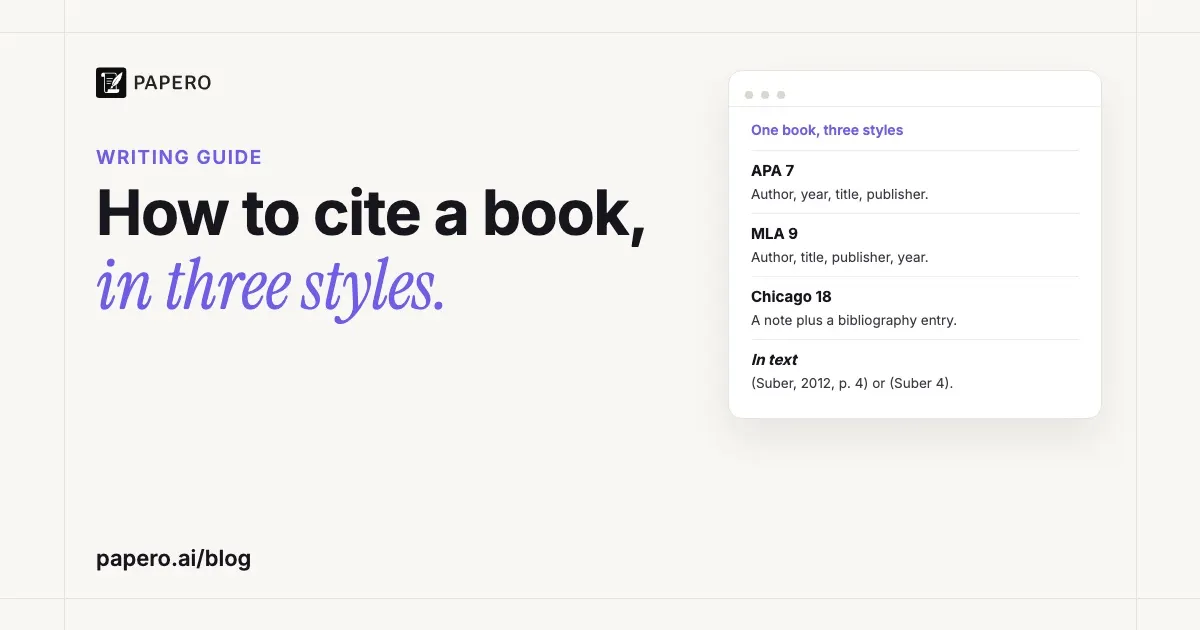
To cite a book, take the author, title, edition, publisher and year from the book’s title page and copyright page, then arrange them in your style’s order. MLA 9 and the Chicago 18 bibliography: Suber, Peter. Open Access. MIT Press, 2012. In the text, point to the page: (Suber 4) in MLA, (Suber, 2012, p. 4) in APA, or a Chicago footnote. APA 7 puts the year second and ends with the book’s DOI: Suber, P. (2012). Open access. MIT Press. https://doi.org/10.7551/mitpress/9286.001.0001
Key Takeaways
- Every style needs the same facts: author, title, edition if it is not the first, publisher and year. The ISBN is not part of the citation.
- APA 7 uses initials, puts the year after the author, writes titles in sentence case and adds the book’s DOI if it has one.
- MLA 9 and Chicago 18 use full names and title case. None of the three needs the city of publication for most modern books.
- Chicago has two systems: footnotes with a bibliography, or author-date citations such as (Suber 2012, 4).
- Cite the edition you read. Darwin’s Origin of Species changed between editions, down to its last sentence.
How to cite a book in APA, MLA and Chicago
A book citation has two parts: an entry in the list at the end of your paper and a short citation in the text that points to it. APA and Chicago author-date put the year in both; MLA cites the author and page in the text; Chicago notes-bibliography puts the details in a numbered footnote. Here is one real book, Peter Suber’s Open Access (MIT Press, 2012), in each style.
| Style | List entry | In-text citation or note |
|---|---|---|
| APA 7 | Suber, P. (2012). Open access. MIT Press. https://doi.org/10.7551/mitpress/9286.001.0001 | (Suber, 2012, p. 4) or Suber (2012) |
| MLA 9 | Suber, Peter. Open Access. MIT Press, 2012. | (Suber 4) |
| Chicago 18, notes-bibliography | Suber, Peter. Open Access. MIT Press, 2012. | 1. Peter Suber, Open Access (MIT Press, 2012), 4. Later: 2. Suber, Open Access, 4. |
| Chicago 18, author-date | Suber, Peter. 2012. Open Access. MIT Press. | (Suber 2012, 4) |
Page 4 holds the book’s definition: Suber (2012) calls open-access literature “digital, online, free of charge, and free of most copyright and licensing restrictions” (p. 4). That sentence is the APA narrative form, with the year after the name and the page after the quotation.
Three differences cause most mistakes. APA capitalizes only the first word of the title and subtitle, and proper nouns; MLA and Chicago capitalize every major word. APA asks for the DOI whenever a book has one, so its entry carries the DOI even if you read the paperback; MLA and Chicago add it for a copy read online. And a Chicago note uses commas and parentheses where the bibliography uses periods. Our guide to the APA reference list shows APA book entries in a full reference list, and the Chicago footnotes guide shows the shortened notes that CMOS 18 prefers to ibid. For the layout of a whole Chicago list, see our guide to the Chicago style bibliography.
What information do you need to cite a book?
You need the author or editor, the full title and subtitle, the edition if it is not the first, the publisher and the year. Take them from the title page first and the copyright page second, rather than from a store listing. For a chapter in an edited book, add the chapter’s author, title and page range.
That order of places to look is the MLA Style Center’s. For the year, APA uses the copyright date on the copyright page, even when the book was released in a different year, so a database record can show another year: Crossref dates Media Effects, 4th edition, to June 2019, while APA’s own example cites a chapter of it as 2020.
The ISBN does not go into the citation. APA says ISBNs are not included in its references, and none of the MLA or Chicago book examples used for this article has one. A DOI is different, because it is a link that resolves to the book.
How do you cite a book with two or more authors?
Name both authors of a two-author book in every style, joined by “&” in APA and “and” in MLA and Chicago. APA inverts every name; MLA and Chicago invert only the first. For three or more authors, in-text citations and Chicago notes use the first author plus “et al.,” and so does an MLA works-cited entry.
| Style | Two authors | Four authors, second edition |
|---|---|---|
| APA 7 | D’Ignazio, C., & Klein, L. F. (2020). Data feminism. MIT Press. https://doi.org/10.7551/mitpress/11805.001.0001 | James, G., Witten, D., Hastie, T., & Tibshirani, R. (2021). An introduction to statistical learning: With applications in R (2nd ed.). Springer. https://doi.org/10.1007/978-1-0716-1418-1 |
| MLA 9 | D’Ignazio, Catherine, and Lauren F. Klein. Data Feminism. MIT Press, 2020. | James, Gareth, et al. An Introduction to Statistical Learning: With Applications in R. 2nd ed., Springer, 2021. |
| Chicago 18 bibliography | D’Ignazio, Catherine, and Lauren F. Klein. Data Feminism. MIT Press, 2020. | James, Gareth, Daniela Witten, Trevor Hastie, and Robert Tibshirani. An Introduction to Statistical Learning: With Applications in R. 2nd ed. Springer, 2021. |
In the text, the two-author book becomes (D’Ignazio & Klein, 2020, p. 3) in APA and (D’Ignazio and Klein 3) in MLA; the four-author book becomes (James et al., 2021) in APA. In the list, APA names up to 20 authors, and Chicago’s quick guide names up to six, giving the first three plus “et al.” for seven or more; MLA 9 names only the first author once a book has three or more. Our guide to MLA in-text citation covers the in-text side of these cases.
How do you cite an edition other than the first?
Add the edition after the title, and leave it out for a first edition. APA puts it in parentheses with no italics and no period before it: (2nd ed.). MLA writes “2nd ed.,” before the publisher. Chicago writes “2nd ed.” after the title in both forms: as a separate element ending in a period in the bibliography, and just before the parentheses in a note.
A Chicago note for the James book reads: 1. Gareth James et al., An Introduction to Statistical Learning: With Applications in R, 2nd ed. (Springer, 2021). The year has to match the edition: the authors’ site dates the first edition 2013 and the second 2021, and page numbers change between them.
How do you cite an edited book or a chapter in one?
When the chapters have different authors, cite the chapter you used. Give the chapter’s author and title, then the editors and the book’s italic title. APA writes the chapter title in plain type, MLA and Chicago in quotation marks. APA and MLA give the chapter’s page range; Chicago 18 no longer requires it in the bibliography.
The example is Kathleen Fitzpatrick’s chapter, pages 351 to 360, in Reassembling Scholarly Communications, edited by Martin Paul Eve and Jonathan Gray (MIT Press, 2020).
| Style | Chapter in an edited book | In-text citation or note |
|---|---|---|
| APA 7 | Fitzpatrick, K. (2020). Not all networks: Toward open, sustainable research communities. In M. P. Eve & J. Gray (Eds.), Reassembling scholarly communications: Histories, infrastructures, and global politics of open access (pp. 351–360). MIT Press. https://doi.org/10.7551/mitpress/11885.003.0035 | (Fitzpatrick, 2020) |
| MLA 9 | Fitzpatrick, Kathleen. “Not All Networks: Toward Open, Sustainable Research Communities.” Reassembling Scholarly Communications: Histories, Infrastructures, and Global Politics of Open Access, edited by Martin Paul Eve and Jonathan Gray, MIT Press, 2020, pp. 351–60. | (Fitzpatrick 351) |
| Chicago 18 bibliography | Fitzpatrick, Kathleen. “Not All Networks: Toward Open, Sustainable Research Communities.” In Reassembling Scholarly Communications: Histories, Infrastructures, and Global Politics of Open Access, edited by Martin Paul Eve and Jonathan Gray. MIT Press, 2020. | 1. Kathleen Fitzpatrick, “Not All Networks: Toward Open, Sustainable Research Communities,” in Reassembling Scholarly Communications: Histories, Infrastructures, and Global Politics of Open Access, ed. Martin Paul Eve and Jonathan Gray (MIT Press, 2020), 351. |
To cite the whole collection, start with the editors: Eve, M. P., & Gray, J. (Eds.). (2020) in APA; Eve, Martin Paul, and Jonathan Gray, editors. in MLA; Eve, Martin Paul, and Jonathan Gray, eds. in Chicago. In MLA terms the book is the container that holds the chapter, as the MLA works cited page guide explains.
Take chapter authors from the chapter’s first page. Crossref’s record for chapter 24 of this volume lists two authors, while the contents page and the chapter itself name only Jane Winters.
How do you cite a translated book?
Credit the translator after the title. APA writes the translators’ initials and surnames with “Trans.” in parentheses and ends the entry with the original year; MLA and Chicago write “Translated by” and the full names. APA’s guidance adds that you write the reference in the language of the translation you read.
The example is the 1913 English translation of Hermann Ebbinghaus’s Memory, first published in German in 1885.
| Style | Translated book | In-text citation or note |
|---|---|---|
| APA 7 | Ebbinghaus, H. (1913). Memory: A contribution to experimental psychology (H. A. Ruger & C. E. Bussenius, Trans.). Teachers College, Columbia University. (Original work published 1885) | (Ebbinghaus, 1885/1913) |
| MLA 9 | Ebbinghaus, Hermann. Memory: A Contribution to Experimental Psychology. Translated by Henry A. Ruger and Clara E. Bussenius, Teachers College, Columbia University, 1913. | (Ebbinghaus), adding the page you quote |
| Chicago 18 bibliography | Ebbinghaus, Hermann. Memory: A Contribution to Experimental Psychology. Translated by Henry A. Ruger and Clara E. Bussenius. Teachers College, Columbia University, 1913. | 1. Hermann Ebbinghaus, Memory: A Contribution to Experimental Psychology, trans. Henry A. Ruger and Clara E. Bussenius (Teachers College, Columbia University, 1913). |
APA’s in-text citation carries both years, earlier first, with a slash. Chicago shortens the role to “trans.” in a note.
How do you cite an ebook or a book with a DOI?
In APA, cite an ebook like the print book: no Kindle, no file format and no database name, plus the DOI if it has one. MLA marks a downloaded ebook “e-book ed.” in its version slot and prefers a DOI to a URL for a book read online. Chicago names the format, such as Kindle, or gives the URL or database for a book consulted online.
Read online through its DOI, Suber’s book becomes:
- MLA 9: Suber, Peter. Open Access. MIT Press, 2012, https://doi.org/10.7551/mitpress/9286.001.0001.
- Chicago 18: Suber, Peter. Open Access. MIT Press, 2012. https://doi.org/10.7551/mitpress/9286.001.0001.
- APA 7: unchanged, because the APA entry already ends with the DOI.
Read in an e-reader app, the MLA entry becomes Suber, Peter. Open Access. E-book ed., MIT Press, 2012. Chicago puts the format last, as in its own example: Roy, Arundhati. The God of Small Things. Random House, 2008. Kindle.
How do you cite a book with no author or a group author?
When an organization wrote the book and no person is named on the title page, the organization is the author in APA and Chicago. If it also published the book, APA names it once, as author, and MLA starts the entry with the title. A book with no author at all starts with its title in all three styles.
| Style | Organization as author and publisher | In-text citation |
|---|---|---|
| APA 7 | American Psychological Association. (2020). Publication manual of the American Psychological Association (7th ed.). https://doi.org/10.1037/0000165-000 | (American Psychological Association [APA], 2020), then (APA, 2020) |
| MLA 9 | Publication Manual of the American Psychological Association. 7th ed., American Psychological Association, 2020. | (Publication Manual), adding the page you quote |
| Chicago 18 bibliography | American Psychological Association. Publication Manual of the American Psychological Association. 7th ed. American Psychological Association, 2020. | 1. American Psychological Association, Publication Manual of the American Psychological Association, 7th ed. (American Psychological Association, 2020). |
The MLA rule is section 5.19 of the MLA Handbook, which the MLA applies to its own book: MLA Handbook. 9th ed., Modern Language Association of America, 2021. The Chicago form is CMOS 13.86, as Thompson Rivers University Library’s CMOS 18 guide gives it. For an anonymous book, the MLA Style Center’s example starts Beowulf. Translated by Alan Sullivan and Timothy Murphy. A printed Bible is another common book with no author; our guide on how to cite the Bible shows how each style names the version instead.
Do you need the city of publication?
Not for most books. APA 7 says not to include the publisher location in book references, and Chicago’s 18th edition says a place of publication is no longer required. MLA dropped the city for most books in its eighth edition; Purdue OWL’s ninth-edition page lists the exceptions: books published before 1900, a publisher with offices in more than one country, or one unknown in North America.
A handout that shows “Cambridge, MA: MIT Press” is probably following an older edition of its style, so check which edition your course uses. That form also matches two numbered styles that still ask for the city: IEEE’s Reference Guide gives the city, the state for U.S. publishers, and the country before the publisher (Cambridge, MA, USA: MIT Press), and NLM’s Citing Medicine treats the place of publication as a required part of a book reference. Our guides to IEEE references and Vancouver reference format show full book entries. For a book published before 1900, Chicago allows the city in place of the publisher. The publisher’s name has small rules of its own: MLA 9 shortens University to U and Press to P, as in U of Chicago P (section 5.65), and turns an ampersand into “and” (5.66).
Which page number and which edition do you cite?
Cite the page of the copy you read, and make the list entry describe that same copy. Wording, page numbers and the year can all change between editions, so a page number only works next to the right edition. If an ebook has no fixed pages, cite a chapter, section or paragraph instead of a location number.
Darwin’s On the Origin of Species shows why. Darwin revised it through six editions, and Project Gutenberg carries three of them: 1859, 1860 and 1872. The 1859 first edition’s last sentence, on page 490, says life’s powers were “originally breathed into a few forms or into one” while the planet “has gone cycling on.” The 1872 sixth edition reads “breathed by the Creator into a few forms” and “circling on.” Quote the sixth edition and cite 1859, and your quotation does not match your source.
For a book reprinted long after it first appeared, APA cites the year of your version and adds the original year, as in its example (Watson & Rayner, 1920/2013). Darwin’s page 490 then takes each style’s form: (p. 490) in APA, (490) in MLA, a bare 490 in a Chicago note. Our guide to APA in-text citation covers when APA requires a page and what to use without one.
Where Papero fits
Papero is an AI writing workspace for students and researchers. Its free ISBN to citation generator takes up to 10 ISBNs at a time and 30 a day with no account, and formats the books in APA 7, MLA 9, Chicago author-date or six other styles. It matches each ISBN to the book’s Crossref record and reads the details through OpenAlex or doi.org.
That means the ISBN to citation generator finds books whose publisher registered a DOI with Crossref, which covers most academic books from large scholarly publishers but few novels, and the ISBN you paste must be one the record lists. Crossref has no record for the paperback ISBN of Suber’s Open Access, 978-0-262-51763-8, but finds the book from its ebook ISBN, 978-0-262-30173-2, and from its DOI. Then check the result against the copyright page: the records behind Suber’s book give the title as “Open Access” and the publisher as “The MIT Press”, as the title page prints it. For APA you would lower-case “access”; the entries in this guide also drop the initial “The”, as Chicago’s own samples do with University of Chicago Press.
The DOI to citation generator also takes a chapter’s own DOI and names the book the chapter is in, but check that entry closely: it leaves out the book’s editors, which Crossref keeps on the book’s own record, so add them from the book’s title page. Papero formats Chicago author-date, not footnotes, so write notes by hand. In the app, the cite box looks sources up by DOI, PMID, arXiv ID or ISBN, as the find sources page shows; on the free plan in-text citations work in full and the reference list shows your entries blurred, and Plus makes it readable and exportable. You can sign up free, and the glossary defines a citation and a bibliography.
Frequently Asked Questions
Do you italicize a book title in APA, MLA and Chicago?
Yes. APA, MLA and Chicago all italicize the title of a whole book in the list entry. A chapter title is not italicized: APA sets it in plain type, and MLA and Chicago put it in quotation marks. APA writes book titles in sentence case; MLA and Chicago use title case.
Do you include the ISBN when you cite a book?
No. APA’s guidance on DOIs and URLs says the ISBN is not included in APA references, and the book examples from the MLA Style Center and Chicago’s citation quick guide leave it out too. A DOI is different: APA adds a book’s DOI whenever it has one, and MLA and Chicago add it for a book read online.
What year do you use when citing a book?
Use the year of the edition you read, from the copyright page. APA uses the copyright date even when the book was released in a different year. For a translation or a reprint, APA puts the year of your version in the entry and the original year at the end, and both appear in the citation, as in (Ebbinghaus, 1885/1913) for a 1913 translation of an 1885 book.
How do you cite a chapter of a book written by one author in APA?
When the same author or authors wrote every chapter, cite the whole book in the reference list and name the chapter in the in-text citation, such as (McEwen & Wills, 2014, Chapter 16, p. 363). APA keeps separate chapter references for edited books, where each chapter has its own author.
How do you cite a Kindle book without page numbers?
Do not use Kindle location numbers. APA asks for the page number when the Kindle book shows one, and otherwise a heading, section name or paragraph number. MLA also warns against device-specific numbering and marks the entry “e-book ed.” Chicago names the format, such as Kindle, at the end of the entry and cites a chapter or section in the note.
Sources
- American Psychological Association, “Book/ebook references” (apastyle.apa.org, updated December 2020, read October 2026 through the Internet Archive): https://apastyle.apa.org/style-grammar-guidelines/references/examples/book-references
- American Psychological Association, “Chapter in an edited book/ebook references” (apastyle.apa.org, updated December 2020, read October 2026 through the Internet Archive): https://apastyle.apa.org/style-grammar-guidelines/references/examples/edited-book-chapter-references
- American Psychological Association, “Elements of reference list entries” (apastyle.apa.org, updated October 2025): https://apastyle.apa.org/style-grammar-guidelines/references/elements-list-entry
- American Psychological Association, “DOIs and URLs” (apastyle.apa.org, updated July 2022): https://apastyle.apa.org/style-grammar-guidelines/references/dois-urls
- American Psychological Association, “Missing reference information” (apastyle.apa.org): https://apastyle.apa.org/style-grammar-guidelines/references/missing-information
- American Psychological Association, “Dictionary entry references” (author and publisher the same) (apastyle.apa.org): https://apastyle.apa.org/style-grammar-guidelines/references/examples/dictionary-entry-references
- American Psychological Association, “Quotations” and “Quotations from material without page numbers” (apastyle.apa.org): https://apastyle.apa.org/style-grammar-guidelines/citations/quotations, https://apastyle.apa.org/style-grammar-guidelines/citations/quotations/no-page-numbers
- A. Adams, “How to cite translated works”, APA Style Blog (apastyle.apa.org, July 19, 2021): https://apastyle.apa.org/blog/citing-translated-works
- MLA Style Center, “How to Cite a Book” (style.mla.org, accessed October 2026): https://style.mla.org/works-cited/citations-by-format/books/
- Susan Doose, “A Closer Look at MLA Style” (ninth-edition rules with MLA Handbook section numbers) (style.mla.org, accessed October 2026): https://style.mla.org/closer-look-at-mla-style/
- MLA Style Center, “How do I cite an e-book in MLA style?” (style.mla.org, accessed October 2026): https://style.mla.org/citing-an-e-book/
- MLA Style Center, “What do I do if I can’t find a book’s publication information on the title page or copyright page?” (style.mla.org, accessed October 2026): https://style.mla.org/finding-book-publication-details/
- MLA Style Center, “How do I provide original publication information?” (its Work Cited entry for the MLA Handbook) (style.mla.org, August 2022): https://style.mla.org/original-publication-information/
- MLA Style Center, “What’s New in the Eighth Edition” (style.mla.org, accessed October 2026): https://style.mla.org/whats-new/
- The Chicago Manual of Style Online, “Notes and Bibliography: Sample Citations”, 18th edition (chicagomanualofstyle.org, read October 2026 through the Internet Archive): https://www.chicagomanualofstyle.org/tools_citationguide/citation-guide-1.html
- The Chicago Manual of Style Online, “Author-Date: Sample Citations”, 18th edition (chicagomanualofstyle.org, read October 2026 through the Internet Archive): https://www.chicagomanualofstyle.org/tools_citationguide/citation-guide-2.html
- Thompson Rivers University Library, “Organization as Author” and “No Author”, Chicago Manual of Style (18th ed.) guide (libguides.tru.ca, accessed October 2026): https://libguides.tru.ca/chicago/books-organizationauthor, https://libguides.tru.ca/chicago/books-noauthor
- Purdue OWL, “MLA Works Cited Page: Books” (owl.purdue.edu, accessed October 2026): https://owl.purdue.edu/owl/research_and_citation/mla_style/mla_formatting_and_style_guide/mla_works_cited_page_books.html
- Purdue OWL, “Reference List: Books” (APA 7) (owl.purdue.edu, accessed October 2026): https://owl.purdue.edu/owl/research_and_citation/apa_style/apa_formatting_and_style_guide/reference_list_books.html
- Suber, P. (2012). Open access. MIT Press. https://doi.org/10.7551/mitpress/9286.001.0001
- D’Ignazio, C., & Klein, L. F. (2020). Data feminism. MIT Press. https://doi.org/10.7551/mitpress/11805.001.0001
- James, G., Witten, D., Hastie, T., & Tibshirani, R. (2021). An introduction to statistical learning: With applications in R (2nd ed.). Springer. https://doi.org/10.1007/978-1-0716-1418-1; edition history from the authors’ site: https://www.statlearning.com/
- Fitzpatrick, K. (2020). Not all networks: Toward open, sustainable research communities. In M. P. Eve & J. Gray (Eds.), Reassembling scholarly communications: Histories, infrastructures, and global politics of open access (pp. 351–360). MIT Press. https://doi.org/10.7551/mitpress/11885.003.0035
- Ebbinghaus, H. (1913). Memory: A contribution to experimental psychology (H. A. Ruger & C. E. Bussenius, Trans.). Teachers College, Columbia University. (Original work published 1885); scan of the 1913 edition on the Internet Archive: https://archive.org/details/memorycontributi00ebbiuoft
- American Psychological Association. (2020). Publication manual of the American Psychological Association (7th ed.). https://doi.org/10.1037/0000165-000
- Darwin, C. (1859). On the origin of species by means of natural selection, or the preservation of favoured races in the struggle for life. John Murray. First-edition facsimile on Wikisource: https://en.wikisource.org/wiki/On_the_Origin_of_Species_(1859)/Chapter_XIV; Project Gutenberg first edition (eBook #1228) and sixth edition (eBook #2009): https://www.gutenberg.org/ebooks/1228, https://www.gutenberg.org/ebooks/2009