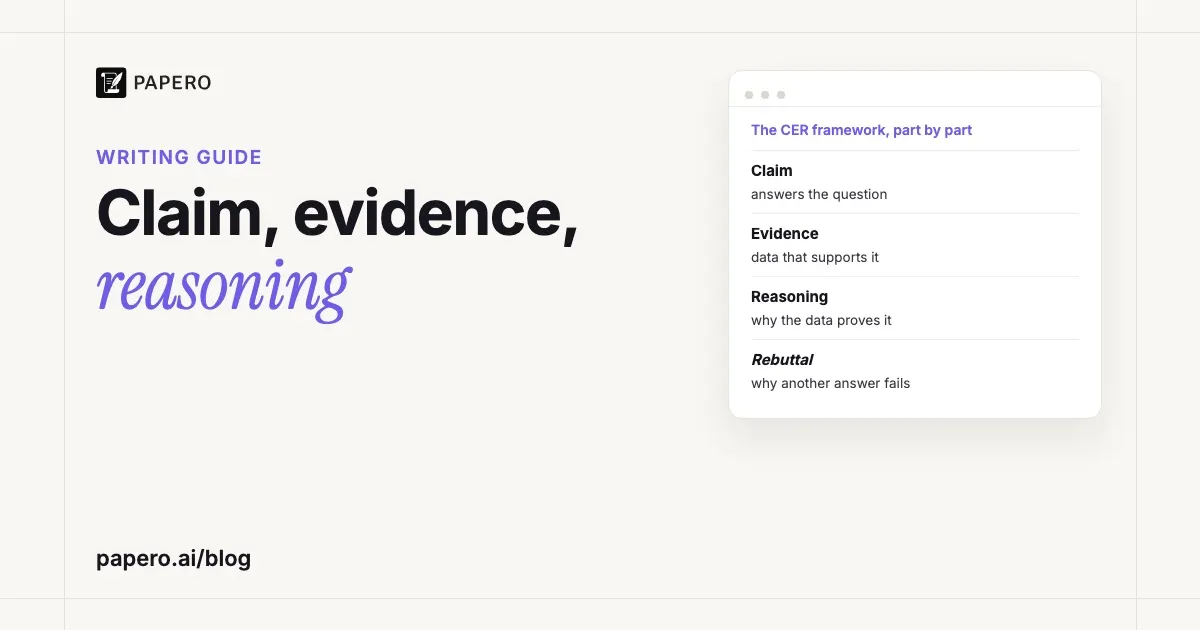
Claim, evidence, reasoning (CER) is a three-part way to answer a question in writing. The claim answers the question in one sentence. The evidence is the data or text that supports it. The reasoning explains why that evidence proves the claim, usually by naming a rule or principle. Katherine McNeill and Joseph Krajcik built it for middle school science, and teachers have since adapted it for English classes too.
Key Takeaways
- Claim: a statement that answers the question. Evidence: enough relevant data to support the claim. Reasoning: why that data counts as evidence.
- Reasoning gives the most trouble: in one study, teachers understood claim and evidence well after training but still found reasoning hard to apply in class. Reasoning names the rule that connects the evidence to the claim.
- McNeill and Krajcik’s later version adds a fourth part, the rebuttal: name another explanation and say why the evidence does not support it.
- Their rubric scores each part from 0 to 2, so a correct claim with too little evidence and no reasoning scores 3 out of 6.
- By our reading, CER maps onto Toulmin’s model of argument: the claim and evidence match Toulmin’s claim and grounds, and the reasoning does the job of his warrant.
What is claim, evidence, reasoning?
CER is a framework for writing an explanation: answer the question, show the data, then explain why the data supports the answer. McNeill and Krajcik developed it from their work with middle school science teachers in Detroit and from research on how students justify their claims. Each part answers a different question, and a CER response is only complete when all three are answered.
| Part | McNeill and Krajcik’s definition | The question it answers | Sentence starters |
|---|---|---|---|
| Claim | “a statement or conclusion that answers the original problem or question” | What is the answer? | I claim that… / The data show that… |
| Evidence | “scientific data that supports the claim”, which should be “both appropriate and sufficient” | How do you know? | According to the data… / In the text, … / One observation is… |
| Reasoning | “the justification for why their data counts as evidence to support their claim” | Why does that evidence prove it? | This shows… because… / Since [rule or principle], … |
| Rebuttal (later versions) | Recognizes alternative explanations and gives counter-evidence and reasoning against them | Why not another answer? | Someone might argue… However, … |
“Appropriate” means the evidence bears on this question; “sufficient” means there is enough of it to make the case, usually more than one data point. The authors want students to “consider and use multiple pieces of evidence”. Students’ evidence can come from their own investigations or from second-hand sources such as books or the internet.
The framework appears in McNeill and Krajcik’s 2012 book for grade 5–8 teachers, Supporting Grade 5–8 Students in Constructing Explanations in Science, subtitled “The Claim, Evidence, and Reasoning Framework for Talk and Writing”. A poster on McNeill’s National Science Foundation project lists the four parts, rebuttal included.
Claim evidence reasoning example in science
Here is a full CER response to one question, using NOAA’s yearly averages of carbon dioxide measured at Mauna Loa Observatory in Hawaii (file dated October 9, 2026). The claim answers the question, the evidence gives the measurements, the reasoning explains why a rising yearly average means a real change, and a rebuttal deals with the one weak spot in the record.
Question: Is the amount of carbon dioxide in Earth’s air changing?
Claim: The amount of carbon dioxide in the air has risen every year since 1959, the first full year of measurements at Mauna Loa.
Evidence: The yearly average was 315.98 parts per million (ppm) in 1959, 369.71 ppm in 2000 and 427.35 ppm in 2025, an increase of 111.37 ppm, or about 35%. Every yearly average from 1959 to 2025 is higher than the one before it: 66 increases in a row. The smallest was 0.42 ppm, from 1964 to 1965.
Reasoning: Carbon dioxide in the air rises and falls with the seasons, so a single month’s reading could mislead. A yearly average includes every season, which cancels out that swing. If the yearly average keeps climbing, year after year, the change is in the air itself, not in the time of year a reading was taken. Sixty-six rises with no fall rule out a few unusual years as the explanation.
Rebuttal: Someone might explain part of the rise another way, as an effect of moving the instruments: after the Mauna Loa volcano erupted in November 2022, NOAA took readings at Maunakea, about 21 miles north, until July 2023. But the yearly average had already risen by more than 100 ppm before that switch (to 416.41 ppm in 2021), so the long rise cannot come from the move.
The evidence section gives numbers, not adjectives. “CO2 has gone up a lot” would score lower, because it gives the reader nothing to check. The reasoning names a general idea (averaging over a full year removes a seasonal pattern) and applies it. And the rebuttal answers a real weakness in the data instead of a made-up one.
Claim evidence reasoning example in English
CER works on a literary text the same way, with quotations as the evidence. This one is about Edgar Allan Poe’s “The Tell-Tale Heart” (1843), quoted from Project Gutenberg’s edition of Poe’s works. The claim answers the question about the narrator, the evidence is three short quotations from the story, and the reasoning explains why those quotations undercut what he says about himself.
Question: Should readers trust the narrator of “The Tell-Tale Heart”?
Claim: No. The narrator insists he is sane, but his own explanation of the murder shows he is not.
Evidence: He asks the reader, “How, then, am I mad?” and offers his calm telling of the story as proof. Yet when he explains his motive, he rules out every ordinary reason: “Object there was none. Passion there was none. I loved the old man. He had never wronged me. He had never given me insult. For his gold I had no desire.” The only reason he gives is the old man’s eye: “I think it was his eye! yes, it was this!”
Reasoning: A sane person who commits a crime usually has a reason others can follow, such as money, revenge or anger. The narrator denies all of these himself, then names a reason no reader would accept. A narrator whose own evidence contradicts his claim cannot be trusted to report events accurately, so the story has to be read against what he says.
In English classes, the evidence is a quotation, and the reasoning is what the quote sandwich method calls the bottom slice: the sentences after the quotation that say what it shows. Our guide to the quote sandwich covers that move for any essay.
Strong vs weak CER: how it is scored
McNeill and Krajcik’s rubric scores each part from 0 to 2. In their worked example, seventh graders had data on four liquids and had to say which were the same substance. Two students gave the same correct claim but very different support.
| Part | Strong response | Score | Weaker response | Score |
|---|---|---|---|---|
| Claim | “Liquid 1 and 4 are the same substance.” | 2 | The same correct claim | 2 |
| Evidence | Density, color and melting point all match | 2 | “Liquid 1 and liquid 4 have the same density and melting point.” No mention of color | 1 |
| Reasoning | “For substances to be the same, they must have the same properties.” | 2 | No link between the matching properties and the claim | 0 |
| Total | 6 | 3 |
The weaker student lost a point for evidence that was correct but not sufficient, and both reasoning points for never saying why matching density and melting point mean the same substance. The missing piece was the principle the authors name: the same substance has the same properties, while different substances have different properties, so samples whose properties all match are the same substance. The authors also say the three parts should read as “a coherent explanation and not three separate unrelated components”, so a teacher may comment on how the whole answer hangs together.
How do you write the reasoning?
State the rule, principle or idea that connects your evidence to your claim, then apply it to your case. Reasoning answers “why does this evidence prove that?” If your reasoning only repeats what the evidence already says, it is a summary and still needs a principle.
A reasoning section usually does three things:
- Name the principle. “Different substances have different properties, so samples with matching properties are the same substance.” “A yearly average cancels seasonal changes.” In English, the principle might be about how narrators, arguments or word choices work.
- Apply it to your evidence. “Liquids 1 and 4 have the same properties, so…” Show that your data fits the rule.
- Close the loop. Restate how this proves the claim, in words that echo the claim.
Students are not alone in finding this hard. McNeill’s National Science Foundation poster reports that after a book study and three workshops, teachers’ understanding of claim and evidence “was strong and their understanding of reasoning improved, but the application of reasoning to classroom practice continued to be challenging.”
What is the rebuttal in CER?
The rebuttal is a fourth part, found in later versions of the framework: describe a different explanation someone could give, then use evidence and reasoning to show why it does not hold. McNeill’s NSF poster defines it as recognizing alternative explanations and providing “counter evidence and reasoning” against them.
A good rebuttal takes on the strongest alternative, not the weakest. In the carbon dioxide example, the honest weak spot was that part of the record came from another site, so the rebuttal answered that. A rebuttal that answers an objection nobody would make adds length without adding strength.
CER vs Toulmin and the quote sandwich
CER is not the only model with these parts. Stephen Toulmin’s model of argument has a claim, grounds and a warrant, plus backing, a qualifier, a counterclaim and a rebuttal. The quote sandwich used in essay writing has a top slice, a quotation and a bottom slice. Read side by side, they make the same demand: show your support, then explain why it supports you.
| CER | Toulmin | Quote sandwich |
|---|---|---|
| Claim | Claim | Your point, stated before the top slice |
| Evidence | Grounds | The quotation (the filling) |
| Reasoning | Warrant (with backing) | The bottom slice: what the quotation shows |
| Rebuttal | Counterclaim and rebuttal | Not part of the model |
This match is our own reading, and it is not exact: CER has no separate backing or qualifier, and the rebuttal joined it later than the other three parts. The third essay in our argumentative essay examples uses Toulmin’s structure in full.
Is CER an explanation or an argument?
It can be either, and science-education researchers disagree about how much the difference matters. In 2011, Jonathan Osborne and Alexis Patterson argued in Science Education that the literature was using “argument” and “explanation” in confused ways, and that the distinction matters. McNeill, one of CER’s authors, replied with Leema Berland in the same journal in 2012, and Osborne and Patterson answered in the same issue.
For a student, the practical point is simple: read what the task asks. A question such as “why does ice float?” asks you to explain something everyone accepts. A question such as “should the school ban phones?” asks you to defend a position others could dispute. CER’s three parts fit both, but an argument usually needs the rebuttal, and an explanation often does not.
CER beyond the science class
The same three moves run through college writing under other names. A body paragraph’s topic sentence is its claim, the cited sources are its evidence, and your interpretation is its reasoning. In a research paper, the results section reports the evidence, and the discussion section supplies the reasoning that connects results to the research question.
Our topic sentence examples show the claim part across paragraph types, and our guides to the results section and the discussion section cover the research-paper version.
Where Papero fits
Papero is an AI writing workspace for students and researchers. Citation search finds real papers for the sentence you are writing, so a claim can be backed by a source you can check, and Papero formats the citation in APA 7, MLA 9 or seven other styles. Among the Review checks, Claims finds sentences that need a citation and offers papers to cite.
The reasoning stays yours. Papero can help you find evidence and cite it, but the sentence explaining why that evidence proves your claim is the part a teacher is grading, and it has to come from your own understanding. The research paper writing page shows where Papero helps, and the glossary entry on empirical evidence defines the kind of evidence a science CER uses.
Frequently Asked Questions
What does CER stand for?
CER stands for claim, evidence, reasoning. The claim answers the question, the evidence is the data or text that supports it, and the reasoning explains why the evidence supports the claim. Some versions add an R for rebuttal: an alternative explanation and why it fails.
What is an example of claim evidence reasoning?
Claim: carbon dioxide in the air is increasing. Evidence: NOAA’s yearly average at Mauna Loa rose from 315.98 ppm in 1959 to 427.35 ppm in 2025, with an increase every single year. Reasoning: a yearly average cancels seasonal swings, so 66 straight rises show a lasting change in the air, not a seasonal pattern.
What is the difference between evidence and reasoning?
Evidence is what you observed or read: the numbers, measurements or quotations. Reasoning is why those observations prove your claim, usually a scientific principle or general rule applied to the evidence. “The two liquids have the same density” is evidence; “different substances have different densities, so matching densities point to the same substance” is reasoning.
How much evidence does a CER need?
Enough to be convincing, which usually means more than one piece. McNeill and Krajcik ask for evidence that is “appropriate and sufficient”, and in their scoring example on identifying the same substance, a student who named two matching properties (density and melting point) instead of all three scored 1 out of 2 for evidence.
Can you use CER in an essay?
Yes. Each body paragraph can follow it: a topic sentence that makes a claim, quotations or data as evidence, and sentences explaining why the evidence supports the claim. In literature and history classes, the evidence is usually a quotation from the text.
Sources
- McNeill, K. L., & Krajcik, J. (in press). Assessing middle school students’ content knowledge and reasoning through written scientific explanations. Authors’ manuscript of a chapter for National Science Teachers Association Press (websites.umich.edu, accessed November 2026): https://websites.umich.edu/~krajcik/McNeill&Krajcik_NSTA.pdf
- McNeill, K. L. “Supporting Grade 5-8 Students in Writing Scientific Explanations”, poster on National Science Foundation grant DRL-0836099 (cadrek12.org, accessed November 2026): https://cadrek12.org/sites/default/files/McNeill_NSF2010_Final.pdf
- McNeill, K. L., & Krajcik, J. (2012). Supporting grade 5–8 students in constructing explanations in science: The claim, evidence, and reasoning framework for talk and writing. Pearson Allyn & Bacon.
- McNeill, K. L., Lizotte, D. J., Krajcik, J., & Marx, R. W. (2006). Supporting students’ construction of scientific explanations by fading scaffolds in instructional materials. Journal of the Learning Sciences, 15(2), 153–191. https://doi.org/10.1207/s15327809jls1502_1
- NOAA Global Monitoring Laboratory, “Mauna Loa CO2 annual mean data” (file created October 9, 2026; accessed November 2026): https://gml.noaa.gov/webdata/ccgg/trends/co2/co2_annmean_mlo.txt
- Poe, Edgar Allan. “The Tell-Tale Heart.” 1843. The Works of Edgar Allan Poe, Volume 2, Project Gutenberg eBook #2148: https://www.gutenberg.org/ebooks/2148
- Osborne, J. F., & Patterson, A. (2011). Scientific argument and explanation: A necessary distinction? Science Education, 95(4), 627–638. https://doi.org/10.1002/sce.20438
- Berland, L. K., & McNeill, K. L. (2012). For whom is argument and explanation a necessary distinction? A response to Osborne and Patterson. Science Education, 96(5), 808–813. https://doi.org/10.1002/sce.21000
- Osborne, J., & Patterson, A. (2012). Authors’ response to “For whom is argument and explanation a necessary distinction? A response to Osborne and Patterson” by Berland and McNeill. Science Education, 96(5), 814–817. https://doi.org/10.1002/sce.21034