A synthesis essay combines evidence from several sources to support a position of your own, and it puts the sources in conversation instead of summarizing them one by one. The synthesis essay example below answers an AP Lang-style prompt on phones in school with four real sources, cited as Source A to D, and a note after each paragraph on what it does.
Key Takeaways
- A synthesis essay argues your position. The sources are evidence for it, not the subject of the essay.
- What makes it synthesis is putting two or more sources in one paragraph and saying how they agree, disagree or qualify each other.
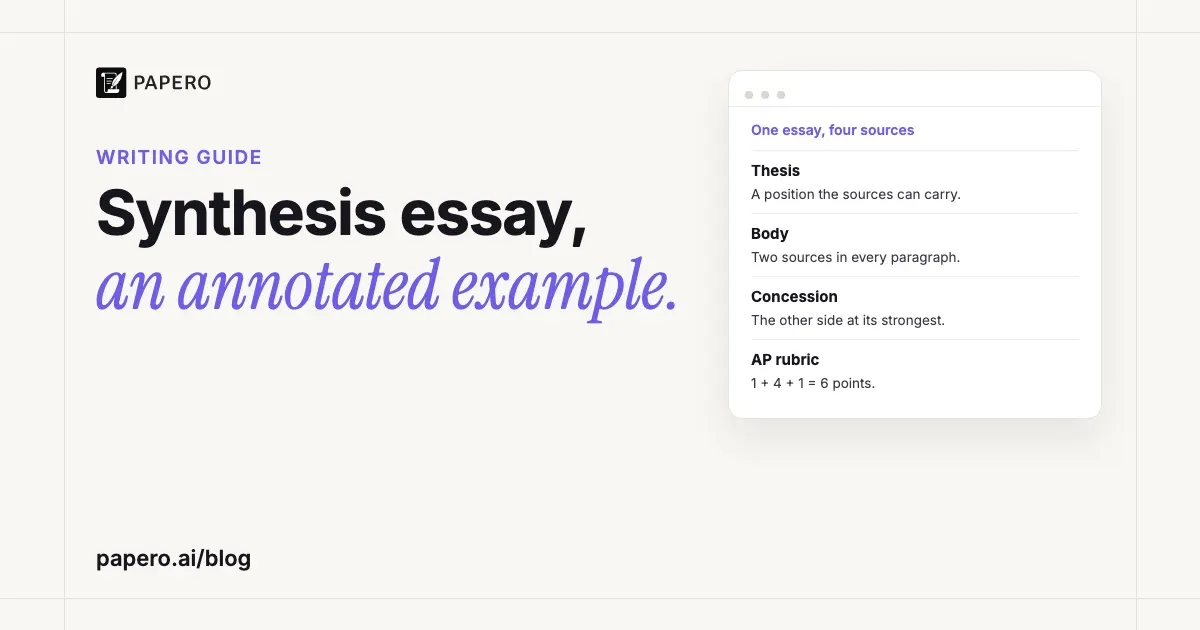
- On the AP Lang exam it is scored out of 6 points: 1 for the thesis, 4 for evidence and commentary from at least three sources, 1 for sophistication.
- A college “synthesis essay” can work differently: you may find the sources yourself and cite them in MLA or APA.
What is a synthesis essay?
A synthesis essay draws on several sources to build one argument or explanation, and shows how those sources relate to each other. On the AP English Language exam it is question 1: you read a set of sources on one topic and write an essay that “synthesizes material from at least three of the sources and develops your position” on the issue in the prompt.
The College Board’s course description calls this “source-based synthesis”: “Body paragraphs feature sources in conversation with one another.” Purdue OWL adds that synthesis can be explanatory or argumentative; the AP essay argues. Our literature review example rewrites three studies as a summary and as a synthesis, and Papero’s glossary entry on research synthesis covers the technique in research writing.
The prompt and the four sources
The example answers a prompt we wrote for this article in the shape of AP Lang question 1. The real exam gives six sources, two of them visual (at least one quantitative), with text excerpts of about 500 words each. This practice set has four real sources, quoted verbatim.
The excerpts are shortened to the lines the essay quotes; the full pages are linked under Sources.
Prompt. In the 2024-25 school year, most public schools in the United States restricted students’ use of cell phones, and several states adopted rules requiring schools to do so. Supporters say phones distract students and harm their well-being; critics say students need to learn to manage the devices they will use for the rest of their lives.
Carefully read the following four sources, including the introductory information for each source. Write an essay that synthesizes material from at least three of the sources and develops your position on the extent to which schools should restrict students’ use of cell phones during the school day.
Source A (quantitative). National Center for Education Statistics, press release, February 19, 2025 (survey of 1,490 public schools, December 2024).
| School Pulse Panel, December 2024 | Public schools |
|---|---|
| Prohibit students from using cell phones during any class | 77% |
| Let teachers decide whether students can have phones in class | 12% |
| School leaders reporting negative impacts of phone use on academic performance | 53% |
NCES Commissioner Peggy Carr: “With 53 percent of school leaders reporting negative impacts of cell phone use on academic performance, and even more citing negative impacts on students’ mental health and attention spans […]”
Source B. Office of the U.S. Surgeon General, Social Media and Youth Mental Health, advisory, 2023.
“Up to 95% of youth ages 13–17 report using a social media platform, with more than a third saying they use social media ‘almost constantly.’”
“[A]dolescents who spent more than 3 hours per day on social media faced double the risk of experiencing poor mental health outcomes”
To parents: “Create tech-free zones” and “consider restricting the use of phones, tablets, and computers for at least 1 hour before bedtime and through the night.”
Source C. OECD, press release on the PISA 2022 results, December 5, 2023.
“PISA shows that moderate use of digital devices in school is associated with higher performance”
“45% of students reported feeling nervous or anxious if their phones were not near them, on average across OECD countries, and 65% reported being distracted by using digital devices in at least some maths lessons.”
“Students who reported being distracted by other students using digital devices in some, most or every maths class scored 15 points lower in PISA maths tests than those who barely experienced this. This represents the equivalent of three-quarters of a year’s worth of education”
Source D. UNESCO, “To ban or not to ban? Monitoring countries’ regulations on smartphone use in school,” July 26, 2023, updated January 24, 2025.
“Removing smartphones from schools in Belgium, Spain and the United Kingdom was found to improve learning outcomes, according to a study cited in the report, especially for students that were not performing as well as their peers.”
Exceptions “for learners who require learning accommodations in the Louisiana ban, and for anyone with a health condition that requires monitoring in Ohio”; and “Saudi Arabia reversed its ban due to the opposition by disability groups for medical purposes.”
“Students need to learn the risks and opportunities that come with technology and not be shielded from them entirely.” And: “Only technology that has a clear role in supporting learning should be allowed in school.”
Sort sources by what they could support before planning: A and C concern learning in class, B well-being mostly outside school, and D argues both for bans and for teaching students to manage phones. That tension inside D is worth more than any single fact.
Synthesis essay outline
A synthesis essay outline has an introduction ending in a thesis that takes a position, two or three body paragraphs that each make one claim with at least two sources in conversation, a paragraph that answers the strongest opposing evidence, and a conclusion that says what the position means. Organize by claims, never one source per paragraph.
| Paragraph | What goes in it | In the example |
|---|---|---|
| 1. Introduction | Context, the debate, a thesis | 77% restrict phones; keep them out of lessons, not the day |
| 2. Body 1 | One claim, two sources, commentary | A and C: distraction costs everyone in the room |
| 3. Body 2 | One claim, two sources, commentary | B and D: harms outside school; bans need exceptions |
| 4. Body 3 | The strongest opposing evidence, answered | D and C: the case for full bans, and UNESCO’s two-sided view |
| 5. Conclusion | The position restated, and its implication | A rule for lessons, practice for the rest of the day |
One source per paragraph produces summaries, which the AP rubric scores as low as 1 point for evidence. Our argumentative essay outline shows the same claim-first plan without a source packet.
Synthesis essay example: phones out of class, not out of school
We wrote this essay for this guide; it is not a student response or a College Board sample, and it is for study, not to hand in. At about 800 words it is longer than most 40-minute exam essays, so that each move is visible.
Paragraph 1: introduction
By December 2024, 77 percent of American public schools prohibited students from using cell phones during any class, and 12 percent left the decision to teachers (Source A). The question now is not whether schools should limit phones but how far the limit should reach. Supporters of all-day bans argue that a phone anywhere in the building is a distraction waiting to happen, while critics argue that students cannot learn to manage a device they are never allowed to touch. Schools should keep phones out of lessons, but they should not lock them away for the whole school day. The evidence of harm is strongest inside the classroom, where one student’s phone costs everyone in the room, while the harms that all-day bans target happen mostly in hours a school does not control, and the hours it does control are the best place for students to learn restraint.
What it does: the first sentence uses the quantitative source to set the context, which is a better opening than a sweeping claim about technology (the rubric names “In a world where…” openings as attempts that do not earn the sophistication point). The middle sentences state both sides fairly, and the thesis is the last two sentences. It takes a position someone could dispute, a middle position but a definite one, and it names the line of reasoning: harm in class, harm outside class, and practice.
Paragraph 2: body, distraction in class
The case for keeping phones out of lessons rests on two kinds of evidence that point the same way. School leaders see the damage: 53 percent report “negative impacts of cell phone use on academic performance,” and NCES Commissioner Peggy Carr notes that even more cite harm to “students’ mental health and attention spans” (Source A). Leaders’ impressions could be wrong, but students’ own reports in the OECD’s PISA survey tell a similar story. Across OECD countries, 65 percent of students said they were distracted by devices in at least some math lessons, and students distracted by other students’ devices “scored 15 points lower in PISA maths tests than those who barely experienced this,” a gap the OECD calls “the equivalent of three-quarters of a year’s worth of education” (Source C). The word “other” matters. A student who keeps her own phone silent can still lose learning to the classmate scrolling beside her, so phone use in a lesson is not a private choice, and a rule for the whole classroom is fairer than leaving the decision to each student.
What it does: this is source-based synthesis in its plainest form. Source A gives what adults believe, Source C gives what students report, and the third sentence says why the second source matters: it checks the first. The commentary then picks out one word, “other,” and builds the paragraph’s claim on it. That attention to “specific words and details from the sources” is what the top band of the evidence row describes.
Paragraph 3: body, what an all-day ban cannot reach
An all-day ban promises more than a school can deliver. The Surgeon General’s advisory finds that up to 95 percent of 13- to 17-year-olds report using social media and more than a third say they use it “almost constantly,” and that adolescents who spent more than three hours a day on it “faced double the risk of experiencing poor mental health outcomes” (Source B). Those are real harms, but the advisory’s own advice to families is about evenings and homes: “Create tech-free zones” and restrict phones “for at least 1 hour before bedtime and through the night” (Source B). A phone locked in a pouch at lunch does nothing about the hours after midnight. Meanwhile, the bans that do exist have had to make room for students who need their phones, or have been dropped: Louisiana exempts “learners who require learning accommodations,” Ohio exempts “anyone with a health condition that requires monitoring,” and Saudi Arabia reversed its ban after “opposition by disability groups for medical purposes” (Source D). Exceptions like these are manageable for a rule about lessons. Stretched across every minute of the school day, they turn a simple rule into a list of who may carry a phone, and when.
What it does: it uses a source that seems to support the other side (Source B’s harms) and turns it, by reading the advisory’s own recommendations closely. It then joins a second source on a different point, exceptions, and the last two sentences tie the exceptions back to the thesis, as the pouch sentence does for Source B. Each claim has a quotation, and each quotation is followed by a sentence that says what it shows.
Paragraph 4: body, the strongest case for a full ban
The strongest argument for an all-day ban comes from the same sources. A study cited by UNESCO found that removing smartphones from schools in Belgium, Spain and the United Kingdom improved learning outcomes, “especially for students that were not performing as well as their peers” (Source D), and across OECD countries 45 percent of students in the PISA survey feel “nervous or anxious if their phones were not near them” (Source C). The second finding shows a dependence worth taking seriously. Yet UNESCO’s own conclusion pulls in two directions. It holds that “Only technology that has a clear role in supporting learning should be allowed in school,” but also that students “need to learn the risks and opportunities that come with technology and not be shielded from them entirely” (Source D). A school that locks phones away from the first bell to the last satisfies the first sentence and abandons the second. The OECD’s finding that “moderate use of digital devices in school is associated with higher performance” (Source C) concerns devices in general rather than phones, so it cannot settle the question, but it points the same way: the goal is moderation students learn, with adults nearby at lunch and between classes, rather than absence that adults enforce.
What it does: this is the concession, and it does more than hint at the other side with “While some may argue that…” It gives the opposing evidence in full, in the opposing side’s best form, then finds a tension inside a single source, UNESCO, and uses it to answer. It also marks the limit of its own evidence: the OECD sentence is about all digital devices, and the essay says so instead of stretching it. Exploring “complexities or tensions across the sources” is the first of the four routes to the sophistication point in the scoring guidelines.
Paragraph 5: conclusion
The sources agree more than the ban-or-no-ban debate suggests. A phone in a lesson costs learning, and not only for the student using it, so schools are right to keep phones out of class. Beyond the classroom, the evidence of harm is about how many hours young people spend online and which hours, and a school controls few of them. A policy that keeps phones away during lessons, allows them at set times, and treats those times as practice would protect learning without pretending that the school gate is where a student’s habits are made.
What it does: it restates the position with what each body paragraph established, in the same order, and adds one implication: what kind of policy follows. It introduces no new source. Our guide on how to write a conclusion compares this kind of ending with conclusions for other essay types.
Synthesis essay thesis examples
A synthesis essay thesis takes a position on the prompt that the sources could support and a reasonable reader could dispute. It does not list what the sources say or weigh pros and cons without choosing. The College Board’s scoring notes say a thesis that only reports “some people say it’s good, some people say it’s bad” does not earn the point.
On the College Board’s sample prompt about public libraries, “Although some may believe that libraries are no longer necessary, they are essential to the success of the US democratic system” earns the point.
Thesis examples for the phone prompt, written for this article:
| Weak | Why it is weak | Stronger |
|---|---|---|
| “Phone bans have advantages and disadvantages.” | Weighs both sides without taking one | “Schools should ban phones for the whole school day, because a rule that holds from bell to bell is the only one that protects the students who are already behind their peers.” |
| “Phones can be distracting in class.” | An obvious fact, not a claim that needs defending | “Because one student’s phone distracts the whole room, phone rules belong to the classroom, not to each student’s judgment.” |
The first stronger thesis argues against the example essay and is just as defensible, since Source D supports it. The rubric rewards a clear position, not a side. The example’s own thesis runs two sentences, which the rubric allows: “The thesis may be more than one sentence, provided the sentences are in close proximity.”
Synthesis essay introduction example
A synthesis essay introduction sets the context with a specific fact from a source, states the debate fairly in a sentence or two, and ends with a thesis that takes a position and previews the reasoning. Four to six sentences is enough. Skip sweeping openings about history or society, and do not summarize every source, because the points are in the body.
Paragraph 1 of the example follows that order. This second introduction, written for this article, carries the opposite thesis:
Up to 95 percent of American 13- to 17-year-olds report using social media, and more than a third say they use it “almost constantly” (Source B). During the school day, adults can still decide when that use stops, and most schools already do so during lessons (Source A). The question is whether the rule should end when class does. Critics of full bans say students need practice managing their phones, but a school day spent half with and half without a phone is not practice; it is a series of interruptions. Schools should keep phones away from the first bell to the last, because a rule that holds all day is easier to enforce, gives students hours of real separation from their phones, and helps most the students who are already behind (Source D).
AP Lang synthesis essay: how it is scored
AP English Language question 1 gives you six sources on one topic, two of them visual, including at least one quantitative source, and asks for an essay that develops your position using at least three of them. It is scored out of 6 points in three rows, and the College Board recommends about 40 minutes for it.
The rows, quoted from the course description’s scoring guidelines (fall 2024 edition, read October 25, 2026):
| Row | Points | What earns them | In the example |
|---|---|---|---|
| A. Thesis | 0-1 | “Responds to the prompt with a thesis that presents a defensible position.” | Out of lessons, not out of the school day |
| B. Evidence and commentary | 0-4 | For 4: “Provides specific evidence from at least three of the provided sources to support all claims in a line of reasoning” and “Consistently explains how the evidence supports a line of reasoning.” | All four sources; commentary after every quotation |
| C. Sophistication | 0-1 | “Demonstrates sophistication of thought and/or a complex understanding of the rhetorical situation.” | The tension inside Source D, and the limit of Source C’s evidence |
In Row B, a response that “Summarizes the evidence but does not explain how the evidence supports the student’s argument” earns 1 point, and one that references “fewer than two of the provided sources” earns 0. Row C can be earned in any one of four ways:
- “Crafting a nuanced argument by consistently identifying and exploring complexities or tensions across the sources.”
- “Articulating the implications or limitations of an argument (either the student’s argument or arguments conveyed in the sources) by situating it within a broader context.”
- “Making effective rhetorical choices that consistently strengthen the force and impact of the student’s argument throughout the response.”
- “Employing a style that is consistently vivid and persuasive.”
Sweeping openings such as “In a world where…” and responses that “Only hint at or suggest other arguments” do not earn it. The rows and points match question 2, where the thesis analyzes a writer’s choices instead; our rhetorical analysis essay example walks through it the same way.
Is a college synthesis essay different from the AP one?
Often, yes. In a college course, “synthesis essay” usually means a researched essay in which you find the sources yourself, cite them in MLA or APA with a Works Cited or reference list, and write several pages instead of a 40-minute response. Some assignments ask for an explanatory synthesis that explains a debate without taking a side. Your assignment sheet sets the rules.
Purdue OWL’s definition fits both: “A synthesis draws on multiple sources to reach a broader conclusion.” The skills carry over, and a signal phrase shows whose idea each sentence carries.
How do you write a synthesis essay?
Read all the sources and note what each could support, choose a position, group the sources by claim, and plan one body paragraph per claim with at least two sources in each. Draft every paragraph as claim, evidence, commentary, give the strongest opposing evidence a paragraph of its own, and end on what your position means.
- Answer the exact question the prompt ends on, not the topic in general.
- Annotate for use. Note the claim each source could support, and find sources that disagree.
- Quote short, comment long. Row B’s points are in the commentary.
- Answer the other side in full, with its best evidence.
Where Papero fits
Papero is an AI writing workspace for students and researchers. Describe a synthesis assignment and it builds a two-level outline with a prompt under every heading. You can add government reports and web pages like the four sources above as manual entries, with an organization as the author, and cite them in MLA 9, APA 7 or seven other styles; one citation can hold several sources.
It suggests the next sentence within each section’s prompt and drafts only from your outline, so your position stays yours. The essay writing page shows the whole process.
Frequently Asked Questions
How many sources do you need in a synthesis essay?
On the AP English Language exam, at least three of the six provided sources. The scoring guidelines require evidence from at least three sources for 2 or more of the 4 evidence-and-commentary points, so a response that uses only two is capped at 1 point in that row. In a college synthesis essay, the assignment sets the number.
How do you cite sources in an AP Lang synthesis essay?
By letter or by description, in parentheses. The College Board’s course description says sources “may be cited as Source A, Source B, etc., or by using the description in parentheses.” Cite a source each time you quote, paraphrase or summarize it.
What is the difference between a synthesis essay and an argumentative essay?
Both take a position, but a synthesis essay builds it from a given set of sources and shows how they relate, while an argumentative essay uses whatever evidence the writer chooses. On the AP Lang exam, question 1 is the synthesis essay with six provided sources, and question 3 is the argument essay, with no sources provided.
Does a synthesis essay need a counterargument?
The AP scoring guidelines do not require one for the thesis or evidence points. A counterargument developed in full is one of the main ways to earn the sophistication point, though, because the guidelines reward exploring “complexities or tensions across the sources,” and only hinting at other arguments does not earn it.
How long is an AP Lang synthesis essay?
The College Board sets a time, not a length: about 40 minutes recommended, within a free-response section of 2 hours and 15 minutes that includes a 15-minute reading period. The synthesis essay example in this guide is about 800 words, longer than most timed responses.
Sources
- College Board, AP English Language and Composition Course and Exam Description, fall 2024 edition (read October 25, 2026): https://apcentral.collegeboard.org/pdf/ap-english-language-and-composition-course-and-exam-description.pdf
- Purdue OWL, “Synthesizing Sources” (owl.purdue.edu, accessed October 2026): https://owl.purdue.edu/owl/research_and_citation/conducting_research/research_overview/synthesizing_sources.html
- National Center for Education Statistics, “More than Half of Public School Leaders Say Cell Phones Hurt Academic Performance,” press release, February 19, 2025 (nces.ed.gov, accessed October 2026): https://nces.ed.gov/learn/press-release/more-half-public-school-leaders-say-cell-phones-hurt-academic-performance
- Office of the U.S. Surgeon General, Social Media and Youth Mental Health: The U.S. Surgeon General’s Advisory, 2023 (hhs.gov, accessed October 2026): https://www.hhs.gov/sites/default/files/sg-youth-mental-health-social-media-advisory.pdf
- OECD, “Decline in educational performance only partly attributable to the COVID-19 pandemic,” press release, December 5, 2023 (oecd.org, accessed October 2026): https://www.oecd.org/en/about/news/press-releases/2023/12/decline-in-educational-performance-only-partly-attributable-to-the-covid-19-pandemic.html
- UNESCO, “To ban or not to ban? Monitoring countries’ regulations on smartphone use in school,” July 26, 2023, updated January 24, 2025 (unesco.org, accessed October 2026): https://www.unesco.org/en/articles/smartphones-school-only-when-they-clearly-support-learning