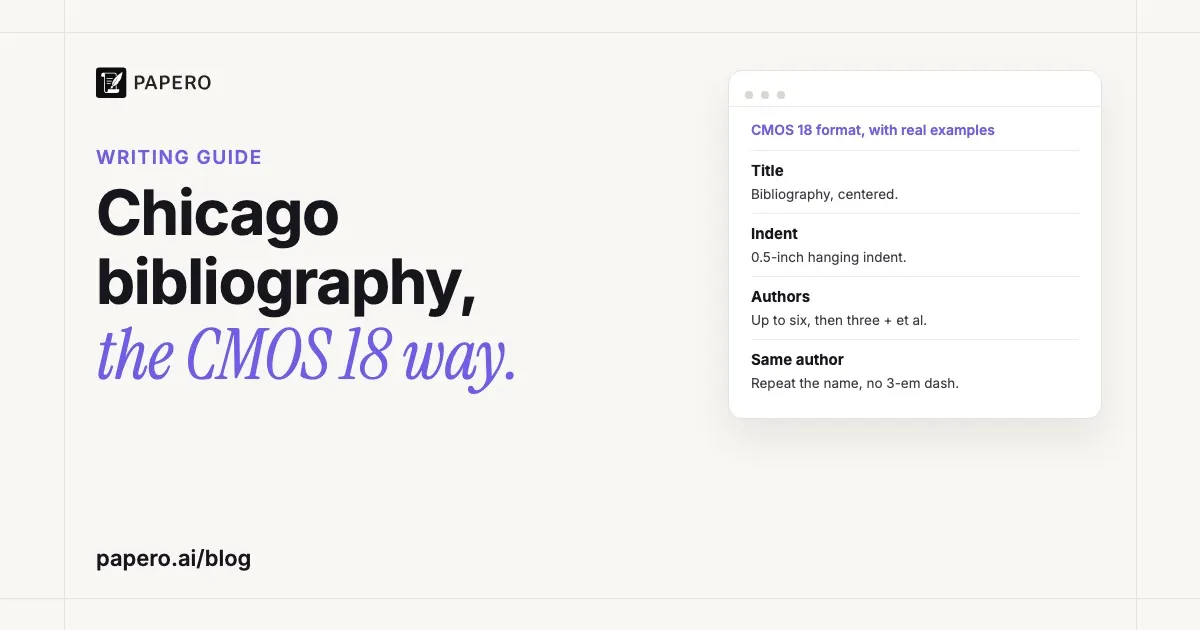
A Chicago style bibliography is the alphabetical list of sources at the end of a paper that uses Chicago’s notes and bibliography system. Title it Bibliography, center the title and give each entry a half-inch hanging indent. Each entry inverts the first author’s name and separates its parts with periods. The 18th edition of The Chicago Manual of Style (2024) lists up to six authors and repeats names instead of using a 3-em dash.
Key Takeaways
- Papers with footnotes or endnotes usually end with a Bibliography; Chicago’s author-date system ends with a reference list instead.
- Layout, from Chicago’s student-paper guidance: title centered, two blank lines below it, each entry single-spaced with a blank line between entries, and a 0.5-inch hanging indent. Your instructor’s rules come first.
- Entries are alphabetical by their first word, usually the first author’s surname. Only the first author’s name is inverted.
- CMOS 18 lists up to six authors in a bibliography entry. With seven or more, list the first three and “et al.”
- CMOS 18 repeats an author’s name instead of using the 3-em dash, and no longer requires the place of publication or a chapter’s page range.
Chicago style bibliography format
Put the bibliography at the end of the paper, after the text and any endnotes, and title it Bibliography. Center the title, leave two blank lines before the first entry, single-space each entry, leave one blank line between entries and indent every line after the first by half an inch. List the entries alphabetically by their first word. Every entry ends with a period.
| Element | Rule |
|---|---|
| Placement | End of the paper, after the endnotes if you use them |
| Title | Bibliography, centered at the top of the first page |
| After the title | Two blank lines before the first entry |
| Spacing | Each entry single-spaced, one blank line between entries |
| Indent | Hanging indent: first line flush left, later lines indented 0.5 inch |
| Right margin | Ragged, not justified |
| Order | Alphabetical by the first word of the entry, usually the first author’s surname; a work with no author goes under its title |
| Punctuation | Parts separated by periods; every entry ends with a period |
The layout rows come from CMOS Shop Talk, the Chicago Manual’s own blog. Its 2019 post on student papers bases them on Kate L. Turabian’s A Manual for Writers and warns that an instructor’s requirements may overrule them. None of these layout rules appears on Chicago’s list of 18th-edition changes. The order and punctuation rows come from Purdue OWL’s CMOS 18 guide. Some instructors want the whole paper double-spaced. The hanging indent is easiest to set as a paragraph format; our guide to the hanging indent in Google Docs and Word shows how.
Chicago bibliography examples by source type
Every entry gives the author, the title and the publication facts, in that order, separated by periods. Book and journal titles are italic; article and chapter titles go in quotation marks. The works below are real, checked against their Crossref, Library of Congress or publisher records in October 2026.
| Source | Bibliography entry |
|---|---|
| Book, one author | Kuhn, Thomas S. The Structure of Scientific Revolutions. University of Chicago Press, 1962. |
| Chapter in an edited book | Bjork, Robert A. “Memory and Metamemory Considerations in the Training of Human Beings.” In Metacognition: Knowing About Knowing, edited by Janet Metcalfe and Arthur P. Shimamura. MIT Press, 1994. https://doi.org/10.7551/mitpress/4561.003.0011. |
| Journal article, two authors, DOI | Roediger, Henry L., III, and Jeffrey D. Karpicke. “Test-Enhanced Learning: Taking Memory Tests Improves Long-Term Retention.” Psychological Science 17, no. 3 (2006): 249–55. https://doi.org/10.1111/j.1467-9280.2006.01693.x. |
| Journal article, more than six authors | Benjamin, Daniel J., James O. Berger, Magnus Johannesson, et al. “Redefine Statistical Significance.” Nature Human Behaviour 2, no. 1 (2018): 6–10. https://doi.org/10.1038/s41562-017-0189-z. |
| Article on a news site | Nunberg, Geoff. “Everyone Uses Singular ‘They,’ Whether They Realize It or Not.” NPR, January 13, 2016. https://www.npr.org/2016/01/13/462906419/everyone-uses-singular-they-whether-they-realize-it-or-not. |
| Web page with no date | University of Chicago Press. “What’s New in the 18th Edition.” The Chicago Manual of Style Online. Accessed October 29, 2026. https://www.chicagomanualofstyle.org/help-tools/what-s-new.html. |
Each row follows Chicago’s 18th-edition sample citations. A chapter takes “In” and “edited by”; CMOS 18 no longer requires its page range. A journal article gives volume, “no.” and issue, the year in parentheses and the page range of the whole article, shortened the way Chicago writes it (249–55), plus a DOI-based URL if you read it online. News articles carry no page numbers. A web page goes under the organization that owns the site, with an access date when the page has no date. Editions, translations and edited books are covered in our guide on how to cite a book, beside APA and MLA. A film entry starts with the director and the label “dir.”, as our guide to citing a movie in Chicago, APA and MLA shows.
How many authors go in a Chicago bibliography entry?
Up to six. Under CMOS 18, a work with six or fewer authors lists every author in the bibliography entry, and a work with seven or more lists the first three followed by “et al.” Notes are shorter: they name one or two authors in full, and for three or more give only the first author and “et al.” Only the first author’s name is inverted.
So the entry for Dunlosky and colleagues’ 2013 review of learning techniques, which has five authors, names all five, from “Dunlosky, John” to “and Daniel T. Willingham”, while the Benjamin article above, which has 72 authors on its Crossref record, stops after three. Join the last two names with “and”. Older guides, some still ranking well, write out up to ten names, so check which edition a guide follows. Other styles set their own cutoff: ACS style lists the first ten authors, then et al.
Names in Eastern order, family name first, are not inverted: Chicago’s sample entry begins “Liu Xinwu.” with no comma.
How is a bibliography entry different from a footnote?
The full note and the bibliography entry hold the same facts but punctuate them differently. The note gives names in normal order, separates its parts with commas and puts the publisher and year in parentheses. The bibliography entry inverts the first author’s name, uses periods and drops the parentheses. A note cites the page you used; a bibliography entry for a book cites no page at all.
| Form | Example |
|---|---|
| Full note | 1. Thomas S. Kuhn, The Structure of Scientific Revolutions (University of Chicago Press, 1962), 10. |
| Shortened note | 2. Kuhn, Structure of Scientific Revolutions, 10. |
| Bibliography entry | Kuhn, Thomas S. The Structure of Scientific Revolutions. University of Chicago Press, 1962. |
| Author-date reference | Kuhn, Thomas S. 1962. The Structure of Scientific Revolutions. University of Chicago Press. |
| Author-date citation in the text | (Kuhn 1962, 10) |
Page 10 stands in for the page you cite. The bibliography never names that page; for a journal article it gives the page range of the whole article, such as 249–55 for the Roediger entry. Purdue OWL reads CMOS 18 as allowing a shortened first note when the paper has a bibliography; ask whether your instructor wants full first notes. Our guide to Chicago style footnotes covers note numbers, shortened notes and why Chicago now discourages “ibid.”
What changed in the 18th edition for bibliographies?
Five changes touch most student bibliographies: up to six authors before “et al.”, repeated names instead of the 3-em dash, no required place of publication for books, no required page range for a chapter in an edited book, and capitals for prepositions of five or more letters in titles. A sixth lets journal entries drop the month or season. All six are on Chicago’s own list of what is new in the 18th edition, published in 2024.
| Rule | Before CMOS 18, as older guides show it | CMOS 18 |
|---|---|---|
| Many authors | All names up to ten | Up to six; with seven or more, the first three and “et al.” (13.23) |
| Several works by one author | A 3-em dash replaces the repeated name | Repeat the name in every entry (13.72) |
| Books | City before the publisher, as in New York: Random House | Place of publication not required (14.30) |
| Chapter in an edited book | Page range of the chapter | Page range not required (14.8) |
| Prepositions in titles | Lowercase, as in Knowing about Knowing | Five letters or more capitalized: Knowing About Knowing (8.160) |
| Journal issues | Month or season with the year | Month or season can usually be left out (13.26) |
Chicago’s own 2019 Shop Talk sample predates CMOS 18 and uses the 3-em dash; follow its layout and repeat the names. CMOS 18 repeats the name and files one author’s works by title, ignoring an initial “A”, “An” or “The” (13.100), so Kuhn’s The Copernican Revolution comes before The Structure of Scientific Revolutions in the sample list below.
The 18th edition also renames “headline style” as title case; Chicago’s own pair for the preposition rule is A Room with a View but Much Ado About Nothing. Coordinating conjunctions stay lowercase in its samples (How the Left and Right Are Winning (and Losing)), so the NPR entry ends “It or Not”.
Is it called a bibliography in Chicago?
Yes, in the notes and bibliography system: the list at the end of a paper with footnotes or endnotes is titled Bibliography. Chicago’s other system, author-date, cites sources in parentheses in the text and ends with a reference list, usually headed References, in which the year follows the author’s name. Your brief or department decides which system you use.
Purdue OWL’s CMOS 18 guide says the bibliography should include every source cited and may list works consulted but not cited, and that it is optional, though recommended, when the notes give full details. The glossary entry on the bibliography compares the term with a reference list, and our guide to the APA reference page shows APA’s version of that list.
Chicago style bibliography example
Here are the six example entries from this guide, plus a second Kuhn book, as one bibliography, in the order they would appear in a paper. The two Kuhn books sit together with the name repeated, as CMOS 18 prefers, and the Chicago web page is filed under U, for the University of Chicago Press, which owns the site.
Bibliography
Benjamin, Daniel J., James O. Berger, Magnus Johannesson, et al. “Redefine Statistical Significance.” Nature Human Behaviour 2, no. 1 (2018): 6–10. https://doi.org/10.1038/s41562-017-0189-z.
Bjork, Robert A. “Memory and Metamemory Considerations in the Training of Human Beings.” In Metacognition: Knowing About Knowing, edited by Janet Metcalfe and Arthur P. Shimamura. MIT Press, 1994. https://doi.org/10.7551/mitpress/4561.003.0011.
Kuhn, Thomas S. The Copernican Revolution: Planetary Astronomy in the Development of Western Thought. Harvard University Press, 1957.
Kuhn, Thomas S. The Structure of Scientific Revolutions. University of Chicago Press, 1962.
Nunberg, Geoff. “Everyone Uses Singular ‘They,’ Whether They Realize It or Not.” NPR, January 13, 2016. https://www.npr.org/2016/01/13/462906419/everyone-uses-singular-they-whether-they-realize-it-or-not.
Roediger, Henry L., III, and Jeffrey D. Karpicke. “Test-Enhanced Learning: Taking Memory Tests Improves Long-Term Retention.” Psychological Science 17, no. 3 (2006): 249–55. https://doi.org/10.1111/j.1467-9280.2006.01693.x.
University of Chicago Press. “What’s New in the 18th Edition.” The Chicago Manual of Style Online. Accessed October 29, 2026. https://www.chicagomanualofstyle.org/help-tools/what-s-new.html.
In a paper, each entry would also have the hanging indent this page cannot show.
How do you format an annotated bibliography in Chicago style?
Write each citation exactly as it would appear in a normal Chicago bibliography, with its hanging indent, and put the annotation in its own paragraph directly below it. Purdue OWL’s annotated bibliography samples indent the annotation half an inch for Chicago, the same as for APA, and one inch for MLA 9. Whether the annotation summarizes, evaluates or both depends on your assignment.
Roediger, Henry L., III, and Jeffrey D. Karpicke. “Test-Enhanced Learning: Taking Memory Tests Improves Long-Term Retention.” Psychological Science 17, no. 3 (2006): 249–55. https://doi.org/10.1111/j.1467-9280.2006.01693.x.
In two experiments, students read prose passages and then either restudied them or took free-recall tests without feedback. Restudying gave better recall on a final test five minutes later, but on tests two days and one week later the students who had been tested remembered substantially more, even though restudying had made the others more confident. The study supports practice tests as a way to learn, not only to assess.
The annotation summarizes the article’s abstract. Our annotated bibliography example shows APA and MLA versions and one source annotated three ways, and the glossary entry on the annotated bibliography has the short definition.
Where Papero fits
Papero is an AI writing workspace for students and researchers, and it does not support Chicago notes and bibliography: it cannot write footnotes or a Bibliography page like the one above. Its Chicago option is author-date: the app maps “Chicago” to the Citation Style Language file for the 18th edition’s author-date style, and the list it builds is headed References.
If your brief accepts Chicago author-date, Papero inserts the in-text citations and builds the reference list as you write; on the free plan the list shows your real entries blurred, and Plus makes it readable and exportable (papero.ai/pricing). The free DOI to citation tool formats up to 10 DOIs at a time in Chicago author-date without an account. Its entries are author-date, so they need reworking for a bibliography: Chicago’s author-date samples put the year after the author and write the issue in parentheses, so the Roediger entry would end Psychological Science 17 (3): 249–55, where the bibliography has Psychological Science 17, no. 3 (2006): 249–55. The research paper writing page shows the whole workflow, the glossary entry on Chicago style summarizes both systems, and you can sign up free.
Frequently Asked Questions
Is Chicago format the same as APA?
No. Chicago’s notes and bibliography system cites sources in numbered footnotes or endnotes and lists them in a Bibliography, which APA does not use. Chicago’s author-date system is closer to APA but still differs: Chicago gives full first names, joins authors with “and” and uses title case, while APA uses initials, an ampersand, the year in parentheses and sentence case.
How do you format a DOI in a Chicago bibliography?
Write the DOI as a URL, starting https://doi.org/, at the end of the entry and follow it with a period. Chicago prefers a DOI-based URL over other links for articles read online (CMOS 13.7). The same URL ends a full note; shortened notes and author-date citations in the text leave it out.
Is a Chicago bibliography double-spaced?
Not by default. Chicago’s guidance for student papers single-spaces each bibliography entry and leaves one blank line between entries, with two blank lines between the title and the first entry. Some instructors ask for the whole paper double-spaced, and Chicago says an instructor’s requirements may overrule its recommendations.
Should a Chicago bibliography include sources you did not cite?
It may. In the notes and bibliography system, the bibliography should include every source cited in the notes and can also list works you consulted but did not cite. Purdue OWL’s CMOS 18 sample paper advises asking your instructor before adding uncited sources.
Sources
- The Chicago Manual of Style Online, “Notes and Bibliography: Sample Citations”, 18th edition (chicagomanualofstyle.org, read October 2026 via the Internet Archive): https://www.chicagomanualofstyle.org/tools_citationguide/citation-guide-1.html
- The Chicago Manual of Style Online, “Author-Date: Sample Citations”, 18th edition (chicagomanualofstyle.org, read October 2026 via the Internet Archive): https://www.chicagomanualofstyle.org/tools_citationguide/citation-guide-2.html
- The Chicago Manual of Style Online, “What’s New in the 18th Edition” (chicagomanualofstyle.org, read October 2026 via the Internet Archive): https://www.chicagomanualofstyle.org/help-tools/what-s-new.html
- CMOS Shop Talk, “How Do I Format a Bibliography in Turabian/Chicago Style?” (2019, written for the 17th edition) (cmosshoptalk.com, accessed October 2026): https://cmosshoptalk.com/2019/03/12/how-do-i-format-a-bibliography-in-turabian-chicago-style/
- Purdue OWL, “Chicago Manual of Style 18th Edition” (owl.purdue.edu, accessed October 2026): https://owl.purdue.edu/owl/research_and_citation/chicago_manual_18th_edition/cmos_formatting_and_style_guide/chicago_manual_of_style_18th_edition.html
- Purdue OWL, “General Format” (CMOS 18) (owl.purdue.edu, accessed October 2026): https://owl.purdue.edu/owl/research_and_citation/chicago_manual_18th_edition/cmos_formatting_and_style_guide/general_format.html
- Purdue OWL, “CMOS NB Sample Paper” (owl.purdue.edu, accessed October 2026): https://owl.purdue.edu/owl/research_and_citation/chicago_manual_18th_edition/cmos_formatting_and_style_guide/cmos_nb_sample_paper.html
- Purdue OWL, “Annotated Bibliography Samples” (owl.purdue.edu, accessed October 2026): https://owl.purdue.edu/owl/general_writing/common_writing_assignments/annotated_bibliographies/annotated_bibliography_samples.html
- American Psychological Association, “Elements of Reference List Entries” (apastyle.apa.org, read October 2026 via the Internet Archive): https://apastyle.apa.org/style-grammar-guidelines/references/elements-list-entry
- Library of Congress catalog records for Kuhn, The Structure of Scientific Revolutions (LCCN 62019621) and The Copernican Revolution (LCCN 57007612): https://lccn.loc.gov/62019621, https://lccn.loc.gov/57007612
- Bjork, R. A. (1994). Memory and metamemory considerations in the training of human beings. In J. Metcalfe & A. P. Shimamura (Eds.), Metacognition: Knowing about knowing (pp. 185–206). MIT Press. https://doi.org/10.7551/mitpress/4561.003.0011
- Roediger, H. L., III, & Karpicke, J. D. (2006). Test-enhanced learning: Taking memory tests improves long-term retention. Psychological Science, 17(3), 249–255. https://doi.org/10.1111/j.1467-9280.2006.01693.x
- Dunlosky, J., Rawson, K. A., Marsh, E. J., Nathan, M. J., & Willingham, D. T. (2013). Improving students’ learning with effective learning techniques: Promising directions from cognitive and educational psychology. Psychological Science in the Public Interest, 14(1), 4–58. https://doi.org/10.1177/1529100612453266
- Benjamin, D. J., Berger, J. O., Johannesson, M., Nosek, B. A., Wagenmakers, E.-J., Berk, R., Bollen, K. A., Brembs, B., Brown, L., Camerer, C., Cesarini, D., Chambers, C. D., Clyde, M., Cook, T. D., De Boeck, P., Dienes, Z., Dreber, A., Easwaran, K., Efferson, C., . . . Johnson, V. E. (2018). Redefine statistical significance. Nature Human Behaviour, 2(1), 6–10. https://doi.org/10.1038/s41562-017-0189-z
- Nunberg, G. (2016, January 13). Everyone uses singular “they,” whether they realize it or not. NPR. https://www.npr.org/2016/01/13/462906419/everyone-uses-singular-they-whether-they-realize-it-or-not